
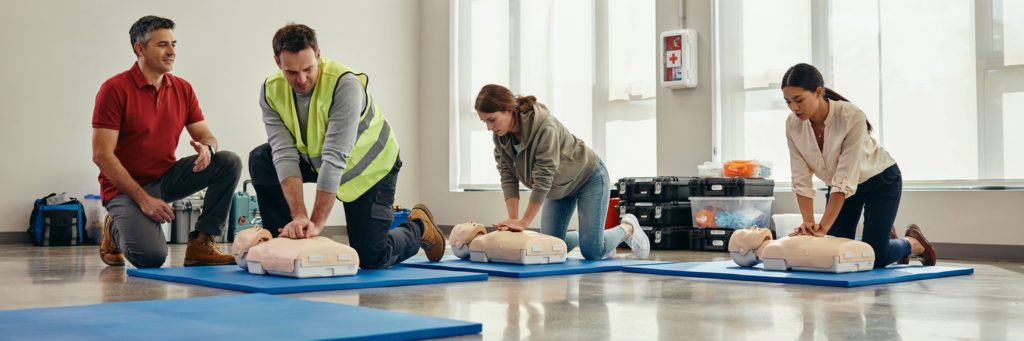
Could you save a life in the next 90 minutes and still make it back for lunch?
Most people assume first aid training means a full day away from the job site, the office, or the kids. A whole day of slides, role plays that feel awkward, and a trainer who reads directly from a laminated sheet. The reality is different. A focused 1.5 hour first aid practical session covers the hands-on skills that matter most CPR, defibrillation, choking response, and emergency management in a format built for real people with real schedules.
At First Aid Alive, our 1.5 hour practical sessions are designed for Brisbane and Gold Coast participants who need genuinely useful skills, not a day of PowerPoint slides. Whether you’re a tradie who needs to tick a compliance box before Monday’s site start, a parent who froze during a near-miss and never wants to feel that way again, or a business owner getting a team trained and back on the floor this session is built around you.
In this guide, we’ll walk you through exactly what a 1.5 hour first aid practical session covers, who it’s designed for, what you’ll be able to do when you walk out, and how to book a session in Brisbane or the Gold Coast.
What Does a 1.5 Hour First Aid Practical Session Cover?
A 1.5 hour first aid practical session covers the core life-saving skills required under Australia’s nationally recognised first aid framework. At First Aid Alive, a standard 1.5 hour practical session includes:
- CPR (Cardiopulmonary Resuscitation) — correct hand placement, compression depth, and rate using current ARC guidelines.
- AED operation — how to safely deploy and use an Automated External Defibrillator.
- Choking response — back blows and abdominal thrusts for adults, children, and infants.
- Unconscious casualty management — recovery position and airway maintenance.
- Bleeding and wound control — applying direct pressure and improvised bandaging.
- Emergency service liaison — what to tell the operator and how to manage bystanders.
- Shock recognition and response — identifying and managing a casualty in shock.
👥 Who is this for? Tradies needing a site ticket, parents who want to be ready for a family emergency, and business owners keeping their team compliant. No clinical background needed for any of them.
Who Is a 1.5 Hour First Aid Practical Session Designed For?
No clinical background. No prior training. No idea what HLTAID011 even stands for. None of that matters here.
A first aid practical session isn’t just for nurses, paramedics, or workplace health and safety officers. It’s for anyone who wants to know what to actually do in the seconds after something goes wrong. The 1.5 hour format strips out the filler and keeps every minute focused on skills you’ll remember and actually use.
Here’s who books in most often.
Tradies and Construction Workers
If you work on a Queensland job site, there’s a good chance first aid certification isn’t optional. Under Safe Work Australia’s first aid code of practice, PCBUs that businesses and employers are required to provide trained first aiders in the workplace. For most construction sites, that means having a current HLTAID011 certificate before you set foot on the floor.
The problem most tradies run into isn’t motivation, it’s timing. Weekday training means lost income. Weekend and early morning sessions are available specifically because a Wednesday afternoon course doesn’t work for someone on a six-day roster. Book online from your phone in a couple of minutes with no phone tag, no waiting for a callback.
Parents and Community Members
Sometimes it’s not a compliance deadline that sends someone looking for a quick first aid course in Brisbane. Sometimes it’s a moment that changes how you think about being prepared.
A four-year-old chokes on a grape at the dinner table. A neighbour collapses at the school fete. You read a news story about a dad who saved his son’s life at a suburban football ground because someone had taught him CPR six months earlier. And something shifts.
That’s the trigger most parents and community members describe. Not a regulatory obligation, just the quiet, gut-level realization that if something happened right now, they wouldn’t know what to do.
You don’t need to be a nurse to save a life. That’s not a motivational poster line, it’s literally how bystander CPR works. The people who make the difference in cardiac arrest situations are almost never clinicians. They’re partners, parents, coaches, and neighbours who knew what to do and did it.
This session is designed for everyday Australians. You’ll feel welcome, not out of place. And you’ll walk out with skills you can actually use.
Workplaces and Small Business Teams
For business owners and HR managers, the calculation is simple. Safe Work Australia’s first aid obligations apply to Queensland workplaces regardless of size and keeping certificates current is part of running a compliant operation.
The challenge isn’t always willingness. It’s logistics. Taking three or four staff members off the floor for a full day of training has a real cost. A focused 1.5 hour practical session changes that equation. You can have a team trained and back at their desks the same morning, certificates on the way.
Group sessions are available for Brisbane and Gold Coast workplaces, with on-site delivery options for teams that need training brought to them. Inquiries for group bookings are turned around within 24 hours because we know that when a compliance deadline is involved, slow responses cost you.
Now you know who this session is built for here’s exactly what happens from the moment you walk in the door.
🕐 Session structure at a glance. The session opens with a brief welcome, moves straight into CPR manikin practice, then AED, choking, and casualty management in sequence. The final block is scenario-based. Every participant is hands-on throughout.
What Happens During the 1.5 Hours A Session Walkthrough
One of the biggest reasons people put off first aid training is not knowing what they’re walking into. Here’s exactly what a 1.5 hour first aid practical session looks like.
What the Trainer Will Cover
The session is built around current Australian Resuscitation Council (ARC) guidelines, the same framework used by hospitals, ambulance services, and emergency responders across the country.
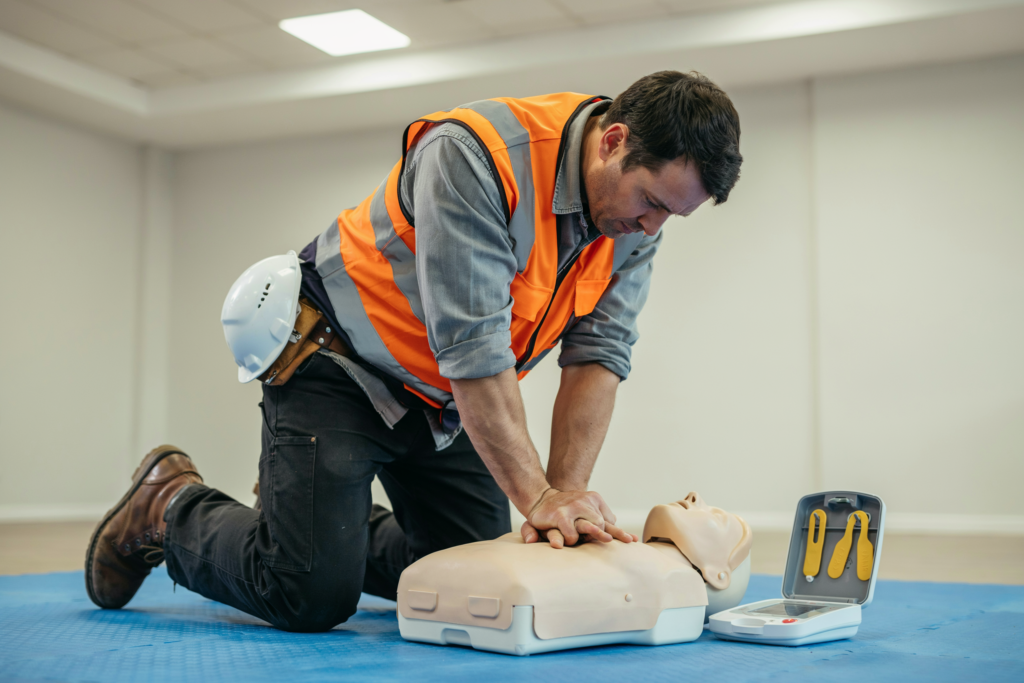
On CPR, that means correct hand placement on the lower half of the sternum, compression depth of at least five centimetres, a rate of 100 to 120 compressions per minute, and the role of rescue breaths within a two-rescuer sequence. Your trainer will walk through the technique, demonstrate it on a manikin, and then hand it over to you.
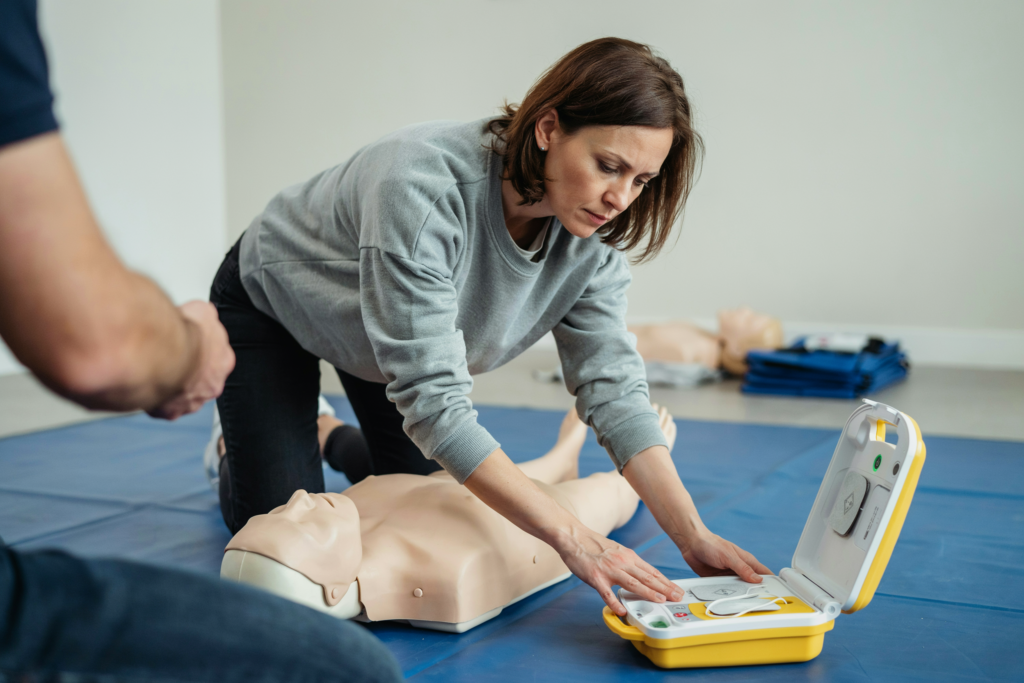
AED pad placement gets its own dedicated block because knowing a defibrillator exists and actually knowing how to use one in a panicked moment are two very different things. The session covers where to place the pads, how to read the device prompts, and how to safely deliver a shock while keeping bystanders clear.
Choking response covers adults, children, and infants separately because the technique changes depending on the casualty’s size and age. Back blows, abdominal thrusts, and infant chest thrusts are all practised, not just described.
The recovery position when to use it, how to roll someone into it without causing further injury, and how to maintain an open airway while waiting for emergency services is covered in the unconscious casualty block.
What You’ll Be Doing (Not Just Watching)
This is where a First Aid Alive session is different from the kind of training people dread.
Every participant gets hands-on manikin time. Not a demonstration you watch from the back of the room, actual compression practice on a training manikin, with real-time feedback from your trainer on depth and rate. If your technique is off, you’ll know before you leave, not after.
The AED practice uses a trainer unit, a real device in demonstration mode so you’re handling actual equipment, not watching a slide of one. That matters. Muscle memory built on real equipment transfers to real emergencies in a way that a diagram on a screen simply doesn’t.
The final block includes pair and group scenario drills. You’ll work through realistic emergency situations with other participants, practising the decision-making that happens in the first few seconds of a real event, who calls 000, who starts CPR, how you manage a bystander who’s panicking.
For parents worried about feeling out of their depth, and tradies who have sat through too many theory-heavy sessions that felt like a waste of a morning, this is what the session is designed to fix. Practical, focused, and done.
That’s 90 minutes of focused, hands-on practice. But is it actually enough? Here’s the honest answer.
Is 1.5 Hours Actually Enough Time to Learn First Aid?
It’s a fair question. And it deserves a straight answer rather than a sales pitch.
The short version: for the core life-saving skills that matter most in a real emergency, yes a focused 1.5 hour first aid practical session is enough to make you genuinely useful. Here’s why.
What the Research Says About Skill Retention
Most people assume longer training equals better outcomes. But the evidence doesn’t support that. Studies on CPR skill retention consistently find that hands-on repetition in short, focused sessions produces better retention than passive full-day classroom formats.
ARC guidelines recommend annual CPR renewal because skills deteriorate without regular reinforcement not because the technique changes year to year. Frequency and hands-on practice matter far more than course length.
Bystander CPR effectiveness is also linked to confidence, not to the duration of training. The people who freeze in emergencies aren’t usually the ones who did a shorter course they’re the ones who never felt like they truly practised. A session where every participant gets real manikin time, real AED practice, and real scenario work builds the kind of confidence that holds up under pressure.
What 1.5 Hours Is and Isn’t
Honesty matters here, so let’s be clear about what this session is and what it isn’t.
A 1.5 hour first aid practical session is exactly that. It’s not a standalone full HLTAID011 certification in isolation. The full HLTAID011 Provide First Aid qualification includes a theory component that’s completed separately, either online before the session or as part of a blended delivery model.
What that means in practice is that the hands-on skills you’re practising in the 1.5 hour session, the CPR technique, the AED operation, the choking response are identical to the skills assessed in the full HLTAID011 qualification. You’re not doing a watered-down version. You’re doing the practical component that sits at the heart of Australia’s nationally recognised first aid framework.
If you’re after the full HLTAID011 certificate, our team can walk you through how the theory and practical components combine. The practical skills are the same either way.
Why First Aid Alive Keeps It Focused
The 1.5 hour format isn’t a compromise, it’s a deliberate curriculum decision.
Every minute of the session is allocated to a skill with a direct application in a real emergency. There’s no filler content, no extended icebreaker activities, no slides that could have been an email. The session is structured so that participants spend the maximum possible proportion of their time with their hands on equipment.
Real equipment is used throughout: training manikins, AED trainer units, bandages, and casualty management props. Not simulations. Not diagrams. Actual equipment that builds actual muscle memory.
And for anyone who still needs convincing, here’s what one recent participant had to say.
Convinced it’s worth your time? Here’s how to get booked in Brisbane, the Gold Coast, or at your own workplace.
How to Book a 1.5 Hour First Aid Practical Session in Brisbane or the Gold Coast
Booking shouldn’t be the hard part. Here’s how it works.
Individual Bookings
The quickest path is straight to the course calendar. First Aid Alive’s online booking system shows real-time session availability across Brisbane and the Gold Coast, no phone call needed, no waiting for someone to email you back with dates.
Pick a session, pay online, and you’ll have a confirmation in your inbox. Wear comfortable clothing and flat shoes, remove any jewellery, and show up as you are. No prior experience needed.
Group and Workplace Bookings
If you’re booking for a team, the process is just as straightforward; it just starts with an inquiry rather than a direct booking.
First Aid Alive offers group sessions and on-site delivery for Brisbane and Gold Coast workplaces. On-site training means your team gets trained at your premises, on your schedule, without anyone having to travel. For businesses with shift workers, multiple sites, or tight operational windows, that flexibility makes a real difference.
Submit a group inquiry and you’ll have a quote back within 24 hours. We’re not going to leave you chasing a response while your compliance deadline gets closer.
What Happens After You Book
The hardest part of getting first aid trained is usually just making the decision to do it. Once that’s done, everything else is straightforward. You pick a session date that fits your schedule, book online, and have a confirmation in your inbox within minutes.
From there, the only thing left to do is show up. Wear something comfortable, leave the jewellery at home, and don’t worry about knowing anything in advance. The session is built for people who are starting from zero just as much as it is for people who’ve done training before and want to sharpen up. The trainer handles everything else.
What happens in the room is the part that actually matters. Ninety minutes of focused, hands-on work manikins, real equipment, real scenarios. No passive watching. No slide decks that run long. Just the skills that make a difference in the first few minutes of an emergency, practised until they feel like something you could actually do under pressure.
When you walk out, you won’t just have a certificate on the way. You’ll have done the compressions. You’ll have used the AED. You’ll have worked through a choking scenario and talked through what to do when someone loses consciousness in front of you. That’s a different thing to ticking a compliance box. It’s the difference between knowing what to do and genuinely feeling like you can do it.
The bigger picture is simpler than people think. First aid skills aren’t reserved for healthcare workers or people with years of training behind them. A ninety-minute practical session is enough to make you genuinely useful in a cardiac arrest, a choking emergency, or a serious workplace injury. That’s a meaningful thing to be able to say about yourself and it starts with booking a session.
Book Your First Aid Training Now
Fast, affordable, and nationally accredited training delivered by professionals who care
Frequently Asked Questions
Q.Do I need any prior first aid experience?
Not at all. The session is designed for complete beginners just as much as it is for people refreshing existing skills. You don't need to know any terminology, recognise any unit codes, or feel confident walking in. Show up as you are and the trainer takes it from there. The entire session is built around the assumption that most people in the room are starting from scratch.
Q.Is this session enough to get my HLTAID011 certificate?
The 1.5 hour practical session is the hands-on component of the full HLTAID011 Provide First Aid qualification. The full certificate also includes a theory component completed separately, either online beforehand or as part of a blended delivery model. The hands-on skills covered in the session are identical to those required for the full HLTAID011 assessment, so you're not doing a lighter version. If you want the full qualification, our team can walk you through how both components fit together.
Q.What should I wear?
Comfortable clothing and flat shoes. You'll be on the floor doing compressions on a training manikin, so anything you'd wear to a gym session works well. Remove rings and bracelets before you arrive as jewellery can interfere with manikin practice and bandaging techniques. There's no dress code and no need to overthink it.
Q.How long is a first aid certificate valid in Queensland?
The full HLTAID011 certificate is valid for three years. The CPR component inside it, HLTAID009, should be renewed annually in line with Australian Resuscitation Council recommendations. Renewal reminders are sent before anything lapses so you're never caught out by a site induction check or a compliance audit.
Q.Is First Aid Alive an ASQA-registered RTO?
Yes. First Aid Alive is a registered training organisation with ASQA — the Australian Skills Quality Authority. The RTO number can be verified directly at training.gov.au. Every certificate issued is nationally recognised across all Australian states and territories, and accepted by Safe Work Australia, ACECQA, AHPRA, and Queensland DET.
Making first aid training more affordable for
every classroom
We believe every student deserves access to life-saving first aid knowledge. That’s why we offer specially reduced pricing for schools and educational groups. Whether you’re booking for a single class, a year group, or your entire school, our flexible packages make training more accessible and cost-effective — without compromising quality.
