
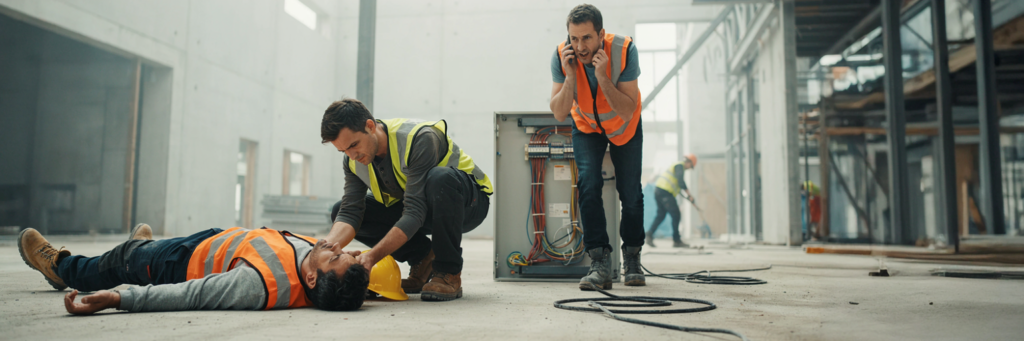
A live LV panel doesn’t give you a heads up. One second your mate’s working the board, next second he’s on the ground and everyone standing around him is looking at each other, not sure what to do next.
This guide isn’t about how to isolate the power or pull someone clear of a live panel. That’s covered in the main rescue guide, and if you haven’t read that one yet, go do it first. This one picks up right after the rescue. Once the power’s off and the casualty’s clear, what actually happens next? That’s the gap most sites, and most training, gloss over.
If you’re a licensed electrician or working a crew in Brisbane or South East Queensland, this is the part that gets skipped in a lot of inductions but matters just as much as the rescue itself. We’ll walk through checking shock severity, DRSABCD and CPR, burns, cardiac arrest and AED use, managing shock, and why “he seems fine” is never good enough to send paramedics away.
What Do You Do If Someone Is Electrocuted at Work?
Here’s the short version, the one you want to have memorised before you ever need it:
Don't touch them. Isolate the power first, or if you can't get to the switch, use something non-conductive to move them clear. Touching a live casualty just gives you a second casualty.
Call 000. Straight away, not after you've had a look at him.
Check DRSABCD. Danger, Response, Send for help, Airway, Breathing, CPR, Defibrillation. Work through it properly, don't skip steps because it feels urgent.
Start CPR immediately if he's not responding or not breathing normally. Grab the AED the second one's available and get it on him.
Manage the burns. Clean, dry dressing. No ice, no ointments, don't try to pull off any clothing that's stuck to the skin.
Treat for shock. Keep him warm, keep him still, keep him calm.
Insist on paramedic assessment, even if he's up and talking and swears he's fine. Especially if he's up and talking and swears he's fine.
That’s the whole sequence at a glance. Now let’s actually get into each bit properly, because “check DRSABCD” doesn’t mean much if you don’t know what changes when the casualties come off a live panel instead of, say, falling off a ladder.
🔍 Remember: Conscious doesn't mean fine. Check contact duration, current path and consciousness before assuming it's minor.
Recognizing Shock Severity: What You’re Actually Dealing With
First thing to get out of your head: conscious does not mean fine. A bloke can be standing up, talking to you, even cracking a joke about it, and still be sitting on some serious internal damage. Electricity doesn’t always leave much to look at on the outside. That’s what makes it different from nearly every other injury you’ll see on a site.
What you’re actually looking for to gauge how bad this might be:
- Entry and exit wounds. Where did the current go in, where did it come out. Sometimes small and unremarkable-looking on the skin, which is exactly the trap.
- Contact duration. A split-second touch and a "couldn't let go" situation are two completely different severity levels.
- Current path. Hand-to-hand contact is more dangerous than hand-to-foot, because hand-to-hand can put current straight through the chest and the heart. This one matters more than people realise.
- Loss of consciousness. Any drop in consciousness, even brief, is a red flag.
- Inability to let go. If he's told you he couldn't release his grip, that's a marker of a more serious current exposure, not a throwaway detail.
None of these on their own tell you the full picture. But run through them and you’ve got a real read on severity, instead of just going off how the bloke looks standing in front of you.
Severity indicators at a glance:
Indicator | Lower concern | Higher concern |
Contact duration | Brief touch | Couldn’t let go |
Current path | Hand-to-foot | Hand-to-hand |
Consciousness | No loss | Any loss, even brief |
Wounds | Small, unremarkable | Visible entry/exit marks |
DRSABCD and CPR for an Electrical Casualty
Same DRSABCD you’ve done a hundred times in first aid refreshers, but with one big electrical-specific twist right at the start.
Danger. For a normal casualty, “danger” means having a look around and making sure the area’s safe. For an electrical casualty, it means confirmed isolation. Not “looks safe,” not “the switch is probably off.” Confirmed. If you’re not certain the power’s isolated, you are not clear to approach, full stop. That’s a rescue-procedure question though, and it’s covered properly in the main LV rescue guide. This piece assumes isolation’s already happened and you’re now dealing with the casualty.
From there it’s the standard run:
- Response: Check if he's responding to voice or touch
- Send for help: Call 000, if you haven't already
- Airway: Clear and open
- Breathing: Check it's normal, not just present
- CPR: Start immediately if not breathing normally
- Defibrillation: Get the AED on as soon as it's available
A couple of things specific to electrical casualties worth knowing. Electrical contact has a higher chance of putting the heart into ventricular fibrillation than most other causes of collapse you’ll see on a site, so if he’s not breathing normally, don’t wait around second-guessing yourself. Start compressions immediately. And if there’s chest burns where you’d normally place AED pads, don’t let that stop you using the AED. Pad placement can be adjusted around burn sites. A slightly awkward pad placement beats not defibrillating at all.
For the full detail on ANZCOR’s basic life support guidelines, that’s worth having a read of directly. This is the practical on-site version, not a replacement for it.
Managing Electrical Burns On-Site
Burns from electrical contact play a different game to burns from heat or flame, and this is the bit most first aid guides brush past too quickly.
Here’s the trap: what you see on the skin is often not what’s actually happened underneath. An entry wound might look small, almost nothing, a mark, a bit of charring, easy to underestimate. But current travels through the body, not across it, and the exit wound is very often worse than the entry point. Sometimes a lot worse. There can be serious tissue damage happening well below the surface that you’ve got no way of seeing just by looking.
So don’t judge how serious this is off how it looks. Treat every electrical burn as more serious than it appears, because odds are it is.
What to do and what not to do:
Do | Don’t |
Cover with a clean, dry dressing | Apply ice |
Keep the casualty warm | Use ointments or creams |
Monitor for changes | Remove clothing stuck to the skin |
Get paramedic assessment regardless of how it looks | Break any blisters that have formed |
That “don’t remove stuck clothing” one trips people up because instinct says get it off him, especially if it’s smouldering or damaged. Don’t. Pulling stuck fabric away from a burn can tear the skin underneath and make the injury worse. Leave it, cover it, let paramedics handle it properly.
And no ice. It feels like the right instinct, cool it down, but ice on a burn can actually damage the tissue further and isn’t what you want here. Clean and dry, that’s it.
💛 Remember: Ventricular fibrillation, not burns, is what usually kills after LV contact. Attach the AED fast.
Cardiac Arrest and AED Use After Electrical Contact
Cardiac arrest is the thing that actually kills people after contact with a live LV panel, more often than the burns do. Ventricular fibrillation, where the heart’s electrical rhythm gets thrown into chaos and stops pumping properly, is the leading cause of death from low voltage contact. That’s worth sitting with for a second, because it changes how you should be thinking about priority on-site. The burns look dramatic. The heart rhythm is what’s actually going to kill him.
So if he’s not responding and not breathing normally, the AED needs to be on him as fast as you can physically get it there. Don’t wait to see if he “comes good.” Don’t spend time debating whether it’s needed. Attach it, let it do its analysis, follow the prompts.
The one hesitation people have is burns getting in the way of pad placement. Here’s the thing to remember: burns do not mean don’t use the AED. If there’s burn damage where a pad would normally go, you adjust placement, not skip the step. A pad slightly off from textbook positioning is still doing its job. Not using the AED because you’re worried about pad placement is the wrong call every time.
Shock Management: Keeping Them Stable Until Paramedics Arrive
Separate from the physical burns, there’s physiological shock to manage too. The body’s broader response to trauma, where blood flow and function start dropping off even without an obvious wound driving it.
Keep it simple:
- Warm. Cover him, get him off cold ground or concrete if you can do it safely.
- Still. No walking around, no "shaking it off," no getting up to finish the job. Lying down or sitting, whatever's comfortable, but not moving around.
- Calm. Talk to him, keep him settled. Panic on top of shock makes everything harder to manage.
- Monitor. Keep an eye on consciousness and breathing the whole time you're waiting for paramedics. If anything changes, you need to know straight away, not find out ten minutes later.
Nothing complicated here, it’s mostly about not letting him get up and walk it off, which is exactly what a lot of blokes will try to do because they don’t want to make a fuss.
Why “They Seem Fine” Isn’t Good Enough
This is maybe the most important section in this whole guide, because it’s the one where people talk themselves out of doing the right thing.
Here’s how it plays out on a lot of sites: someone gets a shock, they’re up on their feet within a minute or two, talking normally, insisting they’re fine, keen to get back to it because there’s a job to finish and nobody wants to be the reason it’s held up. And it’s tempting to let it go. He looks fine. He’s talking. Why call an ambulance over nothing?
Because electrical injury damage doesn’t always show up straight away. That’s the whole problem with it.
- Cardiac arrhythmia can develop hours after the initial contact, even in someone who seemed completely normal immediately after.
- Rhabdomyolysis — muscle tissue breakdown from the electrical current — can lead to kidney damage that isn't obvious at all in the first hour or two.
- Nerve damage from the current path through the body can also take time to become apparent.
None of that shows up as a visible symptom standing on a site five minutes after it happened. It shows up later, sometimes hours later, sometimes at home that night.
So here’s the rule, and it’s not negotiable: never let a conscious electrical shock casualty refuse care. Doesn’t matter how fine he looks. Doesn’t matter how much he insists. Doesn’t matter that the job’s behind schedule and everyone wants to get moving again. Get him seen by paramedics. The bloke who feels completely fine standing on a site an hour after contact with a live panel is not automatically the bloke who’s fine.
🎓 Remember: Injury management is half the picture. The rescue and isolation procedure itself is what UEECD0007/UETDRRF018 trains you in.
Where This Fits Into Your LVR Training
Everything covered here is injury management, what to do once someone’s already been affected by contact with a live panel. It’s one piece of the picture, not the whole thing.
The rescue itself, isolating power safely, getting someone clear of a live panel without becoming a second casualty yourself, that’s a separate skill set, and it’s the core of what UEECD0007 and UETDRRF018 actually train you in. This guide assumes that part’s already happened. Full LVR training covers both: the rescue procedure and what comes after it.
If your ticket’s lapsed, or you’ve never held one and a site just knocked you back over it, that’s what gets you back on-site compliant. Sessions are scheduled with early morning, after-hours and weekend slots available, because we get that losing a full day off-tools over a ticket renewal isn’t something you can just absorb.
Conclusion
Electrical injuries don’t play by the same rules as most things you’ll deal with on-site. A bloke can be up, talking, cracking jokes within minutes of contact with a live panel, and still be carrying damage that hasn’t shown itself yet. That gap between how someone looks and what’s actually happening inside them is the whole reason this stuff matters, and it’s the reason so many near misses on Brisbane sites turn into much bigger problems than they needed to.
What separates a good outcome from a bad one usually isn’t luck. It’s whether the person standing next to the casualty knew what to actually do in the first ninety seconds. Confirmed isolation before touching him, DRSABCD run properly instead of rushed, CPR started without hesitation if he wasn’t breathing normally, AED attached even with burns in the way. None of that’s complicated once you know it. But knowing it under pressure, on a real site, with a mate down in front of you, is a different thing entirely to reading it on a page.
The burns will look bad. They usually do, and they’ll grab everyone’s attention because that’s what’s visible. But the thing that’s most likely to actually kill someone after contact with a live LV panel is a heart rhythm you can’t see from the outside, which is exactly why the AED and paramedic assessment matter more than how the injury looks standing there. Don’t let appearances set the priority.
And the biggest trap on any site isn’t a lack of first aid knowledge, it’s a bloke insisting he’s fine and everyone around him wanting to believe it because there’s a job to get back to. Rhabdomyolysis, arrhythmia, nerve damage, none of that shows up standing on a site five minutes after contact. It shows up later, sometimes hours later, sometimes after everyone’s already gone home thinking the day worked out okay. Insisting on paramedic assessment isn’t being overly cautious. It’s the one call that actually protects him.
None of this replaces proper training, and it’s not meant to. Injury management is one half of what happens after contact with a live LV panel. The rescue and isolation procedure is the other half, and that’s a skill set that needs to be trained properly, not read off a page in the moment it’s needed. If your crew’s working anywhere near LV panels, knowing this stuff cold, not roughly, not half-remembered from a page you read once, is what actually keeps people alive when it counts.
Book Your First Aid Training Now
Fast, affordable, and nationally accredited training delivered by professionals who care
Frequently Asked Questions
Q.How long after an electric shock is it safe to assume someone's okay?
There's no fixed safe window you can just wait out. Complications like cardiac arrhythmia or kidney damage from rhabdomyolysis can take hours to show up, which is exactly why paramedic assessment matters even when someone feels completely normal straight after contact.
Q.Do I need to go to hospital after an electric shock?
Yes, get assessed by paramedics or at a hospital regardless of how you feel immediately after. Feeling fine on-site doesn't rule out internal damage that hasn't been presented yet.
Q.Is it safe to use an AED if the casualty has burns?
Yes. Burns don't mean you skip the AED. If burns are near where a pad would normally sit, adjust the placement and still use it, a slightly off placement is far better than not defibrillating at all.
Q.Do I need a CPR certification to do any of this?
This guide is a practical reference for the moment, but proper CPR and DRSABCD training, along with the isolation and rescue procedure itself, is what UEECD0007 and UETDRRF018 training covers in full so you know it is cold, not just from having read a page once.
Making first aid training more affordable for
every classroom
We believe every student deserves access to life-saving first aid knowledge. That’s why we offer specially reduced pricing for schools and educational groups. Whether you’re booking for a single class, a year group, or your entire school, our flexible packages make training more accessible and cost-effective — without compromising quality.
