

What would you actually do if someone collapsed in front of you right now, at the shops, at a school carnival, in your own backyard?
Most people assume they’d step in. But in the moment, without practiced technique, without certainty about what to do first, the majority freeze. Not from lack of courage. From not knowing whether they’re doing it right.
That hesitation is completely understandable. And it’s also the gap that costs lives.
Chest compressions are the single most important skill in a cardiac emergency. When someone’s heart stops, every minute without CPR reduces their chance of survival by around 10%. The brain starts suffering damage at just 4 to 6 minutes without oxygenated blood. Getting the technique right, correct hand position, proper depth, the right rate, is what keeps blood moving to the brain until help arrives.
This guide covers exactly how to perform chest compressions correctly, including hand placement, compression depth, rate, and the most common mistakes that quietly reduce effectiveness. Whether you’ve never done CPR before or it’s been a few years since your last course, this is your practical, up-to-date refresher built around current Australian Resuscitation Council (ARC) guidelines.
How to Perform Chest Compressions Correctly (Step-by-Step)
Before getting into the detail of each variable, here’s the full sequence at a glance:
Make sure the scene is safe before you approach.
2. Check for response
Tap the shoulders firmly and call their name.
3. Call for help
Call Triple Zero (000) immediately, or point directly at someone and tell them to call.
4. Position your hands
Place the heel of one hand on the centre of the chest (lower half of the breastbone), with the other hand on top and fingers interlocked.
5. Keep arms straight
Position yourself directly above the person with elbows locked.
6. Compress to correct depth
Push down firmly to at least 5cm, but no more than 6cm, for adults.
7. Maintain correct rate
Perform 100 to 120 compressions per minute (roughly the tempo of Stayin’ Alive).
8. Allow full recoil
Let the chest rise completely between compressions without lifting your hands away.
9. Minimise interruptions
Aim for 30 compressions before rescue breaths (30:2 ratio), or perform compression-only CPR if untrained.

Why Correct Technique Matters in a Cardiac Emergency
What happens to the body when the heart stops
The heart is a pump. When it stops, blood stops moving, and the brain is the first thing to feel it.
Within 4 to 6 minutes of cardiac arrest, brain cells begin to die from lack of oxygenated blood. By the 10-minute mark, the damage is often irreversible. The national survival rate for out-of-hospital cardiac arrest in Australia sits at around 10%, but that number rises sharply in areas where bystander CPR rates are high. According to the Australian Resuscitation Council, effective bystander CPR can double or even triple a person’s chance of survival.
Why bystander CPR is the critical window
Paramedics are fast. But average response times still sit somewhere between 8 and 12 minutes depending on traffic and distance. That’s 8 to 12 minutes where the only thing standing between a person’s brain and permanent damage is whoever is standing closest to them.
That person could be you. This isn’t about being a hero. It’s about being present, being willing, and knowing enough to act.
Not sure which course is right for you?
Hand Position for Chest Compressions
Adult hand position step by step
Hand position sounds simple. And it is, once you’ve done it a few times. But getting it wrong, even slightly, either reduces the effectiveness of every compression or puts unnecessary pressure on the wrong part of the chest.
Here’s exactly where your hands go:
- 1. Find the center of the chest. Locate the lower half of the sternum (breastbone), which is roughly the bottom third of that bone.
- 2. Position your dominant hand. Place the heel of your dominant hand directly on that spot. Use the firm, bony base of your palm—not your fingers and not the middle of your hand.
- 3. Interlock your fingers. Place your other hand directly on top of your dominant hand and interlock your fingers, keeping them raised off the chest wall.
- 4. Align your body. Position yourself directly above the person with your shoulders stacked straight over your hands. Keep your arms straight and your elbows locked.
If you’re off to the side or your elbows are bent, you lose mechanical advantage. You’ll tire faster and compress shallower. Get above them and use your body weight, not just your arm strength.
Why hand position affects compression effectiveness
Too high on the sternum and compressions don’t generate enough pressure to push blood effectively. Too low and you risk forcing through the xiphoid process, the small cartilage tip at the base of the sternum, which can cause injury without adding any cardiac benefit.
The target zone is the lower half of the sternum, centre of the chest. That’s where your hands belong.
Once your hands are correctly placed, the next variable that determines effectiveness is how deep and how fast you compress.
📏CPR Precision: Too shallow and you're not circulating blood. Too fast or too slow and the heart can't keep up. Depth and rate are the two variables that make or break CPR effectiveness.
Compression Depth and Rate: The Two Most Critical Variables
How deep should chest compressions be?
For adults, the target is at least 5cm but no more than 6cm, per Australian Resuscitation Council guidelines. Too shallow and you’re not generating enough pressure to circulate blood. Too deep and you risk injury without adding benefit.
Research consistently shows that untrained bystanders most often compress too shallowly. The chest gives more than people expect, and most instinctively hold back. In a real emergency, commit. Lean your body weight through straight arms and push to depth, every single compression.
For children and infants, the target shifts to approximately one-third of the chest depth, covered in more detail further below.
How fast should chest compressions be?
Rate is the other variable that quietly determines whether compressions are effective or not.
The ARC guideline is 100 to 120 compressions per minute. That’s the sweet spot, fast enough to maintain circulation, controlled enough to allow full chest recoil between compressions.
One hundred to 120 BPM is harder to estimate in your head than it sounds, especially under stress. Which is exactly why the Stayin’ Alive trick exists.

The Full CPR Sequence – How Compressions Fit In
DRSABCD the Australian emergency action framework
Chest compressions don’t happen in isolation. They sit inside a structured response sequence that Australian first aid training is built around, DRSABCD. It’s the framework used by the Australian Resuscitation Council and taught in every nationally recognised CPR course in the country.
| Step | Letter | Action |
|---|---|---|
| D | Danger | Check the scene is safe, for you, bystanders, and the patient |
| R | Response | Tap shoulders, call their name, are they conscious? |
| S | Send for help | Call Triple Zero (000) now, or direct someone specific to call |
| A | Airway | Tilt the head back, lift the chin, open and clear the airway |
| B | Breathing | Look, listen, feel, is there normal breathing? No more than 10 seconds |
| C | CPR | Begin chest compressions, 30 compressions to 2 rescue breaths |
| D | Defibrillation | Apply an AED as soon as one is available, use it immediately |
The sequence is designed to be memorable under pressure. When adrenaline hits and rational thinking gets harder, DRSABCD gives you a track to run on. You don’t have to figure out what comes next, you just move to the next letter.
30:2 ratio compressions to rescue breaths
For trained responders, the ARC guideline is 30 compressions followed by 2 rescue breaths, then straight back into compressions without delay. If you haven’t trained, compression-only CPR is a completely valid and supported option under current ARC guidelines.
Interruptions are one of the biggest reducers of CPR effectiveness. Every time you stop, blood pressure drops and the brain loses perfusion. Keep interruptions as short as possible.
When to start, when to stop
Start CPR as soon as you’ve confirmed the person is unresponsive and not breathing normally. Don’t wait for paramedics. Keep going until the person shows signs of recovery, an AED is ready to analize, paramedics take over, or you are physically unable to continue. If there’s another person present, switch compressors every 2 minutes, compression quality drops off fast.
⚠️Common Pitfalls: Most CPR errors aren't from lack of effort. They're from habits that feel right but quietly reduce effectiveness. Knowing what to watch for is half the fix.
Common Chest Compression Mistakes (And How to Avoid Them)
The most common errors
Compressing too shallow is the most common mistake. Shallow compressions, anything under 5cm, don’t generate enough pressure to circulate blood effectively. The fix: commit your body weight through straight arms, get your shoulders over your hands, lock your elbows, and let gravity do some of the work.
Incorrect hand position, either too high or too low on the sternum, reduces effectiveness and can cause injury. Come back to the landmark every time, lower half of the breastbone, centre of the chest.
Not allowing full chest recoil cuts the heart’s ability to refill between compressions. Release pressure fully after each one. Your hands stay on the chest, but your weight comes off completely.
Every interruption drops blood pressure. Keep pauses as brief as possible and rotate compressors every 2 minutes if anyone else is present. Compression quality degrades faster than the responder notices it.
| Common Mistake | What to Do Instead |
|---|---|
| Compressing too shallow | Target 5-6cm, lean body weight through straight arms |
| Incorrect hand position | Find lower half of sternum, centre of the chest |
| Not allowing full chest recoil | Release fully between compressions, don't lean on the chest |
| Pausing too long between compressions | Minimise all interruptions, even for rescue breaths |
| Continuing alone until exhausted | Switch compressors every 2 minutes, quality degrades fast |
CPR for Children and Infants: Key Differences
Child CPR (1 year to puberty)
The core principles don’t change for children, same sequence, same rate, same commitment to depth and recoil. What changes is scale. For children aged 1 year through to puberty, the compression target shifts to approximately one-third of the chest depth. For a larger child, two hands may still be appropriate. For a smaller child, one hand is often enough. Let the size of the child guide you.
Infant CPR (under 12 months)
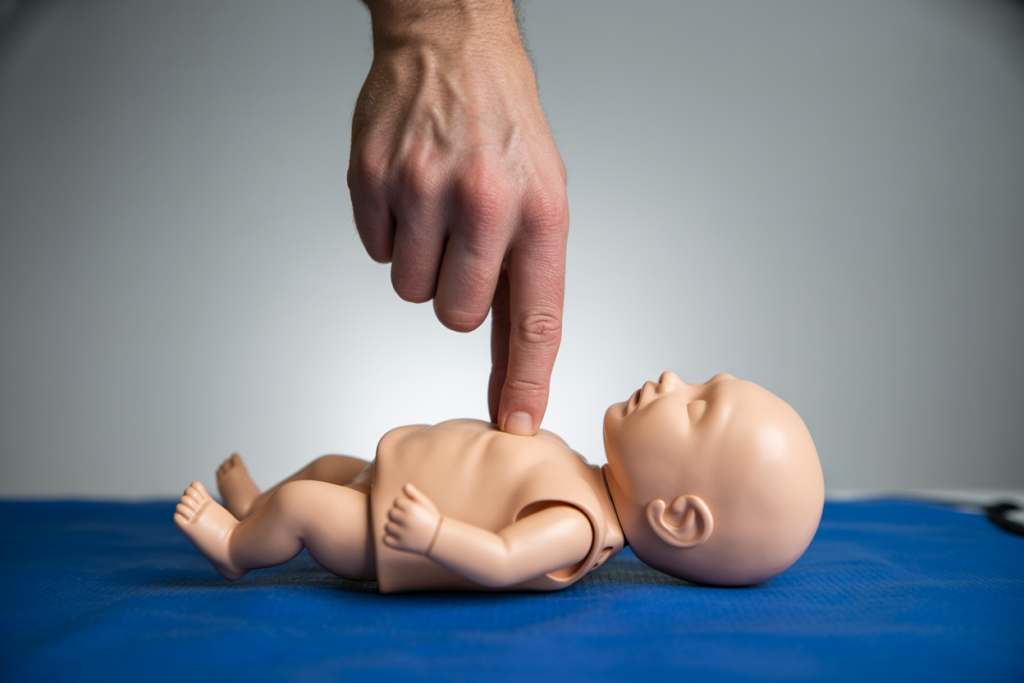
For infants under 12 months, place two fingers on the centre of the chest, just below the nipple line, and compress to approximately one-third of the chest depth. When two rescuers are present, the two-thumb encircling technique is preferred, with both thumbs side by side on the centre of the chest while hands wrap around the infant’s torso.
Compression depth and rate differences by age
The rate stays consistent across all age groups, 100 to 120 compressions per minute. What changes is depth and hand technique.
| Age Group | Hand Technique | Compression Depth | Rate |
|---|---|---|---|
| Adult | Two hands, heel on lower sternum | 5-6 cm | 100-120 BPM |
| Child (1yr-puberty) | One or two hands depending on size | ~1/3 of chest depth | 100-120 BPM |
| Infant (under 12 months) | Two fingers or two-thumb encircling technique | ~1/3 of chest depth | 100-120 BPM |
If you work in childcare or early education, the [HLTAID012 childcare first aid] course covers infant and child CPR in the practical depth your role requires and meets the ACECQA certification standard for childcare workers in Queensland.
Compression Only CPR: Is It Effective?
Yes. At the moment of cardiac arrest, blood already in circulation still carries oxygen. For the first few minutes, compressions alone can push that oxygenated blood to the brain, which is all that matters in those early minutes. The ARC recommends compression-only CPR for bystanders who haven’t trained in full CPR, or those unwilling or unable to give rescue breaths. Both are completely legitimate.
If you’re trained in the full 30:2 method, that remains the preferred approach. But doing something is always better than doing nothing. If rescue breaths aren’t happening, get your hands on the chest, call Triple Zero (000), and keep going until help arrives.
How to Build Real Confidence Not Just Technique
Reading about CPR gives you a foundation. But it can’t give you the physical memory of what 5cm actually feels like under your hands, or the instinct that kicks in when someone is on the ground and your heart rate has doubled.
Muscle memory is built through repetition on a manikin. Research into bystander hesitation consistently points to the same root cause: it’s not that people don’t know CPR exists, it’s that they don’t trust their own ability to do it correctly when it counts. That gap, between knowing and trusting, is what hands-on training closes.
A good CPR course gives you calibrated feedback from a training manikin, real-time correction from a qualified trainer, and repetition under mild pressure that starts building the automatic response you need. Skill fade is real too. The Australian Resuscitation Council recommends annual renewal because technique drifts, guidelines update, and the confidence built in a course needs refreshing. A certificate that’s two or three years old isn’t just a compliance issue. It’s a genuine gap in readiness.
Book Your CPR Course in Brisbane
Cardiac arrest doesn’t send a warning. It happens at backyard barbecues, at school carnivals, at the local pool on a Saturday afternoon, in exactly the kind of ordinary moments that make up everyday life. The four minutes between collapse and paramedic arrival are the four minutes that matter most, and the only thing that fills that gap is a bystander who knows what to do and has the confidence to act.
Chest compressions done correctly, right depth, right rate, right hand position, can double or triple a person’s chance of survival. That’s one of the most genuinely useful skills a person can have, and it’s available to anyone willing to learn it properly.
The technique in this guide reflects current Australian Resuscitation Council guidelines and gives you a strong foundation. But the gap between reading about CPR and performing it under pressure is real, and the only way to close it is through hands-on practice with a qualified trainer on a manikin, with feedback that tells you whether your depth and rate are actually where they need to be.
Annual renewal matters too. Skills fade faster than most people expect, guidelines update, and the quiet confidence that comes from a recent course is genuinely different from the vague recollection of one done three years ago. Staying current isn’t just a compliance tick, it’s the difference between freezing and acting when someone needs you most.
If you’ve been putting this off, now is a reasonable time to stop. You leave with a nationally recognized certificate issued the same day, and more than that, you leave knowing that if something happens, at home, at work, at the pool, you’re the person who can do something about it.
Book Your First Aid Training Now
Fast, affordable, and nationally accredited training delivered by professionals who care
Frequently Asked Questions
Q.How deep should chest compressions be?
For adults, the target is at least 5cm but no more than 6cm, per Australian Resuscitation Council guidelines. For children and infants, the target is approximately one-third of the chest depth. Most untrained bystanders compress too shallow without realizing it, which is why manikin practice with trainer feedback makes a genuine difference to performance under pressure.
Q.How fast should you do chest compressions?
The ARC guideline is 100 to 120 compressions per minute. A useful tempo reference is Stayin' Alive by the Bee Gees at 103 BPM, a song most people can hear in their head without playing it. Maintaining that rate gives the heart the best chance of circulating oxygenated blood to the brain and vital organs throughout the resuscitation effort.
Q.What is the correct hand position for CPR?
Place the heel of one hand on the lower half of the sternum, center of the chest. Place your other hand on top with fingers interlocked and raised off the chest wall. Position yourself directly above the person with arms straight and elbows locked, so your body weight drives each compression rather than arm strength alone.
Q.Can you do CPR wrong and hurt someone?
Rib fractures can occur during CPR, particularly in elderly patients, but this is a known risk and not a reason to hesitate. A person in cardiac arrest has no heartbeat, and the risk of not acting far outweighs any risk from attempting CPR. Bystander CPR, even without formal training, gives that person a fighting chance they wouldn't otherwise have.
Q.How long should you do CPR before stopping?
Continue CPR until the person shows signs of recovery such as normal breathing or movement, an AED is ready to analyze, paramedics take over, or you're physically unable to continue. Where possible, switch compressors every 2 minutes to keep compression depth and rate where they need to be throughout the effort.
Q.Does CPR always work?
CPR doesn't guarantee survival, but it significantly improves the odds. Without it, survival from out-of-hospital cardiac arrest is very low. Bystander CPR can double or triple survival odds by maintaining blood flow to the brain until a defibrillator or paramedics arrive. Starting immediately gives the person the best possible chance of a good outcome.
Making first aid training more affordable for
every classroom
We believe every student deserves access to life-saving first aid knowledge. That’s why we offer specially reduced pricing for schools and educational groups. Whether you’re booking for a single class, a year group, or your entire school, our flexible packages make training more accessible and cost-effective — without compromising quality.
