

Your supervisor just told you that you need a rescue ticket before you’re allowed back on site. The problem is, he didn’t say which one. Now you’re standing there with your phone out, searching two course names that sound almost identical, and neither of them is explaining what you actually need.
Here’s the short version. UETDRRF018, or low voltage rescue, is about electrical hazards. Confined space rescue is about environmental hazards, things like bad air or a space you can’t easily get out of. They are not the same ticket, they don’t cover the same skills, and turning up to book the wrong one is a fast way to lose another day off the tools.
This page sorts it out properly. Two minutes from now you’ll know exactly which course applies to your job, whether you might actually need both, and how to book the right one the first time.
So what’s the actual difference between low voltage rescue and confined space rescue?
Low voltage rescue (UETDRRF018) trains you to safely respond when someone is in contact with live low voltage equipment. Confined space rescue trains you to respond to hazards created by the space itself, like oxygen deficiency or restricted exit.
- Low Voltage Rescue = Electrical hazard. You're dealing with a live electrical source and making the area safe before attempting a rescue.
- Confined Space Rescue = Environmental hazard. You're dealing with the hazards created by the confined space itself, such as oxygen deficiency, toxic gases, restricted access, or engulfment.
There’s one situation where both apply at once, and that’s electrical work carried out inside a confined space, think a switchboard room or an underground pit. We’ll get to that scenario properly further down.
What Is Low Voltage Rescue (UETDRRF018)?
UETDRRF018 is the unit code behind what most tradies just call “low voltage rescue.” If you work anywhere near live electrical equipment, this is probably the ticket your supervisor was talking about.
What the Course Actually Covers
This isn’t a sit-in-a-classroom-and-nod course. It’s built around what actually happens when someone gets caught on a live low voltage source, and what you need to do in the first sixty seconds.
Course Element | What It Prepares You For |
Safe isolation and de-energisation | Making the situation safe before you touch anything |
Recognising shock symptoms | Spotting injury patterns that aren’t always visible |
Safe separation technique | Getting a casualty away from a live source without becoming the second casualty |
Post-rescue first aid and CPR (HLTAID009) | Continuing care once the casualty is clear of the source |
If you haven’t done HLTAID009 yet or you’re not sure whether it’s a prerequisite for you, that’s worth checking before you book.
Who Is Required to Hold It
Short answer: if you’re a licensed electrician or apprentice working on or near live low voltage equipment, you need it.
This gets mandated a few different ways. Sometimes it’s a site induction requirement before you’re allowed through the gate. Sometimes it’s a head contractor asking for it as part of their compliance stack. And sometimes it comes up in a QBCC-linked check where your ticket status gets flagged and suddenly it’s urgent.
If you want the full breakdown of what UETDRRF018 requires before you can even enrol, that’s covered on our prerequisites page.
Confined space rescue looks similar on paper. Different course names, similar sounding “rescue” wording, similar sounding urgency from a supervisor. But it’s solving a completely different problem, and mixing the two up is exactly how people end up booking the wrong one.
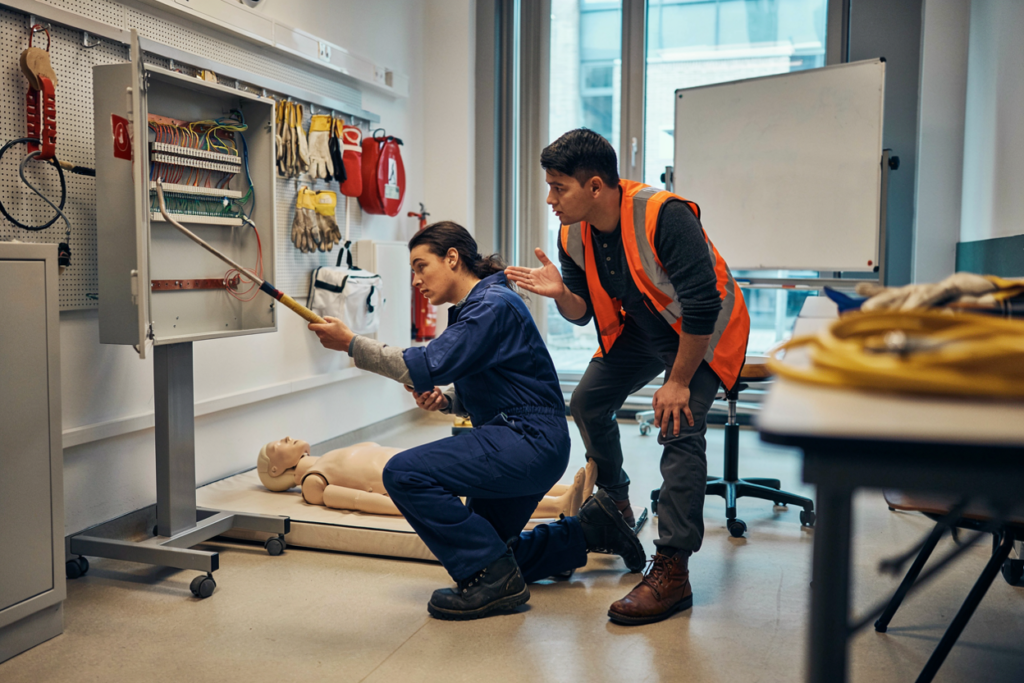
What Is Confined Space Rescue?
Confined space rescue isn’t about electricity at all. It’s about the space itself, and what happens when that space becomes the thing putting you at risk.
What the Course Actually Covers
- Atmospheric hazard recognition, so you can identify oxygen deficiency, toxic gases, or other dangerous conditions before they become life-threatening.
- Entry and exit procedures, including permit systems and standby person protocols, ensuring someone always knows you're in the confined space and can respond if something goes wrong.
- Non-entry and entry rescue techniques, along with the correct use of retrieval equipment for safely recovering a worker during a confined space emergency.
There’s a role chain that runs through the whole course: the entrant who goes in, the attendant who stays outside and watches, and the supervisor who oversees the job. Every one of those roles matters, because a confined space incident usually goes wrong fast, and having someone outside who knows exactly what to do is often the difference that counts.
Who Is Required to Hold It
This one isn’t tied to a trade the way UETDRRF018 is. If your job has you entering confined spaces, pits, tanks, ceiling voids, underground vaults, you need it, electrician or not. Plumbers, riggers, maintenance workers, anyone who physically goes into that kind of space is in scope.
It sits under the WHS Regulation confined space provisions.
For the full regulatory detail, Safe Work Australia‘s confined spaces code of practice is the source worth reading.
So which one applies to you? Here’s the difference side by side.
📊 Quick take: One ticket is about what you're touching. The other is about where you're standing. That's the whole difference in a sentence.
Key Differences at a Glance
Side by side, the difference is a lot easier to see.
Low Voltage Rescue (UETDRRF018) | Confined Space Rescue | |
Hazard type | Electrical (live low voltage) | Environmental (space, air, access) |
Who typically needs it | Licensed electricians, apprentices | Anyone entering confined spaces, any trade |
Typical setting | Switchboards, panels, live equipment | Pits, tanks, ceiling voids, underground vaults |
Mandated by | Site induction, QBCC-linked checks | WHS confined space regulations |
Course length | Half-day | Varies by provider |
The hazard type row is really the whole story. One ticket is about what you’re touching, the other is about where you are. Once that clicks, the confusion mostly disappears.
For most electricians, one ticket covers the job you’re actually doing. But there’s a specific overlap scenario worth knowing about, and it’s more common than people think.
When Do You Need Both?
The Overlap Scenario: Electrical Work Inside a Confined Space
There’s one situation where a single ticket won’t cut it, and that’s when the electrical work itself is happening inside a confined space. A switchboard room. An underground electrical pit. A panel tucked up in a ceiling void.
In these jobs, isolation and rescue techniques on their own aren’t enough, because the space you’re working in is its own hazard on top of the live equipment. You could do everything right with the panel and still be caught out by bad air or a restricted exit. That’s why electricians working in these settings are often required to hold both tickets, not as a box-ticking exercise, but because the two hazards genuinely stack.
We’ve covered a real scenario like this before, a subfloor distribution board job where both the electrical and confined space risks came into play at once. Worth a look if you want to see how it plays out in practice rather than just in theory.
If you’re still not sure which applies to your specific job, here’s a quick way to check.
Which One Does Your Job Actually Require?
Quick Decision Framework
No need to overthink this one. Run through it like this:
- Working on or near live low voltage electrical equipment? You need UETDRRF018 – Perform rescue from a live low voltage panel.
- Entering a restricted or poorly ventilated space? You need confined space entry and rescue training before work begins.
- Both conditions apply at the same time? If you're working on live low voltage equipment inside a confined space, you'll generally need both competencies to meet workplace safety requirements.
That’s it. Most electricians land on the first line and stop there. It’s only the switchboard room and underground pit style jobs, the ones we just walked through, where you end up needing both.
If you’ve worked through this and landed on UETDRRF018, here’s how to lock in the right course without wasting another day figuring it out.
How to Book the Right Course First Time
What to Confirm Before You Book
A few things worth double checking before you lock in a date, because getting any of these wrong means doing this whole exercise again.
- Unit code matches your site requirements. If your supervisor or principal contractor specifies UETDRRF018, make sure that exact unit code appears on the course you're booking—not a similar electrical safety course, a general induction, or another rescue unit.
- Statement of Attainment issued when you need it. If you need proof of competency for a site induction or compliance check, confirm how quickly your Statement of Attainment will be available after you successfully complete the course.
- Choose a venue and date that suit your schedule. Book a course that fits around your current work commitments so you can complete your training without creating unnecessary conflicts.
If you’ve confirmed UETDRRF018 is what you need, you can check dates and lock it in here.
Getting told you need a rescue ticket with no explanation attached is one of the more frustrating parts of working on site. Nobody hands you a manual, they just expect you to know which course covers which hazard, and half the time the two names get thrown around like they mean the same thing. They don’t, and now you know why.
The split really comes down to one question: is the danger in what you’re touching, or is it in where you’re standing. Live equipment is a different problem to a poorly ventilated pit, and trying to cover one with training built for the other leaves a real gap, not just a paperwork gap. That gap is exactly what shows up in the moment someone actually needs help.
Most jobs only ever call for one ticket, and once you’ve matched the hazard to the course, the decision stops being confusing. It’s only when the two risks sit on top of each other, live equipment inside a restricted space, that both training earn their place. Recognising that overlap early saves a scramble later, especially when a head contractor’s compliance check is the one pointing it out instead of you.
None of this is really about the certificate on its own. It’s about being the person on site who actually knows what to do if something goes wrong, not just someone holding a card that says they should. That difference matters more than most inductions let on, and it’s worth taking seriously even when the deadline pressure is doing the talking.
Sort out which hazard you’re actually dealing with, book the course that matches it, and get back to the job without the guesswork hanging over you. That’s really all this comes down to, one ticket for one hazard, and knowing the difference before someone else has to point it out for you.
Book Your First Aid Training Now
Fast, affordable, and nationally accredited training delivered by professionals who care
Frequently Asked Questions
Q.What is UETDRRF018?
UETDRRF018 is the unit code for low voltage rescue. It trains workers to safely respond when someone is in contact with live low voltage equipment, covering isolation, safe separation, and post-rescue first aid.
Q.Do I need low voltage rescue or confined space rescue for switchboard work?
It depends on the setting. A standard open switchboard typically only requires UETDRRF018. If the switchboard is located in a restricted or poorly ventilated space that meets the definition of a confined space, you'll generally need both low voltage rescue and confined space training because the electrical and environmental hazards exist together.
Q.Who is required to complete UETDRRF018?
UETDRRF018 is commonly required for licensed electricians and apprentices who work on or near live low voltage equipment. Many employers, principal contractors, and site inductions specify this competency as part of their safety and compliance requirements.
Q.Is confined space rescue only for electricians?
No. Confined space rescue applies to anyone whose work requires entry into a confined space, including plumbers, riggers, maintenance workers, water industry personnel, and other trades—not just electricians.
Q.How do I know which course my site requires?
Start with the hazards involved. If you're working on or near live low voltage equipment, you need UETDRRF018. If you're entering a restricted or poorly ventilated confined space, you need confined space training. If both hazards are present, you'll generally need both competencies.
Q.What happens if I book the wrong course?
If you complete a course that doesn't match your employer's or principal contractor's requirements, you may still be considered non-compliant. That can mean needing to book and complete the correct course, resulting in additional time and cost.
Making first aid training more affordable for
every classroom
We believe every student deserves access to life-saving first aid knowledge. That’s why we offer specially reduced pricing for schools and educational groups. Whether you’re booking for a single class, a year group, or your entire school, our flexible packages make training more accessible and cost-effective — without compromising quality.
