

You pull up to the job, ute loaded, tools ready to go, and the site super stops you at the gate and asks for your current LV rescue evidence. If your ticket’s lapsed, expired, or it doesn’t cover what this particular principal contractor wants, you’re not working today. That’s a lost day of billable hours for you, or a hole in the crew roster your boss now has to explain to a client.
A rescue from electrical shock course covering UETDRRF018, Perform Rescue from a Live Low Voltage Panel, exists for this exact scenario. It’s not a watered down first aid refresher tacked onto a childcare CPR class. It’s a nationally recognised competency built specifically for electricians who work on or near live panels, and more and more it’s the difference between getting through the gate or getting sent home for the day.
Here’s the thing about this particular certificate, and it’s worth saying plainly before we go any further. If it’s your mate on that panel, you want to know exactly what to do, not guess. That’s not a marketing line, that’s the actual reason this training exists. Every licensed electrician who’s been in the trade long enough has either seen a close call, heard about one from a mate, or thought about what they’d do if it happened on their site. This course is built for that moment, not for the compliance folder.
This guide walks through who actually needs this certification, what the course covers, how the currency and renewal question actually works (this one trips up almost every tradie who searches for it), and how booking works whether you’re getting yourself sorted or certifying a whole crew.
What Is a Rescue From an Electrical Shock Course?
A rescue from electrical shock course is a nationally recognized training program that teaches licensed electricians how to safely break contact between a casualty and a live low voltage source, then provide emergency first aid, including CPR, straight after an electrical incident. This training sits under the unit of competency UETDRRF018, Perform Rescue from a Live Low Voltage Panel, and it’s delivered through a Registered Training Organisation like First Aid Alive (RTO 31106).
A course that actually meets the standard covers:
- Recognising electrical hazards and sizing up panel risk before you go anywhere near it
- Safely breaking contact between a casualty and a live source, without becoming the second casualty
- CPR and AED use following an electrical shock
- Emergency scene assessment and incident reporting
- Certification that's actually recognised for site access and compliance requirements, not just a piece of paper that looks the part
This isn’t first aid content with an electrical label stuck on it. It’s a genuinely different competency, built around a genuinely different risk, and it should feel like that from the first minute of the course. That distinction matters more than it might sound. A lot of tradies who’ve sat through a generic safety course walk in expecting the same watered down delivery, and walk out having noticed the difference within the first ten minutes, because the language, the risk framing, and the practical content are all built around live electrical work specifically, not general workplace first aid with a panel photo added to the slide deck.
Let’s get into who actually needs to hold this ticket, because it’s not every electrician on every job.
⚡ Quick take: If you work on or near live low voltage panels in Queensland, this ticket isn't optional, and it's increasingly checked at the gate before you're allowed on site.

Who Actually Needs This Course?
Short answer: if you work on or near live low voltage panels, this isn’t optional, it’s expected, and increasingly it’s checked at the gate before you’re allowed to swing a hammer.
Is LV Rescue a Legal Requirement?
The Electrical Safety Act 2002 (Qld) and the Electrical Safety Regulation that sits under it are the backbone here. They put the requirement for LV rescue competency on anyone working on or near live electrical installations. On top of that, WorkSafe Queensland’s electrical safety codes of practice and a lot of principal contractors’ site-access rules, think QBCC-regulated construction sites, utilities work, government infrastructure jobs, now mandate a current UETDRRF018 (or equivalent) ticket before you’re allowed on a live panel at all. Insurers and head contractors are leaning the same way too, wanting documented proof of current training as a condition of engagement. Which means, plainly, no certificate can mean no start on site.
Most tradies don’t actually push back on the reasoning here, and that’s worth pointing out. You understand why this rule exists better than almost anyone outside the trade. A panel rescue scenario is a genuine life and death skill gap if it’s left untrained, and nobody who’s spent time around live electrical work needs that explained to them twice. The frustration was never with the requirement itself, it’s with finding a provider that treats it like the serious technical competency it actually is, instead of bundling it in with generic consumer first aid content.
That’s also why it’s worth checking that whatever course you land on is actually tied back to the real regulatory framework, not just a course title that sounds close enough. The Electrical Safety Act 2002 (Qld), the WorkSafe Queensland electrical safety code of practice, and the official UETDRRF018 unit descriptor are the actual sources this training is meant to sit against. A provider who can point back to those, plainly and without dressing it up, is generally a stronger sign of a serious course than one leaning on marketing language alone.
Does This Apply to Apprentices or Only Licensed Electricians?
This covers licensed electricians, electrical contractors, and late-stage apprentices working on live panels, plus industrial maintenance electricians and switchboard techs.
There’s also a whole side of this that doesn’t get talked about enough, and that’s the business owner or compliance manager doing the booking on behalf of a crew rather than for themselves. If that’s you, the content on this page still needs to work, because you’re the one juggling rostering, paperwork, and a deadline across an entire team, not just a single seat.
Once you know you need it, the next question is what you’re actually signing up for.
🛠️ Quick take: This isn't a rebadged first aid class. It's built around the real sequence of a live panel incident, from hazard to rescue to CPR to reporting.
What Does the Course Actually Cover?
Short answer: it’s not a rebadged first aid class, it’s built around the real sequence of a live panel incident, from hazard to rescue to CPR to paperwork.
Classroom vs. Practical Content Split
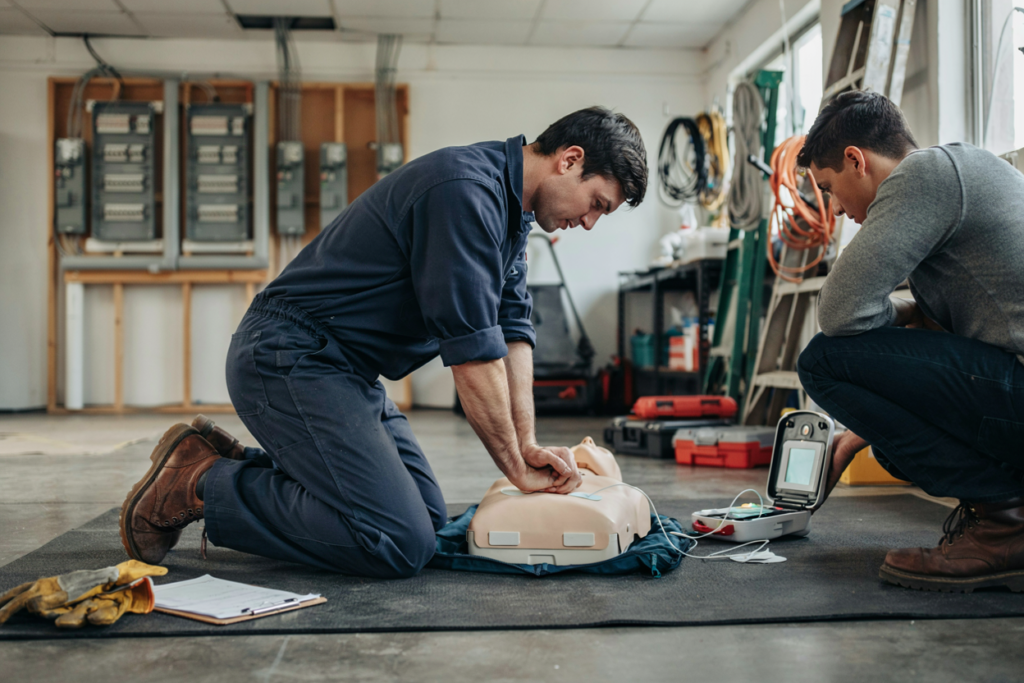
The curriculum maps directly to UETDRRF018, covering hazard identification on and around a live panel, isolation technique (how you actually break contact between a person and a live source without putting yourself in the same position), CPR and AED response following an electrical shock, scene assessment, and incident reporting.
What the Live Panel Simulation Involves
This is where it splits hard from a generic first aid course. For most blokes booking this, none of it is roleplay in the way a CPR mannequin scenario might feel. It maps onto a real job you could be standing on next month, which is exactly why the practical component tends to land differently for this crowd than it does for almost anyone else walking into a training room.
If you’ve ever sat through a training course that felt like it was written for someone who’s never picked up a tool, you’ll notice the difference here straight away. The language, the scenarios, the pace, all of it is built around people who already know their way around a switchboard and don’t need the basics of electrical risk explained from scratch. What they need is the specific sequence of actions for the one scenario that’s genuinely dangerous enough to deserve its own dedicated unit of competency.
There’s also a fear register at play here that’s genuinely different from most other training you’ll have done. Unlike a CPR mannequin scenario, an LV rescue practical component taps into a real occupational fear, arc flash, electric shock, cardiac arrest from contact with a live panel. It’s not roleplay to anyone who’s spent real time around live electrical work, it maps directly onto a scenario you could actually face on a job. That’s exactly why the goal of this course isn’t just a certificate at the end of it. It’s walking out genuinely confident you could perform the rescue correctly if it ever came to that, not just having ticked a compliance box on the way through. There’s also a strong undercurrent of protecting your mates running through all of this, not just protecting your own ticket. Trades culture values competence and reputation, and nobody wants to be the guy on site who didn’t know what to do if a workmate went down.
Curriculum Area | What It Covers |
Hazard identification | Recognising panel risk and electrical hazards before approaching |
Isolation technique | Safely breaking contact between a casualty and a live source |
Emergency response | CPR and AED use following an electrical shock |
Scene management | Emergency scene assessment and incident reporting |
Certification outcome | Recognised for site access and compliance requirements |
How Often Do I Need to Renew It?
Short answer: there’s no single hard national renewal period for LV rescue the way there is for CPR (annual) or first aid (three years), so the real answer comes down to what your employer or the principal contractor on your site expects.
Is There a National Renewal Requirement?
No, and this is honestly where most of the confusion comes from. A lot of tradies assume there’s a fixed expiry date stamped on the certificate somewhere, same as CPR or a white card. There isn’t one hard national rule. That gap is exactly why so many blokes end up doing a panic booking the night before a site starts, “just to be safe,” because nobody’s told them straight what actually counts as current.
What Do Most Principal Contractors Expect?
Renewal timing in practice comes down to employer policy and what the principal contractor on your job requires, not a single blanket rule sitting in legislation. Different sites, different requirements. That’s frustrating if you want a clean answer, but the honest version is better than a made up one.
Think about what’s actually at stake if this gets treated as a box to tick rather than something to stay on top of. If something happens on site and WorkSafe comes in to investigate, and it turns out the LV rescue training on record wasn’t current, that’s not just an awkward conversation, that’s the business’s license and reputation on the line, not only the individual worker’s. For a business owner booking a whole crew, that’s exactly the scenario that keeps compliance officers checking paperwork twice before a principal contractor audit rather than once.
If there’s one thing worth taking away from this whole section, it’s this: don’t guess your currency, check it against the site you’re actually walking onto. Now, whether you’re sorting this for yourself or for a whole crew changes how you should be booking it.
Booking for Yourself vs. Booking a Crew
Short answer: an individual tradie booking one seat and a business owner booking a block of staff are solving two completely different problems, and the booking path should reflect that.
Individual Booking Path
If you’re sorting your own ticket, you want this fast, mobile friendly, and low friction, a handful of form fields, a clear date and time grid, and confirmation straight away. Nobody wants to wade through paragraphs of marketing copy before they can even see available times. A lot of these bookings happen from a ute between jobs or on a smoko break, so the whole thing needs to work properly on a phone, not just look fine on one.
Group Bookings for Contractors and Business Owners
If you’re a compliance officer or business owner booking a block of staff, the problem looks different. You need one point of contact, one invoice, and one compliance record covering the whole crew, plus enough rostering flexibility that you’re not pulling multiple guys off the tools on the same day if you don’t have to. That’s the difference between a smooth audit and a scramble the morning a principal contractor asks for paperwork.
Nobody wants to be the person who booked five guys into the wrong course, or realised too late that the crew’s paperwork doesn’t line up on the exact day it gets checked. A clear group booking path with a single point of contact solves that before it ever becomes a problem, rather than after.
It’s also worth saying that reviews and word of mouth carry more weight with this crowd than polished branding ever will. A testimonial from another electrical contractor or a site foreman means more here than a generic star rating, because it’s coming from someone who’s actually sat through the same practical scenario and knows what a serious version of this course looks like versus a generic one.
None of this is complicated once it’s laid out properly, but it does take a provider who’s actually thought about the two different people landing on this page. One is a tradie booking for himself between jobs, wanting the fastest, cleanest path to a valid certificate. The other is a business owner or compliance manager thinking about an entire crew, a principal contractor’s audit, and a paper trail that has to hold up under scrutiny. Getting both of those journeys right, rather than forcing one into the other, is what separates a course built for electricians from a course that just happens to have electricians turning up to it.
Conclusion
Getting turned away at a gate over a certificate you thought was still current is one of those things that never feels like it could happen to you, right up until it does. A day of billable hours gone, a hole in the roster your boss has to explain, all over a piece of paper that could’ve been sorted in advance with a bit of planning.
The truth is this course was never really built for the paperwork side of things. It was built for the moment nobody wants to think about, the one where a mate’s down on a live panel and there’s no time to guess. That’s the difference between freezing up and knowing exactly what to do, and it’s worth more than any certificate on a wall.
For the electricians reading this who’ve been doing the job fifteen, twenty years without ever needing this training, that’s not a reason to skip it, that’s the whole point. You don’t get to choose the one day you actually need it.
For the business owners and compliance officers sorting a whole crew, the calculation is a bit different but lands in the same place. One booking, one invoice, one paper trail that holds up when a principal contractor comes asking, versus a scramble the morning of an audit. It’s not a hard call once you look at it straight.
On the currency question, don’t leave it to guesswork. Check what your site actually expects rather than assuming last year’s certificate still covers you, because that assumption is exactly what catches people out at the gate.
At the end of the day, this isn’t about ticking a box so someone stops asking. It’s about being the guy on site who’s switched on, who knows what to do if it counts, and who never has to find out the hard way what happens when he doesn’t.
Book Your First Aid Training Now
Fast, affordable, and nationally accredited training delivered by professionals who care
Frequently Asked Questions
Q.What is a rescue from an electrical shock course?
A rescue from electrical shock course is a nationally recognized training program that teaches licensed electricians how to safely break contact between a casualty and a live low voltage source and provide emergency first aid, including CPR, straight after an electrical incident. In Queensland, it's delivered under UETDRRF018 through an RTO such as First Aid Alive (RTO 31106).
Q.Who needs to complete UETDRRF018?
Licensed electricians, electrical contractors, late-stage apprentices, and industrial maintenance electricians who work on or near live low voltage panels generally need this ticket, since it's increasingly required for site access on top of being a genuine safety competency.
Q.Is LV rescue training a legal requirement in Queensland?
The Electrical Safety Act 2002 (Qld) and the Electrical Safety Regulation place the requirement for LV rescue competency on anyone working on or near live electrical installations, and many principal contractors and insurers now treat a current UETDRRF018 certificate as a condition of site access.
Q.How often do I need to renew my LV rescue certificate?
There's no single hard national renewal period for LV rescue training. Renewal timing comes down to your employer's policy and what the principal contractor on your job site currently expects, so it's worth checking against the specific site rather than assuming your last certificate still applies.
Q.Can apprentices complete this course?
Late-stage apprentices working on live panels can complete this training alongside licensed electricians and industrial maintenance staff, since the competency is built around the actual work being performed, not just licensing status.
Q.Can I book this course for a whole crew?
Business owners and compliance officers can book a group of staff through a dedicated crew booking path, with one point of contact, one invoice, and one compliance record covering the whole team rather than separate individual bookings.
Making first aid training more affordable for
every classroom
We believe every student deserves access to life-saving first aid knowledge. That’s why we offer specially reduced pricing for schools and educational groups. Whether you’re booking for a single class, a year group, or your entire school, our flexible packages make training more accessible and cost-effective — without compromising quality.
