
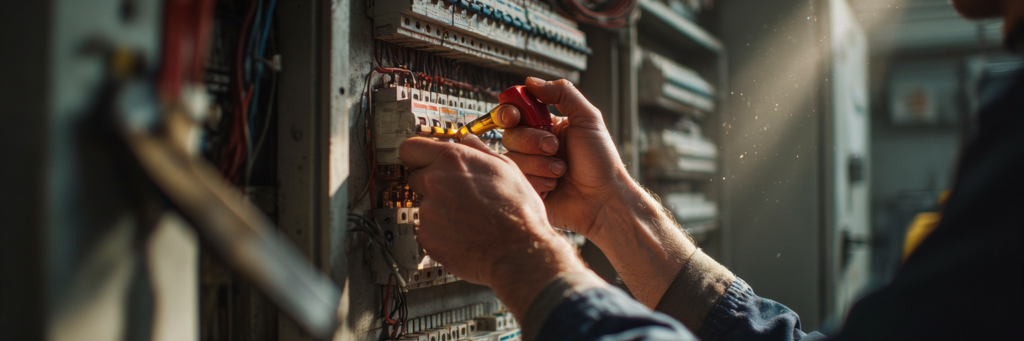
Your apprentice grabs the wrong lead on a live panel. He’s down, and he’s still in contact. You’ve got seconds, not minutes, to do the right thing in the right order. Have you actually rehearsed this, or just ticked the box?
That’s the question that separates the blokes who freeze from the blokes who act. LV panel contact doesn’t happen often on Brisbane sites, but when it does, there’s no time to Google it or ask the bloke next to you what to do. You either know how to perform rescue from a live LV panel or you don’t, and the gap between those two options is measured in seconds, not minutes.
Maybe you’re here because it’s been a while since your last UETDRRF018 refresher and you want the sequence back in your head before it matters. Or maybe you’ve genuinely never had to use this in anger and the whole thing still feels a bit abstract, something that happens to other crews on other sites, not something you’ll ever actually have to do yourself. Either way, you’re in the right spot.
What follows isn’t a rewrite of a generic first aid pamphlet with “electrical” bolted on the front. It’s the actual step-by-step sequence built around what Queensland sites and principal contractors expect from you, right down to what happens after the isolator’s been thrown. Here’s the rundown.
How Do You Perform a Rescue From a Live LV Panel?
If you need the short version before you need the long one, here it is:
- Assess the scene. Check your own safety first, then identify hazards and any bystander risk before you move a muscle.
- Isolate the power. Locate and switch off the main isolator, and verify de-energisation before you make contact.
- Separate the casualty. If isolation isn't possible in time, use an insulated rescue hook or a non-conductive object. Never touch the casualty directly.
- Move to safety. Clear the casualty from the hazard zone once they're free of the current.
- Check response and breathing. Start CPR if they're unresponsive and not breathing normally, and call 000.
That’s the plain-English overview. It’s not a substitute for the hands-on UETDRRF018 practical assessment, and it’s not meant to be, but it’s the sequence that should be running through your head before you ever set foot near a live panel. Read it again. Say it out loud a couple of times if you have to. The words matter less than the order, and the order matters more than almost anything else in this whole article.
🚧 Site Reality: No certificate, no start. Principal contractors and insurers are treating current UETDRRF018 evidence as a condition of engagement, not a nice-to-have.
Why LV Panel Rescue Training Isn’t Optional on Queensland Sites
Under the Electrical Safety Act 2002 (Qld) and the Electrical Safety Regulation that sits underneath it, anyone working on or near live LV installations needs to be competent in exactly this kind of rescue. That’s not a suggestion, it’s the law, and it’s written the way it is because the consequences of getting it wrong are severe. Nobody drafts legislation this specific over something that only matters in theory.
Here’s the bit that actually affects your Tuesday morning: this certificate is a site-access gatekeeper. Principal contractors on QBCC-regulated sites, utilities, and government infrastructure jobs won’t let you through the gate without current evidence of UETDRRF018 competency. Insurers are increasingly asking for the same paper trail before they’ll sign off on engagement. No certificate can mean no start, full stop, and that’s a day of labour gone whether you’re the one on the tools or the one paying the wages.
Think about how that plays out in practice. You roll up to a new job, gear loaded, ready to get stuck in, and the site supervisor asks for your paperwork before you’ve even unpacked the ute. If your LV rescue evidence isn’t current, or isn’t recognised by that particular principal contractor, you’re standing at the gate instead of on the tools. Multiply that by a whole crew and it stops being an inconvenience and starts being a genuine cost to the business.
For the exact code of practice wording, WorkSafe Queensland’s electrical safety documentation is worth a read.
What “Current” Actually Means for Site Access
Here’s where it gets murky. Unlike CPR, which runs on a clean annual cycle, there’s no single national renewal period for LV rescue competency. What counts as “current” is largely driven by your employer’s policy or whatever the principal contractor on that particular site has decided to require.
That ambiguity is exactly why so many blokes end up doing a panic booking just to be safe. Nobody wants to be the guy holding up a whole crew because his paperwork’s out of date, so the safer play is treating your currency as something you check before it becomes a problem, not something you find out about at the gate.
It also pays to remember that different principal contractors can and do interpret currency differently from one job to the next. What satisfied one site’s compliance officer last time might not satisfy the next one, especially on bigger government or utility jobs where the paperwork gets checked more closely. The safest habit is asking early, before you’ve committed your day to a job, rather than assuming last time’s certificate will automatically clear this time’s gate.
Pre-Rescue Assessment, The First 10 Seconds
Before you move, you look. Scene safety, hazard identification, and bystander control all happen before any physical action, not after. This is the part that gets skipped when adrenaline takes over, and it’s the part that keeps a one-casualty situation from becoming a two-casualty situation.
It sounds almost too simple to matter, and that’s exactly why it gets skipped under pressure. Your instinct when a mate is down is to get to him immediately. But if you rush in without checking what’s actually going on around that panel, you can end up as the second person in contact with a live source, and now there’s nobody left standing who knows what to do. Ten seconds of looking before you act isn’t hesitation, it’s the difference between a rescue and a second casualty.
🔌 Golden Rule: Communicate, operate, verify. Say it out loud before you touch that isolator.
Isolating the Power Source
Locating the Main Isolator
Labelling on switchboards isn’t always reliable. Panels get modified, relabeled, or just plain neglected over the years, and what the sticker says isn’t always what the wiring actually does anymore. That’s why the smart move is pre-identifying isolators before work even starts, not scrambling to find them mid-emergency, hunting through a switchboard while someone’s life is on the line.
Any electrician who’s worked on more than a handful of sites has a story about a mislabelled board. It’s one of those things that seems minor until the one day it isn’t, and that one day is exactly the day you don’t want to be guessing. Walking a site and physically confirming which isolator controls which board, before anyone’s plugged a tool in or opened a panel, costs you a few minutes at the start of the job. Not doing it can cost a lot more further down the track.
The Isolation Sequence
The sequence is simple to say and needs to be second nature to do: communicate what you’re doing to anyone nearby, operate the isolator, then verify de-energisation with a non-contact voltage detector before anyone makes contact. This is general guidance only, the actual practical competency here is what gets certified through the UETDRRF018 assessment, and it’s the part of the course that actually puts these steps into your hands so they’re not just words on a page when it counts.
Communication matters more than it sounds like it should. Calling out what you’re doing before you touch that isolator means anyone else nearby knows exactly what’s happening and doesn’t second guess the situation or step in at the wrong moment. It also means if something goes wrong with the isolation itself, someone else already knows the plan and can help without you having to explain it from scratch.
When You Can’t Isolate in Time
Sometimes isolation isn’t fast enough, or isn’t possible at all from where you’re standing. Maybe the isolator’s on the other side of the site, maybe it’s inaccessible, maybe there’s simply no time to get to it before the casualty’s condition worsens. That’s when you move to separation instead.
Situation | What You Do | Why |
Isolator is close and accessible | Isolate first, then verify de-energisation | Removes the hazard at the source, the safest option when time allows |
Isolator is out of reach or too slow | Separate using an insulated rescue hook | Buys time without putting you in contact with the live source |
Uncertain if de-energised | Verify with a non-contact voltage detector before touching anything | Confirms it’s actually safe, not just assumed safe |
Safe Casualty Separation Without Isolation
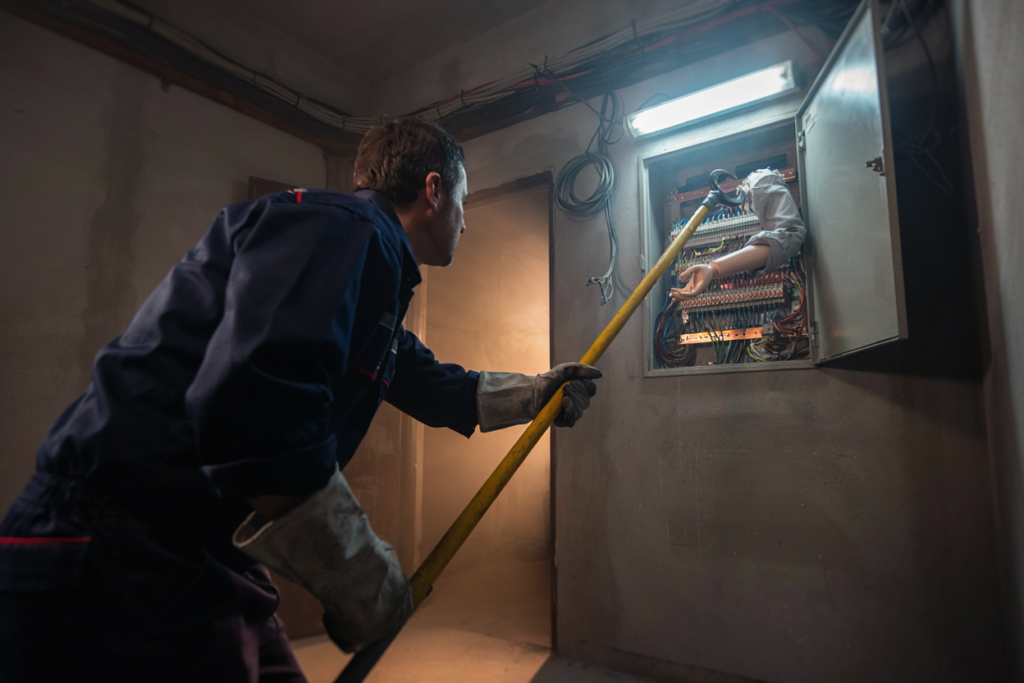
If you can’t isolate, you separate, using an insulated rescue hook or another genuinely non-conductive object. Never bare hands, and never assume something’s “dry” means it’s safe to touch. That assumption has cost people their lives.
This is the part of the sequence that tests you the most, because every instinct in your body is telling you to grab your mate and pull him clear. That instinct will get you killed too if the source is still live and you’re not using the right tool the right way. An insulated rescue hook isn’t optional kit, it’s the piece of equipment that lets you act on that instinct safely instead of turning one emergency into two.
After Separation, Emergency Response Basics
Once the casualty is clear, it’s back to DRSABCD basics: check response and breathing, call 000, start CPR if needed, and use a defibrillator if one’s on hand. If you want a refresher on the CPR side of things specifically, that’s covered on our first aid page.
This is also where a lot of tradies discover the gap between knowing CPR exists and actually being confident doing it under pressure on a real casualty, on a hard concrete floor, with adrenaline running through your own system. It’s worth being honest with yourself about whether you’re actually confident here, not just familiar with the concept. The isolation and separation steps get most of the attention because they’re specific to electrical rescue, but this final stretch is just as much a part of getting your mate through the incident, and it’s worth treating it with the same seriousness rather than assuming you’ll remember it if the moment ever comes.
Common Mistakes That Put Rescuers at Risk
- Trusting panel labelling blindly instead of verifying it yourself.
- Skipping the post-isolation verification step because you're in a hurry.
- Freezing instead of acting in those first critical seconds.
- Attempting separation with something that isn't properly insulated.
These are the mistakes that turn one casualty into two. Every one of them is avoidable with the right training drilled in properly, and every one of them has a common thread running through it: they all come from treating this as something you’ll figure out in the moment rather than something you rehearse until it’s automatic. Real training closes that gap. Reading about it once and hoping it sticks doesn’t.
None of these mistakes come from a lack of intelligence or a lack of care. They come from a lack of repetition. Knowing the theory once, months or years ago, isn’t the same as having the sequence wired into your hands the way it needs to be when someone’s actually down. That’s the whole point of hands-on practical training over a written summary like this one. This article can tell you what to do. It can’t put the movement into your muscle memory. Only practice does that.

Staying Compliant Without Losing a Day on the Tools
Booking for a Crew, Not Just Yourself
If you’re booking for more than yourself, there’s a group path built for that: one point of contact, one invoice, one compliance record for the whole crew. That’s a very different job to booking a single seat for yourself, and it deserves a process that actually matches how business owners and compliance officers work, not a version of the individual booking flow with extra steps bolted on.
Getting a whole crew at once also solves a problem most business owners don’t think about until it bites them: staggered expiry dates across different staff members, all lapsing at different times, all needing to be tracked separately. One booking, one date, one record for everyone removes that headache entirely, and it means whoever’s handling the paperwork on your side isn’t chasing individual certificates every time a principal contractor asks for evidence.
Further reading: Electrical Safety Act 2002 (Qld), the WorkSafe QLD code of practice, and the training.gov.au listing for UETDRRF018.
Conclusion
At the end of the day, this isn’t really about ticking a compliance box or getting a certificate to wave at the site gate, even though that’s the bit that gets you through the morning. It’s about what happens in the ten seconds after someone you work with makes contact with something they shouldn’t have. You don’t get to think it through in the moment. You either know the sequence or you’re guessing, and guessing next to a live panel is how one bloke down becomes two.
The good news is none of this is complicated once it’s drilled in properly. Assess, isolate, separate if you have to, move to safety, check response and breathing. Five steps, said out loud in seconds, but they only come out that fast if you’ve actually rehearsed them rather than just sat through a slideshow once and forgot about it by smoko. There’s a real difference between having heard these steps and being able to run them without thinking, and that difference only shows up in the moment you actually need it, which is exactly the wrong time to find out which category you fall into.
If it’s been a while since your last refresher, or you’ve genuinely never had cause to use any of this, that gap is worth closing before a site audit or a real emergency forces the issue. Getting current isn’t the inconvenience it sometimes feels like, it’s the difference between freezing and acting, and between being the guy who didn’t know what to do and the guy who did. Every electrician who’s been in this trade long enough has heard a story, secondhand or firsthand, about a close call on a panel. The ones who come out of those stories looking good are almost always the ones who’d actually trained for the moment before it arrived.
Whether you’re booking for yourself between jobs or sorting out a whole crew, the sooner it’s sorted, the sooner it’s off your plate and you’re back on the tools with one less thing to worry about. That’s really what this comes down to, being switched on, being current, and being safe to work alongside, because on a job site, that reputation is worth more than almost anything else you can put on a resume. Nobody remembers the guy who had his paperwork sorted early. Everybody remembers the guy who didn’t know what to do when it mattered.
Book Your First Aid Training Now
Fast, affordable, and nationally accredited training delivered by professionals who care
Frequently Asked Questions
Q.How often do I need to renew my LV rescue training?
There's no single national renewal period for UETDRRF018 the way there is for CPR's annual cycle. Currency expectations are largely set by your employer's policy or by whatever the principal contractor on a given site requires, so the safest approach is checking early rather than assuming your last certificate will automatically satisfy the next job.
Q.Can I book LV rescue training for my whole crew at once?
Yes, there's a group booking path built specifically for business owners and compliance officers who need to get multiple staff at the same time. It's set up around one point of contact, one invoice, and one compliance record, so you're not chasing separate paperwork for every team member.
Q.What's the difference between isolating and separating a casualty?
Isolating means switching off the power at the source and verifying it's de-energised before anyone makes contact, which is the safest option whenever it's possible in time. Separating is what you do when isolation isn't fast enough or isn't accessible, using an insulated rescue hook or another genuinely non-conductive object to move the casualty clear without touching them directly.
Q.Is this article enough to prepare me for a real LV rescue?
No, and it's not meant to be. This is a plain-English overview of the sequence, not a substitute for the hands-on UETDRRF018 practical assessment, where the actual competency gets certified and drilled into muscle memory rather than just read about.
Making first aid training more affordable for
every classroom
We believe every student deserves access to life-saving first aid knowledge. That’s why we offer specially reduced pricing for schools and educational groups. Whether you’re booking for a single class, a year group, or your entire school, our flexible packages make training more accessible and cost-effective — without compromising quality.
