

A team member tells you they carry an adrenaline auto injector for a severe allergy. Or maybe nothing’s happened yet, but a recent WHS review flagged it as a gap, and now you’re the one responsible for closing it. Either way the question is the same: if someone had a severe allergic reaction on your premises tomorrow, would anyone on your team know what to do in the first sixty seconds?
Adrenaline auto injector training isn’t about ticking a compliance box. It’s about giving your staff, volunteers or committee the confidence to recognise anaphylaxis, act without hesitation, and use a device like an EpiPen correctly, under pressure, in a real workplace setting, not a classroom simulation.
This guide walks through exactly what adrenaline auto injector training covers, who needs it, and what a genuinely practical course looks like for a hospitality venue, retail team, or community club, not a childcare-focused session repurposed to fit. By the end you’ll know whether awareness training is enough, or whether your team needs something more formal, and how to get it booked without pulling half your roster off the floor.
How to Use an Adrenaline Auto Injector
If you only remember five steps, remember these. This is the practical, in-the-moment sequence, not the full training, just the bare bones of what happens when it counts.
- Remove the safety cap: Take the auto injector out of its case and remove the safety release.
- Position against the outer mid-thigh: Hold the injector at a right angle to the leg, through clothing if needed.
- Push firmly until it activates: You'll feel or hear a click confirming the injection has started.
- Hold in place: Keep it firmly against the thigh for the length of time recommended for your device.
- Call 000 immediately: Even after a successful injection, emergency care is always required for anaphylaxis.
That last step trips people up more than any other. There’s a common assumption that once the injector’s done its job, the crisis is over. It’s not. The adrenaline buys time, it doesn’t fix the reaction, and paramedics need to be on the way regardless of how quickly the person seems to improve.
🔑 Key point: Not the same emergency. Mild reactions and anaphylaxis look different and need different responses. Confusing the two is one of the most common reasons people hesitate when it matters most.
What Does Adrenaline Auto Injector Training Actually Cover?
Recognising the signs of anaphylaxis vs. a milder allergic reaction
This is where most workplace teams get caught out, not on the injection itself, but on knowing when it’s actually needed. A mild reaction might look like hives, some itching, a bit of swelling around the mouth. Uncomfortable, but not life-threatening. Anaphylaxis is different, it moves fast and it moves through the body. Difficulty breathing, swelling of the tongue or throat, a sudden drop in blood pressure, dizziness or collapse. Training spends real time on this distinction, because hesitating to act while trying to work out “is this bad enough” is one of the most dangerous places a bystander can be stuck.
Using an adrenaline auto injector correctly, step by step
Beyond the five-step sequence above, training covers the details that don’t show up in a quick guide, how to handle a device if the person can’t self-administer, what changes if you’re working through clothing, and what “firmly” actually feels like when you’ve never done it before. There’s a real difference between reading the steps and doing them under a trainer’s eye with a practice device in your hand.
What to do before and after the injection
The injection is one moment in a longer sequence. Before it, there’s recognising the emergency and getting the person into a safe position, usually lying down with legs raised, unless they’re struggling to breathe, in which case sitting upright is safer. After it, there’s calling 000, staying with the person, watching for a second wave of symptoms, and being ready to use a second auto injector if one is available and symptoms haven’t improved within the expected window. This is the part a lot of workplace teams don’t think about until they’re asked directly, what happens in the minutes after the injection, while you’re waiting for an ambulance.
How this differs from general first aid training
This one’s worth being upfront about, because it’s the objection Rachel-type buyers raise most often: “how is this different from a general first aid course?” The honest answer is that it’s narrower and more focused. A general first aid course touches on anaphylaxis as one module among many, CPR, burns, fractures, choking, and so on. Adrenaline auto injector training strips that back to one specific, high-stakes skill and goes deeper into it. It’s not a replacement for first aid training, and it’s not trying to be. It’s the difference between a broad toolkit and a single tool you need to be genuinely fast and confident with.
💡 Key point: There's no legal mandate here, but there is a duty of care. Once a risk is known to you, doing nothing about it is the harder position to defend.

Does Your Workplace Actually Need This Training?
WHS duty of care and unmanaged risk
Here’s the thing nobody tells you upfront: there’s no law that says your café or your sporting club must run adrenaline auto injector training. Unlike childcare, where ACECQA sets a hard requirement, general workplaces sit under the broader Work Health and Safety Act, which asks you to manage foreseeable risks to staff, customers or members. Foreseeable is the key word. If you know a staff member carries an auto injector, or you run a venue that serves food to the public, an anaphylaxis risk isn’t hypothetical anymore. It’s identified. And once it’s identified, doing nothing about it becomes a much harder position to defend, whether that’s to WorkCover, an insurer, or just to yourself if something did happen.
Common triggers: staff disclosure, near-miss, insurance/WorkCover review, committee liability
Nobody books this training out of pure curiosity. There’s almost always a trigger. Usually it’s one of these:
- A staff member discloses a severe allergy when they're onboarded
- A near-miss happens, someone has a reaction and the team scrambles, unsure what to do
- An insurer or WorkCover review flags it as an unmanaged risk
- A sporting club committee realises a junior member has a known allergy and there's no trained volunteer at games or training
If any of those sound familiar, that’s not a coincidence. That’s the exact moment most of our workplace bookings come from.
Is awareness training enough, or do you need a formal course?
This is probably the honest question you actually came here with. Short version, it depends on your level of exposure. If you’re running a venue that serves food to the public, or you’ve got a staff member who’s disclosed a severe allergy, awareness alone isn’t enough. You need people who can act, not just recognise. If your risk is lower and more theoretical, say, an office environment with no food service and no known cases, a lighter awareness session might genuinely be proportionate. We’d rather tell you that honestly than sell you a bigger course than you need. The goal isn’t maximum training, it’s the right training for what your workplace is actually exposed to.
Who Should Do This Training? (Hospitality, Retail & Community Settings)
Duty of care looks different depending on what kind of workplace you’re running, here’s how it plays out across the settings we train most often.
Café, restaurant & venue staff
If you’re serving food to the public, you’re serving people whose allergies you don’t know about until they tell you, or until something goes wrong. Front-of-house staff, kitchen staff, even the person on the door needs enough awareness to recognise a reaction happening at a table and know who to call for and what to do while help’s on the way.
Retail teams with customer-facing exposure
It’s easy to assume retail is lower risk than hospitality because there’s no food being served. But customers still have reactions on-site, staff still carry auto injectors, and a store full of people is still a place where a severe allergic reaction can happen with no warning. Retail teams need the same core skill, just without the food-service urgency layered on top.
Sporting clubs and volunteer committees
This is the setting people underestimate most. A junior member with a known nut allergy, a canteen serving snacks, an away game with no trained adult present, the risk is real, and it’s often sitting with volunteers who never signed up thinking they’d need this skill. Training here isn’t just about the member at risk. It’s about protecting the volunteer too, so they’re not the person who freezes because nobody ever showed them what to do.
📋 Key point: Practical beats theoretical. A course that has you handling a device is worth more than one that has you reading about it.
What to Expect on the Day
Once you’ve decided training makes sense, the next question is usually the practical one: what does the day actually look like?
Practical, hands-on training vs. theory-only
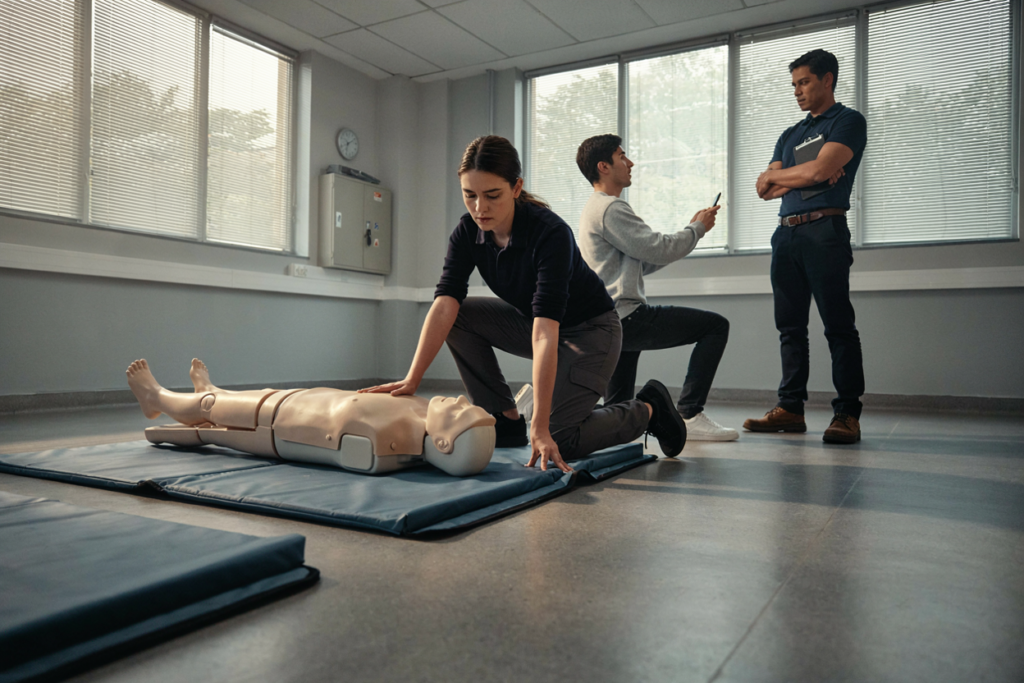
This isn’t a sit-and-watch-a-slideshow session. You’ll be handling practice devices, running through the steps yourself, and working through realistic scenarios rather than just reading about them. There’s a real gap between knowing the theory and having actually done it once with someone watching and correcting you, that’s the gap this training closes.
Group and onsite training options for teams and volunteers
We know pulling staff off the floor costs you money, and asking volunteers to find time isn’t always simple either. Onsite and group training options exist specifically for this, we come to your venue, or we work around your roster and your committee’s availability, rather than asking your whole team to fit around ours.
For more on recognizing and responding to anaphylaxis, the ASCIA anaphylaxis action plan resources are a solid external reference worth having on hand alongside your training.
Choosing the Right Provider for Your Team
Not all adrenaline auto injector training is built the same way, here’s what separates a genuinely useful course from a box-ticking one.
What to look for in a genuinely practical (not box-ticking) course
A good course doesn’t feel like it’s been lifted from a childcare centre and relabelled for your café or your club. It should speak directly to your setting, use hands-on practice rather than theory alone, and leave your team actually able to act, not just able to recite the steps back on a quiz. If a provider can’t tell you clearly how their course applies to hospitality, retail, or community settings specifically, that’s worth noticing.
Why First Aid Alive’s training is built for real workplaces, not repurposed classroom content
Our training’s led by Bill Hunter, First Aid Alive’s principal trainer, who’s spent over 20 years in the field and built this course around what actually happens in a hospitality venue, a retail floor, or a club canteen, not a generic classroom scenario. We’ve worked with café teams who came to us after a near-miss with a customer’s allergy, wanting a course that felt relevant to service, not sterile and clinical.
Severe allergic reactions are more common than most workplaces assume, which is exactly why proportionate, practical training matters more than a certificate filed away and forgotten.
At the end of the day, this comes back to that first question, if someone had a severe allergic reaction on your premises tomorrow, would anyone on your team actually know what to do in those first sixty seconds. Most workplaces never think about it until they’re forced to, and by then the training you wish you’d booked isn’t going to help you in the moment. That’s not meant to scare anyone into a panic booking. It’s just the honest reality of how these situations tend to play out.
What matters most isn’t ticking a box or filing a certificate away somewhere nobody looks at again. It’s your team actually having the confidence to move, to recognise what’s happening, and to use a device correctly without freezing or second-guessing themselves. That confidence doesn’t come from reading a page like this one, as useful as it hopefully’s been. It comes from doing it once, hands-on, with someone showing you what “firmly” actually feels like and correcting you when you get it wrong.
Whether your workplace genuinely needs a formal course or whether awareness training is proportionate depends on your exposure, and that’s worth being honest with yourself about rather than assuming the answer either way. A café serving food to the public sits in a different position to a low-traffic office with no known cases. A sporting club with a junior member who’s disclosed an allergy sits in a different position again, especially when the people responsible are volunteers who never expected to need this skill.
The setting you’re running matters too, and it shouldn’t be an afterthought bolted onto generic content. Hospitality, retail and community club environments each carry their own version of this risk, their own rosters, their own scheduling headaches, and training that doesn’t account for any of that isn’t really training that’s built for you.
None of this needs to be complicated or drawn out. A short, practical, hands-on session that respects your roster or your volunteers’ time is enough to close the gap between “we should probably look into this” and a team that’s actually ready. The people you’re protecting, whether that’s a staff member, a customer, or a club member’s child, are worth that time.
If a WHS review flagged this, if a staff member disclosed a severe allergy, or if you’ve just had a nagging feeling that your team wouldn’t know what to do, that feeling’s usually right, and it’s worth acting on before it’s tested for real.
Book Your First Aid Training Now
Fast, affordable, and nationally accredited training delivered by professionals who care
Frequently Asked Questions
Q.Do I need a prescription to train on an auto injector?
No. Training uses practice or trainer devices that don't contain a needle or medication, so no prescription is needed to attend a session or learn the technique.
Q.Can non-medical staff legally use one?
Yes. Anyone can use an adrenaline auto injector on someone experiencing anaphylaxis in an emergency, and you don't need to be a medical professional or hold a formal qualification to act.
Q.How is this different from carrying a first aid certificate already?
A general first aid certificate covers anaphylaxis briefly as one topic among many, while this training focuses specifically on recognizing anaphylaxis and using an auto injector confidently, which is a narrower and more hands-on skill.
Q.What if my workplace doesn't have anyone with a known allergy?
Anaphylaxis can happen to someone with no prior history, including a customer or visitor, so training isn't only relevant to workplaces with a known case on staff.
Q.Does this replace a full first aid course?
No. It's a focused addition to first aid knowledge rather than a substitute for it, and many workplaces run both to cover the full range of emergencies they might face.
Q.What happens if the person doesn't improve after the injection?
A second auto injector may be given if symptoms haven't improved and one is available, and this is exactly the kind of decision training walks through so it doesn't have to be figured out in the moment.
Making first aid training more affordable for
every classroom
We believe every student deserves access to life-saving first aid knowledge. That’s why we offer specially reduced pricing for schools and educational groups. Whether you’re booking for a single class, a year group, or your entire school, our flexible packages make training more accessible and cost-effective — without compromising quality.
