

You’ve found a provider, checked the dates, and you’re ready to book — but you still have one question that isn’t answered anywhere on the site. What actually happens inside one of these advanced first aid classes?
That question matters more than people give it credit for. There’s a version of “advanced first aid” that genuinely prepares you for a multi-casualty incident on a construction site — and there’s a version that’s basically a standard course with an extra scenario bolted on. They’re not the same thing, and the certificate doesn’t always tell you which one you got.
This guide covers what a quality HLTAID014 class looks like from the first hour to the last, how it differs from standard first aid, how the assessment works, and what you should have in your hands by end of day.
What Do You Learn in Advanced First Aid?
Advanced first aid training at the HLTAID014 level goes well beyond what you’d cover in a standard first aid course. A quality class covers:
- Triage and multi-casualty management — using the START triage system to assess and prioritise multiple patients at the same time
- Extended patient assessment — conducting systematic primary and secondary surveys to identify life-threatening conditions before they escalate
- Haemorrhage control — applying tourniquets, wound packing, and pressure bandaging for severe bleeding
- Shock recognition and management — identifying and responding to hypovolaemic, anaphylactic, and other shock states
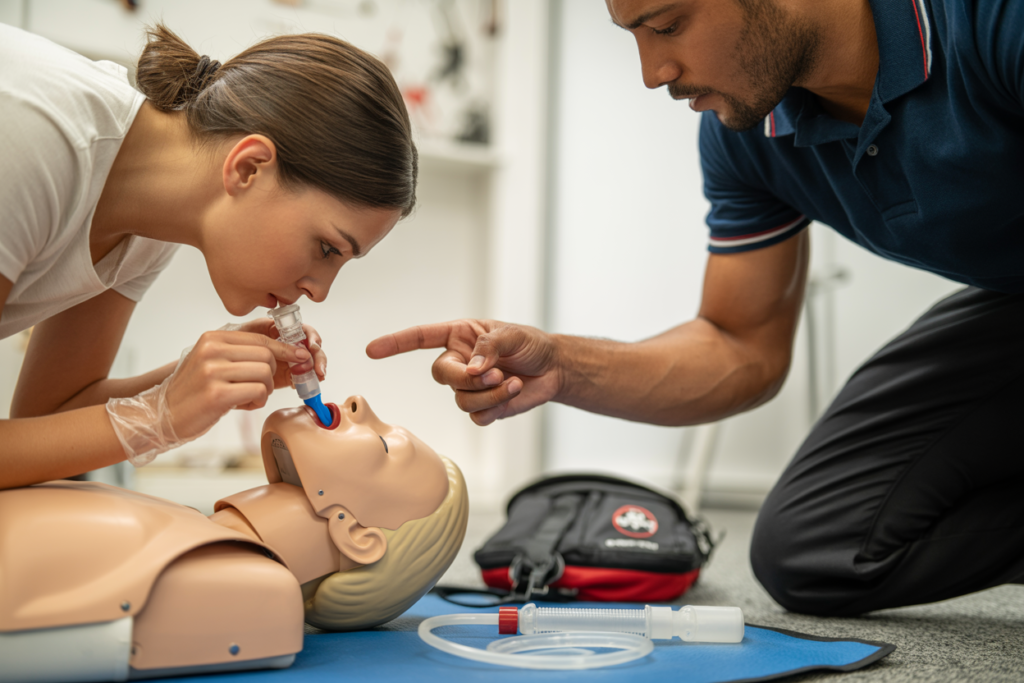
- Advanced airway management — maintaining a clear airway using positioning, suction, and adjunct devices
- Spinal injury management — immobilisation techniques and safe patient movement protocols
- Complex anaphylaxis response — administering adrenaline auto-injectors and managing reactions that don’t resolve with the first dose
- Cardiac emergencies — high-performance CPR, AED operation, and post-resuscitation care
- Documentation and handover — recording patient observations and delivering a structured handover to paramedics when they arrive
Each competency has a practical assessed component. If you’re completing HLTAID014 through a provider who delivers what the qualification demands, you’ll work through every one of those skills hands-on before the day is done.
What Makes HLTAID014 Different From Standard First Aid?
There’s a problem in the advanced first aid market that doesn’t get talked about enough. A lot of providers deliver what is essentially a padded-out HLTAID011 — same content, same scenarios, maybe one extra practical thrown in. Students walk out with the right unit code on their certificate but none of the genuine advanced competency the qualification is supposed to represent.
If you’ve sat through a course like that before, you know the feeling. You leave thinking: that wasn’t worth it.
According to Safe Work Australia, over 180,000 serious workplace injuries are recorded in Australia every year. Having a genuinely qualified Advanced First Aid Officer on site isn’t just a compliance exercise — it’s about the person holding that certificate actually knowing what to do when something goes wrong.
The Qualification Gap Most Providers Don’t Talk About
HLTAID011 — Provide First Aid — covers CPR, basic wound management, fractures, and common medical emergencies. It’s the right cert for a reception desk or a small retail team. It is not designed for a construction site with rotating contractors and the genuine possibility of a multi-casualty incident.
HLTAID014 — Provide Advanced First Aid — is a different qualification at a different level. Broader scope, greater clinical depth, and assessed competencies that reflect it.
| Competency | HLTAID011 | HLTAID014 |
|---|---|---|
| Basic CPR and AED | ✅ | ✅ |
| Wound care and fractures | ✅ | ✅ |
| Single-casualty patient assessment | ✅ | ✅ |
| Primary and secondary survey | ❌ | ✅ |
| Triage — START system | ❌ | ✅ |
| Multi-casualty coordination | ❌ | ✅ |
| Haemorrhage control — tourniquet, wound packing | ❌ | ✅ |
| Shock recognition and management | ❌ | ✅ |
| Advanced airway management | ❌ | ✅ |
| Spinal immobilisation | ❌ | ✅ |
| Complex anaphylaxis management | ❌ | ✅ |
| Structured paramedic handover | ❌ | ✅ |
The unit code on the certificate is not just administrative detail. It’s the thing your insurance coordinator checks, the thing a tender pre-qualification panel verifies, and the thing a WorkSafe Queensland investigator looks at if something goes wrong on your site.
Who Is Actually Required to Hold HLTAID014?
Not every workplace needs an HLTAID014 holder — but a lot more do than most people realise.
WorkSafe Queensland’s first aid requirements set minimum standards based on hazard level and the nature of the work. For high-risk industries — construction, civil infrastructure, manufacturing, mining services — the standard qualification often isn’t enough for the regulator or the insurer.
HLTAID014 is specifically required or strongly recommended for:
- Sites where the designated First Aid Officer is the nominated primary responder
- Construction projects requiring a named Advanced First Aid holder for tender pre-qualification
- Insurance policies that specify “Advanced First Aid” — these require HLTAID014, not HLTAID011
- Remote or FIFO environments where the first aid officer may be the only trained responder for extended periods
- WHS officers building a pathway toward a Certificate IV or Diploma in Work Health and Safety
For a full breakdown of Queensland workplace first aid requirements by industry, the Queensland Workplace First Aid Requirements guide covers the regulatory picture in detail.
⚠️ Compliance Warning: Insurance policies that specify Advanced First Aid require HLTAID014 specifically. HLTAID011 will not satisfy this requirement regardless of how the course is marketed. If your policy or contract says "Advanced First Aid," check the unit code — not the course name.
What Separates a Quality HLTAID014 Provider From the Rest
Not all advanced first aid classes are built the same. The qualification framework sets the minimum standard — but what happens inside the room depends almost entirely on who’s running it and what equipment they’re using.
Instructor Credentials — Why a Paramedic in the Room Changes Everything
There’s a real difference between someone trained to teach first aid and someone who has spent years in clinical emergencies and is now trained to teach.
A paramedic instructor knows what it looks like when the steps don’t work. They’ve managed real multi-casualty incidents, run primary surveys on unconscious patients, and made spinal immobilisation calls on messy scenes. When they debrief a scenario, they’re drawing on cases they’ve actually run — not reading from a facilitator guide.
That context changes how the learning lands. Instead of “yes, that’s the correct sequence,” you get “here’s what that looks like in a real incident, and here’s why the sequence matters.”
Equipment Standards That Signal a Serious Course
The equipment in the room tells you a lot about the course before the instructor says a word.
A quality HLTAID014 class uses clinical-grade AEDs, airway adjunct kits — nasopharyngeal airways, bag-valve masks, suction devices — and traction splints for femoral fracture management. The actual tools you’d reach for in a real advanced first aid response.
Skill transfer is directly tied to the equipment you practise on. If you’ve never held a real tourniquet applicator under time pressure, you haven’t really learned tourniquet application.
| Equipment | Basic Course Standard | Quality HLTAID014 Standard |
|---|---|---|
| AED | Trainer unit / no feedback | Clinical-grade with real feedback |
| Airway management | Basic airway only | NPA, BVM, suction device |
| Bleeding control | Standard bandaging | Tourniquet, wound packing kit |
| Splinting | Basic splint | Traction splint for femoral fractures |
| Patient monitoring | Not included | Pulse oximetry, obs recording |
Your Certificate — What You’ll Have by End of Day
The certificate is the whole point of the compliance exercise. It doesn’t matter how good the training was if the document you submit to your insurance coordinator or tender pre-qualification panel has the wrong unit code or a missing RTO number.
What the Certificate Must Show to Pass an Audit
The certificate must show:
- Unit code: HLTAID014 — not replaced by a course name like “Advanced First Aid” or “Senior First Aid”
- Your full legal name — matching your ID exactly
- Issue date and expiry date — HLTAID014 is valid for three years
- The issuing RTO’s name and RTO number — confirms ASQA registration to deliver this qualification
- The qualification title — Provide Advanced First Aid
The most common compliance error site supervisors report is receiving a certificate with the wrong unit code — HLTAID011 when the contract requires HLTAID014. You can verify any RTO’s registration through the ASQA registered training organisation search. If a provider can’t give you their RTO number before you book, that’s a red flag.
🔍 Certificate Accuracy Alert: Before submitting your certificate to an insurance register or tender document, confirm the unit code reads HLTAID014 — not HLTAID011 or a superseded unit code. This is the single most common compliance error we see from students who trained elsewhere.
Same-Day Digital Delivery — How It Works
For most site supervisors and WHS officers, same-day digital delivery isn’t a nice-to-have. Insurance registers have upload deadlines. Tender submissions have closing times. Project mobilisation checks don’t wait.
Here’s how it works with a provider who has the process set up properly:
- You complete your practical and written assessment during the course
- The assessor marks off your competency sign-off before end of business
- Your digital certificate is issued and sent to your email the same day
- The PDF uploads directly to insurance portals, WHS registers, and compliance systems
Your tax invoice is auto-generated at the same time — ABN, RTO number, and unit code HLTAID014 all included. Everything your accounts payable team needs without a follow-up call.
What to Do With Your Certificate Once You Have It
- Upload to your company WHS register — same day if possible
- Notify your project manager or insurance coordinator — send the PDF directly
- Set a renewal reminder at the 11-month mark — not when someone flags it in a toolbox talk
- Save a copy you can access independently — don’t rely solely on the company register if you move between projects
For WHS officers managing first aid currency across a rotating crew, the free Site First Aid Register Template for Queensland is worth downloading — a single place to track unit codes, issue dates, expiry dates, and renewal status.

How to Prepare for Your Advanced First Aid Class
There’s not a lot of preparation required. A well-structured HLTAID014 course builds from foundations up — so even if you haven’t touched a first aid kit since your last renewal, you won’t be lost.
What to bring:
- Photo ID — a driver’s licence is fine
- Your previous certificate if you’re renewing
- Comfortable clothing — you’ll be kneeling and getting on the floor for practicals
- Sturdy closed-toe footwear
- Food and water for a full training day
What to review: A basic anatomy refresher helps — knowing the difference between arteries and veins, having a rough mental map of where major organs sit. Nothing technical. If you’ve done a first aid course before, think about what you felt least confident in and pay closer attention when those topics come up.
Don’t stress about the assessment. The practical component is observed, not graded on a numerical scale. The assessor is watching whether you can perform skills safely — not looking for reasons to fail you.
Book Your HLTAID014 — Next Available Weekend Date
Advanced first aid classes aren’t all running the same course. The qualification framework sets the floor — what you actually get on the day depends on the instructor in the room, the equipment on the benches, and how seriously the provider takes the difference between issuing a certificate and building genuine competency.
If you’re a site supervisor, WHS officer, or construction foreman, the stakes attached to your HLTAID014 aren’t abstract. They show up in insurance audits, tender pre-qualification checks, and the moment something goes wrong on site.
Advanced Resuscitation Training is a Registered Training Organisation delivering HLTAID014 to site supervisors, WHS officers, and construction teams across South East Queensland. Our instructors are practising or former paramedics with clinical backgrounds in emergency medicine, retrieval, and industrial paramedic roles. Our RTO number is on every course page, every booking confirmation, and every certificate we issue.
Book Your First Aid Training Now
Fast, affordable, and nationally accredited training delivered by professionals who care
Frequently Asked Questions
Q.What is the difference between HLTAID011 and HLTAID014?
HLTAID011 is the standard first aid qualification covering CPR, basic wound care, and common single-casualty emergencies. HLTAID014 goes significantly further — it adds triage, multi-casualty coordination, advanced airway management, haemorrhage control, shock management, and spinal immobilisation. For high-risk industries like construction and civil infrastructure, HLTAID014 is the qualification that satisfies insurance and regulatory requirements, not HLTAID011.
Q.Who needs to hold HLTAID014 in Queensland?
Any designated First Aid Officer on a high-risk worksite who is the nominated primary responder should hold HLTAID014. It's also specifically required for tender pre-qualification submissions that name an Advanced First Aid holder, and for insurance policies that stipulate Advanced First Aid as a coverage condition. WHS officers, site supervisors, and construction foremen in Queensland are the most common holders of this qualification.
Q.How long is an HLTAID014 certificate valid for?
HLTAID014 is valid for three years from the date of issue. Most WorkSafe Queensland compliance checks and insurance audits require a current, unexpired certificate — so booking your renewal at the 11-month mark rather than waiting until it lapses gives you the most flexibility around your site schedule.
Q.What do I need to bring to an advanced first aid class?
Bring photo ID, your previous certificate if you're renewing, and comfortable clothing you can move in — you'll be on the floor for practicals. Closed-toe footwear and food and water for the day are also recommended. The course covers everything from foundations up, so there's no need to study beforehand.
Q.What happens if I don't pass the assessment on the first attempt?
HLTAID014 assessment is competency-based — the assessor is watching whether you can perform skills safely and make sound decisions, not marking you on a numerical scale. If you don't demonstrate competency on a particular skill in the first attempt, you'll be given another opportunity on the day. The goal is for every participant to leave with genuine competency, not to fail people on technicalities.
Making first aid training more affordable for
every classroom
We believe every student deserves access to life-saving first aid knowledge. That’s why we offer specially reduced pricing for schools and educational groups. Whether you’re booking for a single class, a year group, or your entire school, our flexible packages make training more accessible and cost-effective — without compromising quality.
