
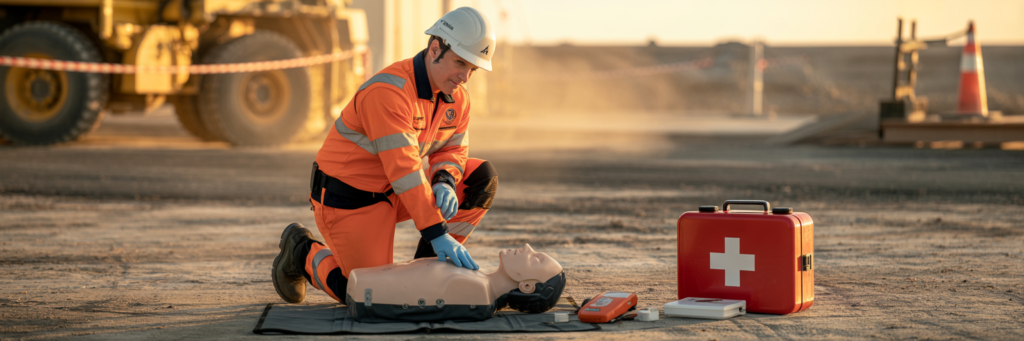
What would you do if a colleague experienced massive bleeding from a machinery accident, and you’re the only qualified first aider on site for the next several hours? Having a comprehensive emergency response checklist could mean the difference between panic and confident, life-saving action.
For first aid officers working remote sites—from FIFO mining operations to construction zones and outdoor recreation areas—advanced first aid emergencies demand systematic, confident responses. When professional medical help is far away, your HLTAID014 training needs to translate into clear, actionable steps that save lives.
This comprehensive advanced first aid emergency response checklist provides you with step-by-step protocols for managing critical emergencies when you’re the primary medical responder. Whether you’re supervising a remote crew, leading outdoor expeditions, or managing workplace safety compliance, this guide delivers the practical framework you need during extended care scenarios.
In this article, you’ll discover detailed response protocols for major trauma, cardiac emergencies, and extended care situations. We’ll cover equipment lists you can actually use, communication procedures that work when cell coverage is patchy, and the systematic DRSABCD+ approach for complex scenarios. By the end, you’ll have a downloadable checklist ready to print and keep in your first aid kit—because when an emergency strikes, you won’t have time to search Google.
⚠️ CRITICAL REMINDER: The average response time for remote sites can exceed 90 minutes. Your first aid response isn't just about the first 10 minutes—it's about managing casualties systematically until professional help arrives. This checklist is your roadmap when your brain is fogged by stress and adrenaline.
What should be in an advanced first aid emergency response checklist?
An advanced first aid emergency response checklist should include:
- Initial Assessment Protocol – DRSABCD systematic approach for scene safety and casualty evaluation
- Emergency Contact Information – Triple Zero (000), site coordinates, nearest hospital details, and emergency evacuation points
- Critical Response Procedures – Step-by-step protocols for severe bleeding, cardiac arrest, respiratory emergencies, and shock management
- Extended Care Guidelines – Procedures for managing casualties beyond the initial response until professional help arrives
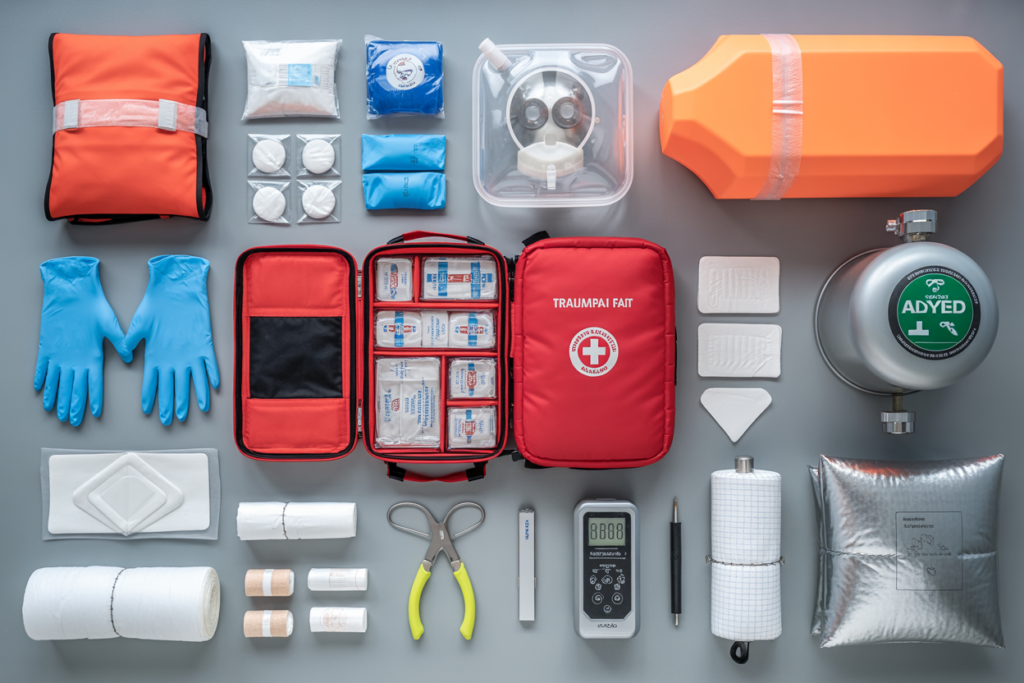
- Equipment Verification List – What’s actually in your first aid kit matters. You need trauma dressings, oxygen equipment, and AED
- Communication Templates – Structured handover information for paramedics and emergency services
- Legal Documentation – Incident report forms and consent procedures
This checklist framework makes sure HLTAID014-trained first aiders can respond systematically to life-threatening emergencies, particularly in remote locations where response times are extended. When you’re far from the nearest hospital, a systematic approach isn’t just recommended—it’s the difference between someone surviving or not.

Understanding the DRSABCD Protocol for Advanced First Aid Emergencies
DRSABCD stands for Danger, Response, Send for help, Airway, Breathing, CPR, and Defibrillation. The Australian Resuscitation Council developed this systematic approach because emergencies make your brain fog up—and when someone’s bleeding out or not breathing, you can’t afford to miss steps.
Here’s the thing about working remote sites. You don’t have the luxury of paramedics showing up quickly. You’re the paramedic for an extended period, maybe longer. That’s why systematic assessment isn’t just helpful—it’s what keeps you from forgetting to check for scene dangers while you’re focused on the casualty, or missing a spinal injury because you went straight to the bleeding.
D – Danger: Before you touch anyone, assess the scene. On remote sites, dangers include operating machinery that hasn’t been isolated, electrical hazards, unstable ground, vehicle traffic, and environmental hazards. Don’t become a second casualty.
R – Response: Check if the casualty is conscious using the AVPU scale (Alert, Voice, Pain, Unresponsive). Talk to them first, then try a painful stimulus if needed.
S – Send for Help: Call Triple Zero (000) with exact site coordinates, access route details, nature of emergency, and number of casualties. Delegate this if you’ve got crew members around.
A – Airway: If they’re talking, their airway’s open. If unconscious, use head-tilt chin-lift or jaw-thrust for suspected spinal injuries. Recovery position maintains airways for unconscious casualties who are breathing.
B – Breathing: Look, listen, and feel. Normal breathing is 12-20 breaths per minute for adults. Assess breathing quality—is it labored, shallow, or irregular?
C – CPR: No breathing or only gasping breaths means CPR starts immediately. Quality CPR means 30 compressions to 2 breaths, at least 5cm deep on adults, rate of 100-120 compressions per minute. Rotate rescuers if possible—CPR is exhausting.
D – Defibrillation: If there’s an AED available, get it immediately. Time to defibrillation is the single biggest factor in cardiac arrest survival. Check that pads are in date and battery is charged.
The “plus” in DRSABCD+ is extended care protocols. Once immediate life threats are managed, positioning becomes important for casualties you’ll be monitoring for extended periods. Track vital signs, document changes over time, and prepare detailed handover information for paramedics.
Critical Emergency Response Procedures for Remote Sites
Severe Bleeding Control and Trauma Management
Your first priority is direct pressure. Not a gentle press—firm, sustained pressure directly on the wound. Use trauma dressings from your first aid kit, clean towels, or even clothing if that’s what you’ve got. Apply pressure and hold it without lifting to check “if it’s working.” Every time you lift, you disrupt clot formation.
If direct pressure isn’t controlling bleeding from a limb, add indirect pressure on the major artery supplying blood to that limb. Commercial tourniquets save lives when arterial bleeding won’t stop with pressure alone. Place the tourniquet above the wound (never directly on a joint), tighten until bleeding stops completely, and note the time applied.
For penetrating trauma with impaled objects, your job is to stabilize, not remove. Removing objects in the field could cause uncontrolled internal bleeding. Pack dressings around the object, stabilize it so it doesn’t move, and wait for advanced care.
Cardiac Emergency Response Protocol
Cardiac arrests on remote sites have lower survival rates than urban areas—that’s reality when the ambulance is far away. But quality CPR and early defibrillation still give your colleague a fighting chance.
Not every chest pain is cardiac arrest. If they’re talking to you about chest pain, they don’t need CPR—they need Triple Zero and monitoring because they could deteriorate. Unconscious and not breathing? Start CPR immediately.
Push hard, push fast. 5cm depth minimum, 100-120 compressions per minute. Compression quality drops significantly after a couple minutes. If you’ve got crew members, rotate frequently. Fresh arms equal quality compressions equal better chance of survival.
Respiratory Emergency Management
Breathing emergencies escalate fast. Asthma attacks, anaphylaxis, choking, chest trauma—each requires different immediate responses, but all need airway management as priority.
For asthma, sit them upright and help them use their reliever inhaler if they have one. Anaphylaxis requires EpiPen use immediately—jab into outer thigh, hold briefly, and call Triple Zero. Even if symptoms improve, they need hospital care.
Complete choking obstruction (can’t cough, can’t speak, going blue)—five sharp back blows between shoulder blades, then five chest thrusts. Alternate until obstruction clears or they become unconscious. If unconscious, start CPR—compressions can dislodge the obstruction.
Shock Recognition and Treatment
Medical shock is life-threatening circulatory failure. Early shock signs include pale, cold, clammy skin, rapid pulse, rapid breathing, and anxiety. Don’t wait for late signs like decreased consciousness or absent pulses.
Lie them flat unless they’ve got chest injuries or breathing difficulty. Elevate legs if possible to shift blood from legs back to core organs. Keep them warm but don’t overheat them. Reassure them—anxiety makes shock worse.
Don’t give them anything to drink, even if they’re thirsty. If they need surgery later, having food or water in their stomach increases complication risks.
🚨 TRAUMA PRIORITY: Life over limb. If a tourniquet is the only way to stop life-threatening bleeding, use it. Potential tissue damage is better than bleeding to death. Note the time applied and don't remove it—let paramedics make that decision.
Essential Equipment and Supplies for Advanced First Aid Response
Your basic workplace first aid kit isn’t enough for remote site emergencies. You need equipment that handles major trauma for extended periods.
Core trauma supplies: Trauma dressings (10cm x 18cm minimum) that combine wound coverage with built-in pressure application. Combine pads for large wounds. Conforming bandages that maintain tension. Triangular bandages for slings, head dressings, and improvised tourniquets.
Commercial tourniquets: CAT or SOFTT tourniquets are non-negotiable for remote sites. Arterial bleeding from limbs kills fast. Store them accessible, not buried in the kit.
Airway management: Oropharyngeal airways in various sizes maintain airways in unconscious casualties. Pocket masks or bag-valve-masks for rescue breathing. Oxygen therapy equipment including portable cylinders with regulators and non-rebreather masks.
AED: Check that pads are in date and battery is charged. Remote site AEDs often sit unused, then fail when needed because nobody checked them.
Splinting and immobilization: SAM splints mold to any limb shape. Cervical collars for suspected spinal injuries if your workplace protocols require them.
Personal protection: Disposable nitrile gloves in multiple sizes. Face shields for CPR. Hand sanitizer. You need to protect yourself so you can keep helping.
Remote site-specific equipment: Satellite phones for areas without mobile coverage. Space blankets prevent hypothermia. Two-way radios for coordinating with crew members during emergencies.
Monthly equipment checks aren’t optional. Verify bandages are sealed and in-date, gloves are stocked, AED battery and pads are current, oxygen cylinder pressure is adequate. Assign specific people to these checks with clear documentation.
Emergency Communication Protocols and Coordination
Communication is where remote site emergency responses often fall apart. You’ve done everything right with the casualty, but if you can’t get help coming or can’t tell them where you are, none of it matters.
Mobile coverage on remote sites is patchy at best. Map your site’s communication dead zones before emergencies happen. Know where coverage works and where it doesn’t. Have backup plans—satellite phones, two-way radios, or runner systems to physically reach where communication works.
When calling Triple Zero, they need specific information immediately: exact GPS coordinates, nearest street address or landmark, property name, access route details. Keep this information on laminated cards in first aid kits so it’s available during emergencies.
Give them casualty information clearly: number of casualties, what happened, conscious or unconscious, breathing or not breathing, obvious injuries, what you’re doing right now. Use simple language describing what you see, not medical diagnoses you’re guessing at.
When paramedics arrive, use MIST format for structured handover:
- Mechanism of injury (what happened)
- Injuries found (what’s wrong with them)
- Signs and vital signs (what you’ve observed)
- Treatment given (what you’ve done)
Hand them your written notes. Paramedics appreciate first aiders who document.
Clear access routes before ambulance arrival. Assign someone to meet them at the site entrance and guide them directly to the casualty. Time paramedics spend navigating obstacles is time the casualty isn’t getting advanced care.
Legal Requirements and Documentation
Your incident documentation is your legal protection. If someone claims you provided inadequate care, your written record of what you did, when you did it, and why you made those decisions demonstrates you acted reasonably.
Good Samaritan protection covers first aid officers responding to workplace emergencies. If you’re acting in good faith and your actions are reasonable given the circumstances, you’re protected from liability for harm that might result—as long as you’re not grossly negligent.
For conscious, alert casualties, explain what you’re doing and get consent. Unconscious casualties can’t give consent, but law assumes reasonable people want life-saving treatment. This is implied consent—proceeding with necessary emergency care because any reasonable person would want help.
Document everything: date, time, location, what happened, casualty condition when you arrived, vital signs, treatment provided and times, casualty response to treatment, when emergency services were called, handover information provided. Be specific with times. Document what you observed, not what you assume.
Track vital signs every few minutes with a timeline showing pulse rate, breathing rate, skin color, and level of consciousness. This demonstrates you monitored properly and shows whether condition worsened despite care.
Medical information is private. Share details only with the casualty, emergency services, workplace investigators, and management on need-to-know basis. Don’t share with curious coworkers or on social media.
Extended Care Management and Monitoring
Extended care separates advanced first aid from basic. You’re not just stabilizing—you’re managing this person’s medical care for an extended period, making ongoing clinical decisions, adapting to changing conditions, and preparing comprehensive handover.
Numbers tell stories when tracked over time. Monitor pulse, breathing, skin condition, and consciousness level regularly. Every few minutes for critically unstable casualties. Document trends—pulse climbing from 80 to 95 to 110 suggests deterioration even if all rates are technically “normal range.”
Watch for early warning signs of deterioration: increasing anxiety or restlessness, confusion, increasing pulse or breathing rate, skin becoming paler and clammier, decreasing consciousness level. Trust your gut. If something feels wrong even when numbers seem okay, something’s probably wrong.
Reassess treatment effectiveness regularly. Is bleeding still controlled? Is airway still open? Is oxygen still flowing? Check without removing dressings—soaked dressings mean add more on top.
Your demeanor sets the tone. If you’re panicking, they panic. If you’re calm and confident (even if you’re faking it), they’re calmer. Explain what you’re doing, give realistic reassurance, and update them regularly about help’s arrival.
📊 TREND MONITORING: One vital sign reading means little. A pulse of 95 could be normal anxiety or early shock. But pulse climbing from 80 to 95 to 110 over 30 minutes? That's deterioration despite your interventions. Document trends—they tell the real story of what's happening.
Implementation and Training
Download the comprehensive checklist and customize it with your site-specific information—GPS coordinates, emergency contacts, access instructions. Print multiple copies. Laminate them. Put one in the first aid kit, one in your vehicle, one in the site office.
Audit your equipment against the lists in this article. What’s missing? What’s expired? Order missing supplies, replace expired items, and reorganize so critical equipment is immediately accessible.
Schedule scenario-based drills regularly. Practice CPR, bleeding control, AED use, and communication protocols. Make scenarios realistic with time pressure and distractions. Debrief afterward to identify what worked and what didn’t.
Your HLTAID014 skills decay without practice. Annual refresher training keeps skills current between formal recertifications. Practice some skills independently—CPR on manikins, bandaging techniques, AED familiarization, scenario walk-throughs with other first aid officers.
Taking Action
This article gave you comprehensive frameworks for advanced first aid emergency response. The tools are here. Implementation is up to you.
You can bookmark this article and forget about it, or you can print the checklists, audit your equipment, schedule practice drills, and genuinely prepare to save lives when it matters.
Remote sites need first aid officers who are actually prepared, not just certified. Be the first aid officer you’d want responding if you were the casualty. Be competent, not just compliant.
Advanced first aid emergency response isn’t about memorizing protocols. It’s about being the person who stays calm when everyone else is panicking. Who thinks systematically when chaos is everywhere. Who provides competent care when someone’s life is in your hands.
You’re that person. Lives depend on it.
Book Your First Aid Training Now
Fast, affordable, and nationally accredited training delivered by professionals who care
Frequently Asked Questions
Q.What's the difference between HLTAID009 and other CPR courses?
HLTAID009 is the current Australian national standard for CPR training. It's what most employers require and it's recognized everywhere in Australia. Some providers offer "CPR awareness" or "participation certificates" that aren't nationally accredited - these won't meet workplace requirements. Always ask specifically for HLTAID009 certification.
Q.Do I need to be physically fit to do CPR training?
Not really. CPR does require physical effort, but our instructors adapt the training for different fitness levels and physical limitations. If you have concerns about back problems or other physical issues, mention this when booking - we can provide modifications while still ensuring you learn effective techniques.
Q.What happens if I "fail" the CPR assessment?
Honestly, very few people fail because you've been practicing the same skills for hours before the assessment. If you're not quite getting something right, the instructor will coach you through it on the spot. Most courses offer free retakes if needed, but it's rarely necessary.
Q.Can I do CPR training if English isn't my first language?
Absolutely. Many Gold Coast training providers have experience with multicultural groups. The hands-on nature of the training actually helps because you're learning through doing, not just listening. Let the training provider know when booking if you need extra support.
Q.How often do I need to renew my CPR certification?
HLTAID009 certificates are valid for 12 months. Your employer should remind you about renewals, but it's your responsibility to keep track. Many people set phone reminders or calendar alerts when they get their certificate.
Q.What should I bring to my hands-on CPR course?
Just bring yourself and wear comfortable clothes you can move in. Avoid tight skirts or restrictive clothing since you'll be kneeling and practicing compressions. The training provider supplies all equipment, manikins, and course materials.
Q.Is hands-on CPR training really better than online courses?
The statistics speak for themselves - people with hands-on training are 3x more likely to attempt CPR in real emergencies and have much higher success rates. Online courses can't teach you what 5cm of compression feels like or correct your hand placement. If you want skills that might actually save a life, hands-on is the only way.
Q.What if someone has a heart attack and I make a mistake?
Here's the thing - without CPR, someone in cardiac arrest will die. With CPR, they have a chance. Good Samaritan laws protect people who provide reasonable assistance in emergencies. The worst thing you can do is nothing. That's why proper training matters - it gives you confidence to act.
Q.Do you train on real people or just manikins?
All CPR practice is done on manikins for safety and hygiene reasons. Modern training manikins are incredibly realistic - they compress like real chests and give you accurate feedback about your technique. You'll never practice actual CPR on another person during training.
Making first aid training more affordable for
every classroom
We believe every student deserves access to life-saving first aid knowledge. That’s why we offer specially reduced pricing for schools and educational groups. Whether you’re booking for a single class, a year group, or your entire school, our flexible packages make training more accessible and cost-effective — without compromising quality.
