

There’s a version of this story that doesn’t end well.
A site supervisor — good at his job, genuinely experienced — is standing over a colleague who’s taken a serious hit on a civil works project. Blood, confusion, a couple of guys standing around not knowing what to do. The ambos are a long way out. And the supervisor’s HLTAID014? Lapsed eight months ago. He went through the motions. He did what he could. But he wasn’t trained for this — not really. Not the multi-casualty management, not the shock treatment, not the airway work that would’ve made a difference in those first critical minutes.
The WorkSafe Queensland investigation didn’t care that he was a good bloke.
Your HLTAID014 doesn’t just represent a qualification — it’s the difference between a controlled emergency response and a WorkSafe Queensland investigation with your name in the report. For site supervisors and WHS officers across Brisbane’s construction, civil infrastructure, and mining sectors, advanced first aid emergency management isn’t a once-every-three-years obligation. It’s an active, operational competency your crew depends on every single shift.
But here’s what most training providers won’t tell you: not all HLTAID014 courses actually deliver genuinely advanced content. A lot of them are padded-out versions of HLTAID011 with one extra scenario bolted on. If you’ve sat through one of those, you already know exactly what we mean.
This guide covers what genuine advanced first aid emergency management looks like on a Queensland worksite, the HLTAID014 competencies that separate real advanced training from box-ticking, how to build first aid capability across a rotating crew, and what Queensland’s regulatory requirements for 2026 actually mean for your site.
What Does HLTAID014 Cover?
HLTAID014 (Provide Advanced First Aid) is the highest-level workplace first aid qualification available in Australia. It covers the skills and knowledge required to manage complex medical emergencies as the designated first aid officer on a worksite.
HLTAID014 competencies include:
- Primary and secondary patient surveys — systematic head-to-toe assessment of casualties
- START triage — sorting multiple casualties by severity in a mass casualty event
- Haemorrhage control — management of severe and life-threatening bleeding
- Shock management — recognition and treatment of hypovolaemic, anaphylactic, and cardiogenic shock
- Extended airway management — including airway adjuncts beyond basic BLS
- Spinal immobilisation — assessment and manual stabilisation of suspected spinal injuries
- Complex anaphylaxis management — including adrenaline auto-injector administration
- Multi-casualty coordination — directing bystanders and managing scene safety
HLTAID014 must be renewed every 3 years, with CPR components (HLTAID009) renewed annually. It supersedes the former HLTAID006 qualification under the current HLT training package.
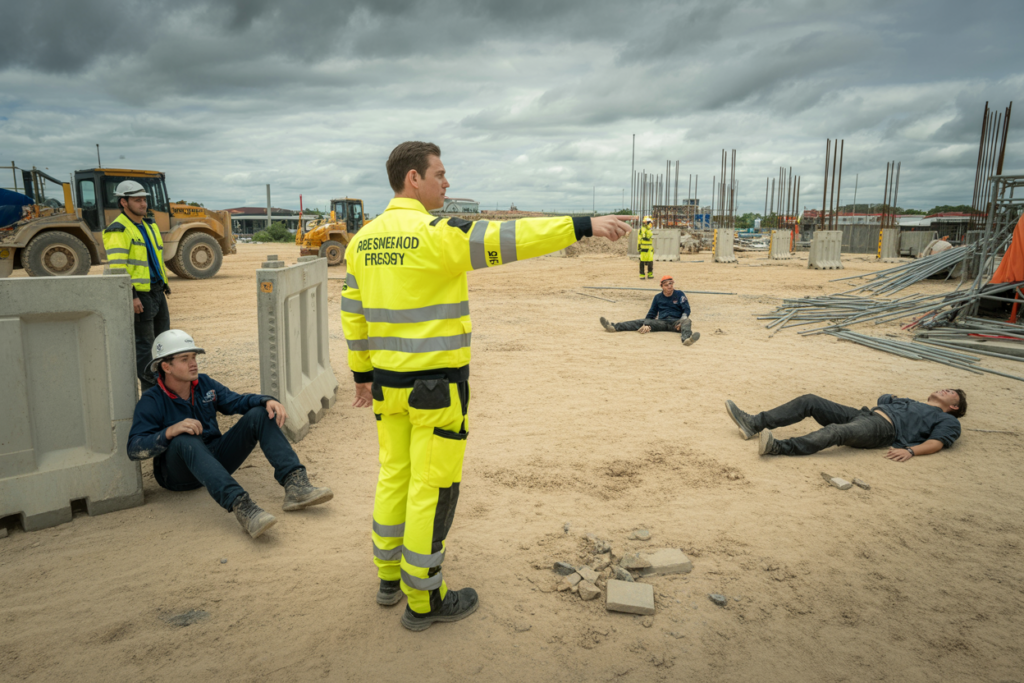
What Separates Advanced First Aid Emergency Management From Standard First Aid
The gap between HLTAID011 and HLTAID014 isn’t just a few extra units on a training register. It’s the difference between knowing how to help one person and knowing how to manage a scene where multiple people need help simultaneously — while an ambulance is still a long way away.
The Clinical Gap Between HLTAID011 and HLTAID014
HLTAID011 covers single-casualty basic life support — CPR, AED use, managing common medical emergencies, applying dressings. It’s solid, and it’s what most workers on a Queensland site will hold. But HLTAID014 is a different level of training entirely. Where HLTAID011 stops at the individual patient, HLTAID014 adds multi-casualty management, START triage protocols, extended patient assessment, scene coordination, advanced airway management, haemorrhage control, spinal immobilisation, and shock management across three distinct clinical presentations. That’s a fundamentally different scope of practice.
Why the Difference Matters on a Queensland Worksite
Construction accounts for 23% of all serious workplace injuries in Queensland despite representing 9% of the workforce. (Safe Work Australia, 2024)
On a live construction or civil infrastructure site, single-casualty incidents are the exception. A scaffolding collapse, a vehicle incident, an excavator rollover — these events routinely produce multiple casualties. The person running your site’s emergency response in those first minutes needs more than HLTAID011 can deliver. For outer Brisbane suburbs and regional Queensland sites, QAS response times can be significant, which means your designated first aid officer is managing patients for a long time before paramedics arrive.
💡 Pro Tip: If you're a site supervisor or WHS officer currently holding HLTAID011 — check your role description. There's a good chance your WHS management plan or insurance policy requires HLTAID014 at your level. A lot of supervisors don't find this out until an audit.
What a Genuinely Advanced Course Looks Like in Practice
Some RTOs take their HLTAID011 delivery, add one multi-casualty scenario, and issue HLTAID014 certificates. The paperwork looks identical. The training absolutely isn’t. A genuine HLTAID014 course means scenario-based delivery rather than PowerPoint slides, clinical-grade equipment in the room, instructors with real pre-hospital or critical care backgrounds, and at minimum one full mass casualty scenario requiring START triage, patient prioritisation, and scene coordination under pressure. You can verify any RTO’s scope of registration on training.gov.au. If a provider can’t tell you exactly what equipment is in the room on course day, that’s a red flag.
| Feature | HLTAID011 | HLTAID014 |
|---|---|---|
| Casualties managed | Single | Multiple |
| Triage protocols | Not included | START triage |
| Airway management | Basic BLS | Adjuncts included |
| Shock management | Basic | Hypovolaemic, anaphylactic, cardiogenic |
| Spinal immobilisation | Not included | Included |
| Scene coordination | Not included | Included |
| Renewal frequency | 3 years | 3 years (CPR annually) |
| Supersedes | HLTAID003 | HLTAID006 |
The Core Competencies of HLTAID014 — What You’ll Actually Learn
Here’s a plain-language breakdown of every major competency in HLTAID014 and what each one looks like when it matters on a real Queensland worksite.
START Triage: Managing Multiple Casualties on a Worksite
START triage — Simple Triage and Rapid Treatment — is the decision framework for sorting multiple casualties by severity when resources are limited and time is short. On a worksite, you arrive at a structural collapse with four workers down — one walking and disoriented, two on the ground, one trapped and unresponsive. One other trained responder with you. Ambulance a long way out. Without START triage, you’re guessing. With it, you’re working a system.
The algorithm assigns each casualty to one of four categories — Immediate (Red), Delayed (Yellow), Minor (Green), or Deceased/Expectant (Black) — based on respirations, perfusion, and mental status. The hard part isn’t the algorithm. It’s making the call to move past a black-tagged casualty when red-tagged patients are still waiting. That’s what scenario-based HLTAID014 training prepares you for.
Primary and Secondary Patient Surveys
The primary survey follows the DRSABCD framework through to a rapid head-to-toe check for life-threatening conditions — catastrophic haemorrhage, airway obstruction, absent breathing, circulatory compromise — identified and managed in order before anything else. The secondary survey comes once the patient is stabilised, covering a more thorough systematic assessment from head to back looking for injuries that aren’t immediately obvious but could deteriorate. A worker who takes a hit from a falling object might look okay at first glance. The secondary survey is what catches internal trauma before it becomes a fatality.
Haemorrhage Control and Shock Management
Uncontrolled haemorrhage is the leading cause of preventable death in trauma. On a construction site, serious bleeding injuries are a genuine daily risk. HLTAID014 goes well beyond “apply pressure and wait,” covering tourniquet application, wound packing using haemostatic gauze, and pressure dressings for wounds requiring sustained controlled pressure. Shock management runs alongside — HLTAID014 covers hypovolemic shock from blood or fluid loss, anaphylactic shock from severe allergic reaction, and cardiogenic shock from cardiac events.
⚠️ Queensland Compliance Alert: Haemorrhage control equipment — including tourniquets and haemostatic dressings — should be listed in your site's first aid kit requirements under your WHS management plan. If it isn't, review this before your next audit.
Airway Management, Spinal Immobilisation, and Complex Anaphylaxis
HLTAID014 covers airway adjuncts — oropharyngeal and nasopharyngeal airways — that maintain a patent airway when basic positioning isn’t enough, taught to Australian Resuscitation Council standards. Any worksite incident involving a fall from height, vehicle collision, or crush injury carries spinal injury risk until proven otherwise, and HLTAID014 covers manual in-line stabilisation technique and communicating the injury mechanism to QAS on handover. For anaphylaxis, training goes beyond the basics to cover complex presentations, biphasic reactions, and the worksite-specific triggers — bee stings, outdoor allergens — that catch sites off guard.
Queensland Workplace First Aid Requirements 2026 — What the Law Actually Requires
The regulatory landscape around first aid officer requirements is more layered than it looks. The legal minimum isn’t always what your insurer requires. And what your insurer requires isn’t always what a state government tender pre-qualification demands.
Safe Work Australia Code of Practice and Queensland Requirements
Safe Work Australia’s Code of Practice: First Aid in the Workplace is the foundation document setting out employer obligations — providing equipment appropriate to the hazards present, ensuring adequate numbers of qualified first aiders, and reviewing arrangements whenever the nature of work changes significantly. For construction, civil infrastructure, and mining, the compliance bar is higher than most employers assume. Higher first aider ratios are expected, HLTAID014 is the expected qualification for designated first aid officers on high-risk sites, and remote or isolated work triggers additional requirements. WorkSafe Queensland has the authority to issue improvement notices and infringement penalties where first aid arrangements are found inadequate.
Certificate Currency: The 3-Year Rule and Annual CPR Requirement
| Qualification | Renewal Frequency | Notes |
|---|---|---|
| HLTAID014 (Provide Advanced First Aid) | Every 3 years | Full requalification required |
| HLTAID011 (Provide First Aid) | Every 3 years | Full requalification required |
| HLTAID009 (Provide CPR) | Annually | Required for all first aid certificate holders |
The annual CPR renewal catches people out more than the three-year cycle does. HLTAID009 needs to be renewed every twelve months as a standalone requirement — an HLTAID014 certificate that’s current but backed by an expired HLTAID009 is a compliance problem waiting to be found. Lapsed certificates produce three specific consequences: WorkSafe investigation exposure, tender pre-qualification failure, and insurance premium impact. None of them are minor.
Building a Site-Wide Emergency Management Framework — Beyond Your Own Certificate
Your HLTAID014 is one person’s qualification. On a rotating crew across multiple active projects, one qualified person is a single point of failure.
Mapping Coverage and Setting the Training Standard
The most common first aid coverage gap on Queensland construction sites isn’t a lapsed certificate — it’s a shift change. A site might have HLTAID014-qualified officers on paper who all work day shift. The afternoon crew — same site, same hazards, same plant — has nobody. That’s not a compliant site. It’s a compliant day shift. Mapping coverage properly means going through every shift, every crew rotation, and every subcontractor movement and asking: who is the qualified first responder on this site, right now?
| Role | Minimum Qualification | Renewal Frequency |
|---|---|---|
| Site Supervisor / WHS Officer | HLTAID014 | 3 years (CPR annually) |
| Team Leader / Foreperson | HLTAID011 | 3 years (CPR annually) |
| All Other Workers | HLTAID009 | Annually |
| Remote / FIFO Workers | HLTAID011 minimum | 3 years (CPR annually) |
| Principal Contractor Rep | HLTAID014 | 3 years (CPR annually) |
This matrix distributes first aid capability so coverage doesn’t depend on one person being present — and gives you a defensible, documented training standard to show an auditor or insurer.
The Site First Aid Register and On-Site Group Training
A training register that lives in a spreadsheet no one’s updated is not a register. It’s a liability. A genuine register tracks each designated officer’s full name, qualification held with unit code, the RTO name and number that issued it, date of issue, expiry date, annual CPR renewal date tracked separately, site assignment, shift coverage, and a renewal reminder at 90 days before expiry.
When multiple officers are due for renewal, on-site group training makes operational sense — no travel time, scenarios built around your actual worksite hazards, scheduling that fits your project calendar, and same-day digital certificates for every participant.

How to Choose the Right HLTAID014 Provider in Brisbane — What to Actually Check
There are a lot of RTOs offering HLTAID014. Some are excellent. Some are delivering HLTAID011 content with HLTAID014 paperwork and hoping nobody checks.
Instructor Credentials and Course Equipment
The trainer at the front of the room is the single biggest variable in whether you get genuinely advanced training or a tick-and-flick exercise. A generic “first aid trainer” can legally deliver HLTAID014 — but they’ve never run a resuscitation in a real emergency, never managed a multi-casualty scene, never made the call to black-tag a patient. An ex-paramedic, ICU nurse, or military medic is teaching from experience. The depth of what gets communicated in the room is completely different. Ask directly: what is your lead trainer’s clinical background? A genuine HLTAID014 course also has clinical-grade AEDs, airway adjuncts, tourniquets and haemostatic dressings, spinal stabilisation equipment, and realistic multi-casualty simulation setups in the room. Ask for the equipment list before you book.
RTO Verification and Certificate Accuracy
Every RTO has a registration number and a scope listing which qualifications they’re registered to deliver. Verify both on training.gov.au. If a provider is issuing HLTAID014 certificates but isn’t registered to deliver it, those certificates won’t hold up in a WorkSafe investigation or satisfy a tender pre-qualification. The unit code HLTAID014 should also be printed on the certificate itself — not just “Advanced First Aid” or “Level 3 First Aid.” That unit code is what auditors, insurers, and tender assessors verify.
| What to Check | Why It Matters | How to Verify |
|---|---|---|
| RTO registration number | Confirms legal registration to deliver nationally recognised training | training.gov.au |
| HLTAID014 in scope of registration | Confirms registration for this specific qualification | training.gov.au |
| Trainer clinical background | Determines depth and quality of advanced content | Ask directly |
| Equipment list | Signals whether advanced content is taught hands-on | Request before booking |
| Same-day certificate delivery | Required for compliance deadline situations | Ask before booking |
| Certificate format — unit code printed | Required for audit, tender, and insurance evidence | Ask to see a sample |
Book Your HLTAID014 Course — Next Available Weekend Date in Brisbane
Your Advanced First Aid certificate is either current or it isn’t. There’s no grey area in a WorkSafe investigation, a tender pre-qualification, or an insurance audit — and there’s no grace period once a lapsed certificate shows up on a compliance register. If your HLTAID014 is within 90 days of expiry, or already lapsed, act now rather than when a deadline forces your hand.
Every course we run is delivered by practicing paramedics and ICU nurses. Your certificate is issued on the day with the HLTAID014 unit code printed clearly — no waiting, no paperwork errors, no chasing a certificate that doesn’t arrive before your submission deadline. A tax invoice with our ABN and RTO number is generated automatically. Weekend courses mean you’re not burning annual leave or pulling yourself off site.
If you’re not ready to book today, check your expiry date, download the free Queensland Site First Aid Register Template to get your team’s currency documented, and check available Brisbane weekend dates on the booking page — no account required. Training four or more? Submit the group enquiry form for a same-day quote.
Book Your First Aid Training Now
Fast, affordable, and nationally accredited training delivered by professionals who care
Frequently Asked Questions
Q.What is the difference between HLTAID011 and HLTAID014?
HLTAID011 covers single-casualty basic life support — CPR, AED use, and common medical emergencies. HLTAID014 goes significantly further, adding multi-casualty management, START triage, extended patient assessment, haemorrhage control, shock management across three clinical presentations, airway adjuncts, spinal immobilisation, and full scene coordination. For site supervisors and WHS officers on high-risk Queensland worksites, HLTAID014 is the expected qualification — not HLTAID011.
Q.How often does HLTAID014 need to be renewed?
HLTAID014 must be renewed every 3 years, but the CPR component — HLTAID009 — must be renewed annually as a separate standalone requirement. This is the part that catches most people out. A current HLTAID014 certificate backed by an expired HLTAID009 is a compliance gap that will show up in an audit, so both need to be tracked separately in your site first aid register.
Q.What does HLTAID014 supersede?
HLTAID014 supersedes HLTAID006 (Provide Advanced First Aid) under the current HLT training package. If your certificate still shows HLTAID006, it isn't just expired — it's from a superseded training package version entirely, and renewal into HLTAID014 is required to hold a current, nationally recognised Advanced First Aid qualification.
Making first aid training more affordable for
every classroom
We believe every student deserves access to life-saving first aid knowledge. That’s why we offer specially reduced pricing for schools and educational groups. Whether you’re booking for a single class, a year group, or your entire school, our flexible packages make training more accessible and cost-effective — without compromising quality.
