
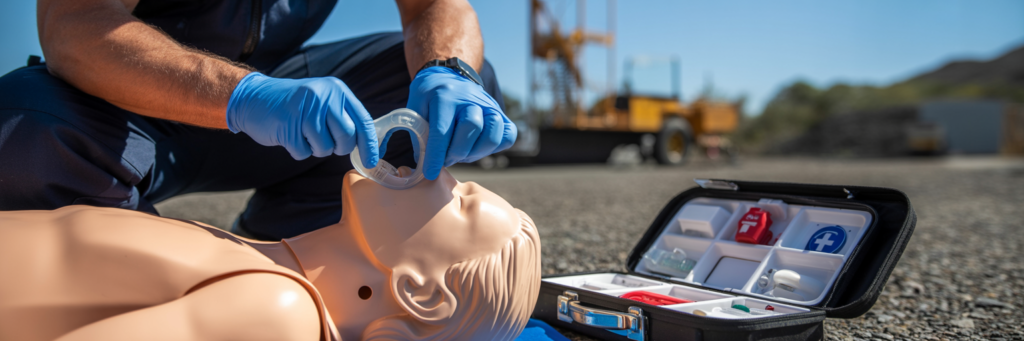
When you’re 280 kilometres from the nearest hospital and a worker goes down with a crush injury, your basic first aid certificate isn’t going to cut it. For remote site supervisors, FIFO workers, and outdoor professionals across Queensland, that nightmare scenario isn’t hypothetical—it’s a daily possibility that demands proper preparation.
I’ve spoken with dozens of site supervisors over the years, and they all say the same thing: lying awake at night imagining what they’d do if someone on their crew had a serious medical emergency. Because when you’re responsible for 15, 20, maybe 30 workers on a site where the ambulance is 90+ minutes away, you need more than just the basics.
Advanced first aid emergency protocols form the critical difference between managing a life-threatening situation confidently and watching helplessly as someone’s condition deteriorates while waiting for help. Unlike basic first aid—which is basically about stabilising someone and handing them over to paramedics—advanced protocols equip you to provide extended care, manage complex trauma, and make critical decisions when you’re the only qualified responder for hours.
This guide breaks down the advanced first aid procedures every remote worker needs to master. We’re talking controlling severe haemorrhage, managing airways in unconscious casualties, coordinating multi-casualty incidents, and providing cardiac emergency care in isolated environments. Whether you’re preparing for HLTAID014 certification or refreshing your skills, you’ll discover the proven protocols that save lives when professional medical help is beyond reach.
What Are Advanced First Aid Emergency Protocols?
Advanced first aid emergency protocols are systematic procedures for managing life-threatening medical emergencies when professional help is delayed or unavailable. These protocols extend way beyond basic first aid by addressing complex trauma, extended patient care, and multi-casualty incidents you’re likely to face on remote worksites.
Here’s what separates advanced protocols from basic first aid:
- Advanced airway management – Maintaining breathing in unconscious casualties using techniques beyond basic positioning
- Severe haemorrhage control – Managing life-threatening bleeding beyond basic pressure application
- Cardiac emergency response – Extended CPR protocols and defibrillator use for prolonged situations
- Trauma assessment systems – Primary and secondary survey methodologies for multiple injuries
- Extended casualty care – Monitoring and managing patients for extended periods until medical transfer
- Multi-casualty triage – Prioritising treatment when you’ve got limited resources and multiple casualties
These protocols are absolutely necessary for remote workers, FIFO personnel, and workplace first aid officers operating in isolated environments where emergency response times exceed 30 minutes. In Queensland, that’s a reality for thousands of workers every single day.
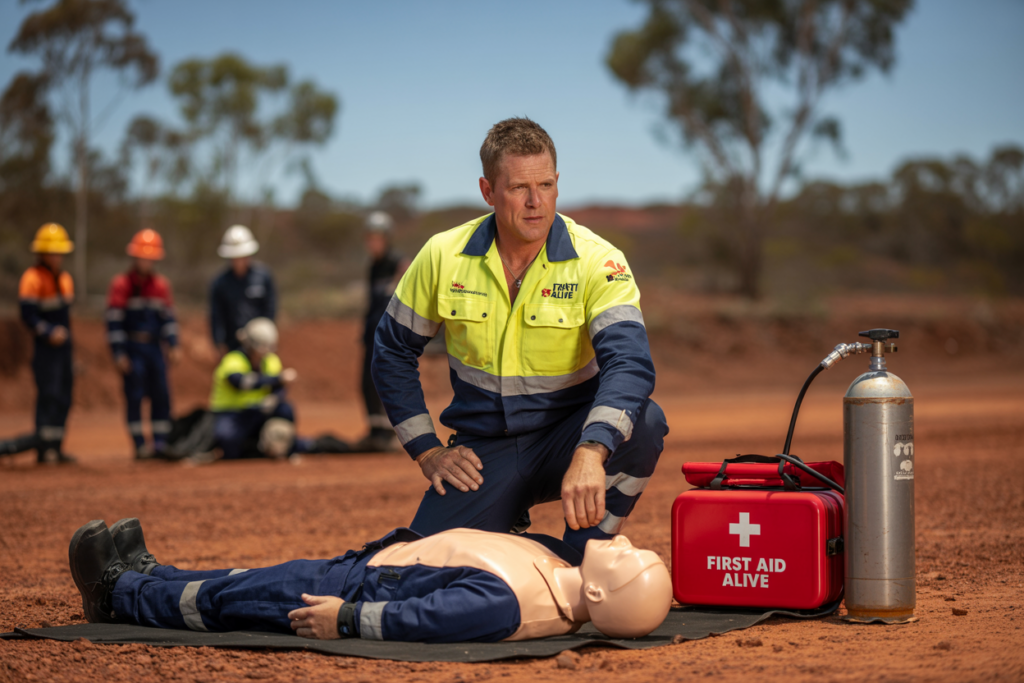
Understanding Advanced First Aid Emergency Protocols vs. Basic First Aid
Most blokes working remote sites have done basic first aid at some point. But here’s the thing—basic first aid is designed for urban environments where paramedics are minutes away. When you’re 200+ kilometres from the nearest hospital, that training falls dangerously short.
Core Differences in Response Scope
The biggest difference between basic and advanced first aid emergency protocols comes down to time and complexity. Basic first aid teaches you to stabilise someone and hand them over to professionals within a short timeframe. Advanced protocols prepare you for extended care—30 minutes to 2+ hours of managing a casualty. That’s a completely different ballgame.
| Aspect | Basic First Aid | Advanced First Aid |
|---|---|---|
| Response Timeframe | Short-term stabilisation | Extended care up to 2+ hours |
| Casualty Assessment | Single primary survey | Multiple reassessments and detailed secondary survey |
| Intervention Complexity | Basic wound care, basic CPR | Advanced haemorrhage control, extended resuscitation |
| Equipment Used | Standard first aid kit | Oxygen therapy, advanced airway devices, trauma supplies |
| Scope of Practice | Stabilisation only | Extended monitoring and clinical decision-making |
Average emergency response times tell the whole story. In metro areas, you’re looking at quick ambulance response. Out in regional Queensland? Try 45-120+ minutes. For FIFO sites in remote areas, you might be waiting for Royal Flying Doctor Service, which can take even longer depending on weather and aircraft availability.
When Advanced Protocols Become Critical
Remote Site Scenarios Requiring Advanced Protocols:
- Severe trauma with prolonged extrication time
- Cardiac arrest requiring extended resuscitation
- Unconscious casualties with airway compromise
- Severe haemorrhage from major vessels
- Multi-casualty incidents requiring triage decisions
- Crush injuries with extended rescue operations
- Environmental emergencies like heat stroke or hypothermia
- Respiratory emergencies in confined spaces
- Anaphylaxis in locations where transport is delayed
- Spinal injuries requiring extended immobilization
If you’re working more than 30 minutes from definitive medical care and responsible for other workers, advanced first aid emergency protocols aren’t optional—they’re absolutely necessary for doing your job safely and legally.
Primary Survey Protocol – The Critical First 60 Seconds
When something goes wrong on a remote site, the first 60 seconds determine everything. Your primary survey is a systematic approach ensuring you’re identifying life-threatening conditions in the right order.
The DR ABC Systematic Approach
Step 1 – DANGER:
Assess scene safety before touching a casualty. Is machinery locked out? Are there overhead hazards? Unstable ground? Chemical exposures? You can’t help anyone if you become a casualty yourself. Check for secondary hazards—fuel spills, pressurized systems, structural instability.
Step 2 – RESPONSE:
Use the AVPU scale: Alert, Voice, Pain, or Unresponsive. Call out clearly: “Can you hear me? What’s your name?” If no response, try a firm shoulder squeeze. Document what level they’re at because changes in consciousness are massive red flags.
Step 3 – AIRWAY:
If they’re talking, their airway is patent. If unconscious, check and secure it immediately. Use head-tilt chin-lift for casualties without suspected spinal injury. For suspected spinal injury, use jaw-thrust technique. Check for foreign bodies, blood, vomit. If unconscious but breathing normally, use recovery position (unless spinal injury suspected).
Step 4 – BREATHING:
Look, listen, and feel for breathing. Watch chest rise, listen for breath sounds, feel for air movement. Normal breathing is 12-20 breaths per minute. Noisy breathing—stridor, gurgling, snoring—indicates partial airway obstruction.
Step 5 – CIRCULATION:
Check pulse at carotid artery (neck) for unconscious casualties, or radial pulse (wrist) for conscious ones. Scan for major bleeding. Check skin color and temperature—pale, cool, clammy skin indicates shock. Test capillary refill by pressing a fingernail—color should return within 2 seconds.
Critical Decision Points in Remote Settings
When do you call for evacuation? Immediately—as soon as the primary survey identifies a life-threatening condition. Get that RFDS or ambulance rolling now because response time means they’re on the way for extended periods.
Do you move the casualty or wait? Generally, don’t move casualties unless there’s immediate danger. Moving someone with spinal injuries or internal bleeding can cause massive harm. If staying means death, you move—carefully.
Advanced Airway Management in Unconscious Casualties
Airway problems kill faster than bleeding. You’ve got maybe 3-4 minutes before brain damage starts. In remote locations where help is 90+ minutes away, your ability to recognize and manage airway compromise is absolutely critical.
Recognizing Airway Compromise
Partial obstruction makes noise: stridor (high-pitched whistling), gurgling (fluid or blood in throat), or snoring (tongue fallen back). Complete obstruction is silent—the most dangerous sign. The casualty can’t move air at all and you’ve got seconds to act.
Advanced Airway Opening Techniques
Oropharyngeal Airway (OPA):
This curved plastic device holds the tongue forward and keeps the airway open in unconscious casualties. Size it properly from corner of mouth to angle of jaw. Insert using the rotate method—upside down initially, then rotate 180°. Confirm placement and monitor continuously.
Nasopharyngeal Airway (NPA):
This softer tube goes through the nose into the back of the throat. Better tolerated by semi-conscious casualties. NEVER use if there’s suspected skull fracture or severe facial trauma. Insert straight back along the floor of the nose, NOT upward.
Managing Vomiting and Aspiration Risk
Unconscious casualties vomit. Recovery position is non-negotiable for unconscious breathing casualties without suspected spinal injury. On remote worksites with rough terrain or uneven ground, adapt while maintaining principles—casualty on their side, head dependent so fluids drain out, airway monitored constantly.
If you’ve got suction equipment, use it. When they start vomiting, turn them, suction, clear the airway, reassess breathing. Document everything for handover to paramedics.
Severe Haemorrhage Control and Shock Management
Uncontrolled bleeding kills fast. On a remote site where the nearest surgical capability is 200+ kilometres away, your ability to control severe haemorrhage is literally the difference between life and death.
The Haemorrhage Control Hierarchy
Step 1: Direct Pressure – Press HARD directly on the wound. Don’t peek—that breaks the forming clot. Maintain continuous pressure.
Step 2: Pressure + Elevation + Pressure Points – Add elevation above heart level. Add pressure point compression upstream of the wound.
Step 3: Haemostatic Dressing Application – Pack specialized dressings directly into the wound, then maintain pressure.
Step 4: Tourniquet Application – For uncontrolled limb bleeding that’s going to kill the casualty.
Step 5: Shock Management Priority – For suspected internal bleeding you can’t control.
Tourniquet Application in Remote Settings
Expose the limb completely. Place 5-7cm above the wound, never over a joint. Tighten until bleeding stops completely—not just reduced, STOPPED. Mark the time on the tourniquet AND casualty’s forehead. Do NOT remove or loosen it. Document everything.
Cardiac Emergency Response and Extended CPR Protocols
Cardiac emergencies on remote sites mean potentially performing CPR for extended periods until evacuation arrives. Extended resuscitation requires different decision-making, team coordination, and mental preparation.
Recognizing Cardiac Events
Heart Attack (Conscious): Chest pain/pressure/tightness, pain radiating to jaw/arm/back, shortness of breath, nausea, sweating, dizziness, anxiety.
Cardiac Arrest (Unconscious): Sudden collapse, completely unresponsive, no normal breathing, no pulse at carotid artery, skin rapidly becomes pale or blue.
Extended CPR When Help is Hours Away
Initial Response: Activate emergency services immediately. Begin CPR at 30:2 ratio. Apply AED as soon as possible. Assign roles if multiple responders available. Compression rate is 100-120 per minute. Push HARD 5-6cm depth. Let chest fully recoil between compressions.
Extended Period Management: Rotate CPR providers every 2 minutes. Continue AED rhythm analysis every 2 minutes. Document everything. Update emergency services with ongoing status.
Extended Resuscitation Decisions: Continue when arrest was witnessed, CPR started quickly, AED shows shockable rhythm, or special circumstances exist. Consider ceasing with obvious death indicators, unwitnessed arrest with unknown downtime, prolonged non-shockable rhythm, or extreme environmental hazards.
AED Operation
Expose chest completely. Dry if wet or sweaty. Remove medication patches. Place pads exactly as diagram shows. Ensure everyone clear during analysis AND shock. Resume CPR immediately after shock. Follow voice prompts.
Managing Heart Attack Without Arrest
Call 000 immediately. Position comfortably—usually sitting or semi-reclined. Loosen tight clothing. Give 300mg aspirin (chewed) if conscious and not allergic. Monitor continuously. Prepare for potential cardiac arrest. Keep them calm.
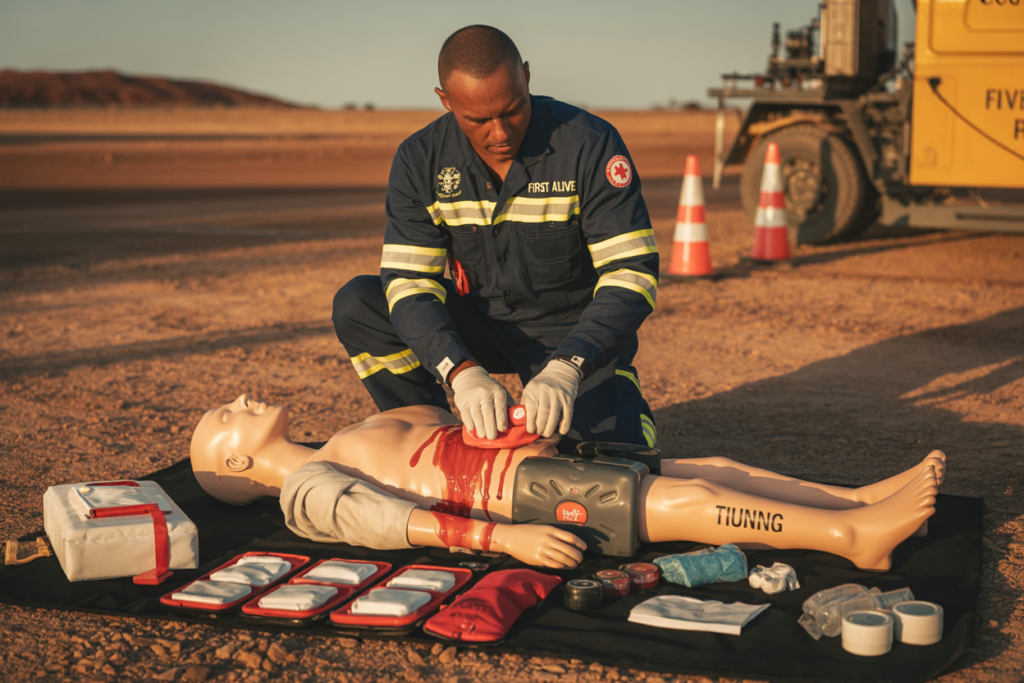
Multi-Casualty Incident Triage and Management
Multiple casualties? Your brain wants to help everyone at once, but you can’t. Multi-casualty triage protocols force you to make calculated decisions about who gets treatment first.
The Triage Mindset
Triage fundamentally changes how you approach first aid. You’re managing a system, doing the greatest good for the greatest number. That’s emotionally brutal on remote sites where you probably know these casualties personally.
The START Triage System
Can they walk? YES → MINOR (Green Tag). NO → Continue assessment.
Are they breathing? NO → Open airway. Now breathing? → IMMEDIATE (Red Tag). Still not breathing → DECEASED (Black Tag). YES → Check breathing rate.
Breathing less than 30 per minute? NO (more than 30) → IMMEDIATE (Red Tag). YES → Check circulation.
Capillary refill under 2 seconds? MORE THAN 2 seconds → IMMEDIATE (Red Tag). LESS THAN 2 seconds → Check mental status.
Can they follow simple commands? CAN’T FOLLOW → IMMEDIATE (Red Tag). FOLLOWS COMMANDS → DELAYED (Yellow Tag).
Category Definitions:
- RED (Immediate): Life-threatening, survivable with intervention
- YELLOW (Delayed): Serious but stable
- GREEN (Minor): Walking wounded
- BLACK (Deceased): Dead or non-survivable
Coordination
Scene Commander handles overall coordination, communication, triage decisions, and scene safety. Treatment Leader manages red-tag casualties. Walking Wounded Supervisor monitors delayed casualties. If you’ve only got one or two responders, combine roles.
Communication Protocols and Medical Handover
You can do everything right with casualty care, but if you can’t communicate effectively with emergency services, it all falls apart.
Effective Triple-Zero (000) Communication
Use the IMIST handover format:
I – Identification: Your name and role, exact location with GPS coordinates, number of casualties, type of incident.
M – Mechanism: What happened, forces involved, time of incident.
I – Injuries: Obvious injuries, triage category if multi-casualty, conscious state.
S – Signs & Vital Signs: Breathing rate and quality, pulse rate and strength, skin color and temperature.
T – Treatment: Interventions performed, casualty response, ongoing care.
Conclusion: Your Next Step Toward Genuine Emergency Preparedness
Advanced first aid emergency protocols aren’t just another compliance box to tick—they’re the difference between confident competence and dangerous uncertainty when someone’s life is in your hands.
Every remote worker, FIFO supervisor, and outdoor professional across Queensland faces the same reality: you’re potentially managing life-threatening emergencies for extended periods before professional help arrives. Basic first aid won’t cut it. You need extended care protocols, decision-making frameworks, and hands-on practice with the equipment and techniques that save lives in isolated locations.
The protocols covered in this guide—primary survey sequences, advanced airway management, severe haemorrhage control, extended CPR, multi-casualty triage, and proper medical handover—form the foundation of HLTAID014 Advanced First Aid certification. But reading about them isn’t the same as practicing them. You need hands-on training from instructors who’ve actually worked remote emergencies.
If you’re responsible for worker safety on remote sites, if you’re the designated first aid officer, or if you’re just someone who takes their duty of care seriously, proper advanced first aid training is non-negotiable. The next emergency won’t wait until you’re ready.
Book Your First Aid Training Now
Fast, affordable, and nationally accredited training delivered by professionals who care
Frequently Asked Questions
Q.What's the difference between HLTAID014 and basic first aid?
HLTAID014 (Advanced First Aid) covers everything in basic first aid plus extended care protocols for managing casualties over longer periods. You'll learn advanced airway management, tourniquet application, extended CPR techniques, multi-casualty triage, and how to manage emergencies when help is delayed for hours. Basic first aid assumes quick handover to paramedics, while advanced training prepares you for remote environments where you're the primary responder for extended timeframes.
Q.Do I need HLTAID014 if I work on remote sites?
If you're designated as a first aid officer on a remote site where emergency response times exceed 30 minutes, HLTAID014 is typically the minimum requirement under WHS legislation. WorkCover audits specifically check that your qualifications match the site risk assessment, and basic first aid generally isn't sufficient for remote work environments. Most mining, construction, and FIFO operations require advanced certification for anyone responsible for workplace first aid.
Q.How long does HLTAID014 certification last?
HLTAID014 certification is valid for three years from issue date, but CPR components require annual refresher training to maintain workplace compliance. Most employers in high-risk industries require annual refreshers regardless of certification validity to ensure your skills stay current. It's recommended to book renewal training well before expiry to avoid work access issues since expired certificates don't meet workplace requirements.
Q.What if my certificate expires and I need to renew?
HLTAID014 renewal courses are shorter than initial certification since you're demonstrating competency rather than learning from scratch. You'll refresh key protocols and update knowledge on any guideline changes. Book renewal training before expiry to avoid gaps in certification, as many sites won't allow you to work as a first aid officer with an expired certificate even if it's only expired by a few days.
Making first aid training more affordable for
every classroom
We believe every student deserves access to life-saving first aid knowledge. That’s why we offer specially reduced pricing for schools and educational groups. Whether you’re booking for a single class, a year group, or your entire school, our flexible packages make training more accessible and cost-effective — without compromising quality.
