

Your HLTAID014 is expiring soon. You know it, your project manager knows it, and your insurer definitely knows it. So you do what any organised site supervisor does — you open a browser, search for options, and within thirty seconds you’re staring at a fork in the road.
On one side: online courses promising same-day completion and slick marketing. On the other: face-to-face courses that want a full day out of your schedule. Both claim to deliver the same qualification. So which one actually holds up when WorkSafe Queensland comes knocking?
The answer depends on what your employer requires, what your site’s insurance policy specifies, and — most importantly — what the HLTAID014 unit of competency mandates under Australian Skills Quality Authority (ASQA) guidelines. Not what the provider claims. What the regulation actually says.
In this article, we break down what online and face-to-face advanced first aid delivery can and cannot legally include, how each format performs under a real compliance audit, and why construction, mining, and infrastructure sectors almost universally require in-person assessment.
Online vs Face-to-Face First Aid Training: Key Differences
Online and face-to-face first aid training differ significantly in how skills are taught, assessed, and recognised by Australian employers and regulators.
Online first aid training:
- Delivers theory components through self-paced digital modules
- Cannot legally include hands-on clinical skills assessment
- Is accepted for knowledge-based units only under ASQA guidelines
- Typically suits lower-level qualifications such as HLTAID009 (CPR) and HLTAID011 (Provide First Aid)
Face-to-face first aid training:
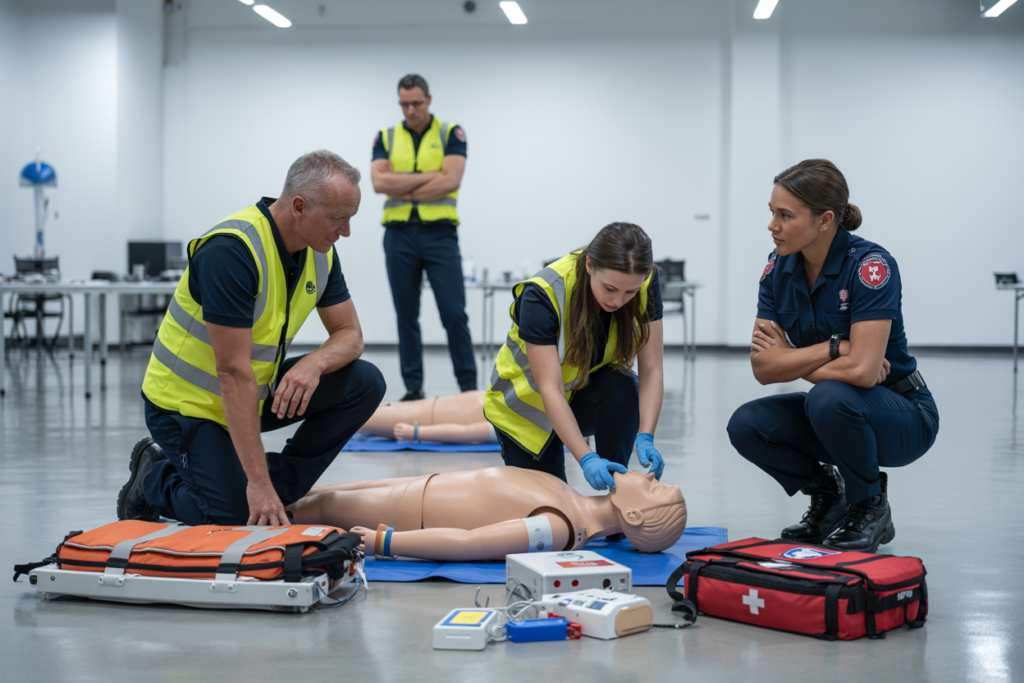
- Includes supervised practical assessment of clinical skills
- Meets the mandatory hands-on requirements of HLTAID014
- Allows trainers to correct technique in real time
- Is required by most Queensland workplace insurance policies and WorkSafe compliance frameworks
For HLTAID014 specifically, Australian training regulations require a face-to-face practical assessment component. Online-only completion does not satisfy this requirement.

1. What HLTAID014 Actually Requires — And Why Delivery Mode Matters
Before you book anything, you need to understand what the HLTAID014 unit of competency actually demands. Because a lot of what gets marketed as “Advanced First Aid” online doesn’t come close to meeting it.
The ASQA Training Package Requirements for HLTAID014
HLTAID014 sits within the HLT Health Training Package — a nationally recognised framework governed by ASQA. The rules aren’t set by individual providers. They’re set at a federal level, and every registered training organisation (RTO) is legally obligated to follow them.
The unit requires demonstrated practical performance evidence. Not a knowledge quiz. Not a multiple choice assessment at the end of a module. Actual demonstrated performance — meaning someone with appropriate credentials has to watch you perform the skill and confirm you can do it to the required standard.
ASQA’s Standards for RTOs 2015 are explicit: practical skills must be assessed in a “simulated or real workplace environment.” A screen cannot replicate that. A video of someone applying a tourniquet correctly does not prove you can apply one. A certificate issued without a practical component doesn’t prove competency — it proves you completed some modules. Read the full HLTAID014 unit of competency on training.gov.au.
What “Blended Delivery” Actually Means
Blended delivery means combining online theory with a face-to-face practical component. Done properly, it’s legitimate — the student completes theory modules at home, arrives at the practical day already familiar with triage frameworks and assessment protocols, and the face-to-face session focuses on skills and assessment.
The problem is that “blended” has become a marketing word. Some providers advertise HLTAID014 as “available online” and bury the mandatory face-to-face requirement in the fine print. If the provider is actually compliant, there’s a practical day somewhere. If there isn’t, that’s a serious compliance problem.
⚠️ Watch the fine print. If an HLTAID014 provider doesn't clearly state when and where the face-to-face practical assessment takes place, that's a red flag — not a convenience feature.
Why This Matters for Queensland Workplaces Specifically
Queensland’s Work Health and Safety Act 2011 places a clear obligation on employers and nominated officers to hold current, compliant qualifications. WorkSafe Queensland audits don’t just check certificate currency — they check RTO registration status and whether the delivery method was compliant with ASQA standards at the time of issue. They identify certificates from providers operating outside their scope of registration. A certificate that can’t withstand that scrutiny isn’t worth the PDF it’s printed on.
For site supervisors in construction, civil infrastructure, and mining services — where WorkSafe audit activity has increased markedly — this isn’t theoretical. It’s an operational risk.
2. The Case For Online Learning — Where It Legitimately Fits
Dismissing online delivery entirely would be lazy. There are genuine, legitimate uses for it in the first aid training space.
Theory Pre-Learning and Its Genuine Benefits
When online is the theory component of a properly structured blended course — not the entire qualification — it adds real value. A student who has worked through triage frameworks, medication administration theory, and patient assessment protocols before the practical day asks better questions and moves through scenarios faster.
That’s genuinely useful for shift workers and FIFO workers who can’t block out weekday study time. Working through theory modules after a site shift, then showing up on course day ready to practice skills rather than absorb information — that’s blended delivery done properly. Online pre-learning that feeds into a face-to-face practical assessment is a feature. Online completion that replaces it is a compliance failure.
Which First Aid Qualifications Can Be Completed Fully Online
There are qualifications where online-only delivery is more appropriate:
- HLTAID009 (CPR) — though even here, current standards include a practical component requirement
- Lower-level refresher theory components for workers maintaining existing qualifications
- First aid awareness modules for non-designated responders who need general awareness but aren’t the nominated site first aid officer
The further up the qualification pathway you go — from HLTAID009 through HLTAID011 and into HLTAID014 — the more hands-on practical assessment becomes non-negotiable. The skills get more advanced, the scenarios more complex, and the margin for undetected errors in technique gets a lot more dangerous.
Red Flags When Evaluating Online First Aid Providers
Before you book anything, check for these warning signs:
- No RTO number displayed on the website — every legitimate provider has one and it should be easy to find
- Certificate issued within minutes of completing online modules — HLTAID014 cannot be legitimately assessed in a single online session
- No scheduled face-to-face assessment date — if there’s no practical day, there’s no compliant HLTAID014
- No trainer credentials listed — a compliant provider is proud of their instructors’ backgrounds; vague descriptions are a warning sign
If a provider ticks two or more of those boxes, move on.
3. Face-to-Face Advanced First Aid — What a Quality Course Actually Looks Like
Knowing that face-to-face is the only compliant delivery method is one thing. Knowing what separates a genuinely advanced course from a padded-out HLTAID011 with an extra scenario bolted on — that’s what matters when you’re evaluating providers.
Not all face-to-face courses are equal. Some providers deliver exactly what the unit requires. Others deliver the legal minimum and call it advanced training. You can tell the difference the moment you walk in the room.
The Clinical Skills You Cannot Learn From a Screen
These are skills that require hands-on repetition and real-time trainer correction. A screen cannot tell you your technique is off. An instructor can.
A properly delivered HLTAID014 course covers:
- Primary and secondary patient survey techniques — systematic head-to-toe assessment under time pressure
- START triage system — applying a structured triage framework across a multi-casualty scenario with real decision pressure
- Spinal immobilization and cervical collar application — an incorrectly applied collar can cause harm; technique matters
- Tourniquet application and hemorrhage control — life-threatening bleeding management that requires muscle memory
- Complex anaphylaxis management — auto-injector technique, secondary reactions, and patient positioning
- Advanced airway management — nasopharyngeal airways and supraglottic devices well beyond basic CPR
Each requires a trainer watching your hands and telling you when you’re doing it wrong. That feedback loop is what separates competency from familiarity.
Why Instructor Credentials Change the Outcome
A trainer with a paramedic or ICU nursing background has managed these scenarios under real pressure — not simulated, actual emergencies. That experience changes how they teach. They contextualize clinical decisions in ways a certificate-holder-turned-trainer simply cannot. When a paramedic instructor explains why hemorrhage control takes priority in a specific scenario, they’re drawing on decisions made at 2am on a highway. That context is worth more than any slide deck.
What the Course Day Should Include | A Benchmark Checklist
Use this as your provider evaluation tool before you book:
- Clinical-grade AED and airway management equipment — not demonstration models
- Multi-casualty triage scenario with at least 3 simulated patients
- Written and practical assessment components both completed on the day
- Same-day digital certificate issued to unit code HLTAID014 — not just “Advanced First Aid”
- Tax invoice auto-generated with ABN and RTO number
Advanced Resuscitation Training’s HLTAID014 course meets every point on this checklist.
4. The Compliance Risk of Getting This Wrong
Understanding what actually happens when a certificate doesn’t meet compliance requirements is what separates a confident booking decision from a costly mistake.
When a Certificate Fails an Insurance Audit
Insurance policies for construction, mining, and infrastructure sites routinely specify HLTAID014 — by unit code — as the minimum qualification for nominated first aid officers. An online-only certificate from a non-compliant provider will not satisfy that requirement. The practical competency evidence isn’t there, and an experienced auditor knows exactly what to look for.
The consequence isn’t just a retraining cost. It’s potential policy voidance during an incident. If a workplace injury occurs and the investigation reveals the nominated first aid officer held a non-compliant certificate, the insurer has grounds to contest the claim. First aid intervention quality — not just certificate currency — has been a contributing factor in outcome severity in documented WorkSafe Queensland incident investigations.
Government Tender and Pre-Qualification Requirements
Pre-qualification for Queensland government contracts increasingly requires verifiable compliant first aid qualifications for nominated personnel. The certificate needs to exist on training.gov.au, issued by an RTO with HLTAID014 within their scope, through a delivery method that satisfies the unit requirements. A certificate that can’t be verified creates a pre-qualification failure — not a query, a failure. One lapsed certificate, a tender window closing in days, a missed submission. Entirely preventable, every time.
WorkSafe Queensland Investigation Exposure
When a workplace incident triggers a WorkSafe Queensland investigation, the investigating officer verifies RTO registration status, delivery method compliance, and training records — not just whether a certificate exists. An online-only HLTAID014 from a non-compliant provider creates personal liability for the WHS officer who approved it. Your name is on the training register. If that certificate doesn’t hold up under scrutiny, you’re the person explaining it to the investigating officer.
5. Queensland-Specific Considerations for HLTAID014
Queensland Regulatory Environment
Queensland’s Work Health and Safety Act 2011 aligns with national model WHS laws — but enforcement patterns here have their own character. WorkSafe Queensland has increased audit activity in construction and civil infrastructure, and the state’s infrastructure boom has put more nominated first aid officers under scrutiny than ever before. Queensland auditors know what compliant HLTAID014 delivery looks like, and certificates that don’t hold up to basic verification don’t impress them. The WorkSafe Queensland First Aid in the Workplace Code of Practice makes employer obligations clear.
Industries Driving HLTAID014 Demand in South East Queensland
HLTAID014 demand across South East Queensland is concentrated in specific sectors — and if you’re working in any of these, your certificate compliance sits under more scrutiny than average:
- Civil infrastructure and road construction — Cross River Rail, Bruce Highway upgrades, and the pipeline of state infrastructure projects active well into the late 2020s
- Mining services — companies servicing Central Queensland and Bowen Basin operations with Brisbane-based mobilisation hubs
- Energy and utilities — the renewable energy surge across SEQ has created new worksites with first aid obligations many operators are still catching up on
- Manufacturing and industrial facilities — significant workforce concentrations with first aid compliance under active review
Finding a Compliant HLTAID014 Provider
Before you book with any provider, run these three checks:
Step 1 — Verify RTO registration on training.gov.au. Confirm their registration is current and active.
Step 2 — Check their scope of registration. HLTAID014 must sit within their approved scope. If it doesn’t, any certificate they issue for that unit is not valid.
Step 3 — Confirm delivery method. Ask directly: is there a face-to-face practical assessment? A compliant provider answers without hesitation.
Advanced Resuscitation Training delivers HLTAID014 with paramedic-qualified instructors, same-day digital certificates, and weekend availability.
💡 Training your whole site crew? ART offers group HLTAID014 bookings and on-site delivery across South East Queensland. Recertify your entire team in a single day — no travel, no disruption to your project schedule.
Which Option Is Right For You?
If you’re a site supervisor, WHS officer, or nominated first aid officer in construction, civil infrastructure, mining services, or any Queensland workplace where HLTAID014 is a compliance requirement, there is only one delivery format that satisfies the unit. Face-to-face practical assessment. That’s what ASQA requires, what WorkSafe Queensland auditors verify, and what your insurer expects to see.
Advanced first aid online and face to face aren’t equivalent options sitting side by side on a menu. Online pre-learning, as part of a properly structured blended course, adds genuine value. Online-only completion of HLTAID014 isn’t a shortcut — it’s a compliance gap waiting to be discovered at the worst possible moment.
Don’t wait until the last minute. The site supervisors who end up scrambling — or worse, discovering a compliance gap mid-audit — are almost always the ones who knew the expiry was coming and assumed they’d deal with it later. Book it now. Do it on a weekend. Leave with a certificate that holds up.
Book Your First Aid Training Now
Fast, affordable, and nationally accredited training delivered by professionals who care
Frequently Asked Questions
Q.Can HLTAID014 be completed fully online?
No. ASQA requires a face-to-face practical assessment component for HLTAID014 — online delivery can cover theory only. Any provider issuing a full HLTAID014 certificate without a practical assessment day is operating outside compliance requirements, and that certificate will not hold up under a WorkSafe Queensland audit.
Q.What is the difference between blended delivery and fully online first aid training?
Blended delivery combines online theory modules with a mandatory face-to-face practical assessment session, while fully online delivery skips the practical component entirely. For HLTAID014, blended delivery is the only online-adjacent format that satisfies ASQA requirements — and the face-to-face practical day is non-negotiable regardless of how much theory was covered online beforehand.
Q.Is an online first aid certificate valid for WorkSafe Queensland compliance?
Only if it was issued by a registered RTO and includes a face-to-face practical assessment component. Online-only HLTAID014 certificates do not satisfy WorkSafe Queensland compliance requirements and will be flagged during an audit — potentially exposing the WHS officer who approved them to personal liability.
Q.How do I verify if my first aid provider is a registered RTO?
Search the provider's RTO number on training.gov.au and confirm that HLTAID014 sits within their current scope of registration. If the unit isn't listed in their approved scope, any certificate they issue for it isn't valid — regardless of how professional the provider's website looks.
Q.How often does HLTAID014 need to be renewed?
HLTAID014 certificates are valid for three years. Most Queensland workplace insurance policies and government contract pre-qualification requirements specify current certification, meaning an expired certificate creates an immediate compliance gap — and the consequences of that gap tend to surface at the least convenient possible moment.
Making first aid training more affordable for
every classroom
We believe every student deserves access to life-saving first aid knowledge. That’s why we offer specially reduced pricing for schools and educational groups. Whether you’re booking for a single class, a year group, or your entire school, our flexible packages make training more accessible and cost-effective — without compromising quality.
