

Your HLTAID014 is sitting in a drawer somewhere. Or maybe it’s uploaded to a compliance portal you haven’t logged into since last renewal. Either way, you’ve got a nagging feeling it might be closer to expiry than you’d like — and on a construction site in South East Queensland, a lapsed Advanced First Aid certificate isn’t just an admin problem. It’s a liability problem.
Here’s a scenario that plays out more often than it should. A site supervisor checks his expiry date the week before a pre-mobilisation audit. It lapsed two months ago. He’s the nominated Advanced First Aid holder on the project team. He knows what that means — not just for him, but for the insurer, the project manager, and the tender they’re about to submit.
The HLTAID014 Provide Advanced First Aid qualification is the benchmark standard for designated first aid officers in high-risk industries across Queensland — construction, civil infrastructure, manufacturing, and mining services among them. It goes well beyond the standard HLTAID011, covering triage systems, multi-casualty management, extended patient assessment, and haemorrhage control. It’s the advanced first aid qualification that WorkSafe Queensland and most construction insurers are specifically looking for.
This guide covers what HLTAID014 actually involves, how it differs from other first aid units, what Queensland workplaces are required to have, and how to get it done with a same-day digital certificate. If your renewal is coming up — or already overdue — you’ll have what you need by the end of this page.
What Is the Advanced First Aid Qualification in Australia?
The advanced first aid qualification in Australia is the HLTAID014 Provide Advanced First Aid — a nationally recognised unit of competency delivered by registered training organisations (RTOs) under the Australian Skills Quality Authority (ASQA) framework.
It’s the highest-level first aid certification available outside of clinical or paramedic training, and the benchmark standard for designated first aid officers in high-risk workplaces including construction, civil infrastructure, manufacturing, and mining.
The qualification is valid for 3 years and must be renewed through a registered RTO. WorkSafe Queensland and industry insurers commonly require at least one current HLTAID014 holder on any active worksite with 10 or more workers.
HLTAID014 vs HLTAID011 — What’s the Actual Difference?
Getting this wrong — completing an HLTAID011 when your contract or insurer specifically requires HLTAID014 — is a mistake that doesn’t show up until the worst possible moment.
What HLTAID011 Covers
HLTAID011 Provide First Aid is the baseline qualification. It covers CPR, AED use, basic wound management, and standard emergency response procedures. For general staff in low-risk environments it’s adequate. It’s the minimum.
HLTAID011 is also embedded within HLTAID014 as a prerequisite competency. So if you hold HLTAID014, you’ve already demonstrated everything HLTAID011 requires — and then some.
What HLTAID014 Adds
HLTAID014 isn’t just “more content” layered on top of the standard course. It’s a fundamentally different response capability.
Where HLTAID011 teaches you to stabilise a single casualty and wait for paramedics, HLTAID014 trains you to manage a scene. Triage systems, multi-casualty coordination, extended patient assessment, haemorrhage control, spinal management, complex anaphylaxis — these are skills that change what’s possible in the first 10 minutes of a serious construction site incident.
One of the paramedic instructors who delivers HLTAID014 training put it plainly: the difference between the two qualifications isn’t about hours in a classroom. It’s about whether the first responder on your site is waiting for help to arrive or actively managing the outcome until it does.
Which Qualification Does Your Workplace Actually Require?
This comes down to three things: the Queensland workplace first aid code of practice, your specific industry obligations, and — critically — the language in your insurance policy.
| Factor | HLTAID011 | HLTAID014 |
|---|---|---|
| Competencies covered | CPR, AED, basic wound care, standard emergency response | All of HLTAID011 + triage, haemorrhage control, multi-casualty management, spinal immobilisation |
| Target industries | Low-risk environments, general workplaces | Construction, mining, civil infrastructure, manufacturing, high-risk sites |
| Validity period | 3 years | 3 years |
| Prerequisite status | Standalone qualification | Embeds HLTAID011 — satisfies both requirements |
The certificate mix-up is a real and recurring problem. Workers complete an HLTAID011 course — sometimes because a provider marketed it loosely as “Advanced First Aid” — submit the certificate, and are later told it’s the wrong unit. The contract required HLTAID014. The tender requires HLTAID014. The insurer requires HLTAID014. Always check the unit code, not just the course name.
Now that the qualification difference is clear, here’s exactly what you’ll be learning inside an HLTAID014 course — and why the clinical content gap between the two certifications matters when a real incident happens on your site.
What Does HLTAID014 Actually Cover? A Full Breakdown
Knowing the unit code is one thing. Knowing what you’re actually going to be trained to do is what separates a course worth attending from a compliance checkbox. Here’s what’s inside HLTAID014, broken down by clinical area.
Patient Assessment Systems
Every HLTAID014 course starts with patient assessment methodology — the structured approach that prevents the most common first responder mistake: treating what you can see and missing what’s actually killing the patient.
The primary survey follows the DRSABCD sequence. You already know this from HLTAID011. What HLTAID014 adds is the secondary survey — a systematic head-to-toe assessment that identifies injuries beyond the immediately obvious. A worker takes a fall from height. The obvious injury is a compound fracture to the lower leg. The secondary survey is what picks up the internal hemorrhage, the suspected spinal injury, the early signs of shock. On an isolated site with no backup, the first responder who completes a thorough secondary survey is giving paramedics information they desperately need. The one who skipped it isn’t.
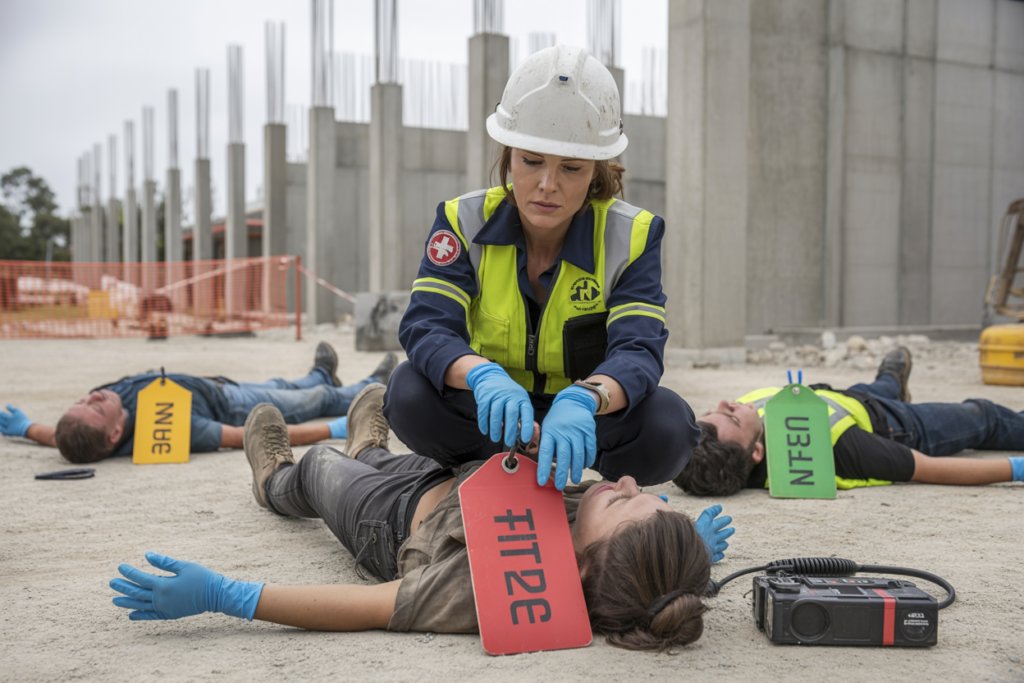
Triage and Multi-Casualty Management
Nothing in HLTAID011 prepares you for a multi-casualty incident. HLTAID014 does.
The START triage system — Simple Triage and Rapid Treatment — gives you a framework for assessing multiple casualties quickly, prioritizing by survival probability, and allocating limited resources under pressure. Red, yellow, green, black. Who gets attention first. Who can wait. Who is beyond intervention with the resources available.
This is the competency that most distinguishes HLTAID014 from everything below it. If your course description doesn’t mention START triage, that’s a signal worth paying attention to.
💡 Why this matters on a construction site: Safe Work Australia data consistently shows construction among Queensland's highest-risk industries for serious and fatal workplace injuries. A structural collapse, a vehicle incident, an explosion — multi-casualty scenarios are low probability, but they happen. The HLTAID014-trained supervisor is the only person on that site with a framework for managing the scene before paramedics arrive.
Hemorrhage Control and Shock Management
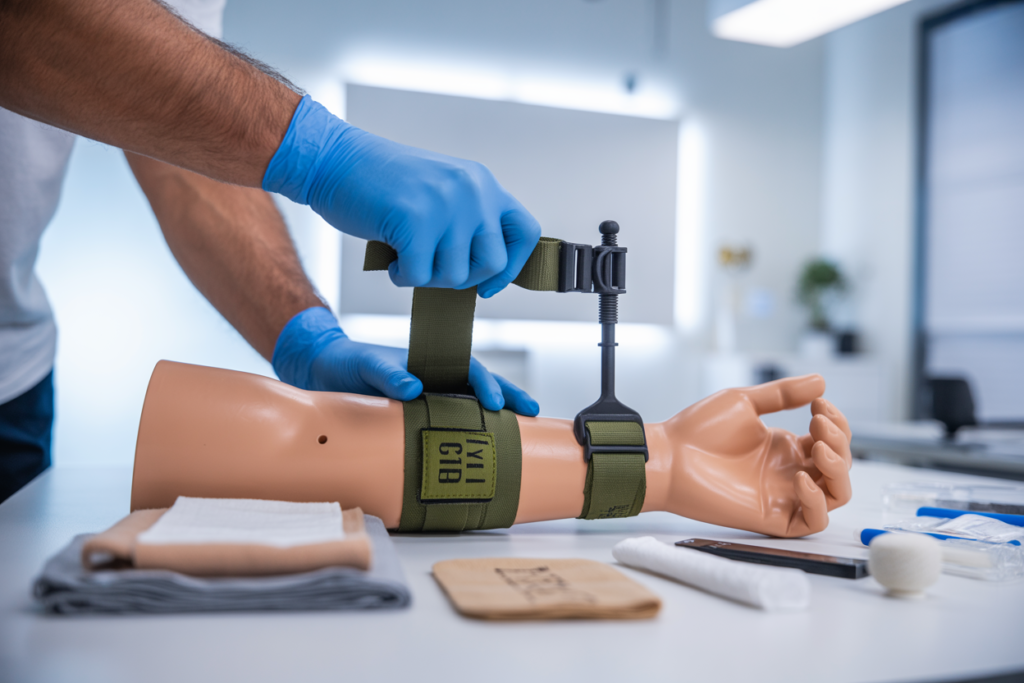
Uncontrolled bleeding is one of the most preventable causes of death in trauma situations — and one of the most common serious injury types on construction sites. Lacerations, crush injuries, penetrating trauma from tools and machinery.
HLTAID014 covers tourniquet application, wound packing, and pressure dressing techniques. Not a brief mention — hands-on practice with clinical-grade equipment until the technique is reliable under stress. Shock management runs alongside it: recognizing the signs of hypovolemic shock and knowing the correct management sequence when hospital resources aren’t available.
A paramedic instructor with more than a decade of Queensland Ambulance Service experience put it directly: hemorrhage control is time-critical in a way that most non-clinical people underestimate. The window between a serious bleeding injury and a survivable outcome can be measured in minutes. HLTAID014 training closes that gap.
Airway Management and Resuscitation
HLTAID014 covers advanced airway positioning, recovery position variations, and resuscitation sequencing well beyond HLTAID009 CPR-only certification — including prolonged CPR, AED integration, team resuscitation, and patient handover protocols. HLTAID014 satisfies the CPR competency requirement and is inclusive of the CPR unit, not separate from it.
Anaphylaxis and Medical Emergencies
Construction sites don’t just produce trauma. Medical emergencies — cardiac events, diabetic crises, seizures, severe allergic reactions — happen in industrial environments, often where ambulance response times are extended. HLTAID014 covers complex anaphylaxis management, adrenaline auto-injector protocols, recognition of biphasic anaphylaxis, diabetic emergencies, seizure response, and chest pain assessment — all framed for the industrial context where a worker’s medical history may not be known. It’s about giving the designated first aid officer a response capability that matches the environment they’re actually working in.
HLTAID014 Course Format — What to Expect on the Day
Will you be tested on everything from scratch? Is there actual equipment, or is it a room full of chairs and a projector? Here’s exactly what to expect.
Course Structure
HLTAID014 is delivered as a single intensive day. First-time candidates work through the full curriculum from the ground up. Renewal candidates — those coming back within their validity window — complete the same assessment with the acknowledged context of prior competency. The renewal day is not starting from zero.
If your certificate has already lapsed, the process is a full reassessment. That’s not a penalty — clinical skills need to be current, not just documented.
Assessment Methods
HLTAID014 assessment has three components: practical skills demonstration, scenario-based assessment, and a written knowledge component.
The practical component is the core of the day — patient assessment sequences, hemorrhage control techniques, triage decision-making, resuscitation — with an assessor signing off each competency. Scenario-based assessment then puts those skills into a realistic context. A simulated construction site incident, multiple casualties, limited information. This is where a genuine HLTAID014 course and a padded standard course become easy to tell apart.
The written component covers legal obligations, duty of care, infection control, and documentation. Straightforward for anyone paying attention through the day. Experienced holders sitting renewal don’t need to panic about being tested from scratch — but clinical technique does drift, and the scenario format gives you the chance to sharpen what’s gone soft.
What to Bring and How to Prepare
- Comfortable clothing for practical scenarios — you’ll be on the floor, kneeling, moving
- Photo ID
- Any prerequisite certificates if completing initial certification
One prep tip: the night before, do a brief mental review of the DRSABCD sequence. Five minutes. It removes the cognitive friction from the first hour and lets you focus on the practical work from the start.
Equipment
Clinical-grade AEDs. Traction splints. Airway management kits. Full-size manikins. These aren’t optional extras — they’re what the HLTAID014 competency standard requires. When you’re being assessed on tourniquet application or airway positioning, you need the actual equipment in your hands, not a description of how it works. Ask what equipment is used before you book. If the answers are vague, keep looking.
HLTAID014 Renewal — Timing, Process and What Lapses Mean
Most site supervisors don’t let their HLTAID014 lapse deliberately. It happens because the expiry date was in a portal somewhere, the reminder never came, and weeks slipped by while a concrete pour and two contractor disputes took priority. By the time it surfaces — during a toolbox talk or pre-mobilization check — the window is tight or already closed.
When Does HLTAID014 Expire?
HLTAID014 is valid for three years from the date of issue. Renewal must be completed before that expiry date for continuous compliance — no gap between the old certificate and the new one.
Book your renewal well before your expiry date. That window gives you enough flexibility to find a course that fits your schedule without scrambling for the last available seat.
Can you renew after it’s expired? Yes. But the compliance gap is real. From the moment your HLTAID014 lapses to the moment your new certificate is issued, you are not a current Advanced First Aid holder. On a worksite where your insurance policy or contract requires one, that gap exists in documentation whether or not anything happens during it.
What Happens If Your Certificate Lapses
An expired HLTAID014 creates three specific exposure points.
Insurance compliance breach. Most construction insurance policies require at least one current HLTAID014 holder on any active site with ten or more workers. A lapsed certificate means that requirement isn’t met. An annual policy audit that finds lapsed certificates across your register is a premium conversation you don’t want to have.
Tender disqualification. Government infrastructure contracts and major private sector tenders increasingly require proof of a current Advanced First Aid holder as a pre-qualification condition. A certificate that expired three weeks ago doesn’t satisfy that condition. With tight tender windows, there’s no time to fix it after you’ve noticed.
WorkSafe Queensland investigation exposure. If a serious incident occurs and a WorkSafe investigation follows, certificate currency is one of the first things examined. A lapsed HLTAID014 on the designated first aid officer’s record isn’t automatically determinative — but it is documented, and it is part of the compliance picture investigators construct.
The Renewal Process Step by Step
- Check your expiry date — confirm the exact date on your current certificate
- Book your renewal course — select a weekend HLTAID014 session well before expiry
- Complete the course — single day, practical and written assessment, scenario-based evaluation
- Receive your digital certificate same day — issued on completion, ready to upload immediately
- Update your compliance register — upload to your insurer portal or site register before end of business
- Set your next reminder — three years from the new issue date
If your certificate has already lapsed, the process is identical. The full reassessment resets your three-year clock from the new issue date.
Managing Renewal Across Your Whole Site
Most site supervisors are informally responsible for tracking first aid currency across multiple designated responders on rotating crews. Certificates expire at different times. People move between projects. The gaps surface during a toolbox talk or pre-mobilisation check — never with enough lead time.
A simple site first aid register solves this: staff name, unit code, issue date, expiry date, provider RTO number. Updated every time someone completes or renews. Without it, you’re relying on individuals to flag their own expiry — which works right up until it doesn’t.
⏰ Certificate already expired — or expiring soon? Weekend HLTAID014 courses available specifically for renewal candidates. Same-day digital certificate means your compliance register is updated before Monday morning. Check Next Available Date →
Book Your HLTAID014
The advanced first aid qualification isn’t a complicated decision once you understand what it involves. HLTAID014 gives a designated first aid officer on a high-risk Queensland worksite a genuine response capability — not just a certificate in a drawer.
The people on your site are relying on you to have this current. When something serious happens on an isolated civil infrastructure site, the person who holds HLTAID014 and the person who holds HLTAID011 are not equally prepared. That gap is real.
The renewal process is one day, practical and scenario-based assessment, same-day digital certificate on completion. The friction people build up around it is almost always larger than the actual process. Book early. Don’t wait for the pre-mobilisation check to flag it.
Book Your First Aid Training Now
Fast, affordable, and nationally accredited training delivered by professionals who care
Frequently Asked Questions
Q.Is HLTAID014 the same as Advanced First Aid?
Yes. HLTAID014 Provide Advanced First Aid is the current national unit code for the Advanced First Aid qualification in Australia under the HLT Health Training Package. Some providers still market it under the course name "Advanced First Aid" without displaying the unit code — which creates confusion when a certificate is submitted for compliance purposes. Always confirm the unit code is HLTAID014 before booking, not just the course title.
Q.How long is HLTAID014 valid for?
HLTAID014 is valid for three years from the date of issue. Renewal must be completed before the expiry date to maintain continuous compliance — if your certificate lapses, a gap exists in your documentation from the expiry date to the new issue date, and that gap is visible to insurers and investigators regardless of whether anything occurs during it.
Q.What's the difference between HLTAID014 and HLTAID011?
HLTAID011 covers core first aid — CPR, AED use, basic wound management, and standard emergency response — and is the baseline qualification for general workplaces. HLTAID014 covers everything in HLTAID011 plus START triage, multi-casualty management, haemorrhage control, spinal immobilisation, extended patient assessment, and complex anaphylaxis management. It's a fundamentally different response capability, and high-risk industries including construction, civil infrastructure, and mining typically require HLTAID014 for designated first aid officers.
Q.Do I get my certificate on the same day?
Yes. Digital certificates are issued on completion of the course — same day, before you leave the venue. That means your certificate is ready to upload to your insurer portal, project management system, or site compliance register the same day you complete training. No waiting for postal delivery, no chasing paperwork the following week.
Q.What happens if my HLTAID014 has already expired?
You can still complete the course and be reassessed — the process is a full reassessment, same format as the standard HLTAID014 day, and your new certificate is issued from the new completion date. The compliance gap between your old expiry date and new issue date is real and documented, but completing the course as soon as possible minimises that window.
Making first aid training more affordable for
every classroom
We believe every student deserves access to life-saving first aid knowledge. That’s why we offer specially reduced pricing for schools and educational groups. Whether you’re booking for a single class, a year group, or your entire school, our flexible packages make training more accessible and cost-effective — without compromising quality.
