
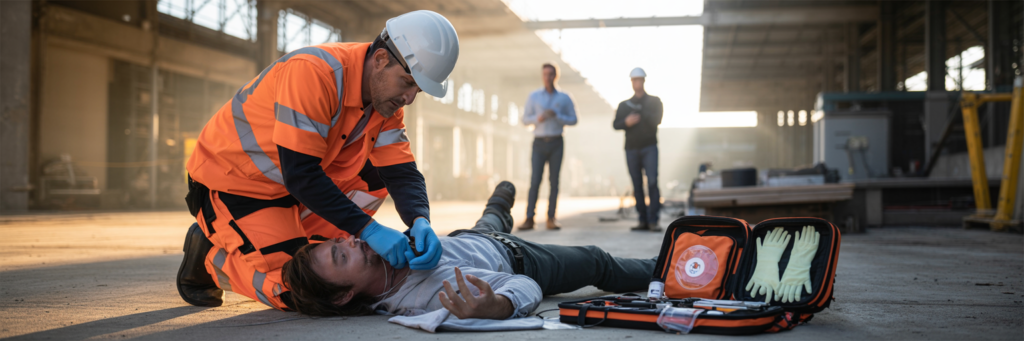
When a worker collapses on your site, you’ve got roughly four minutes before brain damage becomes irreversible. Are you confident your current skills match the complexity of what you’re actually facing?
A site supervisor once watched a compactor pin a worker’s lower leg. He was the designated first aid officer. He had his HLTAID014. And in the moments after it happened, he realised that knowing the certificate exists and knowing what to actually do under pressure are two completely different things.
When a serious incident unfolds on a construction site, the first five minutes determine everything. Not the ambulance. Not the hospital. The five minutes before any of that — when the site supervisor is the most qualified person present.
This guide breaks down the core advanced first aid response techniques covered under HLTAID014 — the same skills paramedics use in the field. We cover START Triage, primary and secondary patient surveys, haemorrhage control, shock management, extended airway management, and complex anaphylaxis response. No filler. Just the advanced content every serious site supervisor actually came here for.
What Are Advanced First Aid Response Techniques?
Advanced first aid response techniques are clinically grounded emergency skills that go beyond basic CPR and wound care. They are the core competencies taught under HLTAID014 — Provide Advanced First Aid — and are designed for designated workplace first aid officers, site supervisors, and WHS professionals.
These techniques include:
- START Triage — rapidly sorting multiple casualties by survival priority
- Primary Patient Survey — systematic ABCDE assessment of airway, breathing, circulation, disability, and exposure
- Secondary Patient Survey — head-to-toe examination to identify hidden injuries
- Haemorrhage Control — tourniquet application, wound packing, and pressure techniques
- Shock Management — recognising and slowing haemorrhagic and anaphylactic shock progression
- Extended Airway Management — positioning, suctioning, and adjunct use
- Complex Anaphylaxis Response — multi-dose epinephrine protocols and monitoring

START Triage — How to Sort Multiple Casualties Under Pressure
What START Triage Actually Means in a Workplace Context
Most first aid training assumes one patient. One person, one problem, your full attention on them until the ambos arrive. HLTAID014 doesn’t have that luxury.
START — Simple Triage and Rapid Treatment — is the system Queensland emergency services use when multiple casualties are present. On a construction site, this might mean a scaffolding collapse, a vehicle rollover, or an explosion in a confined space. The site supervisor holding the HLTAID014 needs to make life-or-death prioritization decisions in under 60 seconds per casualty. That’s not a dramatic overstatement. That’s the actual clinical requirement.
START divides casualties into four categories:
| Triage Category | Colour Code | What It Means |
|---|---|---|
| Immediate | 🔴 Red | Life-threatening but survivable with rapid intervention |
| Delayed | 🟡 Yellow | Serious injury but can wait without immediate risk to life |
| Minor | 🟢 Green | Walking wounded — can self-manage temporarily |
| Deceased / Expectant | ⬛ Black | No pulse, not breathing, or unsurvivable injuries |
The assessment framework that drives this is the 30-10-2 rule — respirations, pulse, and mental status. Those three data points, gathered in under a minute, determine the triage colour. Simple in theory. Genuinely hard under pressure when someone is screaming at you from three metres away.
Why the First Casualty You Reach Is Often the Wrong One to Treat
Your instinct at a multi-casualty scene is to go to the person making the most noise. That instinct is wrong. The loudest person is usually the most stable — they have enough neurological function to call out. The silent casualties are the ones in greatest danger.
START forces a rapid sweep of every casualty before treating any of them. Without it, you might stabilise a broken leg while someone nearby bleeds out from a femoral artery injury you never got to.
🟡 SITE SUPERVISOR TIP: Before any incident, designate a secondary responder. Your job as the HLTAID014 holder is assessment and coordination — not solo treatment of every casualty.
Primary Patient Survey — The ABCDE Assessment Framework
Why Systematic Assessment Saves Lives When Adrenaline Spikes
Under stress, untrained responders skip steps. They fixate on the most visible injury rather than the most life-threatening one. The ABCDE framework overrides that instinct — a repeatable, clinical sequence that works even when your hands are shaking.
A — Airway: Is the airway open and clear? Manual clearance, correct positioning, and airway adjuncts are all within HLTAID014 scope. No airway, no survival.
B — Breathing: Assess rate, depth, and symmetry. Paradoxical chest movement can indicate a serious chest injury. Absent breath sounds on one side is a significant finding for paramedic handover.
C — Circulation: In trauma, catastrophic hemorrhage control comes first. Assess pulse rate and quality, skin color, temperature, and capillary refill. Pale, cold, clammy skin with a rapid thready pulse is a shock presentation.
D — Disability: Use the AVPU scale — Alert, Voice, Pain, Unresponsive — to categorize conscious state. Check pupils for equality and reactivity. Unequal pupils after a head injury is a serious finding.
E — Exposure: Full body examination. You cannot assess what you cannot see. Cut away clothing to find hidden injuries, particularly where PPE can mask significant wounds.
Common Mistakes During Initial Assessment
- Fixating on the most visible injury rather than the most life-threatening one
- Skipping circulation assessment because there’s no obvious external bleeding — internal hemorrhage can be catastrophic before a single drop of blood is visible
- Failing to document findings for handover — timestamped observations are clinically valuable to the paramedics taking over
Hemorrhage Control — Stopping the Bleed Before the Ambulance Arrives
The Three-Tier Approach to Hemorrhage Control
Uncontrolled bleeding is the leading cause of preventable death in workplace trauma. In construction environments — where angle grinders, excavators, and heavy plant equipment are part of a normal working day — hemorrhage control is the single most important advanced skill a site supervisor can hold. The TECC framework and the Hartford Consensus both reach the same conclusion: the majority of preventable trauma deaths involve hemorrhage that was controllable with the right technique applied in the right order.
Tier 1 — Direct Pressure: The starting point, always. Both hands, full body weight, no interruption. Every time you lift the dressing to check, you break the developing clot and restart the process. Add layers on top if blood soaks through.
Tier 2 — Wound Packing: For deep lacerations or injuries where flat pressure is difficult — the groin, axilla, or neck — pack hemostatic gauze into the wound cavity all the way to the base, then apply direct pressure over the top.
Tier 3 — Tourniquet Application: When direct pressure and wound packing are insufficient for limb injuries with severe arterial involvement, a tourniquet saves lives. Position it 5–7 centimeters above the wound, wind the windlass until bleeding stops, lock it, and write the time of application on the tourniquet or the patient’s skin. Do not remove in the field.
Tourniquet Myths That Cost Lives
The biggest barrier to tourniquet use isn’t lack of training. It’s hesitation driven by misinformation. Military medicine data has comprehensively dismantled the claim that tourniquets cause limb loss. What causes limb loss — and death — is uncontrolled arterial hemorrhage while you’re hesitating.
Tourniquets are for limb injuries only — not junctional wounds at the groin, armpit, or neck, where wound packing is correct. Improvised tourniquets from belts or torn clothing fail consistently. They can’t occlude arterial blood flow and can actually accelerate blood loss. A purpose-built clinical device is not optional on a high-risk site.
🔴 QUEENSLAND REGULATION NOTE: Under the Queensland WHS Regulation 2011, high-risk construction sites must have at least one HLTAID014 holder present during all active work periods. First aid kit requirements include specific provisions for haemorrhage control equipment.

Shock Management — Recognising and Slowing Deterioration
The Four Types of Shock a Site Supervisor Is Most Likely to Encounter
Shock is a cascade of physiological failure where the body’s tissues stop receiving adequate oxygen delivery. Managing it correctly requires knowing which type you’re dealing with — treating the wrong type with the wrong intervention doesn’t just fail to help, it can cause harm.
| Shock Type | Primary Cause | Key Field Signs | Position |
|---|---|---|---|
| Haemorrhagic | Blood/fluid loss | Pallor, tachycardia, cold skin | Supine, legs elevated if no spinal injury |
| Anaphylactic | Allergic reaction | Hives, swelling, wheeze, rapid collapse | Supine — do not sit upright |
| Cardiogenic | Cardiac damage | Chest pain history, pulmonary oedema signs | Semi-reclined, not flat |
| Neurogenic | Spinal injury | Bradycardia with hypotension, warm skin | Spinal precautions, supine |
Early recognition signs across all types include pallor, diaphoresis, tachycardia, and altered consciousness. A fit construction worker can compensate and look relatively stable while losing significant blood volume.
Position management matters more than most people realize. For hemorrhagic and anaphylactic shock, sitting a patient upright reduces venous return at exactly the moment the heart needs every drop of circulating volume. For cardiogenic shock, semi-reclined eases respiratory distress without compromising circulation further. Generic advice — “lay them down, keep them warm” — is dangerously incomplete without knowing which type you’re managing.
Extended Airway Management — Beyond the Recovery Position
Airway Adjuncts Available to an HLTAID014 Holder
Basic first aid teaches the recovery position. Advanced first aid teaches what to do when the recovery position isn’t enough — when the jaw is clenched, when there’s active vomiting into a compromised airway, or when the mechanism of injury means you can’t roll them at all.
Oropharyngeal Airway (OPA): A curved plastic device inserted into the mouth to hold the tongue away from the posterior pharynx. Sizing is critical — measured from the centre of the mouth to the angle of the jaw. Contraindicated in any patient with a gag reflex present.
Nasopharyngeal Airway (NPA): Inserted through the nostril when the OPA is contraindicated — clenched jaw, partial gag reflex, or oral trauma. Better tolerated by semi-conscious patients. Contraindicated where basal skull fracture is suspected.
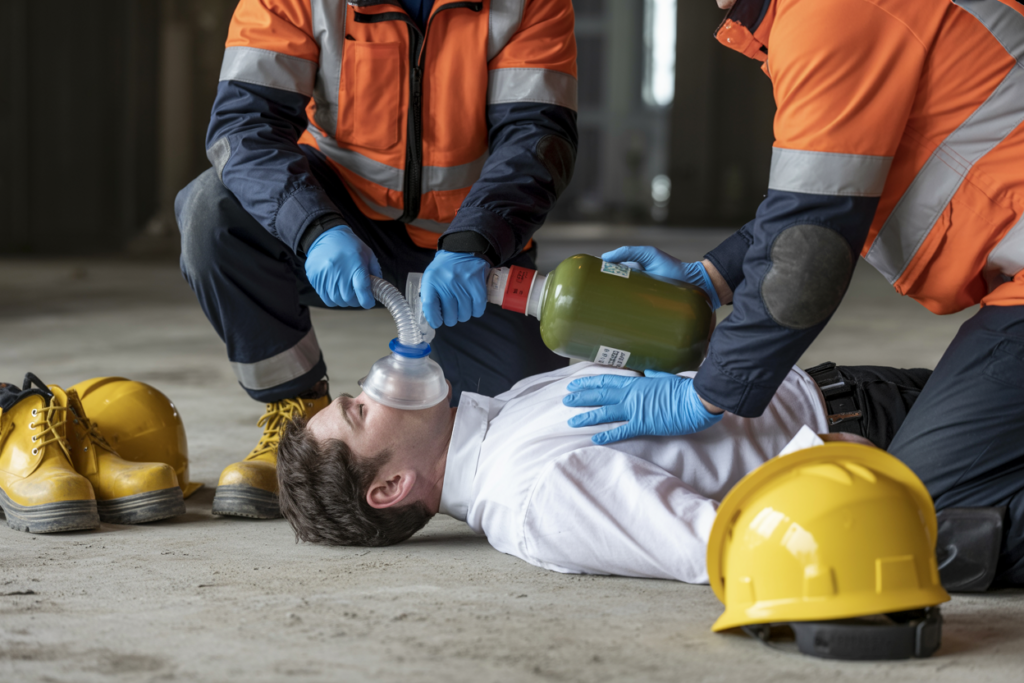
Bag-Valve-Mask (BVM) Ventilation: Manual ventilation for a patient not breathing adequately. The most common error is mask seal — if the mask isn’t sealed correctly, most delivered volume escapes. Two-person technique is significantly more effective and is what current ARC guidelines recommend.
Suction Devices: For active vomiting, blood pooling, or secretions compromising airflow. Use intermittent suction, no deeper than you can see, with the patient’s head turned to the side where possible.
Spinal Precautions During Airway Management
Falls from height, vehicle rollovers, and crush injuries carry a realistic risk of spinal injury — which creates a direct conflict with standard airway management. The resolution is manual in-line stabilization: one responder manages the airway while a second holds the head neutral. The log roll for repositioning requires a minimum of three responders, with the person controlling the head calling the movement.
Current 2025 ARC guidelines have moved toward a selective approach to spinal immobilization based on mechanism and clinical findings — exactly the kind of nuance HLTAID014 covers and the standard course does not.
Complex Anaphylaxis Response — When One Dose Isn’t Enough
Most people who’ve done a first aid course know the basics. Severe allergic reaction, grab the EpiPen, jab it into the outer thigh, call 000. That’s not wrong — it’s just incomplete.
HLTAID014 covers what happens when the first dose doesn’t fully reverse the reaction, when the patient improves and then deteriorates again, and when your response window is longer than anyone planned for.
Biphasic anaphylaxis is a delayed second reaction occurring after apparently successful initial treatment — anywhere from one to seventy-two hours later, without additional allergen exposure. A patient who has received epinephrine cannot be cleared as stable and left unmonitored. They need hospital assessment regardless of how well they appear to have recovered.
Multi-dose epinephrine protocol: If the first dose produces inadequate response, a second dose is indicated at the five-minute mark. Not thirty minutes. Not “wait and see.” Five minutes.
Positioning: The instinct to sit an anaphylaxis patient upright is understandable and wrong. Anaphylaxis causes massive vasodilation — sitting upright can precipitate cardiovascular collapse within seconds. Supine with legs elevated is correct.
Documentation for handover: Time of first dose, patient response, time of second dose if administered, vital signs, known allergen, relevant medical history. A timestamped handover from an HLTAID014 holder directly influences paramedic and hospital treatment decisions.
Any worker with a known severe allergy should have a current ASCIA anaphylaxis action plan on site, with prescribed epinephrine devices current and accessible. Under Queensland WHS legislation, the PCBU has a duty to identify allergen exposure risks and implement controls — an HLTAID014 holder is one layer of that control, not the whole system.
🔴 QUEENSLAND REGULATION NOTE — 2026 UPDATE: ASCIA updated their anaphylaxis management guidelines in 2024. If your site's protocols haven't been reviewed against current ASCIA guidelines, that review is overdue.
HLTAID014 vs HLTAID011 — What the Extra Competencies Actually Mean on Site
HLTAID011 is the standard workplace first aid qualification — CPR, basic wound management, fractures, burns, single-patient response. It’s the minimum for most low-to-medium risk workplaces and solid for what it covers. The operative phrase is “for what it covers.”
HLTAID014 extends well beyond it across five areas directly relevant to a construction site supervisor:
| Competency | HLTAID011 | HLTAID014 |
|---|---|---|
| CPR and defibrillation | ✅ | ✅ |
| Basic wound management | ✅ | ✅ |
| Single patient assessment | ✅ | ✅ |
| START triage (multi-casualty) | ❌ | ✅ |
| ABCDE primary survey | ❌ | ✅ |
| Secondary patient survey | ❌ | ✅ |
| Airway adjuncts (OPA, NPA, BVM) | ❌ | ✅ |
| Haemorrhage control (tourniquet, wound packing) | ❌ | ✅ |
| Shock management (all four types) | ❌ | ✅ |
| Complex anaphylaxis (multi-dose protocol) | ❌ | ✅ |
| Spinal precautions during airway management | ❌ | ✅ |
| Incident leadership and coordination | ❌ | ✅ |
| Clinical handover to paramedics | ❌ | ✅ |
The leadership and coordination competency is the one most often overlooked but arguably the most valuable for a site supervisor. HLTAID014 trains the holder to function as the clinical coordinator — directing bystanders, managing the scene, and maintaining situational awareness across the whole incident rather than tunnel-visioning on a single intervention.
State and federal government infrastructure tenders increasingly specify HLTAID014 by unit code in pre-qualification requirements. A company that submits HLTAID011 certificates where HLTAID014 was required doesn’t get a phone call asking them to correct it. They get disqualified. Most commercial insurance policies for construction sites above certain thresholds also reference HLTAID014 explicitly — a lapsed certificate creates a compliance gap an insurer can use to contest a claim.
What Separates a Certificate From Genuine Preparedness
The advanced first aid response techniques covered in this guide aren’t theoretical. They’re the same skills Queensland paramedics use when they arrive at a workplace incident — and the skills you’re expected to have ready before they get there.
START triage, the ABCDE primary survey, haemorrhage control, shock recognition, extended airway management, complex anaphylaxis response — these aren’t separate topics you learn once and file away. They’re a connected clinical framework. Triage tells you who to treat first. The primary survey tells you what to treat. Haemorrhage control and shock management buy the time the patient needs. Airway management keeps them oxygenated while you wait. Anaphylaxis protocol covers the reaction that doesn’t follow the simple script.
For every site supervisor carrying an HLTAID014 in Queensland, the certificate is the starting point — not the finish line. What matters is whether the training behind it was real enough to hold up under pressure, whether the instructor had actually attended the kinds of incidents the course prepares you for, and whether the scenarios built genuine muscle memory rather than just enough familiarity to pass an assessment.
If your HLTAID014 is current, this guide gives you a clinical reference to come back to. If it’s coming up for renewal — or already lapsed — the next available weekend course is the practical next step.
Book Your First Aid Training Now
Fast, affordable, and nationally accredited training delivered by professionals who care
Frequently Asked Questions
Q.What are advanced first aid response techniques?
Advanced first aid response techniques are clinically grounded emergency skills taught under HLTAID014 — including START triage, ABCDE patient assessment, haemorrhage control, shock management, extended airway management, and complex anaphylaxis response. They go well beyond the single-patient, basic intervention scope of the standard HLTAID011 qualification and are designed for designated first aid officers in high-risk workplace environments.
Q.What is the difference between HLTAID011 and HLTAID014?
HLTAID014 extends beyond HLTAID011 to include multi-casualty triage, advanced airway adjuncts, extended patient assessment frameworks, all four types of shock management, and leadership coordination during workplace incidents. For high-risk construction sites, Queensland WHS Regulation 2011 requires HLTAID014 — not HLTAID011 — to be held by the designated first aid officer, and many insurance policies and government tenders specify the unit code explicitly.
Q.How long does HLTAID014 last before renewal?
HLTAID014 requires renewal every three years. Queensland workplaces in high-risk industries should track expiry dates across all designated first aid officers — a lapsed certificate on a high-risk site is both a legislative breach and a potential insurance liability that can affect claims, premium renewals, and tender pre-qualification.
Q.What advanced skills does HLTAID014 cover that HLTAID011 doesn't?
HLTAID014 covers START triage for multi-casualty incidents, the ABCDE primary and secondary patient survey frameworks, three-tier haemorrhage control including tourniquet application and wound packing, all four shock types and their specific management protocols, extended airway management with OPA, NPA, BVM, and suction adjuncts, complex anaphylaxis response including biphasic reaction management, spinal precautions during airway management, and clinical handover to paramedics — none of which are covered under the standard course.
Making first aid training more affordable for
every classroom
We believe every student deserves access to life-saving first aid knowledge. That’s why we offer specially reduced pricing for schools and educational groups. Whether you’re booking for a single class, a year group, or your entire school, our flexible packages make training more accessible and cost-effective — without compromising quality.
