
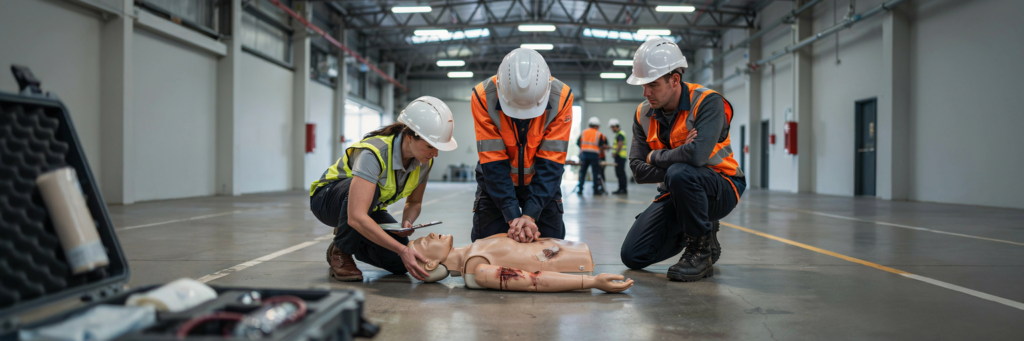
Your apprentice’s standard first aid certificate covers a sprained ankle and a minor cut. It doesn’t cover a crush injury from a mobile plant, a fall from height, or a worker going into shock with no ambulance in sight. And if your site’s risk profile demands more than that, a basic certificate isn’t going to satisfy a principal contractor’s pre-qualification check, or a WorkSafe Queensland audit either.
That’s the gap advanced first aid simulation training is built to close. Unlike classroom-only courses that walk through theory and call it compliance, simulation-based HLTAID014 training puts you and your crew through realistic, high-pressure scenarios, the kind your site actually produces, so the certificate in your hand reflects real capability, not just a tick in a register.
In this guide, we’ll cover what advanced first aid simulation training actually involves, why it matters for construction, civil, and industrial sites across Brisbane and South East Queensland, how it satisfies tender and audit requirements, and how to get your crew booked and certified with minimal disruption to your site.
What is advanced first aid simulation training?
Advanced first aid simulation training is HLTAID014-aligned first aid education that uses realistic, scenario-based exercises, rather than classroom theory alone, to prepare workers for serious incidents like crush injuries, falls from height, severe bleeding, and shock. It typically includes:
- Hands-on simulated casualty scenarios reflecting real workplace risks
- Advanced resuscitation and trauma management practice
- Decision-making under time pressure, supervised by qualified trainers
- Assessment against the nationally recognised HLTAID014 unit of competency
This approach is built for supervisors, WHS officers, and workers on higher-risk sites where standard first aid certification doesn’t meet compliance or tender requirements.
Why Standard First Aid Certification Isn’t Enough on High-Risk Sites
Here’s something most site supervisors don’t find out until it’s too late: there’s a real, meaningful gap between HLTAID011, the standard first aid certificate, and HLTAID014, the advanced one. And it’s not a small gap either.
HLTAID011 is built for everyday workplace incidents. Sprains, minor burns, a cut that needs a dressing, someone who’s feeling faint. It’s a solid baseline, and most workplaces genuinely need it. But it was never designed to cover what happens on a civil construction site, a mine services job, or an industrial plant where the risks are bigger and the consequences of getting it wrong are a lot more serious.
HLTAID014 is built for exactly that. It’s the qualification that prepares someone to manage advanced resuscitation, trauma, and multi-injury scenarios, the kind of incidents that don’t wait politely for an ambulance to arrive.
A few site risk factors that tend to trigger the need for advanced-level cover:
- Working at heights and elevated work environments
- Mobile plant and heavy machinery operating areas
- Excavation and high-risk construction activities
- Confined spaces requiring specialised emergency response
- Remote or outer-metro locations where emergency services may be delayed
That last one matters more than people think. If your site sits well outside metro Brisbane, you’re not looking at a fast ambulance response. It’s just the reality of working further out, and it’s exactly why WorkSafe Queensland expects employers to assess that risk properly under the WHS Regulation, rather than assuming a basic certificate will cover every site the same way.
This is also where it stops being a “nice to have” and becomes a hard requirement. Principal contractors and tender documents will often name HLTAID014 specifically, not “first aid training” in general terms. If your qualifications register shows HLTAID011 where a tender or a head contractor’s pre-qualification process calls for HLTAID014, that’s a gap. And it’s the kind of gap that gets caught fast, usually through contractor management platforms like RapidGlobal, Cm3, or Avetta-style systems, which flag missing or mismatched qualifications before site access is even granted.
Standard First Aid (HLTAID011) | Advanced First Aid (HLTAID014) | |
Designed for | General workplace incidents | High-risk site environments |
Covers | Minor injuries, basic CPR | Advanced resuscitation, trauma, multi-injury triage |
Suited to | Offices, retail, light industrial | Construction, civil, mining services, utilities |
Typically required by | General employers | Principal contractors, high-risk tenders |
Common trigger | Standard WHS obligation | Heights, plant, excavation, remote location risk |
If you’re not sure which side of that table your site falls on, that’s worth working out before an audit or a tender deadline forces the question for you.
🎯 Worth knowing: A certificate proves you sat through the content. Simulation training is what proves you can actually use it under pressure.
What Makes Simulation-Based Training Different
Sit through a classroom-only first aid course and you’ll learn the theory just fine. You’ll know the steps for CPR, you’ll know what shock looks like on paper, you’ll probably pass the assessment without much trouble. But theory and a real emergency are two very different things, and the gap between them is exactly where simulation-based training earns its place.
Vocational education research has shown, fairly consistently, that skills retention is significantly higher when training is practical and hands-on, rather than lecture-based. That makes sense if you think about it the way Marcus would. Nobody freezes up reciting a fact they read in a workbook. People freeze up, or don’t, based on what their body and their decision-making have actually rehearsed under pressure. Simulation training closes that gap by making the rehearsal real.
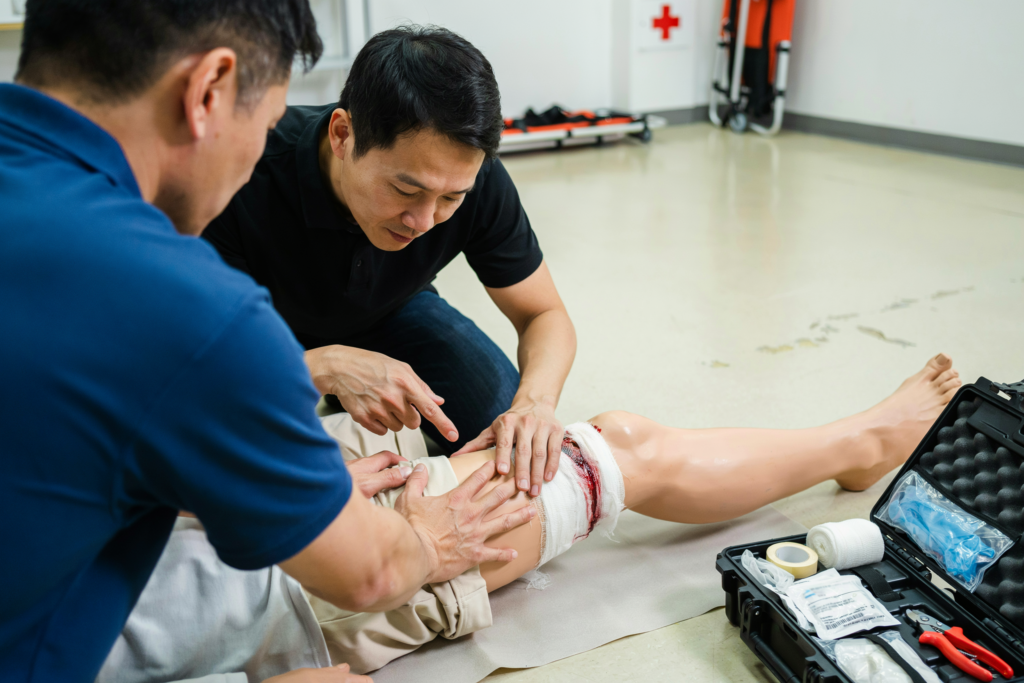
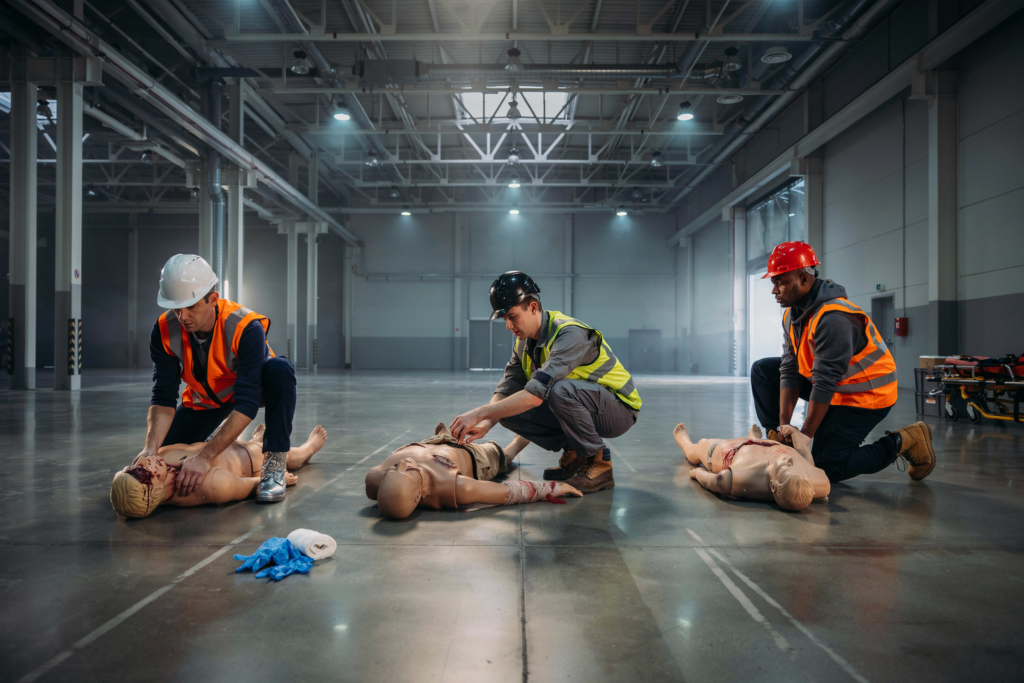
In a genuine simulation-based HLTAID014 course, that means scenarios built specifically around the risks a construction, civil, or industrial site actually produces. Not a generic slide about “severe bleeding,” but a moulage-based scenario, simulated wounds and injuries that look and feel real, with a manikin or trained actor playing the casualty, while you and your crew work through it under a clock, with a qualified trainer watching how you respond. A crush injury scenario after a mobile plant incident. A fall from height with suspected spinal involvement. Chemical exposure. Remote trauma, where you genuinely have to manage a casualty until help arrives, not just for the few tidy minutes a textbook example assumes.
What that does is build something theory alone can’t. It builds muscle memory. It builds the kind of decision-making speed that doesn’t come from knowing the right answer, it comes from having already made that decision once, under pressure, in a room that was deliberately built to make it hard. By the time a real incident happens on-site, the goal isn’t that you remember a checklist. It’s that your body already knows what to do, because it’s done it before.
This kind of training also tends to align closely with ANZCOR and ARC guidelines on resuscitation training standards, which increasingly recognize that scenario-based, hands-on instruction produces more competent and more confident responders than classroom delivery alone.
It’s also worth saying plainly: this is the part of advanced first aid training that separates a genuinely useful course from a box-ticking one. Marcus has likely sat through compliance theatre before, a course that exists to generate a certificate rather than a capable responder. Simulation-based training is the clearest signal that what you’re paying for is the second thing, not the first.
What’s Covered in HLTAID014 Advanced First Aid Training
So what does an HLTAID014 course actually walk you through? Here’s the breakdown, module by module.
Advanced resuscitation and CPR for complex situations. This goes beyond the standard CPR most workers already know. It covers resuscitation in situations that aren’t straightforward, multiple casualties, complicating injuries, or environments where standard positioning and access aren’t possible.
Trauma management. This is the core of what makes HLTAID014 “advanced.” You’ll work through:
- Severe bleeding control, including techniques beyond a basic pressure bandage
- Fracture management and stabilisation techniques
- Spinal care, particularly relevant for falls from height
- Recognising and managing shock before it becomes life-threatening
Casualty assessment and triage in multi-injury scenarios. On a real site, an incident rarely produces one tidy, isolated injury. HLTAID014 trains you to assess multiple casualties or multiple injuries at once and work out who needs attention first, and in what order, which is a genuinely different skill from managing a single, straightforward injury.
Legal and ethical obligations of an advanced first aid officer. Once you’re the person holding this qualification, there’s a clearer expectation placed on you, both legally and ethically, around how you respond and what’s expected of you on-site. This module makes sure you understand exactly where that line sits.
A quick checklist of what’s covered:
- Advanced resuscitation and complex CPR
- Severe bleeding and trauma control
- Fracture and spinal management
- Shock recognition and response
- Multi-casualty triage and assessment
- Legal and ethical responsibilities of an advanced first aider
HLTAID014 is a nationally recognized unit of competency, aligned to training.gov.au, which means the qualification is recognized consistently across Australia, not just locally, and it’s independently verifiable by any contractor management system or auditor who wants to check it.
🛡️ The bottom line for supervisors: A qualifications gap is far easier to close on your own timeline than on an auditor's.
Meeting WorkSafe Queensland and Tender Compliance Requirements
Here’s the fear Marcus actually carries, even if he doesn’t say it out loud: if WorkSafe audits us next month and our qualifications register has a gap, do we lose the site, the tender, or worse?
It’s a fair thing to lose sleep over. So let’s address it directly.
How this course satisfies your WHS risk assessment obligations. Under the WHS Regulation, employers are required to assess first aid needs based on the actual risks present on-site, not a generic, one-size-fits-all assumption. When your site involves heights, plant, excavation, or remote location risk, an HLTAID014-qualified responder is how that obligation gets properly closed out, not just on paper, but in genuine capability.
Closing a qualifications register gap before an audit finds it. This is the part that matters most under time pressure. If you already know, or suspect, that your register has a gap between what your site requires and what your current first aiders hold, the smart move is closing that gap before an audit or tender review forces the issue. Once it’s flagged externally, you’re reacting under someone else’s timeline, not yours.
Getting your Statement of Attainment uploaded fast. This is where same-day digital certificate delivery becomes the practical bridge between “course completed” and “site access maintained.” No waiting on paperwork while your crew stands idle off-site.
Audit-ready, in three steps:
- Identify the gap between your site's risk profile and your current qualifications register
- Book your crew into HLTAID014 simulation-based training
- Receive digital certification and upload it directly to your contractor management system
Why Brisbane and SEQ Site Supervisors Choose First Aid Alive
There’s a difference between a training provider who happens to offer HLTAID014 and one who actually understands the environment you’re working in. First Aid Alive is built around the second kind.
RTO accreditation you can verify yourself. First Aid Alive operates as RTO 31106, registered and compliant with ASQA standards. That’s not a claim you need to take on faith either, it’s independently checkable on training.gov.au, which matters when you’re the one whose name is attached to the qualifications register a tender or audit will be checking.
Trainers who’ve actually worked in environments like yours. There’s a real difference between a trainer who’s only ever delivered first aid in a classroom and one who understands what a crush injury scenario, a fall from height, or a remote-location incident genuinely looks like on a construction, civil, or industrial site. That kind of background shows up in how a course is delivered, not just in what’s printed on the certificate.
A track record with the clients who matter most to this conversation. First Aid Alive has worked with principal contractors and civil and industrial clients across Brisbane and South East Queensland, the kind of organisations whose pre-qualification and tender requirements are exactly what’s driving this whole decision for you in the first place.
If you want the fuller picture on trainer backgrounds and accreditation, that’s covered in more depth on our About and Trainers page.
Getting Your Crew Audit-Ready, Without Losing Site Productivity
A standard first aid certificate was never built for the kind of site Marcus runs. Heights, mobile plant, excavation, remote distances from emergency services, these are exactly the risk factors that push a site past what HLTAID011 was designed to cover, and exactly why principal contractors and tender documents start naming HLTAID014 specifically.
Simulation-based training is what makes that qualification mean something beyond a line on a register. Real scenarios, real pressure, real decision-making practice, so the certificate in your crew’s hands reflects what they can actually do, not just what they sat through.
Getting there doesn’t have to cost you site productivity either. Group bookings, on-site training options, and flexible scheduling mean your crew gets certified on your timeline, not the other way around. And once training’s done, fast digital certification means your Statement of Attainment is ready to upload to RapidGlobal, Cm3, Avetta, or whatever system your principal contractor runs, before it ever becomes the gap an audit catches.
If your site’s risk profile has already told you it needs advanced-level cover, the only real question left is how fast you can close that gap.
Book your crew’s advanced first aid simulation training with First Aid Alive today.
Book Your First Aid Training Now
Fast, affordable, and nationally accredited training delivered by professionals who care
Frequently Asked Questions About HLTAID014 Advanced First Aid
Q. Is HLTAID014 the same as a standard first aid certificate?
No. HLTAID011 is the standard first aid certificate most workplaces hold, covering everyday incidents like minor cuts, sprains, and basic CPR. HLTAID014 is a separate, advanced-level qualification built for higher-risk environments, covering advanced resuscitation, trauma management, and multi-casualty triage that standard first aid doesn't include.
Q. Who actually needs advanced first aid training?
Generally, anyone working on a site where the risk profile includes heights, mobile plant, excavation, confined spaces, or a long distance from emergency services. Site supervisors, WHS officers, leading hands, and plant operators are common candidates, particularly where a principal contractor or tender document names HLTAID014 specifically.
Q. Why does simulation-based training matter if the qualification is the same either way?
Because the qualification reflects what was assessed, not how it was taught. Simulation-based delivery uses realistic, scenario-based exercises rather than classroom theory alone, so the person holding the certificate has actually practiced the kind of decision-making a real incident demands, not just memorized the content.
Making first aid training more affordable for
every classroom
We believe every student deserves access to life-saving first aid knowledge. That’s why we offer specially reduced pricing for schools and educational groups. Whether you’re booking for a single class, a year group, or your entire school, our flexible packages make training more accessible and cost-effective — without compromising quality.
