
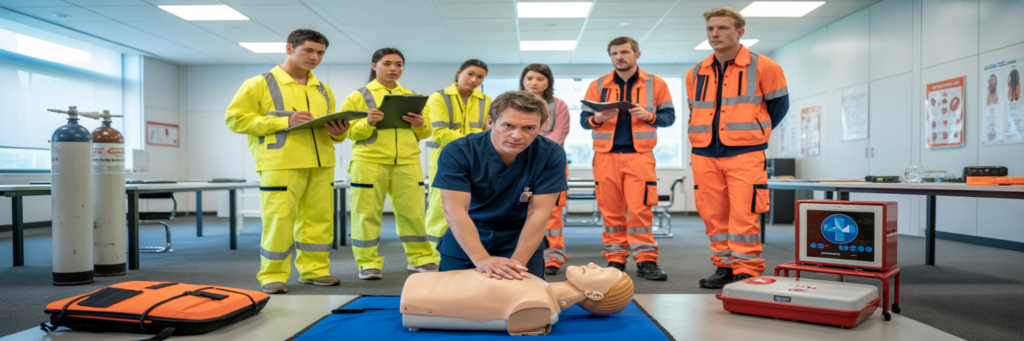
When you’re the designated first aid officer hundreds of kilometres from the nearest hospital, basic CPR training isn’t enough. Advanced first aid skills become the difference between managing a life-threatening emergency and watching helplessly while waiting for evacuation. For remote site workers, construction supervisors, and outdoor professionals, the question isn’t whether you’ll face a serious medical emergency—it’s whether you’ll be adequately prepared when it happens.
Advanced first aid skills go far beyond bandaging cuts and performing basic CPR. This comprehensive guide breaks down the critical competencies covered in HLTAID014 (Provide Advanced First Aid) training, from managing extended care scenarios to handling complex trauma in isolated environments. Whether you’re preparing for your first advanced first aid course, refreshing expired certifications, or determining if your current skills meet industry requirements, you’ll discover exactly what advanced first aid training involves, why it’s needed for remote workers, and how these life-saving techniques differ from basic first aid certification.
Let’s explore the advanced first aid skills that could save a colleague’s life when you’re the only help available.
⚡Quick Reality Check: In remote Australian worksites, average ambulance response time exceeds 60 minutes. Basic first aid teaches you to manage casualties for 10-15 minutes. Advanced first aid prepares you for the gap in between—where lives are actually saved or lost.
What Are Advanced First Aid Skills?
Advanced first aid skills are specialized medical competencies that enable first aid officers to manage complex emergencies and provide extended care until professional medical help arrives. Unlike basic first aid, which covers immediate response to common injuries, advanced first aid training equips responders to handle life-threatening situations in remote or isolated environments where ambulance response times exceed 30 minutes.
Key advanced first aid skills include:
- Managing airways and breathing for unconscious casualties
- Controlling severe bleeding and treating traumatic injuries
- Recognizing and responding to shock, heart attacks, and strokes
- Providing oxygen therapy and advanced resuscitation techniques
- Triage and management of multiple casualties
- Extended patient care and monitoring over hours, not minutes
- Using specialized equipment including defibrillators and oxygen systems
- Coordinating emergency evacuations and handovers to paramedics
These skills are taught in HLTAID014 (Provide Advanced First Aid) certification courses, which are mandatory for first aid officers in high-risk industries including mining, construction, and remote work operations across Australia.
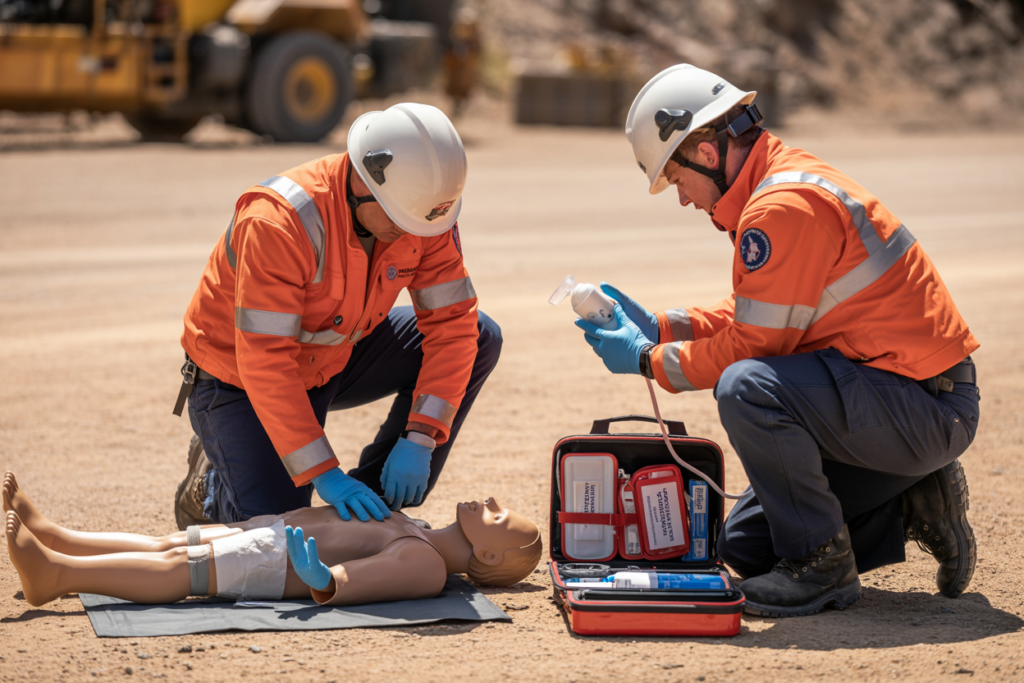
Core Advanced First Aid Skills You’ll Master
Advanced Airway Management and Breathing Support
When someone’s unconscious and their airway’s compromised, you’ve got minutes—not hours—to act. Advanced first aid training takes you beyond the basic head-tilt chin-lift maneuver you learned in standard CPR courses.
You’ll learn how to properly insert oropharyngeal airways (OPAs) for unconscious casualties who’ve lost their gag reflex. These curved plastic devices keep the tongue from blocking the airway, buying you time when someone’s unresponsive. For conscious patients with facial trauma or potential spinal injuries, nasopharyngeal airways (NPAs) become your go-to tool—they’re gentler and less likely to trigger vomiting.
The jaw-thrust maneuver replaces the standard head-tilt technique when you’re dealing with suspected neck or spinal injuries. It’s a more complex skill that requires practice to get right, but it’s what keeps you from potentially worsening a spinal injury while trying to save someone’s life.
Bag-valve-mask ventilation is where things get serious. You’ll practice delivering breaths to non-breathing casualties using specialized equipment, maintaining proper seal and rhythm. In remote environments where you’re potentially managing someone for 90+ minutes before helicopter evacuation arrives, knowing how to effectively ventilate someone becomes the difference between life and death.
Oxygen administration rounds out your airway management toolkit. You’ll learn proper flow rates—typically 6-15 litres per minute depending on the situation—and how to set up and operate portable oxygen systems safely in field conditions.
Severe Bleeding Control and Trauma Management
Basic first aid teaches you to apply pressure and elevate. Advanced first aid teaches you what to do when that’s not working.
Direct pressure techniques become more sophisticated—you’ll learn the difference between applying pressure over a wound versus applying pressure to arterial pressure points. When you’re dealing with severe arterial bleeding that’s soaking through dressings, knowing exactly where to press on the brachial, femoral, or carotid arteries can be what stops catastrophic blood loss.
Haemostatic dressings are specialized gauze impregnated with clotting agents. They’re standard kit in mining and remote construction sites now, and you’ll learn when and how to pack wounds with these materials. It’s not as simple as stuffing gauze into an injury—there’s a technique that maximizes contact with bleeding vessels while avoiding air pockets.
Tourniquet application is taught as a last-resort technique for limb injuries with uncontrollable bleeding. You’ll practice with commercial tourniquets (not improvised ones), learning the proper placement (high and tight on the limb), how to document the time of application, and why you never loosen a tourniquet once it’s on—that’s a job for hospital staff.
Advanced Resuscitation Techniques
CPR in advanced first aid courses goes deeper than the standard 30 compressions and 2 breaths you learned in basic training.
You’ll learn two-rescuer CPR, where one person manages compressions while another handles ventilations and equipment. The coordination and communication required is something you can only really learn through repeated practice. You’ll understand why switching roles every 2 minutes prevents fatigue and maintains compression quality over extended periods—because when the helicopter’s 90 minutes out, you can’t afford to tire out.
AED operation becomes second nature. You’ll practice pad placement on different body types, understand what “analyzing rhythm” actually means, and learn how to safely deliver shocks while managing bystanders. More importantly, you’ll practice continuing CPR around the AED’s analysis cycles without losing momentum.
Oxygen-assisted resuscitation combines your CPR skills with oxygen delivery systems. You’ll learn to coordinate oxygen flow with ventilations, maintain equipment while performing compressions, and manage the added complexity of hoses and masks during an already stressful situation.
Shock Recognition and Management
Shock kills people—often before the original injury does. Advanced first aid training teaches you to recognize the subtle early signs before shock becomes irreversible.
You’ll learn the physiological progression: pale, cool, clammy skin; rapid, weak pulse; rapid breathing; altered consciousness; eventually leading to organ failure. More importantly, you’ll learn the difference between hypovolemic shock (from blood loss), cardiogenic shock (from heart problems), and anaphylactic shock (from severe allergic reactions)—because each type requires different management priorities.
Positioning becomes critical. For most shock cases, you’ll learn the proper leg elevation technique to improve blood return to vital organs. For suspected spinal injuries, you’ll maintain flat positioning. For chest injuries or breathing difficulties, you’ll use the semi-recumbent position. Getting this wrong can worsen outcomes, so the training drills these decision trees into your muscle memory.
Medical Emergencies You’ll Be Prepared to Handle
Cardiac Emergencies: Heart Attacks and Cardiac Arrest
There’s a difference between a heart attack and cardiac arrest, and knowing which you’re dealing with determines your entire response strategy.
Heart attacks happen when blood flow to part of the heart muscle gets blocked. The person’s usually conscious, experiencing crushing chest pain that radiates down their left arm or into their jaw. They’re sweating, pale, nauseated, and genuinely terrified.
Your advanced first aid training teaches you the DRSABCD action plan specifically for cardiac events. You’ll position them sitting up with knees bent—lying flat can make breathing harder when the heart’s struggling. You’ll learn to administer aspirin (300mg, chewed not swallowed) if the person’s not allergic.
Cardiac arrest is when the heart stops pumping effectively. The person collapses, becomes unresponsive, and stops breathing normally. This is where your advanced CPR and AED skills become critical in remote locations.
Stroke Recognition Using FAST Protocol
Strokes are time-critical emergencies where every minute counts. Advanced first aid drills the FAST protocol into your assessment routine:
Face – Ask the person to smile. Does one side of their face droop? Arms – Ask them to raise both arms. Does one arm drift downward? Speech – Ask them to repeat a simple phrase. Is their speech slurred or strange? Time – If you see any of these signs, time to call emergency services immediately.
You’ll also learn the less common but equally serious signs: sudden severe headache, sudden vision problems in one or both eyes, sudden dizziness or loss of balance, and sudden confusion. For remote workers, the challenge is recognizing these symptoms in workmates who might brush off “just feeling a bit off” as fatigue or dehydration.
Your management focuses on positioning—lying flat with head and shoulders slightly elevated to reduce pressure on the brain. You’ll learn why you never give someone with suspected stroke anything to eat or drink (swallowing may be impaired, leading to choking), and how to monitor and document any changes in their condition during the extended wait for evacuation.
Respiratory Emergencies: Asthma and Anaphylaxis
Severe asthma attacks and anaphylaxis can both close someone’s airway, but they require different immediate responses.
Asthma management in advanced first aid goes beyond “use their puffer.” You’ll learn the proper technique for assisting someone with their reliever medication—usually 4 puffs initially through a spacer, waiting 4 minutes, then reassessing. You’ll recognize when someone’s deteriorating—they can’t speak full sentences, they’re using accessory muscles in their neck and shoulders to breathe, their lips are turning blue.
Anaphylaxis is more dramatic and faster-moving. Someone who’s been stung by a bee or eaten something they’re allergic to can go from fine to life-threatening distress in minutes. Their throat swells, breathing becomes impossible, blood pressure crashes, and they collapse.
You’ll practice administering adrenaline auto-injectors (EpiPens) on training devices. The technique is specific: remove the safety cap, jab firmly into the outer thigh (works through clothing), hold for 3 seconds, then massage the area. You’ll learn that one dose might not be enough—if symptoms don’t improve within 5 minutes, a second dose may be required.
Diabetic Emergencies: Hypo vs Hyperglycaemia
Blood sugar emergencies can look similar but require opposite treatments. Getting it wrong can kill someone, so advanced first aid teaches you the assessment skills to tell them apart.
Hypoglycaemia (low blood sugar) comes on fast. The person becomes confused, aggressive, sweaty, pale, and shaky. They might seem drunk. Left untreated, they’ll lose consciousness. Your response is simple: get sugar into them quickly. You’ll learn the “15-15 rule”—15 grams of fast-acting carbohydrate (3-4 glucose tablets, half a can of regular soft drink, or a tablespoon of honey), wait 15 minutes, recheck their condition.
The catch is they need to be conscious enough to swallow safely. If they’re unconscious or can’t swallow, nothing goes in their mouth—you’re managing their airway and waiting for paramedics who can administer IV glucose.
| Medical Emergency | Critical Signs | Your Priority Action |
|---|---|---|
| Heart Attack | Crushing chest pain, sweating, pale, nauseated | Sitting position, aspirin 300mg, call emergency services |
| Cardiac Arrest | Unconscious, not breathing, no pulse | Immediate CPR, AED, prepare for extended resuscitation |
| Stroke | Face droop, arm weakness, slurred speech | FAST assessment, semi-elevated position, nothing by mouth |
| Anaphylaxis | Throat swelling, breathing difficulty, collapse | EpiPen to outer thigh, flat position, second dose if needed |
| Severe Bleeding | Blood soaking through dressings, signs of shock | Arterial pressure points, haemostatic dressing, tourniquet if needed |
Advanced First Aid Skills vs Basic First Aid: Key Differences
Response Time Expectations
Basic first aid assumes help’s coming in 10-15 minutes. You keep someone stable, call triple zero, and hand over to paramedics relatively quickly. The training reflects this—you learn enough to bridge that short gap.
Advanced first aid operates in a completely different reality. You’re preparing to manage casualties for 30 minutes, 60 minutes, sometimes 90+ minutes before professional medical help reaches your location. That’s not a slight extension of care—it’s a fundamentally different medical scenario.
Consider a crushing chest injury on a remote mine site. With basic first aid, you’d position the person, monitor them, and wait. With advanced first aid skills, you’re managing their airway as it becomes compromised, you’re monitoring for tension pneumothorax (collapsed lung that’s getting worse), you’re coordinating with emergency services about where to establish a landing zone, and you’re preparing detailed handover notes about the patient’s condition over the last 75 minutes.
Equipment and Resources
Walk into a basic first aid course and you’ll see bandages, band-aids, maybe a basic CPR manikin. Walk into an advanced first aid training room and you’ll see equipment that looks like it belongs in an ambulance.
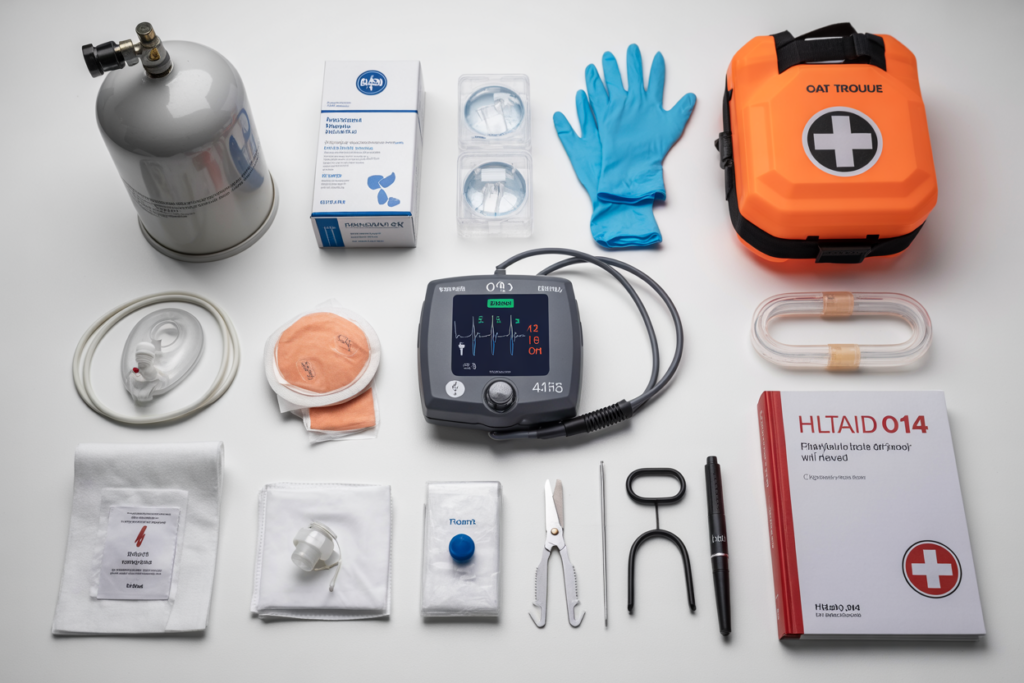
Oxygen cylinders with regulators and delivery masks. Bag-valve-mask resuscitation units. Suction devices for clearing airways. Cervical collars for spinal immobilization. Oropharyngeal and nasopharyngeal airways in multiple sizes. Haemostatic dressings. Commercial tourniquets rated for combat situations.
You’ll learn not just how to use this equipment, but how to maintain it, how to do equipment checks, how to troubleshoot when something’s not working properly. Because in a remote emergency, you can’t just call for different equipment—you work with what’s in your first aid kit.
Scope of Injuries and Illnesses Covered
Basic first aid covers common injuries: cuts, burns, sprains, basic CPR, choking. These account for probably 90% of first aid situations in urban environments where help’s readily available.
Advanced first aid skills prepare you for the other 10%—the serious, complex, life-threatening situations where your intervention makes the actual difference between survival and death.
You’ll learn to manage multi-system trauma. Someone who’s fallen from height and has a head injury, possible spinal injury, fractured ribs, and internal bleeding all at once. You’re not just treating one problem—you’re prioritizing which life-threat to address first while monitoring for deterioration in other systems.
Crush injuries from machinery or rock falls require specific management protocols. The injured tissue releases toxins when blood flow’s restored, which can cause kidney failure and cardiac arrest. You’ll learn why you never release a crushing force that’s been in place for more than 15 minutes without medical backup—and what to do when you’re in a remote location where that medical backup is an hour away.
Who Needs Advanced First Aid Skills?
Mining and Resources Sector Workers
If you’re working FIFO in the mining industry, HLTAID014 isn’t just recommended—it’s typically mandatory for anyone in a supervisory or designated first aid officer role.
Underground miners face unique hazards. Crushing injuries from rockfalls, exposure to toxic gases, confined space incidents, and the reality that you might be hundreds of meters underground when someone needs help. Emergency response protocols assume you’ve got advanced first aid skills because basic CPR isn’t sufficient for serious chemical exposures or traumatic injuries.
Site supervisors and leading hands need current HLTAID014 as part of their position requirements. You can’t progress into these higher-paying leadership roles without it.
Construction and Infrastructure Projects
Construction sites are high-risk environments where serious injuries happen despite safety protocols. Falls from height, electrocution, crushing injuries from equipment, and penetrating trauma from power tools are all realistic scenarios.
Site supervisors and safety officers must hold HLTAID014 under most company policies. You’re responsible for potentially dozens of workers on larger projects, and you need the skills to manage everything from minor lacerations to serious head injuries.
Civil construction projects often operate in semi-remote locations where advanced first aid skills become critical due to extended emergency response times.
Outdoor Recreation and Adventure Tourism
Expedition guides, outdoor education instructors, and adventure tourism operators work in environments where the business model involves taking people away from readily accessible medical care.
Bushwalking guides leading multi-day hikes need to manage everything from snake bites to heart attacks on trails hours from the nearest road. Your advanced first aid skills aren’t just about certification—they’re about keeping clients alive when things go wrong.
Rock climbing instructors, whitewater rafting guides, and mountain bike tour operators face environments where injuries can be complex and evacuation is logistically difficult.
School camp coordinators and outdoor educators have a duty of care to students, and parents expect professional-level first aid competency when groups of children venture into wilderness areas.
⚠️The Real Cost of Being Unprepared: Without advanced first aid skills, you're gambling with lives. You're also gambling with your career (can't get promoted), your legal protection (inadequate training equals liability), and your employer's compliance (WorkCover audits check certification levels). The question isn't if you'll need these skills—it's when.
Taking the Next Step: Your Advanced First Aid Training
Advanced first aid skills aren’t something you pick up from watching YouTube videos or reading a manual. The techniques require hands-on practice, the decision-making requires scenario-based training, and the confidence requires working through realistic emergencies under instructor supervision.
For remote site workers, FIFO employees, and outdoor professionals, HLTAID014 certification isn’t just a ticket to better job opportunities—though it absolutely opens doors to supervisor roles and higher pay grades. It’s about knowing you can actually help when someone’s life is on the line.
The difference between basic and advanced first aid becomes obvious the first time you’re managing a serious emergency in a remote location. Basic first aid gives you enough knowledge to feel helpless in complex situations. Advanced first aid gives you the skills and confidence to make life-saving interventions while professional help is still an hour away.
Look for providers with instructors who’ve worked in emergency services—ex-paramedics, former mine site medics, people who’ve actually used these skills in the field. Check that class sizes are limited so you get adequate hands-on practice time. Verify they’re using current Australian Resuscitation Council guidelines and proper training equipment.
Your career progression depends on maintaining current qualifications. Your legal protection depends on having recognized training. Most importantly, someone’s life might depend on the advanced first aid skills you learned when the situation no one wants to face actually happens.
The question isn’t whether to get HLTAID014 training. The question is whether you’ll be ready when you need to be.
Book Your First Aid Training Now
Fast, affordable, and nationally accredited training delivered by professionals who care
Frequently Asked Questions About Advanced First Aid Skills
Q.How long does HLTAID014 certification last?
Your HLTAID014 certificate is valid for 3 years from the date of issue, but there's a catch—you need to renew your CPR component (HLTAID009) annually. Most employers require yearly CPR refreshers even though your advanced first aid certification hasn't technically expired. Don't let either certification lapse, because even one day overdue can mean you're not covered if you respond to an emergency at work.
Q.What's the difference between HLTAID011 and HLTAID014?
HLTAID011 is Provide First Aid (basic first aid)—it's your standard workplace first aid covering common injuries and basic CPR. HLTAID014 is Provide Advanced First Aid, which goes way beyond basics to cover extended casualty management, advanced airway techniques, oxygen therapy, and managing complex medical emergencies over extended periods. Think of basic first aid as keeping someone stable for 15 minutes until paramedics arrive, while advanced first aid prepares you to manage casualties for 60-90+ minutes in remote locations.
Q.Can I do advanced first aid training completely online?
No, and you should be suspicious of anyone who says you can. HLTAID014 requires substantial hands-on practical assessment—you need to physically demonstrate CPR technique, airway management, use of oxygen equipment, and scenario-based emergency responses. Some providers offer online pre-learning to cover theory, but you'll still need face-to-face training for the practical components. Fully online "advanced first aid" certificates aren't worth the digital paper they're printed on and won't be accepted by legitimate employers.
Q.Is HLTAID014 recognized across all Australian states?
Yes, HLTAID014 is a nationally recognized qualification under the Australian Qualifications Framework. A certificate issued in Queensland is valid in Western Australia, Victoria, or anywhere else across Australia. This is particularly important for FIFO workers who might work on sites in different states or for outdoor guides who operate across state borders. Just make sure your provider is a registered RTO (Registered Training Organisation) with the Australian Skills Quality Authority.
Q.What happens if I can't pass the practical assessment?
Legitimate training providers want you to succeed, so if you're struggling with any component, you'll get additional coaching and practice time. Most courses build in enough time for multiple practice attempts before the formal assessment. If you genuinely can't demonstrate competency by the end of the course, you won't receive your certificate—but good providers will offer you the chance to return for additional training at no extra cost or minimal cost. It's rare for people to completely fail if they've attended the full course and put in the effort.
Making first aid training more affordable for
every classroom
We believe every student deserves access to life-saving first aid knowledge. That’s why we offer specially reduced pricing for schools and educational groups. Whether you’re booking for a single class, a year group, or your entire school, our flexible packages make training more accessible and cost-effective — without compromising quality.
