

When you’re hundreds of kilometers from the nearest hospital and a workmate suffers a severe crush injury, basic first aid knowledge won’t save their life. You need advanced first aid techniques—the kind that keep someone alive until help arrives.
Advanced first aid techniques go far beyond band-aids and ice packs. These are clinical skills bridging the gap between basic first aid and paramedic-level care—designed for extended emergency management when professional help is hours away.
Whether you’re a FIFO site supervisor, outdoor recreation guide, construction manager, or workplace first aid officer, mastering these techniques isn’t about ticking boxes. It’s about genuine competence when someone’s life is in your hands.
This guide covers the seven critical advanced first aid techniques: bleeding control, airway management, oxygen therapy, shock treatment, spinal management, wound care, and extended monitoring.
What Are Advanced First Aid Techniques?
Advanced first aid techniques are clinical interventions used to manage serious injuries and medical emergencies when professional help is delayed. These techniques go beyond basic first aid to include extended patient care, advanced bleeding control, and complex emergency management.
The seven core advanced first aid techniques include:
- Advanced bleeding control – Hemostatic dressings, pressure point control, and tourniquet application for severe hemorrhaging
- Advanced airway management – Oropharyngeal airways, recovery positioning for unconscious patients, and suction techniques
- Oxygen therapy administration – Safe use of oxygen equipment for respiratory emergencies
- Shock management and treatment – Recognition, prevention, and treatment of hypovolemic, cardiogenic, and anaphylactic shock
- Spinal injury management – Immobilization techniques and safe patient movement
- Advanced wound care – Deep wound packing, chest seal application, and burn management
- Extended patient monitoring – Vital signs tracking and deterioration recognition over extended timeframes
These techniques are taught in HLTAID014 (Provide Advanced First Aid) certification courses and are essential for workplace first aid officers, remote site workers, and emergency responders.
Understanding Advanced First Aid vs. Basic First Aid
Most people think first aid is first aid—learn CPR, apply a bandage, you’re done. But there’s a massive difference between basic courses and what you need managing serious emergencies far from hospitals.
Basic first aid (HLTAID011) covers fundamentals: CPR, treating minor cuts and burns, basic bandaging, recognizing shock. It’s designed for urban environments where ambulances arrive quickly. The assumption is you’re keeping someone stable until paramedics take over.
Here’s where basic falls apart: mine sites, remote construction crews, multi-day expeditions. When response times extend to hours, you’re not just applying bandages—you’re managing entire medical emergencies. You’re the only medical care this person’s getting until evacuation arrives.
That’s why high-risk industries require HLTAID014. Mining companies, construction firms, outdoor recreation operators—they learned basic certification doesn’t cut it when someone’s seriously injured far from help.
Advanced first aid teaches complex scenario management. You’re learning tourniquet application for life-threatening hemorrhaging based on military trauma research. You’re practicing with oropharyngeal airways. You’re administering oxygen therapy with different delivery systems. You’re packing deep wounds with hemostatic dressings. You’re monitoring vital signs over extended periods and recognizing deterioration patterns.
Courses spend most time on hands-on practice, not PowerPoint lectures. You’re working through high-pressure scenarios with realistic injuries, making split-second decisions, building muscle memory that kicks in during real emergencies.
One paramedic told me the biggest difference is confidence. Basic students learn “what to do.” Advanced students learn “how to manage the entire emergency until handover”—understanding why each intervention matters and adapting when situations don’t match textbook scenarios.

Advanced Bleeding Control Techniques
Severe bleeding can kill someone in minutes. When you’re hours from hospital, you need to know how to stop it.
Direct Pressure and Hemostatic Dressings
Proper direct pressure means hands directly over the wound, applying sustained firm pressure for minimum 10 minutes without checking. Most people check too early and restart the clotting process.
When significant bleeding won’t respond to basic pressure, hemostatic dressings (like QuikClot) accelerate clotting. Pack these directly into the wound, apply pressure, and maintain it until bleeding stops or help arrives.
Tourniquet Application
Modern tourniquets (CAT or SOFT-T) don’t automatically cause limb loss—that’s outdated information. They’re designed to stop arterial bleeding without tissue damage when applied correctly.
Use tourniquets when direct pressure isn’t working for limb injuries, for arterial spurting that won’t stop, for amputations, or when managing multiple casualties.
Application: Place high and tight on the limb—several inches above the wound, never over a joint. Tighten until bleeding stops completely. Lock it. Note the exact time.
Arterial vs. Venous Bleeding
Arterial bleeding: bright red blood spurting with each heartbeat. Immediately life-threatening, requires aggressive intervention.
Venous bleeding: darker red blood flowing steadily. Under lower pressure, usually controllable with direct pressure and elevation.
Advanced Airway Management Techniques
An airway compromised for several minutes means permanent brain damage. In remote locations where help is hours away, your airway management skills are the difference between recovery or death.
Recognizing Airway Compromise
Signs someone’s airway is compromised: they can’t speak or they’re making high-pitched sounds when breathing (stridor), their lips or face are turning blue (cyanosis), they’re using neck and shoulder muscles to breathe, or they’ve got decreased or absent breath sounds. An unconscious person who’s snoring loudly has a partially obstructed airway—the tongue has fallen back.
Main causes in remote workplaces: trauma (facial injuries, neck injuries), unconsciousness from any cause (tongue falls back to block airway), anaphylaxis (throat swelling), or foreign body obstruction.
The assessment triangle: look, listen, feel. You’re looking at the chest for movement and the face for color changes. You’re listening for breathing sounds and abnormal noises. You’re feeling for air movement from nose and mouth.
Brain damage from oxygen deprivation starts quickly. In a remote emergency, if someone’s airway is compromised, you act immediately.
Advanced Airway Positioning
Basic first aid teaches head tilt-chin lift. Advanced first aid teaches when that technique will kill someone.
If there’s any possibility of spinal injury—always assume it in workplace trauma—head tilt-chin lift can damage the spinal cord. Use jaw thrust instead: fingers behind the angle of the jaw, pushing forward, opening the airway without moving the neck.
Recovery position varies by injury. Standard recovery position works for unconscious breathing patients without spinal injuries. Suspected spinal injury requires modified recovery position or log-rolling with multiple helpers maintaining spinal alignment.
For remote workers: you might maintain airway positioning for extended periods. Take turns with others, use padding and supports, constantly monitor that the airway stays open.
Shock Management and Treatment
Shock is one of those medical terms that gets thrown around a lot, but most people don’t really understand what it means. Medical shock is when your body isn’t getting enough blood flow to vital organs. Without treatment, shock progresses to organ failure and death.
Understanding Different Types of Shock
Four main types: Hypovolemic shock (blood or fluid loss from trauma, dehydration, burns), Cardiogenic shock (heart can’t pump effectively), Anaphylactic shock (severe allergic reaction progressing incredibly fast), and Neurogenic shock (spinal cord injuries).
Recognizing Shock Early
By the time obvious signs show up, the person is already in serious trouble. You need to recognize early signs before it progresses to decompensated shock where organ damage is happening.
Early shock signs: rapid weak pulse (heart compensating by beating faster), pale cool clammy skin (blood shunted to vital organs), anxiety or restlessness (brain sensing something’s wrong), and rapid shallow breathing (body trying to get more oxygen).
Progressive shock: confusion or altered consciousness, greyish or mottled skin, thready pulse, irregular breathing, eventually unconsciousness.
Shock doesn’t stabilize on its own—it progresses. When you suspect shock, treat immediately and monitor continuously.
Treatment Protocol
Position: lying flat with legs elevated about 30 centimeters (unless spinal, chest, or head injuries—then keep flat). For cardiogenic shock, sitting up slightly might be better.
Maintain body temperature with blankets. Prevent heat loss, but don’t actively warm them with heat packs—that brings blood to the skin and away from vital organs, making shock worse.
Oxygen therapy if available. High-flow oxygen supports organ function while you’re managing shock.
Monitor vital signs regularly and document them. Check pulse rate and quality, respiratory rate, level of consciousness, skin color and temperature.
Don’t give food or drink. If they need surgery, having food or fluids in their stomach increases complications.
Spinal Injury Management
If you manage spinal injuries wrong, you can turn survivable injuries into permanent paralysis or death.
Rule: assume spinal injury in any significant trauma until proven otherwise.
High-risk mechanisms: falls from height, vehicle accidents, motorcycle/ATV accidents, direct blows to head or back, diving into shallow water, crushing mechanisms.
Around 30% of spinal cord injuries are made worse by poor handling after the initial injury.
Manual Inline Stabilization
Keep someone’s spine from moving while you assess them, provide treatment, or wait for help.
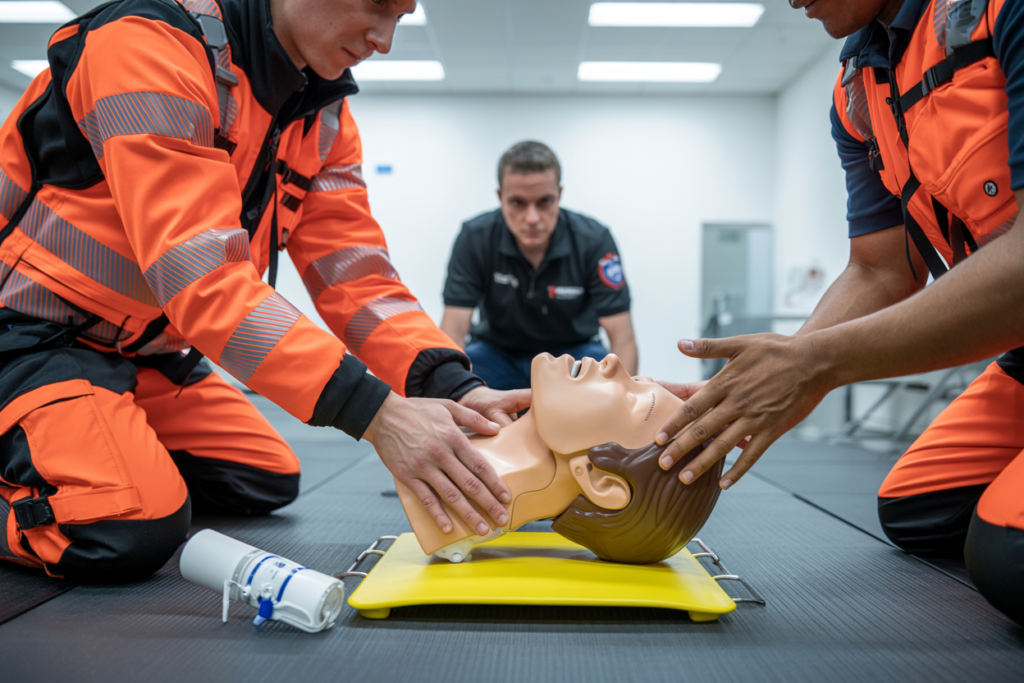
Hand placement: kneel at patient’s head, place hands on both sides with palms over ears and fingers along jaw and skull. Gentle but firm support preventing movement.
Goal: maintain neutral alignment—spine in natural position, not flexed, extended, or rotated.
Advanced Wound Care
Advanced wound care manages serious wounds—deep lacerations, penetrating trauma, severe burns—when you’re hours from surgical care. The skills you learn here bridge the gap between basic bandaging and professional medical treatment.
Deep Wound Assessment
When assessing deep wounds, you’re looking at multiple factors simultaneously. Depth is obvious—can you see muscle, tendon, or bone? That immediately tells you this is serious. But you’re also assessing contamination (is there dirt, grease, or other foreign material driven into the wound?), involvement of underlying structures (can they move the affected joint? Is there spurting blood indicating arterial damage?), and location (wounds over joints, hands, face, or genitals are higher risk even if they don’t look as dramatic).
Wounds needing immediate hospital care: any wound where you can see bone, tendon, or deep muscle; wounds with active arterial bleeding that won’t stop with direct pressure; wounds with significant contamination you can’t clean properly; wounds involving hands, face, or joints where function is at risk; any wound with obvious nerve damage (numbness or inability to move below the wound).
Wound Packing
For deep wounds with persistent bleeding, wound packing is the technique that keeps someone alive until they reach surgery. It sounds brutal, but when done correctly, it’s life-saving.
Pack with hemostatic gauze when available (combines mechanical pressure with chemical clotting). Pack gauze into the wound, filling the entire cavity from the bottom up. This isn’t gentle—you need firm, consistent packing to create enough pressure to stop bleeding. Pack until the wound is completely filled, then apply direct pressure over the packed wound for 10+ minutes.
Burn Management
Burns are tricky because pain level doesn’t correlate with severity, and the treatment that feels right is often wrong.
Burn classification: Superficial (red, painful, no blisters like sunburn), Superficial partial thickness (blisters, very painful, deeper skin layers), Deep partial thickness (red or white, less painful due to nerve damage), Full thickness (white or charred, no pain due to destroyed nerves).
Most painful burns aren’t the deepest—nerve destruction eliminates pain. If someone’s got a burn that looks white or charred and they’re saying “it doesn’t hurt that much,” that’s actually a worse burn than the red blistered area that hurts terribly.
Treatment protocol: stop the burning process first (remove hot clothing unless it’s stuck), cool with water for extended periods (research shows you need significant cooling time to stop ongoing tissue damage—people always stop too early), remove jewelry or tight clothing before swelling starts, cover with clean non-stick dressing, and arrange evacuation based on severity.
Extended Patient Monitoring and Assessment
In remote first aid, you’re managing patients for extended periods. Recognizing deterioration—stable or improving—keeps someone alive.
Vital Signs
Track five core vital signs regularly: pulse rate and quality, respiratory rate and effort, level of consciousness, skin color and temperature, blood pressure if available.
Pulse: normal adult 60-100 bpm. Feel for strength, regularity, rate.
Level of consciousness: AVPU scale—Alert, Voice (responds to speech), Pain (responds to painful stimulus), Unresponsive. Any deterioration is serious.
Recognizing Deterioration
Warning signs: pulse increasing and weakening, respiratory rate increasing or irregular, consciousness declining, skin getting paler/greyer, increasing anxiety or restlessness.
Trend matters more than single measurements. Pulse climbing over time signals deterioration. Watch for changes, not just absolute numbers.
Training and Maintaining Competence
Getting the certificate is just the start. The challenge: maintaining skills so your hands remember what to do when your brain is panicking.
HLTAID014 Requirements
HLTAID014 (Provide Advanced First Aid) is nationally recognized across Australia. Prerequisites: current CPR certification (HLTAID009). Quality courses include course manual, practical skills assessment, training equipment use, and nationally recognized statement of attainment.
Certification valid three years. CPR needs annual renewal.
Choosing Quality Providers
RTO registration is non-negotiable. Verify on ASQA website—if not registered, certificate is worthless.
What separates good from mediocre: instructor qualifications and real-world emergency experience. Look for paramedics, emergency nurses, military medics, remote area nurses.
Spend most course time practicing physical skills—applying tourniquets, packing wounds, managing airways, running scenarios.
Maintaining Skills
Research shows first aid skills decay significantly within months without practice.
Practice recommendations: review course manual regularly, watch technique videos from reputable sources, talk through scenarios, arrange practice sessions if workplace has equipment.
Certificate makes you compliant. Regular practice makes you competent.
Making Advanced First Aid Skills Reality
You’ve seen the seven critical advanced first aid techniques separating basic certification from genuine life-saving competence: advanced bleeding control stopping hemorrhaging when direct pressure isn’t enough, airway management keeping unconscious patients breathing, oxygen therapy supporting failing organs, shock treatment preventing deterioration, spinal injury protocols avoiding paralysis, wound care managing serious trauma, and extended monitoring recognizing deterioration before it becomes critical.
Common thread? They’re designed for extended care scenarios managing someone for considerable time until professional help arrives. That’s reality for remote workers. Mining sites, construction projects, outdoor recreation areas—you’re potentially hours from definitive care. Basic first aid knowledge isn’t sufficient.
Career benefits are real. Workplace first aid officer roles, supervisor positions, safety management opportunities—they require or strongly prefer HLTAID014 certification. But beyond career advancement, there’s something more fundamental: confidence that if someone’s life is in your hands during an emergency, you actually know what to do. You’re not guessing. You’re not hoping. You’re managing the situation based on solid training and practiced skills that could save a life.
The gap between having a certificate and having competence is what quality training bridges. Find a provider with experienced instructors teaching realistic scenarios, spending most course time on hands-on practice, understanding remote work challenges. Ask about instructor backgrounds—paramedics, emergency nurses, military medics bring credibility and practical knowledge that makes training stick.
The question isn’t whether advanced first aid techniques are useful. The question is: when the emergency happens and someone’s looking at you for help, will you be ready?
Book Your First Aid Training Now
Fast, affordable, and nationally accredited training delivered by professionals who care
Frequently Asked Questions
Q.What is advanced first aid?
Advanced first aid (HLTAID014) is training that teaches you to manage serious medical emergencies when professional help is delayed. It covers advanced bleeding control, airway management, oxygen therapy, shock treatment, spinal management, wound care, and extended patient monitoring for remote locations where you're the only medical help for hours.
Q.What's the difference between basic and advanced first aid?
Basic first aid covers CPR, minor injuries, and basic bandaging for quick ambulance response. Advanced first aid teaches serious trauma management, advanced medical equipment use, clinical decision-making, and extended care for hours—designed for remote locations and high-risk industries.
Q.Who needs advanced first aid certification?
Workplace first aid officers in high-risk industries, FIFO workers, mine site supervisors, construction managers, outdoor recreation guides, and anyone working in remote locations. Many employers in mining, construction, and outdoor recreation require HLTAID014 for safety officer and supervisor roles.
Q.How long is advanced first aid certification valid?
HLTAID014 certification is valid for three years, with CPR requiring annual renewal. Some workplaces require more frequent refresher training—check your employer's specific requirements to stay compliant.
Q.Is advanced first aid hard to learn?
Advanced first aid isn't hard if you're willing to practice. Quality courses focus on hands-on scenarios rather than theory, building muscle memory through realistic practice. The difference from basic is practice time and commitment to maintaining skills.
Q.Can I do advanced first aid training online?
Advanced first aid requires significant hands-on practice, so it can't be completed entirely online. Some providers offer blended learning with online theory, but you'll need face-to-face practical assessment to demonstrate competency.
Q.What equipment do I need for advanced first aid?
Remote sites stock equipment including hemostatic dressings, tourniquets, oxygen cylinders, oropharyngeal airways, suction devices, and spinal immobilization equipment. Your training course familiarizes you with this equipment—you don't need to purchase anything for training.
Making first aid training more affordable for
every classroom
We believe every student deserves access to life-saving first aid knowledge. That’s why we offer specially reduced pricing for schools and educational groups. Whether you’re booking for a single class, a year group, or your entire school, our flexible packages make training more accessible and cost-effective — without compromising quality.
