
Most advanced first aid courses hand you a workbook, point you at a manikin, and call it a day. You sit through a few PowerPoint slides, practice some bandaging, sign the assessment sheet, and walk out with a certificate. If you’ve ever done one of those and thought “would I actually cope if three workers went down on my site at once?” — that’s not a confidence problem. That’s a course quality problem.
HLTAID014 Provide Advanced First Aid is a different qualification. It requires demonstrating real clinical competency — triage under pressure, multi-casualty coordination, extended patient assessment, haemorrhage control. The kind of stuff that can’t be ticked off with a printed workbook and a basic CPR dummy. But plenty of providers are charging HLTAID014 prices while delivering something that’s basically an expensive HLTAID011 with a new cover page.
Knowing exactly what advanced first aid training materials a legitimate HLTAID014 course should include means you can spot the difference before you book. This guide covers every component you should expect: participant manuals, clinical equipment, scenario materials, assessment tools, and the digital resources you receive on the day. Whether you’re renewing ahead of a compliance deadline or looking at group training for your site crew, use this as your checklist.
What Equipment Is Used in HLTAID014 Training?
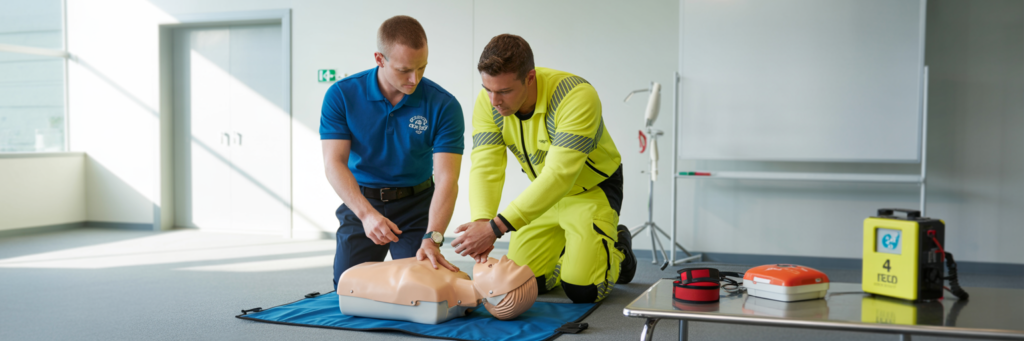
A legitimate HLTAID014 course uses clinical-grade equipment that reflects real emergency scenarios. Participants should expect to work hands-on with all of the following:
- Airway management kit — oropharyngeal airways, bag-valve-mask resuscitators
- Clinical-grade AED — with adult and paediatric pads
- Bleeding control equipment — tourniquets, haemostatic dressings, wound packing supplies
- Spinal immobilisation equipment — cervical collars, long spine board
- Traction splint — for mid-shaft femur fractures
- Oxygen delivery equipment — non-rebreather masks, nasal cannulas
- CPR manikins — at an appropriate ratio for HLTAID014 standard
- Scenario props — simulated trauma makeup, casualty cards for triage exercises
Courses using basic CPR manikins and a printed workbook are not delivering HLTAID014 to standard.

Why Training Materials Matter More in HLTAID014 Than Any Other First Aid Course
There’s a version of this conversation that goes: “It’s just a first aid course, how different can it really be?” And if you’ve spent any time in the industry, you’ve probably met someone who came back from one of those padded-out courses thinking exactly that.
The difference between HLTAID011 and HLTAID014 isn’t just time in the room. It’s equipment, assessment complexity, and the clinical depth that the unit descriptor on training.gov.au actually requires providers to deliver.
The Difference Between HLTAID011 and HLTAID014 — It’s the Equipment, Not Just the Hours
HLTAID011 covers CPR, basic wound management, and foundational emergency response. It’s the right qualification for a lot of people. But it doesn’t require traction splints. It doesn’t assess two-rescuer BVM technique. It doesn’t test your ability to run a START triage system across multiple casualties with deteriorating vitals.
HLTAID014 requires all of that — and the performance evidence criteria from training.gov.au are specific. You can’t demonstrate competency in spinal immobilisation without a cervical collar and a long spine board. You can’t assess haemorrhage control without a tourniquet and wound packing supplies. You can’t run a multi-casualty triage exercise without casualty cards. The equipment isn’t an optional extra — it’s what makes the assessment valid.
| Competency Area | HLTAID011 | HLTAID014 |
|---|---|---|
| CPR and AED use | ✓ | ✓ |
| Basic wound management | ✓ | ✓ |
| START triage system | ✗ | ✓ |
| Multi-casualty coordination | ✗ | ✓ |
| Spinal immobilisation | ✗ | ✓ |
| Traction splint application | ✗ | ✓ |
| Haemorrhage control — tourniquet and wound packing | ✗ | ✓ |
| Extended patient assessment — primary and secondary survey | ✗ | ✓ |
| Two-rescuer airway management | ✗ | ✓ |
| Oxygen delivery | ✗ | ✓ |
What the ASQA Framework Actually Requires Providers to Supply
RTOs delivering HLTAID014 are regulated under the ASQA Standards for RTOs 2015, which requires providers to have the facilities, equipment, and assessment tools necessary to deliver the unit to standard. In practice, enforcement is complaint-driven — meaning a substandard course can run for months before anyone flags it.
That’s the real risk. Completing a course, holding a certificate, and then discovering during a WorkSafe Queensland investigation that the training didn’t meet the unit’s assessment requirements. Your certificate exists. The training behind it doesn’t hold up to scrutiny. Serious injuries on construction sites are not hypothetical. The question isn’t whether your site will have a medical emergency — it’s whether the person holding the HLTAID014 certificate was actually trained to respond to one.
The equipment list is only half the story — the quality of your participant manual determines how much of that clinical knowledge you retain after course day.
💡 Compare HLTAID014 vs HLTAID011 — Which Does Your Site Actually Need? Not sure which qualification applies to your site's compliance requirements? Read the full comparison before you book.
The Participant Manual — What a Quality HLTAID014 Workbook Contains
The manual you’re handed on course day tells you a lot about the provider before the instructor says a word. A thin, generic workbook with stock photos and a glossary is a red flag. A well-constructed participant manual is a clinical reference document — something you’ll reach for months later when reviewing your site’s first aid response plan.
Pre-Course Reading and Theory Components
A quality HLTAID014 participant manual covers the theory underpinning every hands-on skill in the course — anatomy and physiology relevant to emergency response, the START triage system in enough depth to apply it under pressure, pharmacology basics for anaphylaxis and asthma management, and the legal framework covering duty of care, scope of practice, and Queensland-specific WHS obligations.
If the pre-reading pack you receive before course day is two pages of general safety reminders, that’s not an HLTAID014 manual. That’s filler.
Assessment Workbooks and Evidence Portfolios
Every task in the assessment workbook should map directly to the HLTAID014 performance evidence criteria on training.gov.au — written responses demonstrating triage decision-making, patient assessment sequences, and emergency management protocols. Not multiple choice questions about what colour bandage to use.
A legitimate workbook asks you to document a simulated patient assessment from primary survey through to handover, and requires you to demonstrate decision-making under scenario conditions. If the assessment felt like a year 10 health class quiz, it wasn’t built to HLTAID014 standard.
What to Do With Your Manual After Course Day
Your participant manual doesn’t stop being useful when you walk out the door. It becomes a working reference for your site — consult it when reviewing first aid kit contents, updating your emergency response plan, or briefing new crew members. A good provider will also issue a digital version along with quick-reference cards for tourniquet application and traction splint use. Those reference cards are what you want laminated inside your site first aid kit lid.
Once you understand what a quality manual covers, the next question is whether the provider has the clinical equipment to back it up.
Clinical Equipment You Should Expect to Use on Course Day
If a provider can’t give you a straight answer about what equipment is in the room on course day, that’s your answer. HLTAID014 is a hands-on qualification built around clinical skill development — and clinical skills don’t develop by watching someone demonstrate on a diagram. You need to put your hands on the equipment, repeatedly, under scenario pressure.
Airway and Breathing Equipment
Airway management is where HLTAID014 pulls away from standard first aid most sharply. You’re not just learning to tilt a head and watch for chest rise — you’re learning to size and insert an oropharyngeal airway (OPA), manage a partially obstructed airway in an unconscious casualty, and run a two-rescuer bag-valve-mask (BVM) technique, which is an explicit HLTAID014 requirement that genuinely takes practice to do effectively.
- Oropharyngeal airways (OPA) — multiple sizes, with sizing and insertion technique assessed
- Bag-valve-mask (BVM) resuscitators — two-rescuer technique, mask seal, ventilation rate
- Suction devices — manual and powered, for airway clearance in trauma casualties
- Pocket masks — single-rescuer scenarios where BVM isn’t available
A course that skips OPA insertion or only demonstrates BVM without letting you practice it hasn’t met the unit’s assessment requirements.
Circulation and Hemorrhage Control
Uncontrolled hemorrhage is one of the leading causes of preventable death in trauma, and HLTAID014 treats it accordingly — hemorrhage control is a core competency, not a footnote, and it requires real equipment to assess properly.
- Tourniquets — CAT and SOFTT-W application, correct placement, time-to-application assessed
- Hemostatic dressings — wound packing technique for junctional and limb wounds
- Pressure bandaging — Israeli bandage application, pressure maintenance, reassessment
You should be practicing tourniquet application until you can do it correctly under stress, not just watching a demonstration.
Immobilization and Trauma Management
This is the equipment list that most clearly distinguishes a genuine HLTAID014 course from a padded HLTAID011. Spinal immobilization, femur fracture management, and pelvic injury response all require specific equipment — and all appear in the HLTAID014 performance evidence criteria.
- Cervical collars — multiple sizes, sizing technique and application using in-line manual stabilisation
- Long spine board — with head blocks and strapping, log roll technique with a team
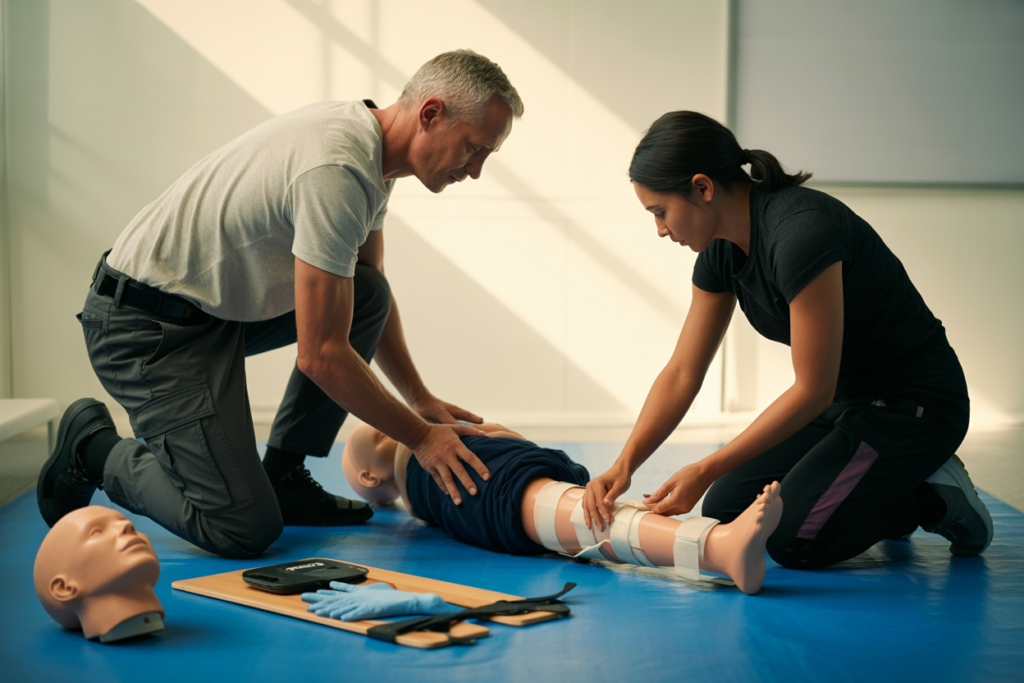
- Traction splint — Sager or Kendrick style, for mid-shaft femur fractures, including application and reassessment
- Pelvic binder — application technique for suspected pelvic ring injuries
If a provider doesn’t have a traction splint in the room, they are not delivering HLTAID014 to standard. Full stop.
Resuscitation Equipment and AED Training Units
- Clinical-grade AED training units — real pad placement practice, adult and paediatric pad differentiation, rhythm recognition basics
- Adult and paediatric manikins — at an appropriate ratio that gives every participant genuine hands-on practice time
- Pocket masks — single-rescuer CPR scenarios
A low manikin-to-participant ratio is a meaningful indicator of course quality. If half the room is watching while the other half practices, that’s observation — not skill development.
Equipment alone doesn’t build competency — it’s what your trainer does with it that separates a genuine advanced course from a padded standard one.
Scenario-Based Learning Materials — How Real Training Differs From a Classroom Exercise
You can sit in a room with all the right equipment and still walk out underprepared. Equipment is the prerequisite. What actually builds competency is what happens when the instructor puts you in a scenario, assigns you a role, hands you a casualty card, and tells you to manage it. That’s the part that separates a genuine HLTAID014 course from a very well-equipped lecture.
Casualty Cards and Multi-Casualty Triage Exercises
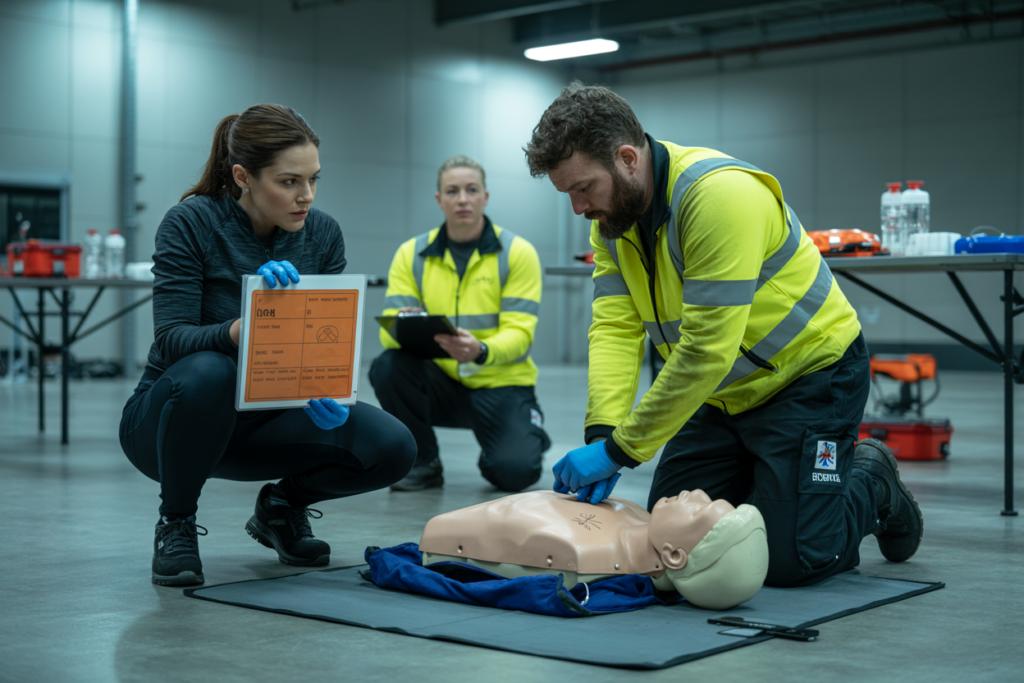
Casualty cards are the backbone of a legitimate triage exercise. Each card assigns a simulated patient a set of injuries, vital signs, and a deterioration timeline. You have to assess, triage using the START system, prioritise treatment, and coordinate with other responders while the scenario evolves — you don’t know what you’re dealing with upfront.
Without casualty cards, START triage cannot be properly assessed. Reciting the categories — immediate, delayed, minor, expectant — is not the same skill as applying them under pressure across multiple casualties with conflicting priorities. That’s what the HLTAID014 assessment conditions require.
Simulated Trauma and Moulage
Moulage is simulated trauma makeup — wound simulation, cyanosis, pallor, burns, deformity. Research in medical education shows simulation-based learning produces significantly better retention than lecture-only delivery — around 75% retention at 24 hours versus roughly 10% for passive formats. The reason is stress inoculation. When the casualty in front of you looks like they’re actually injured, your stress response activates and you have to manage it while still performing the skill correctly. That’s what makes the real thing manageable.
A provider who skips moulage is choosing cheaper delivery over your actual preparedness.
Scenario Props and Environmental Simulation
Legitimate HLTAID014 scenario delivery includes environmental props mirroring conditions participants are likely to face — confined space casualties, elevated fall victims with suspected spinal injury, heat exhaustion in Queensland summer conditions, and multi-casualty incidents requiring triage under time pressure. The assessment conditions require you to apply skills in context with realistic decision-making pressure, not just perform them in isolation. A provider without casualty cards, moulage, and environmental props is delivering a skills demonstration with an assessment form attached — not an HLTAID014 course. Those are very different things, and the difference matters the moment something goes wrong on your site.
🔬 Did You Know? Simulation-based training produces retention rates around 75% at 24 hours compared to roughly 10% for lecture-only delivery. For a skill you may need to use under extreme stress, that gap is the difference between competency and hesitation.
On-Site Group Training — Materials and Equipment for Workplace Delivery
You sort out your own HLTAID014. You’re back on the register. Then you look at your crew list and realise several of your designated first aid officers are either lapsed or approaching expiry. That’s not a paperwork problem — that’s an operational risk. On-site group training is how you resolve it without pulling your team across multiple individual bookings.
The full clinical equipment suite should be transported to your location — cervical collars, traction splints, tourniquet sets, AED training units, manikins, casualty cards, moulage kit. All of it. Before booking, confirm that in writing. Some providers deliver a reduced package for on-site sessions and call it the same course. The assessment requirements don’t change because the venue does.
What does change is logistics. Your team doesn’t travel. No unfamiliar venue, no time lost getting there. The course comes to them, and your crew arrives ready to train.
For on-site delivery, you’ll need adequate clear floor space per group for scenario exercises, a hard level surface for CPR and log roll technique, covered space to keep delivery practical in Queensland conditions, and power access for AED training units. A crib room, large shed, or cleared demountable is usually sufficient. A good provider will ask about the space before committing to the date — not after they arrive.
The pre-course briefing pack your team receives also matters. Participants who arrive knowing what to wear, what physical requirements to expect, and what pre-reading to complete get more out of the day and the scenario exercises run more efficiently.
What Your HLTAID014 Course Should Actually Include
The advanced first aid training materials a provider brings to course day are the clearest signal of what kind of course you’re actually getting. Not the website copy. The equipment in the room, the quality of the manual, the scenario props on the floor, and the certificate in your inbox at the end of the day.
If you’ve read through this guide and started mentally checking off what your last HLTAID014 course did or didn’t include, that’s worth paying attention to. A traction splint you never practiced with. A triage exercise that was really just a discussion. A certificate that arrived days later with no unit code visible. These aren’t minor complaints — they’re indicators of whether the training behind your certificate would hold up when it matters most.
The clinical equipment, the scenario resources, the assessment workbook aligned to performance evidence criteria — these are what HLTAID014 actually requires. Providers who cut corners on any of it are issuing a certificate that looks the same as one backed by genuine training. Until someone checks.
A WorkSafe Queensland investigation doesn’t distinguish between a certificate issued after a rigorous course and one issued after a half-day lecture. You carry the liability either way. The difference is whether you can demonstrate the training was delivered to standard.
Book with a provider who can show you exactly what’s in the room before you arrive. Ask about the equipment list. Ask about scenario delivery. Ask whether the certificate will display the HLTAID014 unit code on the day. The answers will tell you everything you need to know.
Book Your First Aid Training Now
Fast, affordable, and nationally accredited training delivered by professionals who care
Frequently Asked Questions About Advanced First Aid Training Materials
Q.What's the difference between the equipment used in HLTAID011 and HLTAID014?
HLTAID011 covers the essentials — CPR, AED use, basic wound management, and foundational emergency response. HLTAID014 requires a significantly more advanced equipment set on top of that, including traction splints, cervical collars, long spine boards, pelvic binders, oropharyngeal airways, bag-valve-mask resuscitators, haemostatic dressings, and tourniquets. If the course you're looking at doesn't list those items on the course page, there's a good chance it isn't delivering HLTAID014 to standard.
Q.Do I need to bring anything to an HLTAID014 course?
A quality provider will issue a pre-course briefing pack that covers exactly what to bring, but at minimum you'll need photo ID so your certificate can be issued in your full legal name on the day. If your employer is funding the course, bring any documentation your accounts payable team requires for the tax invoice. Wear comfortable clothing and closed-toe shoes — HLTAID014 involves floor work, kneeling, and patient-handling components throughout the day.
Q.How do I know if my HLTAID014 certificate is compliant for a WorkSafe or insurance audit?
A compliant HLTAID014 certificate must display your full legal name, the unit code HLTAID014 in full, the RTO name and registration number, and clearly stated issue and expiry dates. If your certificate shows only "Advanced First Aid" without the unit code, or if the RTO registration number is missing, it may not satisfy an audit requirement. Check those fields as soon as the certificate is issued — not six months later when you need to submit it.
Q.What should I look for in an HLTAID014 participant manual?
A quality manual is a clinical reference document, not a generic safety booklet. It should cover anatomy and physiology relevant to emergency response, the START triage system in enough depth to apply under pressure, pharmacology basics for anaphylaxis and asthma, and the legal framework covering duty of care and Queensland WHS obligations. The assessment workbook component should map directly to the HLTAID014 performance evidence criteria on training.gov.au — if it reads like a basic quiz, it wasn't built to standard.
Making first aid training more affordable for
every classroom
We believe every student deserves access to life-saving first aid knowledge. That’s why we offer specially reduced pricing for schools and educational groups. Whether you’re booking for a single class, a year group, or your entire school, our flexible packages make training more accessible and cost-effective — without compromising quality.
