
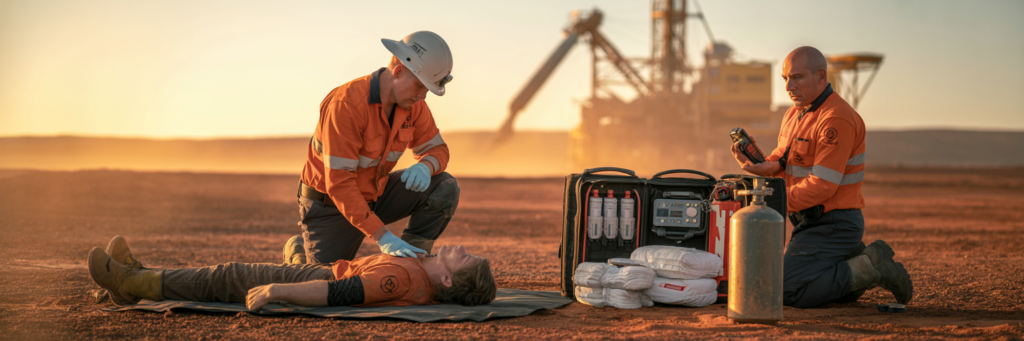
What would you do if a coworker suffered massive bleeding 200 kilometres from the nearest hospital, and you were the only person who could help? Standard first aid training teaches you to manage minor injuries and call for emergency services—but what happens when you ARE the emergency services?
This is the reality for thousands of FIFO workers, remote site supervisors, construction managers, and outdoor professionals across Queensland. Basic first aid certification simply isn’t sufficient for remote or high-risk work environments where extended care capabilities can mean the difference between life and death.
Advanced first aid trauma response training (HLTAID014) fills this critical gap. It teaches you to manage severe bleeding, maintain airways during prolonged emergencies, recognize and treat shock, handle multi-casualty incidents, and provide extended care for up to several hours when professional medical response is delayed.
This comprehensive guide covers everything you need to know about advanced trauma response training: the specific skills you’ll master, who requires this certification, how it compares to basic first aid, and how to select quality training that prepares you for real emergencies.
⚠️ Reality Check: In remote Queensland, average emergency response times regularly exceed 60 minutes. In mining and construction, you're often the only medical responder for 90-120 minutes. Basic first aid wasn't designed for this reality.
What is Advanced First Aid Trauma Response?
Advanced first aid trauma response is specialized training that prepares first aiders to manage life-threatening injuries and medical emergencies in remote or high-risk environments where professional medical help may be delayed for extended periods. Unlike basic first aid, which focuses on minor injuries and assumes rapid ambulance handover, trauma response training equips you to provide critical care for potentially hours.
Key trauma response skills include:
- Severe bleeding control – using advanced tourniquets and hemostatic techniques
- Airway management – for unconscious casualties during extended care
- Shock recognition and treatment – to prevent deterioration
- Multi-casualty triage – to prioritize treatment in mass casualty incidents
- Extended care protocols for managing injuries over 60+ minutes
- Spinal injury management in remote locations
In Australia, advanced first aid trauma response is taught through HLTAID014 (Provide Advanced First Aid) certification, required for remote site first aid officers, FIFO workers, outdoor professionals, and workplace safety officers managing high-risk environments.
Understanding Advanced First Aid Trauma Response
What Makes Trauma Response Different from Basic First Aid
Here’s the thing most people don’t get until they’re actually out there: basic first aid and advanced trauma response are solving completely different problems. And if you’re working in remote areas, on construction sites, or anywhere that’s more than 20 minutes from a hospital, you need to understand this difference before someone’s life depends on it.
The Time Factor Changes Everything
Basic first aid courses assume the ambulance shows up in 10-15 minutes. You stabilize, you keep the person calm, and then you hand over to the professionals.
Advanced first aid trauma response? You’re planning for 60 to 120 minutes or more of extended care. When you’re at a remote mine site or construction project in the middle of nowhere, your “ambulance response time” might actually be helicopter retrieval with significant delays.
You’re not just keeping someone stable for 10 minutes. You’re actively managing their injuries, monitoring their condition, adjusting your treatment as things change, and making clinical decisions for over an hour. That’s a completely different skill set.
Injury Severity: Minor Problems vs Life-Threatening Trauma
Basic first aid teaches you to handle the injuries you’d see in an office or retail environment. Someone cuts their hand. A customer trips and sprains their ankle. You’re dealing with minor to moderate injuries where the main job is “don’t make it worse and wait for the ambulance.”
Advanced trauma response prepares you for the stuff that kills people if you don’t know what you’re doing. Severe hemorrhage from a lacerated artery. Crush injuries with massive tissue damage. Cardiac events in workers who are already compromised. Multi-system trauma from falls or vehicle accidents.
And here’s what really separates the two: in basic first aid, you’re taught to stabilize and support until professionals arrive. In advanced trauma response, you ARE the professional for the next 60-120 minutes. There’s no one else coming.
Clinical Intervention: What You’re Actually Allowed to Do
The scope of practice between basic and advanced first aid is massive. Basic first aid gives you bandaging, basic wound care, CPR, and the ability to use an AED. You’re working with a standard first aid kit—plasters, gauze, triangular bandages.
Advanced trauma response training teaches you clinical interventions that actually manage life-threatening conditions. You learn proper tourniquet application for arterial bleeding that won’t stop with direct pressure. You’re trained on advanced airway insertion for casualties who can’t maintain their own airway. You learn shock management protocols that involve positioning, monitoring, and active treatment. You work with professional trauma equipment: oxygen delivery systems, advanced airways, hemostatic agents, spinal immobilization gear.
Here’s How They Actually Compare
| Aspect | Basic First Aid (HLTAID011) | Advanced Trauma Response (HLTAID014) |
|---|---|---|
| Response Time Assumed | 10-15 minutes | 60+ minutes to several hours |
| Injury Severity | Minor to moderate | Life-threatening trauma |
| Primary Skills | Bandaging, CPR, basic wound care | Hemorrhage control, advanced airway management, shock treatment |
| Equipment | Standard first aid kit | Trauma supplies, oxygen, advanced airways |
| Typical Environment | Office, retail, urban | Remote sites, construction, wilderness |
| Certification | HLTAID011 | HLTAID014 |
Core Trauma Response Skills You’ll Master in HLTAID014
Severe Bleeding Control and Hemorrhage Management
This is the big one. The skill that’ll save more lives than almost anything else you learn.
Basic first aid teaches you direct pressure and elevation. But what happens when blood is pumping out with every heartbeat and direct pressure isn’t enough?
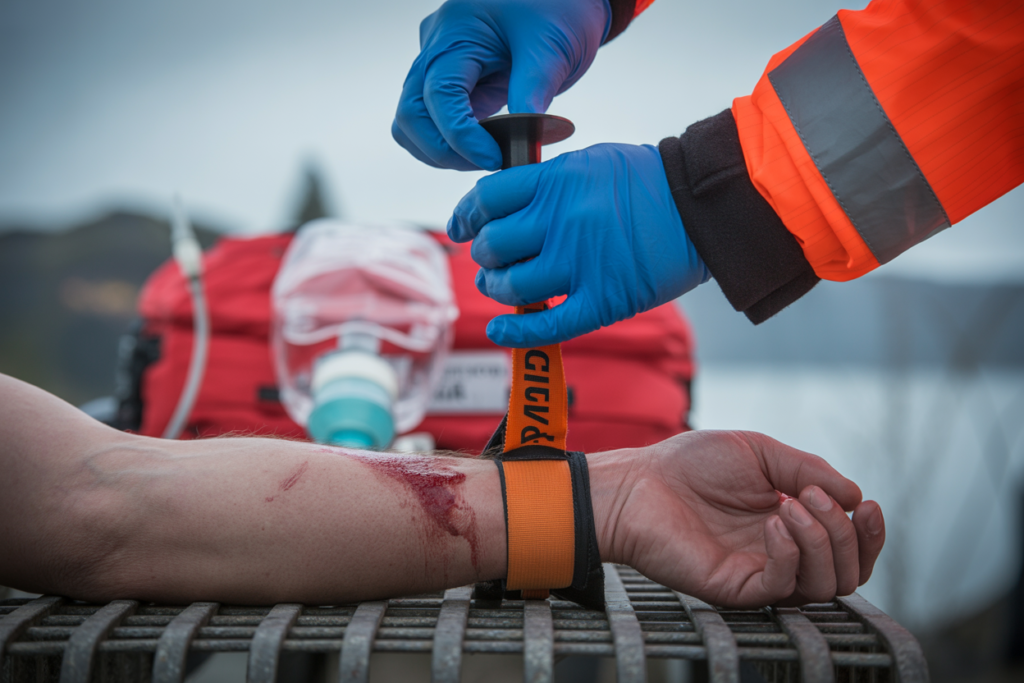
You’ll learn proper tourniquet application for arterial bleeding that won’t respond to direct pressure. And I’m not talking about the old “twist a stick in a bandage” nonsense from war movies. You’re learning modern Combat Application Tourniquets (CAT) and how to apply them correctly—because a badly applied tourniquet can cause more damage than it prevents.
Hemostatic agents are the other game-changer. These are specialized gauze products impregnated with clotting agents. When you’ve got deep wounds where you can’t apply a tourniquet—say a deep laceration to the groin or shoulder area—hemostatic gauze packed into the wound can stop bleeding that would otherwise be uncontrollable.
And here’s the part most people don’t think about: you’ll learn to monitor and reassess. Bleeding doesn’t always stay controlled. Shock can worsen bleeding. You need to know when to adjust your interventions.
Advanced Airway Management Techniques
Basic first aid teaches you to check if someone’s breathing and put them in the recovery position if they’re unconscious but breathing. What happens when someone’s unconscious for 90 minutes and their airway keeps compromising?
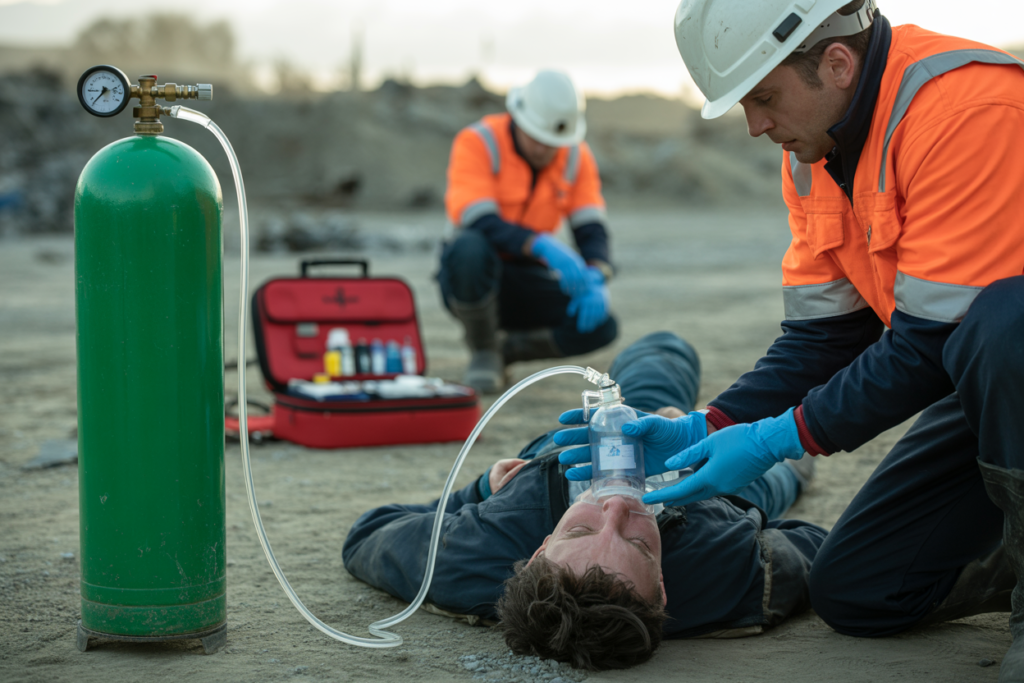
You’ll learn oropharyngeal airways (OPAs) and nasopharyngeal airways (NPAs)—these are medical devices that maintain an open airway in unconscious casualties. You’ll learn when to use each one, how to size them correctly, and how to insert them properly.
Suction equipment training – is included because airways don’t stay clear on their own. Blood, vomit, secretions—they all compromise airways, especially during extended care.
You’ll also learn oxygen administration. When to use it, how to calculate appropriate flow rates, and how to use different oxygen delivery devices—nasal cannulas for low-flow oxygen, non-rebreather masks for high-flow oxygen.
Shock Recognition and Treatment Protocols
Shock kills people. Not immediately, but progressively, as the body’s compensatory mechanisms fail and vital organs start shutting down. By the time obvious signs of shock appear, the person is already in serious trouble.
Advanced trauma response training teaches you to recognize early shock before it becomes life-threatening.
You’ll learn the different types of shock—hypovolemic shock (blood loss), cardiogenic shock (heart failure), neurogenic shock (spinal injury), anaphylactic shock (severe allergic reaction)—and how to identify which type you’re dealing with because they require different management approaches.
Early signs of shock – are subtle. Anxiety or restlessness. Pale skin. Slight increase in respiratory rate. Thirst. These are your body’s early warning system before things deteriorate.
Spinal Injury Management in Remote Environments
Spinal injuries are terrifying because the wrong movement can turn a recoverable injury into permanent paralysis. But here’s the reality in remote environments: you can’t just “not move them” for 90 minutes while waiting for a helicopter.
You’ll learn proper spinal immobilization techniques – that protect the spine while allowing you to provide necessary care.
Manual inline stabilization—how to hold someone’s head and neck in neutral alignment while other responders work. Cervical collar application for suspected neck injuries. Log roll technique for moving casualties with suspected spinal injuries when you absolutely have to move them.
Multi-Casualty Triage: When You Can’t Help Everyone at Once
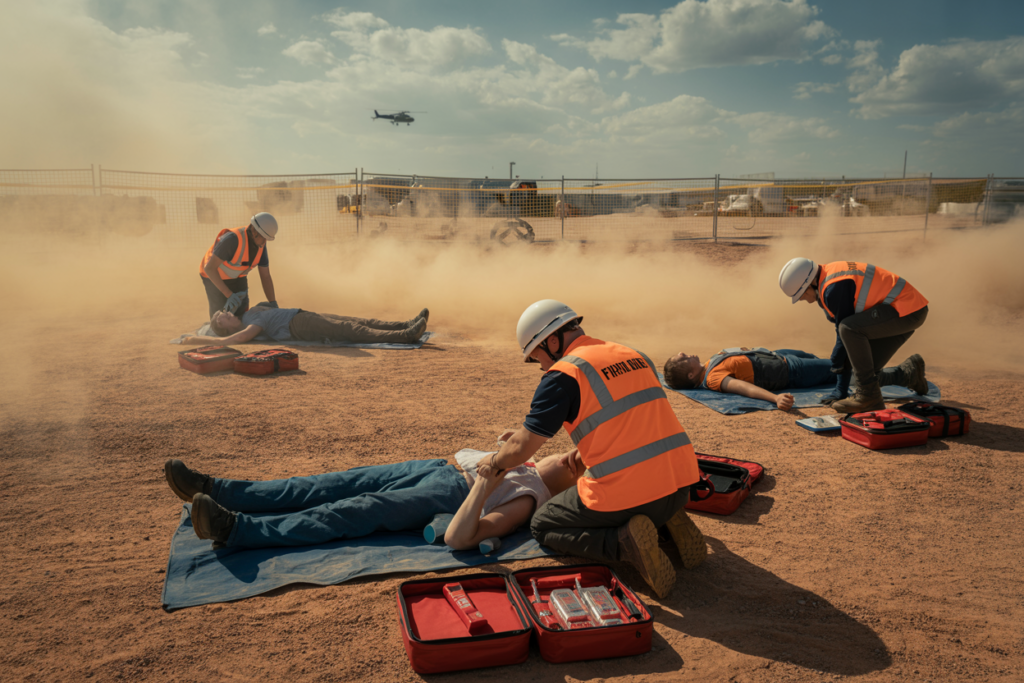
This is the scenario no one wants to think about but everyone needs to be prepared for. What happens when you’ve got multiple casualties and you’re the only first aider on scene?
Triage is the system for prioritizing casualties – based on severity and survivability.
You’ll learn the START triage system (Simple Triage And Rapid Treatment)—a quick assessment protocol that lets you categorize casualties in under 60 seconds each.
The four triage categories:
- Immediate (Red tag): Life-threatening injuries requiring immediate intervention to survive
- Delayed (Yellow tag): Serious injuries but stable enough to wait for treatment
- Minor (Green tag): Walking wounded who can wait for treatment
- Dead/Expectant (Black tag): No signs of life or injuries incompatible with survival
Extended Care Protocols: Managing Casualties for Hours, Not Minutes
This is what separates advanced trauma response from basic first aid more than anything else. You’re not just stabilizing for 10 minutes—you’re providing active care for potentially several hours.
Continuous monitoring and documentation – becomes necessary. You need to track vital signs every 5-10 minutes, document your interventions, note any changes in condition, and prepare comprehensive handover information for retrieval services.
You’ll learn what to monitor:
- Pulse rate and quality (getting faster and weaker means shock is worsening)
- Respiratory rate and quality (getting faster or more labored means deterioration)
- Level of consciousness (any decline means immediate reassessment)
- Skin color and temperature (pale, cool, clammy means shock)
🎯 Do You Need This Training? If you work more than 20 minutes from a hospital, manage high-risk activities, or are responsible for others in remote environments, advanced trauma response isn't just recommended—it's necessary.
Who Needs Advanced First Aid Trauma Response Training
Remote Site and FIFO Workers
If you work on remote sites—mining operations, oil and gas facilities, construction projects in the middle of nowhere—this training isn’t optional, it’s necessary.
Most mining companies operating in Queensland have moved to mandatory HLTAID014 for anyone in a first aid officer role. And that makes sense when you look at the reality of mine site emergencies. You’re often hundreds of kilometers from the nearest hospital. Helicopter retrieval takes time to organize and dispatch.
Oil and Gas Operations
Similar story. Remote drilling sites, pipeline operations—these environments combine high-risk work with delayed emergency response. Advanced first aid is typically mandatory for safety officers and recommended for team leaders.
Construction and Infrastructure Professionals
Construction sites see injuries that basic first aid wasn’t designed to handle. Falls from height causing multi-system trauma. Crush injuries from machinery or structural collapse. Penetrating injuries from tools or materials. Severe burns from welding or electrical incidents.
Site Supervisor and Leading Hand Expectations
If you’re moving into supervisory roles, advanced first aid certification sets you apart. It shows you’re serious about workplace safety. It demonstrates leadership capability. And frankly, it’s becoming an informal requirement for promotion in many construction companies.
Outdoor Recreation and Adventure Tourism Industry
If you’re leading people into remote environments—bushwalking, rock climbing, kayaking, 4WD tours, outdoor education programs—advanced trauma response training is basically mandatory, even if it’s not legally required.
You’re taking groups into areas where emergency services can’t easily reach. If someone suffers a serious injury, you’re managing that emergency for potentially hours while organizing helicopter retrieval or evacuation.
Workplace First Aid Officers: Beyond the Minimum
If you’re designated as a workplace first aid officer, you need to ask yourself: does basic first aid actually prepare me for the emergencies I might face in my workplace?
Manufacturing and Warehousing
These environments involve machinery, forklifts, heavy materials, height work. The injury potential goes well beyond minor cuts and sprains. Crush injuries, amputations, serious falls—these are the incidents that happen in industrial environments, and basic first aid doesn’t prepare you to manage them.
Events and Venue Management
If you’re responsible for first aid at events—concerts, sporting events, festivals—you’re potentially dealing with mass casualty situations, cardiac events in large crowds, trauma from crowd crushes or violence.
Career Development and Professional Advancement
Moving from Trades to Supervision
In construction, mining, and industrial sectors, moving into leading hand or supervisor roles often requires advanced first aid certification. You’re demonstrating that you’re willing to take on additional responsibility, that you’re serious about workplace safety, and that you can be trusted to manage high-stakes situations.
Transitioning to Safety Officer Roles
If you’re looking to move from trades work into health and safety roles, advanced first aid is basically mandatory. Safety officer positions typically require HLTAID014 as a minimum qualification.
Conclusion: Being Prepared When It Matters Most
Someone’s bleeding out hundreds of kilometers from the nearest hospital. The helicopter’s been called but it’s 90 minutes away. And you’re the only person who can help.
That scenario isn’t hypothetical for thousands of workers across Queensland. It’s the reality of working remote sites, construction projects, outdoor recreation—anywhere professional medical help isn’t coming quickly.
The question is: when that moment comes, are you actually prepared?
Basic first aid teaches you to stabilize minor injuries and wait for the ambulance. It’s completely inadequate when you’re the primary medical responder for potentially hours.
Advanced first aid trauma response training—HLTAID014—gives you the skills that actually matter in high-risk, remote, and extended care situations. You learn to control life-threatening bleeding. You learn to manage airways in unconscious casualties. You learn to recognize and treat shock. You learn to triage multiple casualties. You learn to provide competent care for hours, not minutes.
But here’s what matters more than the technical skills: you build the confidence that you can actually do this when someone’s life depends on it.
You’re not going to feel 100% confident the moment you finish the course. But you’ll feel significantly more prepared than you did before. You’ll have practiced the skills enough times that they’re becoming automatic. You’ll know what to do, even if you’re nervous doing it.
Your coworkers are counting on you to be prepared.
If you’re working in remote areas, on FIFO rosters, in construction, in outdoor recreation—anywhere that combines physical risk with delayed emergency response—you need this training. Not just because your employer might require it. Not just because it helps your career advancement. But because you’re eventually going to be in a situation where someone needs help and you’re the only one there.
When that moment comes, you want to know you did everything you could to be prepared.
Don’t wait until your certification expires. Don’t wait until something happens and you realize you weren’t adequately trained. Don’t wait until someone’s lying there injured and you’re thinking “I should have done that advanced first aid course.”
Book it now. Find a quality provider with experienced instructors and realistic training. Get yourself properly prepared.
Because the worst time to realize you needed better training is when someone’s bleeding out in front of you and you don’t know what to do.
Get certified. Be prepared. Save lives.
Book Your First Aid Training Now
Fast, affordable, and nationally accredited training delivered by professionals who care
Frequently Asked Questions About Advanced First Aid Trauma Response
Q.How long does HLTAID014 certification last?
Your HLTAID014 certification is valid for 3 years from the date of issue, but there's a catch—your CPR component (HLTAID009) only lasts 12 months. This means you need to renew your CPR annually to maintain full currency, even though your advanced first aid doesn't expire for 3 years. Most workplaces require both certifications to be current, so plan for a quick CPR refresher every year and a full HLTAID014 renewal every 3 years.
Q.Is HLTAID014 the same as Advanced First Aid?
Yes, HLTAID014 (Provide Advanced First Aid) is the current national course code for what people commonly call "Advanced First Aid." If you see providers advertising "Advanced First Aid training," they should be delivering HLTAID014 certification. The course code changed from the old HLTAID003 several years ago, so if any provider is still using outdated codes, that's a red flag they're not keeping current with national standards.
Q.Can I do HLTAID014 online or does it have to be in person?
HLTAID014 must include substantial face-to-face practical training—you can't do this course entirely online. Some providers offer blended learning where you complete theory components online before attending in-person practical sessions, which can reduce the face-to-face time needed. However, you'll still need to attend practical training to demonstrate skills like tourniquet application, airway management, and scenario-based responses because these can't be properly assessed remotely.
Q.What's the difference between HLTAID014 and Remote Area First Aid?
HLTAID014 (Advanced First Aid) is the foundation qualification that teaches extended care and advanced trauma response skills, while Remote Area First Aid (often called RIIFAW or Wilderness First Aid) builds on HLTAID014 with additional content specific to remote environments—things like improvised equipment, extended evacuation scenarios, and environmental emergencies. If you work in genuine remote wilderness areas, you might need both qualifications, but for most FIFO, mining, and construction roles, HLTAID014 alone is what's required.
Q.How often do I need to renew my CPR certification?
CPR certification (HLTAID009) needs to be renewed annually—every 12 months. Even though your HLTAID014 is valid for 3 years, the CPR component expires after 1 year, and most workplaces require both to be current. CPR refresher courses are quick and straightforward, usually running for a few hours, so schedule one every year between your major HLTAID014 renewals to maintain continuous certification.
Q.Is HLTAID014 recognized across all Australian states?
Yes, HLTAID014 is a nationally recognized qualification under the Australian Qualifications Framework, which means it's valid in every state and territory. Whether you train in Queensland and work in Western Australia, or move between states for FIFO work, your certification is recognized everywhere. This is one of the benefits of the national training system—you don't need separate certifications for different states like you would in some other countries.
Making first aid training more affordable for
every classroom
We believe every student deserves access to life-saving first aid knowledge. That’s why we offer specially reduced pricing for schools and educational groups. Whether you’re booking for a single class, a year group, or your entire school, our flexible packages make training more accessible and cost-effective — without compromising quality.
