
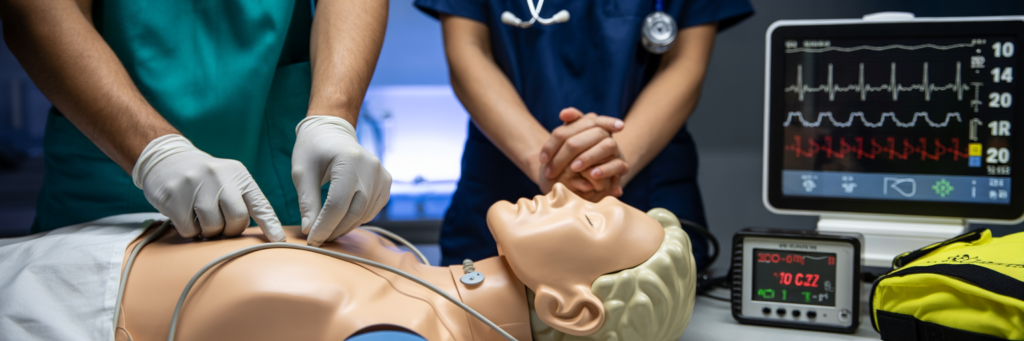
When was the last time you confidently led a resuscitation without second-guessing your assessment sequence?
For critical care nurses, emergency physicians, and paramedics, advanced resuscitation assessment isn’t just a skill—it’s the difference between decisive action and hesitant uncertainty during a code blue.
Most of us learned resuscitation frameworks years ago during our initial training. You probably practiced DRSABCD until you could recite it in your sleep. But here’s the problem: the 2024 Australian Resuscitation Council guidelines changed enough that what you remember from 2021 might not be current anymore. The changes aren’t dramatic enough to make headlines, but they’re significant enough to affect your clinical practice.
Whether you’re managing post-cardiac arrest care in ICU, leading trauma resuscitations in ED, or conducting field assessments as a paramedic, systematic evaluation is your most reliable tool when everything else is chaos. It’s the framework that prevents you from missing critical findings when you’re running on adrenaline and everyone’s yelling for directions.
This isn’t another basic CPR review that treats you like you’ve never seen a resuscitation before. You don’t need someone to explain how to check for a pulse or why chest compressions matter. What you need is a structured approach to advanced resuscitation assessment that aligns with ARC 2024 standards—the kind of framework that guides your decisions when a patient’s deteriorating fast, the monitor’s alarming, and everyone’s looking to you for direction.
Understanding ARC 2024 Advanced Resuscitation Assessment Updates
The 2024 Australian Resuscitation Council guidelines refined how we approach assessment during active resuscitation. The biggest shift? Moving from “pause and check” toward continuous real-time assessment.
Instead of stopping compressions every two minutes for full reassessment, you’re now integrating assessment into ongoing resuscitation. Your ETCO2 waveform tells you about perfusion quality without pausing. Your team member checks pulses during rhythm analysis. The monitor gives continuous feedback.
Key changes affecting your practice:
The 2024 guidelines emphasize capnography as an assessment tool during CPR. If your ETCO2 is below 10 mmHg after 20 minutes of resuscitation, that’s telling you something about perfusion quality and prognosis.
Airway assessment got more specific. Now there’s clearer guidance on when to escalate from basic to advanced airway based on specific clinical indicators, not just arbitrary time limits.
Circulation assessment during CPR includes specific targets for compression quality that your team should monitor continuously: depth 5-6cm, rate 100-120/min, complete recoil between compressions.
The reversible causes—4Hs and 4Ts—got reorganized based on likelihood and assessment priority. Hypoxia and hypovolemia move to the front because they’re both common and rapidly correctable.
For experienced clinicians, these updates mostly formalize what you were probably already doing. But having it in official guidelines means you can advocate for better equipment and standardized approaches across your team.
DRSABCD Quick Reference for Healthcare Professionals
| Component | Assessment Focus | Time Allocation | Critical Action |
|---|---|---|---|
| D - Danger | Equipment, infection control, team safety | 3 seconds | Visual sweep while positioning |
| R - Response | GCS, pupils, posturing patterns | 5-10 seconds | Establish neurological baseline |
| S - Send for Help | Resource needs, team activation | Immediate | Assign roles, request equipment |
| A - Airway | Patency, sustainability, escalation need | 5 seconds | Basic → Advanced decision |
| B - Breathing | Rate, depth, symmetry, ETCO2 | 10 seconds | Target 10 breaths/min with airway |
| C - Circulation | Pulse, CPR quality, monitor correlation | 5-10 seconds | Start compressions if no pulse |
| D - Defibrillation | Rhythm identification, pad placement | <5 seconds | Shock shockable rhythms immediately |

Primary Survey: The DRSABCD Assessment Framework
You’ve done DRSABCD a thousand times. But the advanced version for healthcare professionals looks different because you’re working with equipment, teams, and monitoring that completely change how you assess.
Danger Assessment in Critical Care Environments
In hospital, danger assessment isn’t about traffic or power lines. It’s about not getting shocked by the defibrillator, not catching whatever infectious disease your patient might have, and not tripping over the crash cart.
Your danger assessment in critical care includes:
- Equipment hazards: Defibrillator pads correct? Everyone clear before shock?
- Infection control: Patient’s status known? Gloves and eye protection minimum
- Team safety: Everyone positioned safely for prolonged CPR?
- Environmental: Bed at appropriate height? Emergency equipment accessible?
This takes about 3 seconds—a quick visual sweep while moving into position.
Response Evaluation: Beyond Basic Consciousness Checks
In critical care, you’re evaluating level of consciousness, neurological status, and whether their current state represents acute deterioration or expected post-intervention status. This goes way beyond tapping someone’s shoulder and asking if they’re okay.
AVPU is fine for rapid screening, but GCS gives you more granular information that actually influences your decisions. A patient who’s “V” (responds to voice) on AVPU could be GCS 12 (opens eyes to speech, confused conversation, obeys commands) or GCS 8 (opens eyes to pain, incomprehensible sounds, flexion to pain)—that’s a four-point difference that completely changes your airway management, imaging decisions, and disposition planning.
Pupillary response tells you about brainstem function and helps differentiate causes. Equal and reactive pupils? Good sign for potential neurological recovery. One blown pupil (dilated and non-reactive)? You’re thinking increased ICP from bleed, herniation, or structural injury—this patient needs urgent imaging and neurosurgical consultation. Both pinpoint (1-2mm)? Consider opiate overdose, and you’re reaching for naloxone. Both dilated and fixed? Either you’re late in a prolonged arrest with poor prognosis, or there’s a toxicological cause, or they’ve had significant hypoxic injury.
Posturing patterns give you additional information about brainstem integrity. Decorticate posturing (arms flexed toward core, legs extended) suggests damage above the red nucleus but below the cortex. Decerebrate posturing (everything extended, arms rotated inward) indicates damage at or below the red nucleus. Neither is good, but they’re telling you about the level and severity of neurological injury.
Here’s what experienced clinicians know: response can change during resuscitation, and that change tells you something. A patient who was unresponsive at the start might start fighting the airway after a few rounds of CPR and adrenaline—that’s actually a positive sign indicating brain perfusion is improving, even though it makes your technical management more difficult. You might need to adjust your airway management or consider sedation, but you’re doing that because they’re getting better, not worse.
Send for Help: Activating Code Blue Systems
For advanced resuscitation assessment, “send for help” means more than hitting the emergency button. You’re simultaneously activating the code blue team, assigning roles, getting the crash cart, and requesting additional equipment.
The assessment part: determining what resources you actually need. Witnessed VF arrest in a monitored patient? You might only need the defibrillator and extra hands. Unwitnessed arrest in a general ward patient? You need the full team, airway trolley, and probably an ICU bed.
Airway Assessment Under Crisis Conditions
Advanced airway assessment asks: “is it open, will it stay open, do I need to secure it, and how urgently?”
Your rapid evaluation:
- Patency now: Can air move? Look, listen, feel. Five seconds maximum
- Sustainability: Will it stay open? Deeply unconscious patients can’t maintain their own airway
- Foreign body vs obstruction: Vomit? Blood? Tongue? Each requires different management
- Escalation decision: Basic maneuvers? Bag-mask? Definitive airway?
The decision to intubate during CPR isn’t always straightforward. If CPR quality is excellent with bag-mask ventilation and your team member isn’t confident with intubation, continuing what’s working might be better than interrupting compressions for difficult intubation.
The 2024 guidelines: use the most effective airway management available without significantly interrupting compressions.
Breathing Assessment: Clinical Signs That Matter
You’re assessing breathing adequacy, not just presence. The question isn’t “are they breathing?” but “is this breathing pattern achieving adequate gas exchange and supporting circulation?”
Rate: During CPR, aim for 10 breaths per minute (one every 6 seconds) once you’ve got an advanced airway. This is way slower than people naturally bag, especially under stress. Too fast—which is the most common error—decreases venous return and makes CPR less effective. When you hyperventilate during CPR, you’re increasing intrathoracic pressure, which makes it harder for blood to return to the heart, which means your compressions are generating less forward flow.
Depth: Moderate chest rise with each ventilation. Over-inflation increases intrathoracic pressure and reduces compression effectiveness. If you’re squeezing the entire bag, you’re probably over-ventilating. Aim for about two-thirds compression of the bag.
Symmetry: Unequal chest rise could mean pneumothorax, hemothorax, or mainstem intubation where the ETT’s advanced too far. Tension pneumothorax is a reversible cause that’ll kill your patient if you miss it, and it can develop quickly during positive pressure ventilation.
SpO2: Often unreliable during arrest due to poor perfusion—the probe can’t detect a signal when peripheral blood flow is minimal. Don’t make decisions based on the number when it’s jumping between 60% and “no signal.” Rely on clinical assessment and ETCO2 instead.
ETCO2 waveform: Your most valuable tool during CPR. A good square waveform confirms ETT placement. It tells you ventilations are adequate and gives you indirect information about circulation. ETCO2 above 10-15 mmHg during CPR suggests you’re generating forward flow. Below 10 mmHg consistently? Either compression quality needs improvement or you’re not achieving adequate circulation despite good technique.
Clinical pearl: sudden jump in ETCO2 from 15 mmHg to 35-40 mmHg often means return of spontaneous circulation before you feel a pulse. When circulation restarts, CO2 delivery to lungs increases dramatically. Check for pulse immediately—don’t wait for the next scheduled rhythm check.
Circulation Assessment in Cardiac Arrest
Circulation assessment during active CPR is continuous.
Pulse check: Carotid pulse for 5-10 seconds maximum. If it’s not obvious within 10 seconds, assume no pulse and continue CPR. Some prefer femoral pulse because it’s easier to feel during CPR.
Cardiac monitor integration: Correlate what you see on the monitor with what you feel clinically. Organised rhythm but no pulse? PEA. No organised rhythm? VF, VT, or asystole.
CPR quality: Someone monitors quality continuously. Adequate depth? Rate 100-120? Complete recoil? This is real-time assessment, not post-start checking.
ETCO2 during CPR: Gives indirect feedback about circulation quality. Staying above 10 mmHg means compressions are generating forward flow. Drops below 10 and stays there means either decreased compression quality or inadequate circulation generation.
Defibrillation Readiness Assessment
Defibrillation assessment happens in the first 60 seconds, then every 2 minutes during rhythm checks. Speed matters here because every second you delay appropriate defibrillation decreases survival.
Rapid rhythm identification: Determine shockable vs non-shockable in under 5 seconds. VF (chaotic, irregular waveform with no identifiable complexes) and pulseless VT (wide, regular complexes at rate usually >100) are shockable. PEA (organized electrical activity without pulse) and asystole (flatline or near-flatline) are not shockable.
If you’re not confident with rhythm interpretation at speed, this is a skill that needs deliberate practice. The difference between shocking asystole (which doesn’t help and delays compressions) and shocking VF (which might save the patient) is pattern recognition. You can’t pause to think about it during a code—you need to know instantly.
Pad placement: Anterior-lateral is standard. One pad right upper chest below clavicle, one pad left mid-axillary line. Not touching each other, not over medication patches (remove those first), not over pacemaker devices (place at least 8cm away). Proper placement matters for effective current delivery through the heart.
Safety: Someone confirms “everyone clear” and visually checks before every shock. Two seconds. Don’t skip it because you’re in a hurry—getting shocked yourself doesn’t help anyone, and you becoming a patient doesn’t help the patient you’re trying to save.
The question isn’t just “should we shock?” It’s “should we shock NOW or continue CPR?” Some evidence suggests continuing high-quality compressions for 60-90 seconds before first shock might improve outcomes for unwitnessed arrests. But witnessed arrest with immediate defibrillator access? Shock immediately makes sense. The key is minimizing interruptions to compressions once you start.

Secondary Survey: The ABCDE Systematic Assessment
The secondary survey gives you detailed, system-by-system assessment after your first round or two of CPR. Primary is “what’s going to kill them in the next 60 seconds.” Secondary is “what caused this and what else might kill them in the next 10 minutes.”
Airway: Advanced Assessment Beyond Patency
If you’ve intubated, confirm tube placement and security. ETCO2 waveform is gold standard—consistent waveform means tube’s in right place. Check tube depth: usually 21cm for women, 23cm for men, but what matters is whether it’s moved.
A dislodged ETT during CPR is a disaster. Make sure it’s properly secured and someone’s monitoring position during compressions.
Breathing: Ventilation Adequacy
Tidal volume: Moderate chest rise with each ventilation. Squeezing bag two-thirds should be enough. Squeezing the whole bag over-inflates lungs and decreases CPR effectiveness.
Ventilation rate: Most common error is hyperventilation. You want 10 breaths per minute once you’ve got advanced airway. Hyperventilation increases intrathoracic pressure and makes compressions less effective.
ETCO2 trending: Should be stable at 10-20 mmHg during CPR. Climbing? Not ventilating enough. Dropping? CPR quality decreased or perfusion worsening.
Bilateral air entry: Unequal entry could mean pneumothorax or mainstem intubation. Pneumothorax can progress to tension quickly with positive pressure ventilation.
Circulation: Perfusion Assessment
CPR quality monitoring: Continuously assess compression depth (5-6cm), rate (100-120/min), and recoil. Compressor fatigue happens fast—swap every 2 minutes.
ETCO2 as perfusion indicator: Above 10-15 mmHg suggests adequate forward flow. Below 10 mmHg despite good technique means worse prognosis.
Vascular access: Good IV or IO access? Can you push drugs quickly? Might need better access before next drug dose.
Rhythm reassessment: Every 2 minutes check rhythm. Has VF/VT persisted? Changed to PEA or asystole? ROSC occurred?
Disability: Neurological Assessment
Pupil assessment: Size, symmetry, reactivity. Equal and reactive suggests better neurological outcome than blown or fixed.
Response to interventions: Some patients show consciousness during CPR—moving limbs, trying to breathe over ventilator. Positive sign indicating cerebral perfusion.
Glucose check: Hypoglycaemia can cause arrest. Quick check rules it out as reversible cause.
Exposure: Looking for Hidden Problems
Strip the patient down and look for missed signs. Track marks suggesting overdose? Surgical scars indicating recent surgery? Rashes suggesting anaphylaxis or sepsis? Medical alert bracelets? Fever suggesting sepsis? Hypothermia is a reversible cause.
Takes 30 seconds during rhythm check—looking for obvious signs that change management.
⏱️ TIME-CRITICAL THINKING: You're not investigating each reversible cause sequentially. You're treating the likely ones based on history and clinical signs while maintaining high-quality CPR.
Reversible Causes Assessment: The 4Hs and 4Ts
Every cardiac arrest has a cause. Think through the reversible ones systematically while resuscitation continues.
The 4 Hs
Hypoxia: Adequately oxygenated? Airway patent? Ventilations effective? Check SpO2 and ETCO2.
Hypovolaemia: Obvious bleeding? Trauma? Recent surgery? Ruptured AAA? If hypovolaemia is likely, need volume resuscitation and blood products.
Hyper/hypokalaemia: Check recent bloods. Dialysis patients, renal failure, certain medications are at risk. ECG showing tall peaked T waves suggests hyperkalaemia.
Hypothermia: Check temperature. If core temp below 35°C, need slow rewarming and prolonged resuscitation—not dead until warm and dead.
The 4 Ts
Thrombosis: Massive MI or PE causing arrest? History of chest pain? Recent surgery suggesting PE risk? Might need thrombolysis during CPR or immediate cath lab.
Tension pneumothorax: Unequal chest rise? Tracheal deviation? Decreased air entry? JVP elevated? Needle decompression can be life-saving. Don’t wait for chest X-ray during CPR.
Tamponade: Recent cardiac surgery? Trauma? Malignancy? Hard to diagnose during CPR, but ultrasound can show pericardial fluid. Treatment is pericardiocentesis.
Toxins: Drug overdose? Medication error? Known ingestion? Think specific antidotes—naloxone for opiates, lipid emulsion for local anaesthetic toxicity, digoxin antibodies for digoxin.
Think through these systematically while CPR continues. You’re treating likely ones based on history and clinical signs while maintaining high-quality CPR.

Post-ROSC Assessment Protocol
ROSC doesn’t mean the job’s done. Post-ROSC care in the first hour determines neurological outcome.
Confirm adequate perfusion: Palpable pulse? Blood pressure? Peripherally perfusing? Sometimes you get brief pulse that disappears—not sustained ROSC.
Reassess airway and breathing: Maintaining own airway or need to stay intubated? Respiratory effort? SpO2 target post-ROSC is 94-98%, not 100%.
12-lead ECG: Get within 5 minutes of ROSC if possible. Looking for STEMI or cardiac causes needing immediate intervention.
Targeted temperature management: Current guidelines aim for normothermia (36-37°C), avoiding fever. Fever in first 72 hours post-arrest is associated with worse neurological outcomes.
Neurological assessment: GCS, pupil check, obvious focal signs. Don’t predict outcome based on immediate post-ROSC neuro status—can improve significantly over first few hours.
Identify and treat the cause: Go back to 4Hs and 4Ts. What caused this arrest? If you haven’t treated it, they’ll arrest again.
The Assessment Skill That Defines You
The difference between a good critical care clinician and an exceptional one often comes down to assessment. Not how fast you push drugs or how perfectly you do compressions, but how systematically you evaluate what’s actually wrong.
When everyone’s looking to you for direction during a code, your assessment framework guides every decision. It’s what lets you stay calm and methodical when everything around you is chaos. It’s what prevents tunnel vision when the monitor’s alarming and three people are shouting different suggestions.
The 2024 ARC guidelines gave us updated frameworks based on current evidence. Now it’s on you to integrate them into practice, drill them until they’re automatic, and trust your systematic approach even when your gut screams something else.
Your patients deserve a clinician who assesses systematically, thoroughly, and confidently. You deserve to feel confident that your assessment skills match your clinical experience. Make that investment in yourself.
Book Your First Aid Training Now
Fast, affordable, and nationally accredited training delivered by professionals who care
Frequently Asked Questions: Advanced Resuscitation Assessment
Q. What's the most significant change in the ARC 2024 guidelines for advanced resuscitation assessment?
The biggest shift is moving from periodic "pause and check" assessment toward continuous real-time assessment during CPR. Instead of stopping compressions every two minutes for full reassessment, you're now integrating assessment tools like continuous ETCO2 monitoring, pulse checks during rhythm analysis, and ongoing compression quality feedback. This approach minimizes interruptions to CPR while still gathering the clinical information you need to guide treatment decisions.
Q. How reliable is pupil assessment during and after cardiac arrest?
Pupil assessment provides valuable information but shouldn't be used for prognostication immediately post-ROSC. During arrest, equal and reactive pupils suggest better potential for neurological recovery, while abnormal findings (blown pupil suggesting herniation, pinpoint pupils suggesting opiate overdose, both fixed and dilated in prolonged arrest) help identify causes and severity. However, pupil responses can improve significantly in the hours after ROSC, so don't make outcome predictions based on immediate post-arrest neurological findings—neurological status often evolves considerably over the first 24-72 hours.
Q. What should we target for post-ROSC oxygen saturation and temperature management?
Post-ROSC targets have evolved based on recent evidence. For oxygen saturation, aim for 94-98%—not 100%, as hyperoxia may worsen neurological outcomes. For temperature management, current guidelines recommend maintaining normothermia (36-37°C) and actively preventing fever, as temperatures above 37.5°C in the first 72 hours post-arrest are associated with worse neurological outcomes. These targets represent a shift from earlier aggressive hypothermia protocols toward more moderate temperature control focused on avoiding both fever and hypothermia.
Q. What's the most common mistake healthcare professionals make during resuscitation?
Hyperventilation during CPR is arguably the most frequent error, even among experienced clinicians. Under stress, people naturally bag too fast—often 20-30 breaths per minute instead of the recommended 10 breaths per minute once an advanced airway is secured. Excessive ventilation increases intrathoracic pressure, which impedes venous return to the heart and reduces the effectiveness of chest compressions. This directly decreases coronary and cerebral perfusion. Setting a timer or metronome for ventilations (one breath every 6 seconds) can help prevent this error, especially during high-stress situations when natural timing becomes unreliable.
Q. How do I maintain assessment skills when cardiac arrests are relatively rare?
Even in busy emergency departments or ICUs, individual clinicians may only participate in a few arrests per month. Maintain proficiency through simulation training, cognitive rehearsal (mentally walking through your assessment sequence), reviewing actual cases with your team, and practicing systematic assessment on stable patients. Many units conduct regular mock codes specifically to practice the assessment and decision-making process. Consider joining your facility's resuscitation committee or teaching basic life support—explaining concepts to others reinforces your own understanding. When you do participate in real resuscitations, debrief afterward to identify what went well and what could improve, treating each event as a learning opportunity rather than just another shift task.
Making first aid training more affordable for
every classroom
We believe every student deserves access to life-saving first aid knowledge. That’s why we offer specially reduced pricing for schools and educational groups. Whether you’re booking for a single class, a year group, or your entire school, our flexible packages make training more accessible and cost-effective — without compromising quality.
