

It’s 2:37 AM. Your pager goes off—Code Blue, Ward 5C.
As you sprint down the corridor, that familiar adrenaline hits, but so does the question: “When was the last time I practiced advanced airway management?” Three years? Four? The crash cart is in front of you, the junior nurses are looking to YOU for direction, and the monitor shows a rhythm you haven’t seen since your last recertification.
This is the reality for critical care nurses across Australia’s ICU and Emergency Departments. You’re expected to lead resuscitation efforts with confidence, make split-second clinical decisions, and execute advanced skills flawlessly—often with months or years between actual practice opportunities.
The 2024 Australian Resuscitation Council guidelines introduced significant updates to advanced resuscitation protocols, yet many experienced healthcare professionals haven’t had the chance to properly integrate these changes into their clinical practice. Whether you’re working in ICU, ED, or responding to critical incidents as a paramedic, maintaining advanced resuscitation clinical skills isn’t optional—it’s the difference between life and death.
In this guide, we’ll explore the 7 critical advanced resuscitation clinical skills every healthcare professional must master, incorporating the latest ARC 2024 evidence-based protocols.
What advanced skills do critical care nurses need for resuscitation?
Critical care nurses require seven key advanced resuscitation skills beyond basic CPR:
- Rhythm Recognition & Interpretation – Rapidly identifying shockable rhythms (VF, VT) versus non-shockable rhythms (PEA, asystole) in under 3 seconds
- Advanced Airway Management – Competency with bag-valve-mask ventilation, laryngeal mask airways (LMA), and oxygen delivery systems
- Emergency Drug Administration – Precise dosing and timing of resuscitation medications including adrenaline, amiodarone, and atropine
- Defibrillation & Cardioversion – Safe and effective operation of manual defibrillators with appropriate energy selection
- Team Leadership & Communication – Directing multidisciplinary resuscitation teams using closed-loop communication
- Post-Resuscitation Care – Managing the critical first hour after ROSC (Return of Spontaneous Circulation)
- High-Quality Chest Compressions – Maintaining ARC guideline standards for depth (5-6cm), rate (100-120/min), and minimal interruptions
These skills align with 2024 Australian Resuscitation Council (ARC) guidelines and require regular practice to maintain clinical competency.
Rapid Rhythm Recognition & Interpretation
Why Rhythm Recognition Speed Matters in Critical Care
Here’s something they don’t teach you in nursing school: the difference between a save and a loss often comes down to three seconds.
Every 60-second delay in defibrillation reduces survival by 7-10% according to ILCOR data. If you’re staring at the monitor trying to remember if that’s coarse VF or artifact, trying to recall what you learned three years ago—that’s survival percentage dropping while you’re thinking.
The cognitive load during actual codes is massive. You’re managing the crash cart, directing team members, communicating with the medical team, and somehow you also need to interpret that rhythm instantly.
The Four Critical Rhythms You Must Recognize Instantly
Ventricular Fibrillation (VF): Chaotic, irregular waveform with no identifiable QRS complexes. The moment you see VF, you’re reaching for the defibrillator. There’s no pulse check, no “let me just confirm this first.” VF means immediate defibrillation.
Ventricular Tachycardia (VT): Wide QRS complexes at a rate above 100 bpm. If your patient is pulseless, you’re treating it exactly like VF—immediate defibrillation. If they’ve got a pulse, you’re going down a different treatment pathway.
Pulseless Electrical Activity (PEA): Organized electrical activity without mechanical cardiac output. Defibrillation won’t help—you need to find and fix the underlying cause while doing high-quality CPR. That’s where the H’s and T’s become critical.
Asystole: Minimal to no electrical activity. Before you call it, rule out fine VF, lead disconnection, and incorrect gain settings. Always check your leads are connected properly and increase your gain to make sure you’re not missing fine VF.
Common Rhythm Recognition Mistakes That Cost Lives
Mistaking fine VF for asystole is probably the most dangerous recognition error. Fine VF can look almost flat on the monitor, especially if your gain is set low. Always increase your gain and check multiple leads before deciding something’s asystole.
⚠️Common Mistake: Confusing artifact with VF. Patient movement, loose electrodes, electrical interference—they can all create patterns that look like VF if you're not careful. Before you shock, do a quick pulse check and look at your patient.

Advanced Airway Management
Why Airway Skills Matter More Than You Think
Poor airway management during resuscitation kills patients. Not dramatically, not obviously, but through inadequate oxygenation that compromises every other intervention you’re doing. You can have perfect compressions and give drugs at exactly the right times, but if you’re not effectively oxygenating that patient, none of it matters.
Bag-Valve-Mask Ventilation: The Foundation Skill
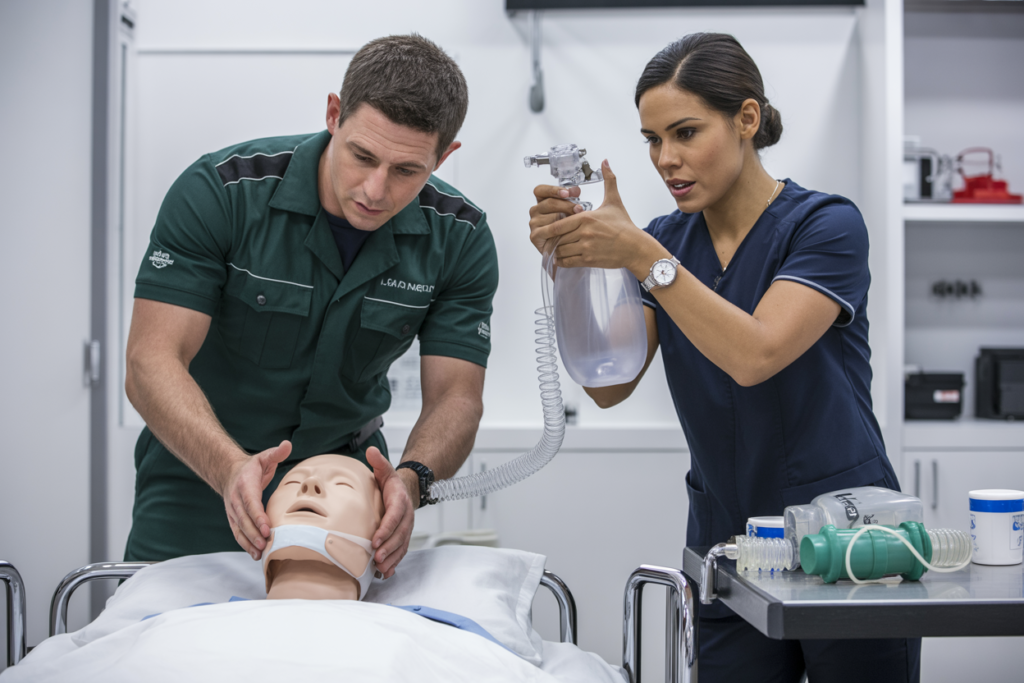
If there’s one advanced resuscitation clinical skill that separates experienced clinicians from beginners, it’s effective BVM ventilation. Two-person BVM is your default approach when you’ve got enough hands.
Person one focuses entirely on the mask seal and airway positioning—two-handed technique with thumbs on top of the mask, fingers along the jaw, lifting the jaw up into the mask. Person two squeezes the bag, watching for chest rise, coordinating with compressions during CPR.
The most common mistakes: inadequate seal (air hissing out around the mask), hyperventilation (the ARC guidelines are clear—10 breaths per minute during CPR, not 15 or 20), and inadequate tidal volume (you should see visible chest rise with each ventilation).
Supraglottic Airways: When and How to Use LMAs
An LMA can be a game-changer during prolonged resuscitation when you’re struggling to maintain effective BVM ventilation. The 2024 ARC guidelines acknowledge supraglottic airways as an acceptable alternative to intubation during cardiac arrest.
LMA insertion requires confidence. Deflate the cuff completely, maintain pressure against the roof of the mouth as you advance, inflate the cuff when positioned. You should get easy ventilation with visible chest rise—if you’re not, it’s usually positioned incorrectly.
Emergency Drug Administration
Why Drug Timing and Dosing Matter in Cardiac Arrest
Drug administration during cardiac arrest is probably the most error-prone aspect of resuscitation. Not because nurses don’t know their drugs, but because codes are chaotic and when someone yells “push a milligram of epi,” you need to know exactly which concentration, which route, and which timing without stopping to think.
The Essential Resuscitation Drugs You Must Know
Adrenaline: Your primary drug during cardiac arrest—1mg IV every 3-5 minutes. Most crash carts stock 1:10,000 concentration (1mg in 10mL) for cardiac arrest. Do not confuse this with 1:1,000 concentration used for anaphylaxis.
The 2024 ARC guidelines recommend adrenaline as soon as possible for non-shockable rhythms. For shockable rhythms, you’re giving it after the third shock if you haven’t achieved ROSC.
Amiodarone: Your anti-arrhythmic for refractory VF/VT—300mg IV initially, followed by 150mg if VF/VT persists. You’re giving this after the third shock in refractory VF/VT, not earlier.
Atropine: This is where guidelines have changed significantly. The current ARC guidelines do NOT recommend routine atropine use during cardiac arrest with asystole or PEA. Atropine is still used for symptomatic bradycardia in patients with a pulse, but not during actual cardiac arrest.
Drug Administration Timing and Protocols
Standard CPR cycles are 2 minutes. You’re giving adrenaline every 3-5 minutes, which works out to roughly every second CPR cycle. Someone on your team needs to be designated as the medication nurse and timer—tracking what’s been given, calling out when drugs are due.
Prepare your next doses during CPR cycles, not during rhythm checks. When you’re doing compressions, you’ve got 2 minutes before the next check. Use that time to draw up medications and have syringes labeled and ready.
Defibrillation & Cardioversion
Manual Defibrillation vs Automated External Defibrillators
If you’re working in critical care, you need to be comfortable with manual defibrillators. With a manual defibrillator, you can analyze the rhythm, select your energy level, charge, and shock in under 10 seconds. An AED takes 30-45 seconds—delay you can’t afford during cardiac arrest.
Energy Selection and Escalation Protocols
The 2024 ARC guidelines recommend an initial shock of 200 joules for biphasic defibrillators. If the first shock doesn’t convert the rhythm, you’re escalating: 200J for first shock, then 300J, then 360J for subsequent shocks.
Don’t pause compressions to charge the defibrillator—charge while compressions continue, pause just long enough to clear and deliver the shock (2-3 seconds), then immediately resume compressions. Total pause time should be under 10 seconds.
Safety Procedures During Defibrillation
The “clear” protocol needs to be quick but thorough. Visual confirmation is more reliable than just announcing “clear”—look at the patient’s chest, look at the bed rails, look for hands on the patient. Make eye contact with the person doing compressions to confirm they’ve stepped back.
Remove oxygen sources from immediate contact with the patient during defibrillation. If you’re using a BVM, make sure it’s not resting on the patient’s chest during the shock.
Synchronized Cardioversion for Stable Rhythms
Cardioversion is for patients with organized rhythms who have a pulse—unstable atrial fibrillation, SVT, stable VT. The sync button on your defibrillator times the shock to deliver during the R wave to avoid inducing VF.
Cardioversion typically uses lower energy than defibrillation—starting at 100-120J biphasic for atrial fibrillation. The patient should be sedated for cardioversion because delivering a shock to someone who’s awake is painful.
Post-Resuscitation Care (Post-ROSC)
The Critical First Hour After ROSC
Getting ROSC isn’t the finish line. The next 60 minutes might be even more critical than the resuscitation itself. Post-ROSC care determines whether your patient survives to discharge with their brain intact.
Studies show that the first hour after ROSC is when most secondary injury happens. Hemodynamic instability, hyperoxia, hyperthermia—all contribute to ongoing brain injury even after you’ve got circulation back.
Temperature Management and Targeted Temperature Management
The 2024 ARC guidelines now recommend either targeted temperature management at 32-36°C OR maintaining normothermia, with the key being to avoid fever. Hyperthermia (>37.5°C) in the first 72 hours post-arrest is harmful and should be actively prevented.
Monitor core temperature continuously and keep them between 36-37°C for at least the first 24 hours. If they start spiking fevers, you’re actively treating it with paracetamol, cooling blankets, or ice packs.
Hemodynamic Optimization Post-ROSC
The 2024 ARC guidelines recommend maintaining MAP (Mean Arterial Pressure) of at least 65 mmHg, with consideration of higher targets for patients with chronic hypertension. Post-arrest, cerebral autoregulation is impaired—if blood pressure drops, cerebral perfusion drops directly.
Immediately after ROSC, titrate oxygen down to target SpO2 of 92-96%. Not 100%. Evidence shows that hyperoxia post-arrest is associated with worse neurological outcomes. You’re targeting normocapnia with PaCO2 of 35-45 mmHg.
Preventing Re-Arrest in the First 24 Hours
The most common reasons patients re-arrest are largely preventable: recurrent arrhythmias, hypoxemia, electrolyte abnormalities, untreated underlying causes, and hemodynamic instability.
Post-ROSC patients need intensive monitoring—continuous cardiac monitoring, arterial blood pressure monitoring, hourly blood gases, frequent labs. This isn’t overkill—these patients are incredibly unstable and can deteriorate rapidly.
High-Quality Chest Compressions: The Foundation of Survival
Why Compression Quality Matters More Than Most Interventions
Studies using objective feedback devices show that even experienced clinicians frequently compress at the wrong depth, wrong rate, don’t allow full chest recoil, and pause too frequently. Compression quality is the single most important modifiable factor in cardiac arrest survival.
Without good compressions, you’re not perfusing vital organs, which means all your other interventions are working on a patient whose brain isn’t getting oxygen.
The Five Critical Components of Effective Compressions
Adequate Depth: 5-6cm in Adults. This is deeper than it looks. You need to feel the sternum compress significantly. Your arms should be straight, using body weight. If it doesn’t feel like hard work, you’re probably not deep enough. Rib fractures happen—that’s acceptable when you’re trying to save someone’s life.
Appropriate Rate: 100-120 Compressions Per Minute. This is faster than most people naturally compress. One hundred per minute works out to about 5 compressions every 3 seconds.
Complete Chest Recoil Between Compressions. Completely release pressure and let the chest fully recoil to its normal position. Leaning on the chest between compressions reduces the effectiveness of your next compression.
Minimal Interruptions in Compressions. Keep interruptions under 10 seconds. Continue compressions while the defibrillator charges, pause just long enough to deliver the shock, then immediately resume.
Correct Hand Position. Lower half of the sternum, center of the chest. Hands stacked, fingers interlocked, heel of the lower hand on the sternum. Arms straight, shoulders directly over the patient.
Physical Demands and Managing Compressor Fatigue
High-quality compressions are genuinely exhausting. Research shows compression quality deteriorates after about 60-90 seconds, even though the person doesn’t necessarily feel tired.
Rotate every 2 minutes, no exceptions. The switch should be seamless—next compressor is in position, previous compressor counts “switch” on the last cycle, new compressor immediately takes over. Total interruption under 5 seconds.
Don’t let people go longer than 2 minutes because “they’re doing fine.” Quality compressions matter more than who’s doing them.
Maintaining Your Advanced Resuscitation Clinical Skills
Mastering these seven advanced resuscitation clinical skills—rhythm recognition, airway management, drug administration, defibrillation, team leadership, post-ROSC care, and high-quality compressions—isn’t optional for critical care professionals. It’s the baseline competency required to effectively lead or participate in cardiac arrest responses.
But here’s the uncomfortable truth: reading about these skills doesn’t make you competent at them. Healthcare professionals lose confidence and competence in high-risk, low-frequency skills within 6-12 months without practice.
Your patients deserve better than skills that have slowly deteriorated since your last certification course. They deserve a clinician who’s practiced recently, who’s current on the latest ARC 2024 guidelines, who’s confident because they’ve done this multiple times in realistic scenarios with expert feedback.
What you should do next:
Practice regularly. Use simulation opportunities at your workplace. Volunteer for code team. Review rhythm strips during breaks. Five minutes of daily practice maintains skills better than cramming before recertification expires.
Stay current. The ARC guidelines get updated based on emerging evidence. When updates are released, actually read them.
Seek feedback. Participate in code debriefs. Ask for honest feedback about your performance during simulations. The only way to identify gaps is through feedback from people who know what good practice looks like.
Refresh formally. Don’t wait until your certification expires to get hands-on training. Best practice is refreshing these advanced resuscitation clinical skills every 12-24 months, not every 36 months.
The difference between knowing these skills theoretically and performing them confidently under pressure comes down to deliberate practice with expert feedback in realistic scenarios. That requires hands-on training with actual equipment, realistic scenarios, and instructors who’ve been where you are.
Your next code could happen tonight. Will you be ready?
Book Your First Aid Training Now
Fast, affordable, and nationally accredited training delivered by professionals who care
Frequently Asked Questions About Advanced Resuscitation Training
Q.What's the difference between basic and advanced resuscitation skills?
Basic resuscitation (BLS/CPR) focuses on initial response: recognizing cardiac arrest, calling for help, performing chest compressions and rescue breaths, and using an automated external defibrillator (AED). Advanced resuscitation skills include rhythm interpretation, manual defibrillation, advanced airway management (BVM, LMA), emergency medication administration, team leadership, and post-resuscitation care. Advanced skills are designed for healthcare professionals who manage cardiac arrests in clinical settings where you're expected to do more than basic CPR while waiting for help to arrive.
Q.How often should I refresh my advanced resuscitation skills?
The Australian Resuscitation Council recommends recertification every 3 years as a minimum standard, but many critical care facilities require annual skills verification because the evidence shows significant skill degradation happens within 12 months. Best practice suggests practicing high-risk, low-frequency skills like advanced airway management and complex rhythm recognition quarterly to maintain genuine competency, not just certification compliance. If you haven't practiced these advanced resuscitation clinical skills in 12+ months, you should consider a refresher course even if your certification hasn't technically expired.
Q.Can I complete this training online?
No. Advanced resuscitation skills require hands-on practice with real equipment under expert supervision who can provide immediate feedback on your technique. While some theory components can be delivered online, the Australian Resuscitation Council requires face-to-face practical assessment for certification because these are psychomotor skills that can't be adequately assessed through video submission or written tests. Effective courses balance efficient theory delivery with extensive hands-on practice (approximately 70% practical scenarios), which is why participants consistently report they "actually improved skills" rather than just "checked a compliance box."
Q.What equipment will I practice with during training?
Advanced resuscitation courses should provide hands-on practice with realistic manikins, monitoring equipment, manual defibrillators, advanced airway devices (BVM, LMAs), and emergency medications in a simulated clinical environment. You need to practice with equipment that mirrors what you'll actually use in your workplace, not just basic training dummies. Quality courses invest in realistic simulation equipment because muscle memory with proper equipment is what translates to competence during actual codes.
Making first aid training more affordable for
every classroom
We believe every student deserves access to life-saving first aid knowledge. That’s why we offer specially reduced pricing for schools and educational groups. Whether you’re booking for a single class, a year group, or your entire school, our flexible packages make training more accessible and cost-effective — without compromising quality.
