

Survival rates for in-hospital cardiac arrest vary by as much as 300% between facilities — and the difference isn’t luck. It comes down to whether teams are measuring, analysing, and systematically improving their resuscitation performance.
If you’ve been nursing in ICU, ED, or CCU for any length of time, you already know how to run a code. Clinical experience is real and it counts. But here’s the tension that doesn’t get talked about enough: clinical competence and measurable, improvable resuscitation performance are not the same thing. You can be a technically capable nurse and still be running blind on the metrics that actually predict whether your patient survives.
Advanced resuscitation quality improvement — the systematic use of objective data to evaluate and improve cardiac arrest responses — is how high-performing critical care units close that gap. It directly affects how you perform under pressure, how you lead a team, and how your credentials look when you’re going for that charge nurse or clinical educator role.
What Is Resuscitation Quality Improvement?
Resuscitation quality improvement (RQI) is a systematic, data-driven process used by critical care teams to measure, analyse, and continuously improve the clinical performance of cardiac arrest responses. Rather than relying on post-event recall, RQI uses objective metrics captured during and after resuscitation events to identify performance gaps and drive targeted training interventions.
The core metrics tracked in a structured RQI program include:
- CPR compression fraction — percentage of arrest time with active chest compressions
- Compression rate and depth — measured against ANZCOR/ARC guideline targets
- No-flow time — interval between compressions, including during rhythm checks and defibrillation
- Time to first shock — for shockable rhythms (VF/pVT)
- Post-ROSC care compliance — targeted temperature management, hemodynamic targets, 12-lead timing
- Team response interval — time from arrest recognition to first compression
Why Resuscitation Quality Improvement Matters for ICU and ED Nurses
The gap between perceived and measured resuscitation performance
Research consistently shows that clinician self-assessment of CPR quality correlates poorly with objective measurement. Even experienced nurses overestimate their compression fraction by 15–20% — because the feel of good compressions and the data of good compressions are two different things, and without a feedback device in the loop there’s no way to know the difference.
In-hospital cardiac arrest survival rates are directly linked to compression fraction targets. ANZCOR guidance sets the minimum at 60% — but the data points toward 80% as the threshold where outcomes meaningfully improve. Every 10% drop below that target correlates with a measurable reduction in ROSC probability. A nurse sitting at 68% isn’t just missing a number on a spreadsheet. She’s working in a performance gap with a direct line to patient outcome.
📊 Data Point: Experienced clinicians overestimate CPR compression fraction by 15–20% on average — a gap that only objective measurement can close.
How RQI data exposes blind spots that experience alone cannot
Nine years in ICU does not guarantee a compression fraction above 80%. Experience gives you pattern recognition and the ability to stay calm when everything is going wrong — genuinely valuable things. But they don’t self-correct biomechanical performance gaps that have quietly embedded themselves over years of practice.
CPR feedback-enabled defibrillators — the Zoll and Philips HeartStart devices most major Queensland hospitals already have on their wards — capture compression rate, depth, and fraction in real time. The data exists. The question is whether it’s being systematically reviewed and acted on.
For nurses with their eye on charge, clinical educator, or NUM roles — understanding RQI metrics signals systems thinking. The ability to read a code blue not just as a clinical event but as a data point in an improvement cycle. That’s the competency that distinguishes a technically skilled nurse from someone genuinely ready to lead a unit.
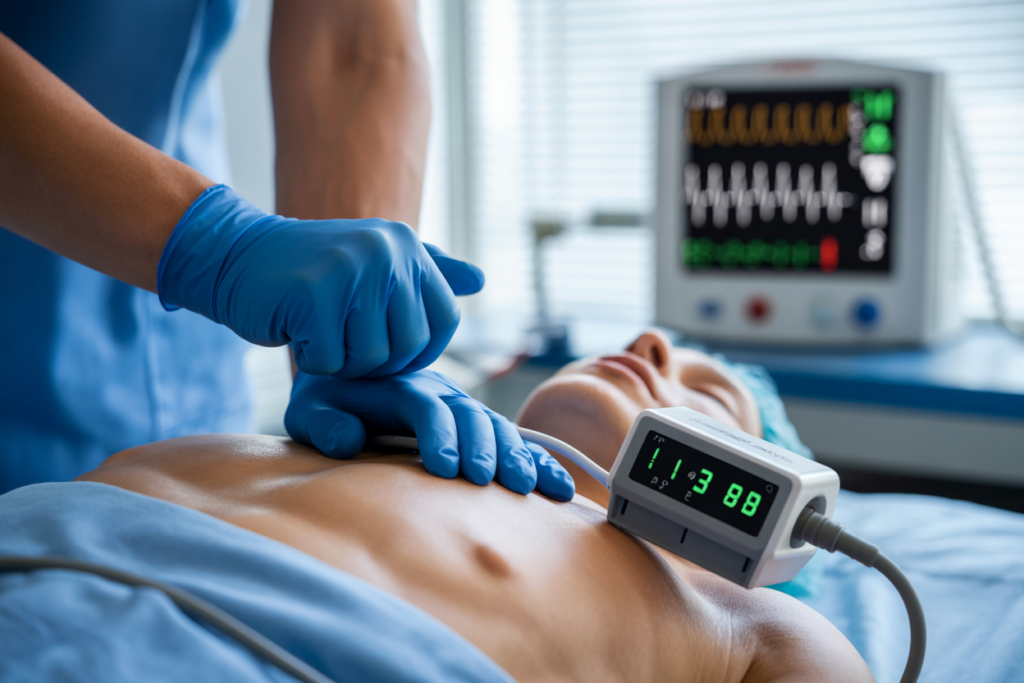
The Six Core Metrics of Resuscitation Quality Improvement
CPR Compression Fraction: The single most predictive metric
Compression fraction is the percentage of total arrest time with active chest compressions — the metric most consistently linked to ROSC probability and survival to discharge. Every pause counts against it: rhythm checks, defibrillation setup, airway interventions, team handovers. ANZCOR 2024 sets the target at ≥80%. Staying there requires deliberate team choreography, not just individual technique.
Compression Rate and Depth: Hitting the ANZCOR targets
ANZCOR 2024 targets: 100–120 compressions per minute at 5–6cm depth for adults. Above 120/min, cardiac fill time is compromised. Below 100/min, coronary perfusion pressure drops. Depth below 5cm produces insufficient perfusion pressure regardless of rate. These numbers are derived from the hemodynamic requirements of a heart that isn’t beating on its own.
No-Flow Time: Why every second off the chest costs survival probability
No-flow time is the cumulative duration of all compression pauses — rhythm checks, defibrillation, airway management, team changeovers. ANZCOR targets less than 10% of total arrest duration. When compressions stop, coronary perfusion pressure drops to zero within seconds. Each interruption costs more time than the pause itself, because it takes several compressions to rebuild adequate perfusion pressure.
Time to First Shock: The shockable rhythm window
For VF and pulseless VT, each minute without defibrillation reduces survival probability by approximately 10%. ANZCOR 2024 targets first shock delivery within 2 minutes of rhythm recognition. A team that hasn’t pre-assigned the defibrillation role bleeds minutes they don’t have.
Post-ROSC Care Metrics: Where survival is won or lost after ROSC
ROSC is not the finish line — it’s the start of a second critical window. Post-ROSC targets include targeted temperature management (32–36°C), hemodynamic stabilisation, and 12-lead ECG timing for STEMI identification. Neurological injury is substantially worsened by hyperthermia, hypotension, and hypoxia in the post-ROSC period — all modifiable if the team is executing the protocol correctly.
Team Response Interval: The systems metric that reflects unit culture
Time from arrest recognition to first compression reflects everything upstream of the clinical response — ward layout, staff proximity, crash cart positioning, alarm protocols. Delays directly reduce the probability of a shockable rhythm being present when the team arrives. The longer the interval, the more likely VF has deteriorated to asystole.
| Metric | ANZCOR 2024 Target | Why It Matters |
|---|---|---|
| Compression fraction | ≥80% | Every 10% drop below 80% correlates with measurable reduction in ROSC probability |
| Compression rate | 100–120/min | Above 120 reduces fill time; below 100 reduces coronary perfusion pressure |
| Compression depth | 5–6cm adult | Depth <5cm produces insufficient coronary perfusion pressure |
| No-flow time | <10% of arrest duration | Pauses for rhythm check, defibrillation, airway — all must be minimised |
| Time to first shock (VF/pVT) | <2 min from recognition | Each minute of VF without defibrillation reduces survival by ~10% |
| Post-ROSC temperature | 32–36°C | Targeted temperature management reduces neurological injury post-arrest |
🏥 Queensland Hospitals Have the Hardware: Most major facilities already run CPR feedback-enabled defibrillators. The gap isn't equipment — it's whether the data those devices capture is being systematically reviewed and acted on at ward level.
How RQI Programs Are Structured in Queensland Hospitals
CPR feedback devices and real-time data capture on Queensland wards
Most major Queensland hospitals already have CPR feedback-enabled defibrillators on their wards. The hardware is there. What varies dramatically — between facilities, between wards, sometimes between shifts — is what happens to that data afterwards.
In some units, post-arrest defibrillator downloads are reviewed routinely and benchmarked against ANZCOR 2024 targets. In others, the data sits on the device until the next arrest — unreviewed, unactioned, invisible. That gap is one of the most significant missed opportunities in hospital-based resuscitation improvement.
Post-event debriefing: structured vs ad hoc
A hot debrief — conducted within an hour of the arrest while the team is still together — captures factual and emotional accuracy that deteriorates rapidly. A cold debrief held one to three days later allows device data review and a more considered conversation. Both produce better outcomes than ad hoc corridor discussions. The problem in most Queensland hospitals isn’t reluctance to debrief — it’s that few clinicians have been explicitly trained to facilitate one using objective data.
How resuscitation data feeds into accreditation and ACHS review cycles
ACHS EQuIP standards reference resuscitation committee reporting and audit frequency as part of hospital accreditation. Queensland Health’s Clinical Excellence Queensland (CEQ) framework includes resuscitation as a tracked safety and quality indicator. Facilities must demonstrate they’re monitoring performance and acting on what the data shows — not just that protocols exist.
Clinicians who can read a post-arrest data download, contribute to a resuscitation committee discussion, or run a structured debrief are exactly the people hospital quality teams want in educator and leadership roles. ART Brisbane courses are recognised for credentialing by Metro North Health, Metro South Health, Mater, and Wesley Hospital.
The Role of Structured ART Training in Building RQI Competency
Why simulation-based training produces measurable RQI metric improvement
Simulation-based training with real-time CPR feedback devices is the only modality consistently shown to produce measurable improvement in compression fraction performance in subsequent real cardiac arrest events. Not lecture. Not video. Structured simulation with objective feedback, calibrated against ANZCOR targets, delivered by an instructor who can identify and correct technique in real time.
Compression fraction and depth are biomechanical skills — they degrade without deliberate, measured practice. A nurse can accumulate a decade of resuscitation experience and still drift consistently outside target range, because nobody has ever put a feedback device on her compressions and shown her the data.
What ANZCOR-aligned ART training covers that hospital in-services typically don’t
Hospital in-services are inconsistent — content varies by educator, assessment rigour varies by facility. They rarely address all six RQI metrics in a structured way. Structured ART training with an ANZCOR 2024-aligned curriculum covers:
- ALS algorithm execution — VF, pVT, PEA, and asystole with correct intervention sequencing
- Team leadership under pressure — role assignment, closed-loop communication, real-time metric monitoring
- Airway decision-making — BVM technique, supraglottic airways including LMA and iGel
- Drug dosing sequences — adrenaline and amiodarone timing, correct intervals
- Post-ROSC protocols — targeted temperature management, hemodynamic targets, 12-lead timing
Each element maps directly to an RQI metric. That’s what separates training that builds genuine competency from training that produces a sign-off sheet.
🎓 Instructor Credibility Matters: All ART Brisbane courses are facilitated by clinicians with active or recent ICU, ED, or CCU backgrounds — not generic first aid trainers. Instructor profiles and registrations are available on the course page.
How ART certification supports your AHPRA CPD portfolio
Externally certified ART through an ASQA-registered RTO provides documented, portable, nationally recognised CPD evidence — something a hospital in-service sign-off alone cannot. An AHPRA audit asks whether CPD is relevant to your practice context, measurable, and delivered by a recognised provider. Externally certified ART satisfies all three. A ward in-service satisfies one, sometimes two.
- ✓ ASQA-Registered RTO
- ✓ AHPRA CPD Recognised — Category 1
- ✓ Nationally Recognised Certificate Issued Same Day

Applying RQI Principles as a Team Leader in the Code Blue Environment
Calling the metrics in real time
Nurses who understand RQI metrics lead a code differently — actively monitoring the numbers that determine whether the event goes well, not just managing the immediate clinical tasks.
Effective code blue team leaders narrate targets aloud. “Compression fraction is strong, maintain rate.” “Two minutes — prepare for rhythm check, minimise no-flow time.” “That pause was long — back on the chest.” It’s a learnable, trainable skill that keeps the team calibrated in real time rather than discovering after the event that compression fraction sat at 64% for the last eight minutes.
Closed-loop communication directly reduces no-flow time by eliminating task handover ambiguity. “Sarah, you’re on compressions, confirm” — Sarah confirms back — no gap between the previous compressor stepping off and Sarah stepping on. Repeated across a resuscitation, that gap is where no-flow time accumulates.
The post-code debrief: how to run one that drives genuine improvement
A structured hot debrief using the RQI metric framework is more effective than a general performance discussion. The framework:
- Acknowledge the team — one sentence, genuine, before anything else
- Review compression fraction — what the device recorded, whether it hit target
- Review no-flow time — identify specific pauses, whether they can be shortened
- Review time to first shock — for shockable rhythms, what caused any delay
- Review post-ROSC handover — was the protocol initiated promptly
- One thing to carry forward — a single, actionable improvement for the next event
No blame. No performance review. Close the loop between what happened and what the data showed — and give the team one concrete thing to do differently next time.
Case Study — The Debrief That Changed the Ward
A Queensland ICU nurse with nine years of experience enrolled in ART training after her hospital introduced a credentialing requirement for HDU charge nurse eligibility. During simulation, a CPR feedback device showed her compression fraction was consistently at 68% — well below the 80% ANZCOR 2024 target.
The gap wasn’t technique. It was pause management — rhythm check intervals that ran slightly long, handover gaps that added up. Cumulatively, they were costing her 12 percentage points of compression fraction across every code she ran.
She returned to her ward and introduced informal pre-shift conversations about pause minimisation. Six months later, her ward’s post-ROSC survival data had improved measurably. She was credited in a unit governance meeting and appointed ward resuscitation champion — with a CPD portfolio in strong shape for her NUM application.
What the Metrics Tell You About Yourself as a Clinician
Most critical care nurses don’t lack confidence in their clinical ability. What they carry — quietly, often without naming it — is uncertainty about whether their performance under pressure actually matches the standard they hold themselves to. RQI metrics answer that question with data instead of guesswork.
Compression fraction doesn’t care how many codes you’ve run. The ANZCOR 2024 targets are the same whether you’re three years into ICU or thirteen. Objective measurement removes the ambiguity — it shows you exactly where you’re performing well and where the gap is. Gaps that are visible are gaps that can be closed.
The nurses who engage with RQI — who seek out simulation with real feedback, who learn to facilitate a structured debrief, who understand how compression fraction connects to coronary perfusion pressure and ROSC probability — aren’t just better at running codes. They’re the ones who get asked to lead them. Who build CPD portfolios that hold up under an AHPRA audit and stand out in a NUM panel interview.
Understanding the metrics is the start. Training to them is what moves the numbers that matter.
Book Your First Aid Training Now
Fast, affordable, and nationally accredited training delivered by professionals who care
Frequently Asked Questions
Q.What is resuscitation quality improvement?
Resuscitation quality improvement (RQI) is a systematic, data-driven process used by critical care teams to measure, analyse, and continuously improve cardiac arrest response performance. Rather than relying on subjective post-event recall, RQI uses objective metrics — CPR compression fraction, no-flow time, time to first shock, and post-ROSC care compliance — captured during and after resuscitation events to identify gaps and drive targeted training interventions.
Q.What is the target CPR compression fraction for in-hospital cardiac arrest?
ANZCOR 2024 guidelines recommend a CPR compression fraction of at least 80% during cardiac arrest resuscitation. Research shows compression fractions below 60% are associated with significantly reduced ROSC probability — and that even experienced clinicians routinely overestimate their fraction without a feedback device confirming the data.
Q.How does ART training improve resuscitation quality metrics?
Structured ART training using real-time CPR feedback devices and high-fidelity simulation is the only modality consistently shown to produce measurable improvement in compression fraction performance in subsequent real cardiac arrest events. It reinforces ALS algorithm adherence, reduces no-flow time, and builds the team communication skills that keep metric targets on track under genuine pressure.
Q.Does completing ART training count toward AHPRA CPD requirements?
Yes. Externally certified Advanced Resuscitation Training from an ASQA-registered RTO contributes to AHPRA CPD requirements as a Category 1 continuing professional development activity for registered nurses in Queensland. It provides documented, portable CPD evidence that satisfies AHPRA audit criteria — a stronger position than a hospital in-service sign-off alone.
Q.What's the difference between a hot debrief and a cold debrief?
A hot debrief is conducted within an hour of the arrest while the team is still together — it captures the factual and emotional accuracy that deteriorates quickly and takes roughly five minutes using the RQI metric framework. A cold debrief is held one to three days later to allow device data review and a more measured conversation, and is better suited to complex events where immediate post-arrest emotion might compromise the quality of reflection.
Making first aid training more affordable for
every classroom
We believe every student deserves access to life-saving first aid knowledge. That’s why we offer specially reduced pricing for schools and educational groups. Whether you’re booking for a single class, a year group, or your entire school, our flexible packages make training more accessible and cost-effective — without compromising quality.
