
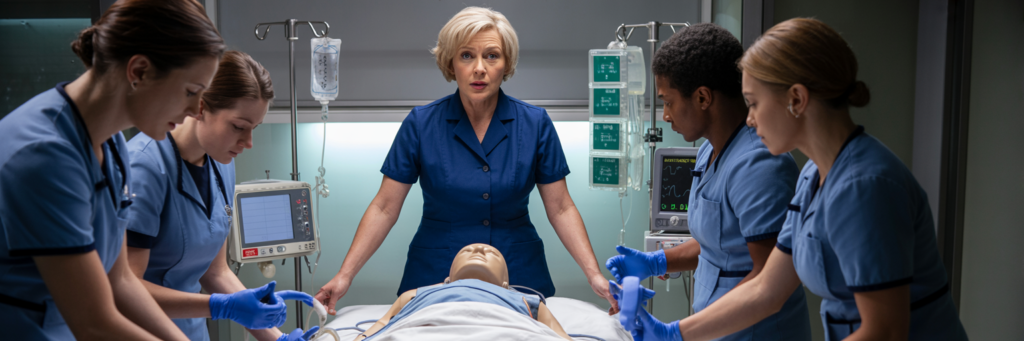
You’ve run codes. You know the algorithm. So why does the thought of being the most senior person in the room at 2am still sit uncomfortably in the back of your mind?
For most experienced nurses, the answer isn’t a knowledge gap — it’s an execution gap. Advanced resuscitation simulation training exists precisely to close it. Not by re-teaching you the basics, but by putting you inside high-fidelity arrest scenarios where the algorithm has to run automatically, the airway decisions have to be made in real time, and the team has to follow your lead.
This article walks you through exactly what to expect — the scenario formats, ALS and airway content, team leadership components, and how it translates into recognised AHPRA CPD hours. If you’ve been weighing up whether simulation offers anything beyond your hospital in-service, here’s your straight answer.
What Happens in Advanced Resuscitation Simulation Training?
Advanced resuscitation simulation training is a structured, scenario-based course designed for registered healthcare professionals to practise and consolidate advanced life support skills in a controlled, high-fidelity environment.
A typical course covers:
- ALS algorithm execution — managing pulseless rhythms including VF, pVT, PEA, and asystole in real-time simulated arrests
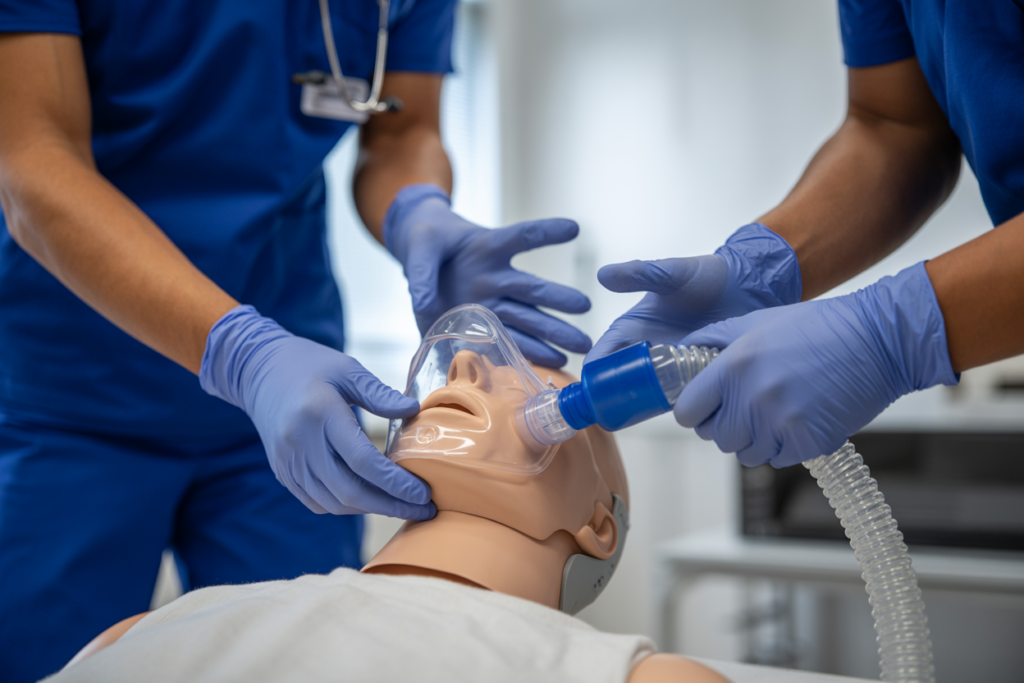
- Advanced airway management — BVM technique, supraglottic airway insertion (LMA, iGel), and intubation support
- Resuscitation pharmacology — adrenaline and amiodarone dosing, timing, and administration under pressure
- Defibrillation — rhythm recognition and safe shock delivery
- Team leadership and communication — directing a resuscitation response, closed-loop communication, role delegation
- Post-ROSC care — immediate management priorities following return of spontaneous circulation
- Structured debrief — instructor-led review of performance with individual feedback
Courses are aligned to current ANZCOR guidelines and contribute to AHPRA CPD registration requirements.
📋 Why This Matters for Your Registration: Simulation training delivered by an ASQA-registered RTO produces a nationally recognised certificate with an RTO number — the document format AHPRA auditors and hospital credentialing teams require. A hospital in-service completion record does not carry the same weight.

Why Simulation Training Hits Differently to Your Hospital In-Service
If you’ve been doing resus in-services every year for the past five, eight, ten years — you already know they’re inconsistent. One educator runs a tight, scenario-heavy session with genuine debrief. Another hands out a laminated algorithm, runs through the slides, ticks the box. Same hospital. Same ward. Different year. What counts as “completed resus in-service” varies enormously depending on who happened to run your session and when.
Advanced resuscitation simulation training is a different structure entirely.
The Problem With Inconsistent In-Service Delivery
Hospital in-services review the protocol on paper. What they rarely do — because the environment doesn’t support it — is put you inside a running arrest scenario with an instructor watching your technique, communication, and decision-making in real time. Content depth varies ward to ward, scenario fidelity varies educator to educator, and the hospital completion record that results is tied to one facility — not portable to an AHPRA audit, not always accepted for credentialing at another health network.
What Deliberate Practice Means in a Resus Context
Deliberate practice is structured, repeated exposure to specific high-demand tasks in a consequence-free environment, with immediate feedback on performance. It’s the mechanism behind how surgeons, pilots, and elite athletes build skills that hold under pressure — and it’s how simulation applies to resuscitation training.
You’re not reading about a VF arrest. You’re running one. When you hesitate on the drug dose or lose control of the airway sequence, no one gets hurt — but you get corrected. Immediately. By someone who has run those scenarios in a real ICU. Research consistently shows that psychomotor skills — compression rate, BVM technique, defibrillation sequencing — degrade meaningfully within weeks to months without reinforcement. A slideshow review doesn’t reset that clock the way hands-on simulation does.
The Portability Problem: Why Your Hospital Completion May Not Be Enough
A hospital in-service completion record is an internal document. It doesn’t tell the AHPRA auditor what the course covered, who delivered it, what competency standard was applied, or how many hours were logged. It doesn’t carry an RTO number. It wasn’t issued by a nationally registered training organisation.
An externally certified qualification from an ASQA-registered RTO does all of that. And when you’re sitting in front of a credentialing panel at a new health network, or responding to an AHPRA audit notice, the difference between those two documents is not a small one.
| Hospital In-Service | Advanced Resuscitation Simulation (RTO-Issued) | |
|---|---|---|
| Content depth | Varies by educator | Standardised, ANZCOR-aligned |
| Scenario fidelity | Low to moderate | High-fidelity, arrest-level |
| Instructor feedback | Rarely individualised | Real-time, scenario-specific |
| AHPRA CPD recognition | Inconsistent | Explicitly documented |
| Certificate portability | Internal record only | Nationally recognised, RTO-issued |
| Class composition | Mixed — all staff levels | Registered healthcare professionals only |
Hospital in-services review the protocol. Simulation training builds the instinct. The difference shows up at 2am when you’re the most senior person in the room.
Understanding why simulation works differently is the first step — knowing exactly what you’re walking into on the day is the next.
The Structure of a Simulation Day
Before You Arrive and Into the First Scenarios
Most courses include an online theory component completed beforehand — ALS algorithm structure, rhythm recognition, pharmacology basics — so the face-to-face day skips the introductory content and goes straight into scenarios. What to review: current ANZCOR ALS algorithm, shockable and non-shockable rhythms, adrenaline and amiodarone dosing.
The day opens with a short orientation — equipment familiarisation, team formation, scenario briefing. From there, the scenarios start. Early rotations establish baseline: how the team moves, where the gaps are. You’ll rotate through every role — compressor, airway, medication, scribe, team leader — across the day. The instructor is observing the whole time, actively watching technique, communication, and decision-making from the first scenario.
Complexity, Leadership, and Debrief
As the day progresses, scenarios increase in complexity. The rhythms get harder to read. The clinical picture gets less clean. Every participant takes the team leader position — calling the rhythm, directing the team, making the airway escalation decision, then debriefing with an instructor who can tell you exactly where your communication held and where it didn’t. Later scenarios include peri-arrest deterioration, post-ROSC management, and ISBAR handover under pressure. These aren’t add-ons. They’re the scenarios that separate a clinician who can run a code from one who can manage everything around it.
The structure sets the container. The scenarios are where the real work happens.

The Scenarios: What You’ll Actually Be Running
The ALS simulation course runs four core scenario types, plus advanced elements layered across the day.
Shockable Rhythms: VF and Pulseless VT
Shockable rhythms are where speed and sequencing matter most — every minute of delay in defibrillation reduces survival probability. In simulation, you’re managing the full arrest sequence in real time: rhythm recognition under pressure, defibrillation sequencing, CPR quality, and adrenaline timing. The pVT scenario adds complexity that catches people out more than VF does — teams that are fluid on VF can hesitate on pVT. Simulation exposes that hesitation where it costs nothing.
Non-Shockable Rhythms: PEA and Asystole
PEA tests clinical thinking more than technical execution. The monitor shows electrical activity. The patient has no pulse. The team has to systematically work through the H’s and T’s while running CPR and managing the airway simultaneously. The team leader has to direct a differential diagnosis in real time, with incomplete information, while keeping arrest management running. It’s the scenario most nurses find hardest — not because the protocol is complicated, but because the cognitive load of managing uncertainty while leading a team is genuinely demanding.
The Peri-Arrest Scenario and Post-ROSC
The peri-arrest scenario tests early recognition and escalation decision-making — the actions taken before the crash cart gets pushed through the door. Post-ROSC management is a distinct clinical phase with its own priorities: hemodynamic stabilisation, 12-lead ECG, targeted temperature management, and ISBAR handover under pressure. Simulation gives you a chance to do that handover badly once, get direct feedback, and do it better the next time.
Managing the rhythm is one thing. Managing the airway is another — and it’s where simulation delivers its most specific clinical value.
Advanced Airway Management: What the Course Covers
Airway is a psychomotor skill, and psychomotor skills degrade without hands-on reinforcement in a way that theory doesn’t. Whether your BVM seal is actually effective, whether your iGel insertion is producing the result you think it is — those questions only get answered when someone with clinical expertise is watching you do it.
BVM Technique: The Errors That Don’t Show Up Until Simulation
The most common BVM errors — inadequate mask seal, incorrect head positioning, excessive ventilation volume — are easy to make, hard to self-detect, and consequential in a real arrest. In simulation, the instructor observes seal quality directly. If your tidal volumes aren’t translating, you’ll be corrected before the scenario runs further. Two-person BVM technique is also covered — one clinician maintaining the C-E grip seal, one managing the bag. For many nurses, simulation is the first time this has been practised deliberately rather than improvised mid-arrest.
Supraglottic Airways, Intubation Support, and the Decision Tree
iGel insertion is covered in depth — sizing, preparation, insertion technique, and confirming placement — in the context of CPR running and the team managing simultaneous tasks. The assisting nurse’s role in intubation is covered too: equipment preparation and the current ANZCOR position on cricoid pressure, which has shifted in recent guideline updates. The airway decision tree runs BVM → supraglottic airway → intubation support, with clinical decision points based on ventilation adequacy, airway patency, and arrest trajectory — each requiring a real-time call in simulation.
Airway technique errors that go unnoticed in a real arrest are identified and corrected in simulation. Instructor observation of BVM seal, SGA insertion, and ventilation technique provides the kind of feedback that isn’t available when a patient’s life is on the line.
Technical skills are the foundation. What separates a competent resus participant from an effective resus leader is what happens above the technical layer.
🎯 The Leadership Gap Most Nurses Don't Know They Have: Technical competency and leadership competency are two different things. Simulation is the only environment where you can practise leading a real arrest — directing roles, managing simultaneous actions, and communicating under cognitive load — before it's required clinically.
Team Leadership Under Pressure
Knowing the algorithm and being technically solid makes you a competent resus participant. Most experienced ICU and ED nurses are already there. What makes a resus leader is different — it’s taking the lead without hesitation when the arrest alarm goes off and you’re the most senior person on the floor, directing roles, managing simultaneous actions, and adjusting the plan when the first interventions don’t produce a response. That gap isn’t closed by knowing more. It’s closed by doing it under pressure, with someone watching and giving you direct feedback afterward.
Closed-Loop Communication and Role Delegation
In simulation, closed-loop communication is observed and debriefed explicitly — not as a theoretical concept, but as a live performance skill. The instructor tracks how directives are given, whether they’re acknowledged, and where the loop breaks down. What the debrief surfaces is specific: not “your communication needs work” but “when you called for adrenaline, you didn’t direct it to a named team member and nobody moved for four seconds.” Role delegation is covered with the same specificity — and the harder skill of adjusting that delegation mid-arrest when something isn’t working, without creating confusion in a scenario that’s still running.
How Simulation Builds the Automaticity That Leadership Requires
When you’re still consciously thinking about compression rate and drug timing, you don’t have the mental bandwidth to lead. Repeated simulation builds the automaticity that frees that bandwidth — each rotation through compressor, airway, and medication roles reinforces the technical layer until it runs without deliberate thought, leaving your attention available for the decisions that actually require leadership.
In simulation, you rotate through the team leader role in every scenario type. Instructor debrief after each rotation provides the kind of direct performance feedback that isn’t available in a real clinical arrest.
Leadership capability is what you take back to the ward. The certificate is what you take to your AHPRA portfolio.
AHPRA CPD Recognition — How Simulation Training Counts Toward Your Registration
How AHPRA Counts Clinical Simulation Hours
AHPRA’s continuing professional development registration standard requires registered nurses to complete a minimum of 20 CPD hours per registration period. Clinical simulation sits within the Educational Activities category — the same category as formal postgraduate study and accredited workshops. A course delivered by an ASQA-registered RTO, aligned to current ANZCOR guidelines, with a nationally recognised unit of competency attached, answers the auditor’s key questions before they’re asked: was the activity relevant, was it delivered by a credible provider, and can you document what you learned?
What Your Certificate Needs to Include for an Audit
An AHPRA-compliant CPD certificate needs to include: the course title, the name of the registered training organisation, the RTO number, the unit of competency code, the hours completed, and the date of completion. An incomplete certificate — one missing the RTO number, or naming a provider that isn’t on the ASQA national register — creates a problem in an audit you can’t easily fix after the fact.
Advanced Resuscitation Training is an ASQA-registered RTO. Certificates include all documentation required for AHPRA CPD portfolio submission — course title, RTO number, hours completed, and date of completion.
RTO-Issued vs Hospital In-Service: The Audit Difference
A hospital in-service completion record was generated by your employer’s education system for internal HR purposes. It has no obligation to meet the AHPRA CPD documentation standard, doesn’t carry an RTO number, and may not be retrievable if you’ve changed employers or the system has been updated. An ASQA-registered RTO operates under a nationally consistent quality framework. The certificate it issues is a regulated document, the unit of competency sits on the national training register at training.gov.au, and the provider’s registration status can be verified by an AHPRA auditor in under sixty seconds. That’s the difference between a document that holds up under scrutiny and one that creates questions you don’t want to be answering in an audit response.
ART certificates have been accepted for clinical credentialing requirements by Metro North Health, Metro South Health, Mater Health, Wesley Hospital, and St Andrew’s War Memorial. If you need confirmation for your specific facility’s credentialing team, contact us before booking.
Ready to Book Your Simulation Course?
The scenarios are harder than a hospital in-service. The airway feedback is more specific than anything you’ll get in a real arrest. The team leader debrief will surface things about your communication under pressure you didn’t know were there. And you’ll leave with a nationally recognised qualification that holds up in an AHPRA audit, a credentialing application, or a conversation with a NUM about the charge nurse role.
The hesitation you carry into every arrest — the quiet uncertainty about whether you’d truly lead it well — that’s what this course is built to resolve. By putting you inside the scenarios, correcting what needs correcting, and sending you back to the ward with the certainty that only comes from having actually done it.
Book Your First Aid Training Now
Fast, affordable, and nationally accredited training delivered by professionals who care
Frequently Asked Questions
Q.Will this course teach me anything new if I'm already working in ICU or ED?
Yes — and the point isn't new information, it's structured execution of what you already know. Advanced resuscitation simulation training is built for practising clinicians, so it starts from your clinical baseline rather than from zero. What it adds is high-fidelity scenario practice under pressure, with an experienced instructor watching your performance and giving you specific feedback on technique, communication, and decision-making that routine ward practice and hospital in-service delivery don't provide at this level.
Q.How does simulation training count toward my AHPRA CPD hours?
Clinical simulation delivered by an ASQA-registered RTO sits within the Educational Activities category of the AHPRA CPD registration standard. Your digital certificate is issued at the end of the course day and includes everything required for AHPRA CPD portfolio submission — course title, RTO number, unit of competency code, hours completed, and date of completion. If you need to confirm whether the hours will cover your outstanding CPD requirement for the current registration period, contact us before booking.
Q.Who else will be in the course with me?
ART simulation courses run exclusively for registered healthcare professionals — registered nurses, paramedics, doctors, and allied health clinicians. There are no mixed civilian and clinical cohorts. The course is built for people who already have clinical baseline competency, and the group composition reflects that — the content, the scenarios, and the debrief are all calibrated to a clinician audience.
Q.How quickly will I receive my certificate?
Your digital certificate is issued at the end of the course day, formatted for direct upload to your AHPRA CPD portfolio. It includes all documentation required for audit purposes — course title, RTO number, hours completed, and date of completion. There's no follow-up required and no waiting for processing.
Q.What's the difference between HLTAID015 and an ART simulation course?
HLTAID015 is the nationally recognised unit of competency that the ART course delivers. Simulation is the training methodology used to achieve that competency. Completing the ART simulation course results in the HLTAID015 qualification, issued by an ASQA-registered RTO — the unit code that sits on the training.gov.au register and that an AHPRA auditor or hospital credentialing team can independently verify.
Making first aid training more affordable for
every classroom
We believe every student deserves access to life-saving first aid knowledge. That’s why we offer specially reduced pricing for schools and educational groups. Whether you’re booking for a single class, a year group, or your entire school, our flexible packages make training more accessible and cost-effective — without compromising quality.
