
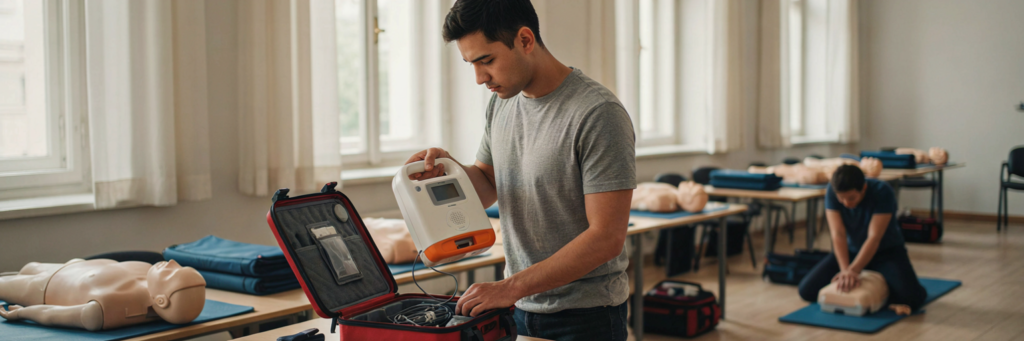
A lot of people searching for an AED training course assume they need to book something separate from their regular first aid course, and end up more confused than when they started. You go looking for information on defibrillators and you land on American pages talking about American guidelines, or you find a standalone AED-only provider and start wondering if that’s actually what your workplace needs. It isn’t the straightforward answer people expect to find.
Here’s the thing that trips most people up: if you’re doing a Provide First Aid course (HLTAID011), AED training is already built in. It’s not an add-on, it’s not an upsell, it’s part of the course you’re already booking. What people are actually looking for when they search this is usually one of two things: what does the AED component of a first aid course cover, or do I need something extra on top of what I’m already doing.
This post walks through what an AED training course actually covers, how it fits inside your broader first aid training, what the day looks like in practice, and what certificate you walk away with at the end.
What Is AED Training?
AED training teaches you to recognise the signs of cardiac arrest and use an Automated External Defibrillator to help restart a normal heart rhythm, following ANZCOR-aligned guidelines used across Australia. It’s taught as a practical, hands-on component within first aid courses like HLTAID011, not as a separate qualification.
It’s worth being clear early on that this isn’t a course about the technology itself. Nobody’s expecting you to understand how the internal circuitry analyses a heart rhythm, or why the device is built the way it is. The training is entirely about what you do, in what order, and how confidently you do it.
What you actually learn covers:
- Recognising the signs of cardiac arrest, including unresponsiveness and abnormal or absent breathing
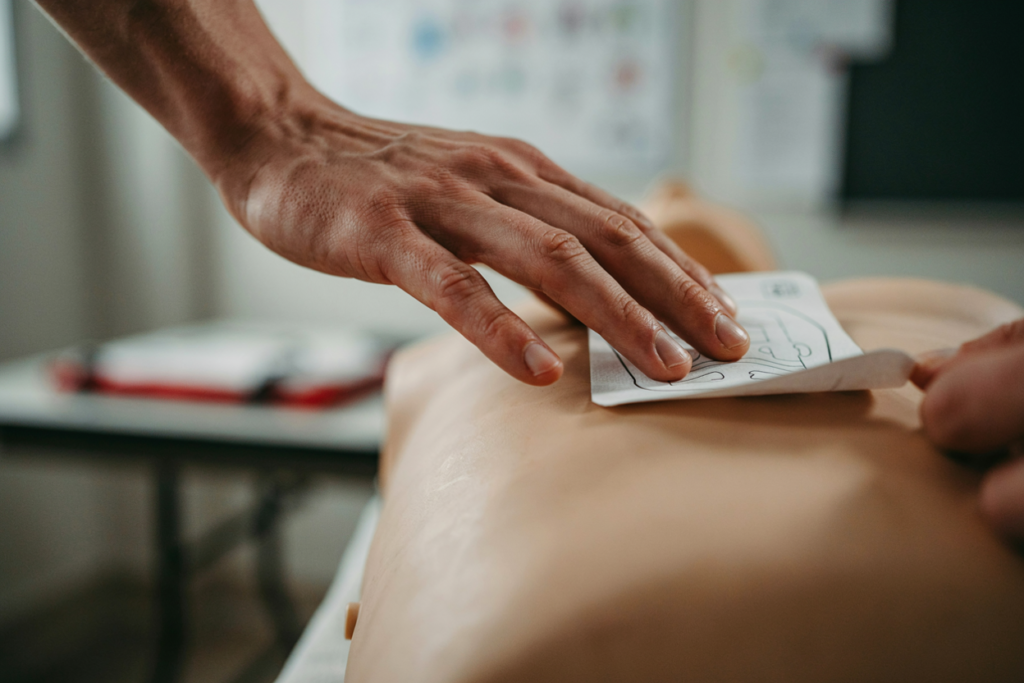
- How to correctly apply the AED pads to a person's chest
- Following the AED's voice prompts, which guide you through each step in real time
- Combining AED use with CPR, since the two work together rather than one replacing the other
- ANZCOR-aligned procedures for adult AED use, which is what Australian workplaces and RTOs teach and expect
None of this is treated as a stand-alone skill you bolt onto what you already know. It’s woven into the same sequence you use for any collapse or cardiac emergency, so by the time you’re actually reaching for an AED, the steps leading up to it already feel familiar rather than foreign.
📋 Worth knowing: AED skills are assessed as part of the same practical component as CPR, not as a separate sign-off.
What Does an AED Training Course Actually Cover?
The AED component of your first aid training isn’t a separate module tacked on at the end. It sits right inside the practical skills you’re building throughout the day, alongside CPR and basic life support. Your trainer walks you through the ANZCOR Chain of Survival, which is the framework Australian first aid courses are built around: early recognition, early CPR, early defibrillation, and early advanced care. Each link matters on its own, but the training focuses on how they connect, because a person who’s collapsed doesn’t benefit from any one step done perfectly in isolation. What actually improves the outcome is moving through the whole chain without hesitating between steps, and that flow is what the practical component is really drilling into you.
The Core Skills You’ll Learn
By the end of the AED component, you should be able to:
- Turn the unit on and follow its voice prompts without hesitating
- Place the pads correctly, even under pressure
- Keep performing CPR while the AED analyses the heart rhythm
- Deliver a shock safely when the AED advises it, and know when it won't
- Work as part of a team, alternating compressions and AED operation
None of these skills are taught as isolated checkboxes. Your trainer runs scenarios where you’re moving between compressions and the AED the way you actually would in a real event, so switching between skills gets just as much attention as the skills themselves. That’s often the part people underestimate going in, and the part they find most valuable coming out.
Recognising When to Use an AED
A big part of the training isn’t the device itself, it’s knowing when to reach for it. You’re taught to recognise a person who is unresponsive and not breathing normally, and to understand that an AED is used alongside CPR, not instead of it. Most people come out of this part surprised at how much the machine actually does for you. Once it’s switched on, it talks you through nearly everything.
If you haven’t looked at what the full course involves beyond the AED component, the Provide First Aid course (HLTAID011) page covers the rest of what’s taught on the day.
Once you understand what you’re learning, the next logical question is how the device itself actually works.
⚡ Reminder: The AED does the analysis. Your job is recognition, pad placement, and keeping CPR going around it.
How Does an AED Actually Work?
An AED sounds a lot more complicated than it actually is. The whole point of the design is that someone with no medical background can pick it up and use it correctly, and that’s exactly what you’re trained to do.
Voice Prompts and Automatic Heart Rhythm Analysis
Once the AED is switched on, it talks you through every step out loud. You attach the pads where it shows you, and the device analyses the person’s heart rhythm on its own. It only advises a shock if one is actually needed, so you’re not making that call yourself. It’s built to guide, not to test you.
Is It Safe for a Non-Medical Person to Use?
Yes, and this is genuinely one of the most reassuring parts of the training. AEDs won’t deliver a shock unless the heart rhythm calls for it, so there’s no risk of doing harm by using one on someone who doesn’t need it. That built-in safeguard is exactly why the Australian Resuscitation Council (ANZCOR) supports AED use by trained laypeople as a standard part of first aid response, not something reserved for paramedics.
This is also why AEDs are turning up in more workplaces, shopping centres, and community spaces than they used to. The device is designed around the assumption that whoever finds it might have no clinical background at all, and the training exists to make sure that assumption holds up when it actually matters. You’re not being trained to override the machine’s judgement, you’re being trained to work alongside it confidently.
Knowing how the device protects you from getting it wrong naturally raises the next question: do you actually need a separate course to learn it, or is this already covered?
How an AED works, step by step:
Step | What Happens | What You Do |
1. Power on | The unit activates and begins giving voice prompts | Follow each instruction as it’s spoken |
2. Pad placement | The AED tells you where to place the pads | Attach the pads to bare skin as shown |
3. Rhythm analysis | The device reads the heart rhythm automatically | Stand clear and let it analyse |
4. Shock advice | The AED only advises a shock if one is needed | Deliver the shock only when prompted |
5. Ongoing CPR | The device prompts you to resume compressions | Continue CPR until help arrives or told to stop |
Do You Need a Separate AED Course, or Is It Already Included in First Aid Training?
This is the question that brings most people to this page, and the answer is simple: if you’re doing HLTAID011, you don’t need to book anything else. AED training is already included.
HLTAID011 Includes AED Training
HLTAID011, the Provide First Aid course, is actually made up of two component units: HLTAID009 (Provide Cardiopulmonary Resuscitation) and HLTAID010 (Provide Basic Emergency Life Support). AED training sits within these components, not off to the side. So when you complete HLTAID011, you’re not just getting general first aid skills, you’re getting CPR and AED training as a built-in part of the same qualification. One course, one certificate.
When a Standalone AED-Only Course Might Make Sense
There are a small number of situations where a standalone AED course could be relevant, mostly for people who already hold a current HLTAID009 or HLTAID011 and just want a short refresher closer to their renewal date. For most people searching this, though, that’s not the situation they’re in. If your certificate has lapsed or you’ve never done one, HLTAID011 is the course that covers everything in one sitting, AED included.
Where people occasionally get caught out is assuming a general first aid certificate from years ago automatically included this content, when older courses or non-nationally-recognised training didn’t always cover it the same way. If you’re not certain what your existing certificate actually included, it’s worth checking rather than assuming, particularly if it’s been a while since you last renewed.
If you’re not sure whether your existing certificate has lapsed, our certificate expiry explainer walks through how to check.
The straightforward move here is to book the course that already has AED training built in, rather than trying to piece together two separate bookings.
Once you know which course you actually need, the next thing most people want to know is what the day itself looks like.
🎯 Bottom line: If you don't already hold a current HLTAID009 or HLTAID011, you don't need a separate AED course. HLTAID011 covers it in one sitting.
What to Expect: AED Training as Part of Your First Aid Course
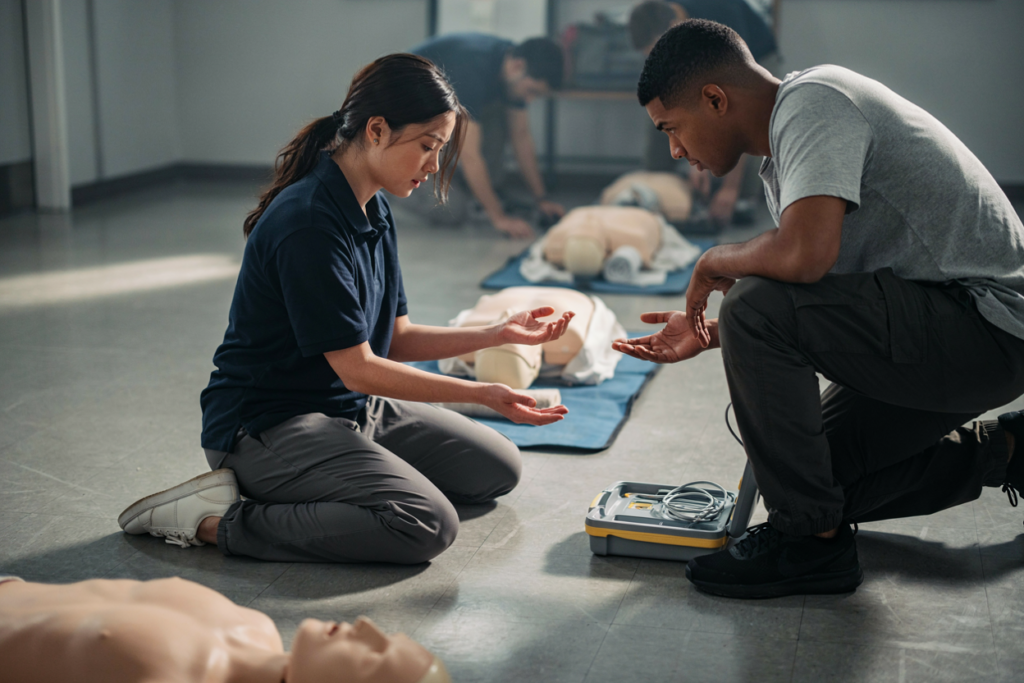
The AED component is heavily practical. You’ll spend far more time with your hands on a training AED and a manikin than you will sitting through slides. Trainers run you through the sequence repeatedly, so the actions start to feel automatic rather than something you’re trying to remember under pressure. That repetition is really the whole point. It’s the difference between knowing what to do in theory and actually being able to do it when it counts.
You’re not sitting through content that feels disconnected from what you’ll actually use. The AED and CPR components are woven together throughout the course, which mirrors how you’d actually use them together in a real situation.
Trainers are also there to answer the questions people are often too self-conscious to raise in a group setting, like what actually happens if you place a pad slightly wrong, or whether you can hurt someone by starting CPR when it turns out they didn’t need it. Getting those answered out loud, in the room, tends to matter more for people’s confidence than any amount of reading beforehand.
Once the practical side is done and dusted, the last piece is what you actually walk away with.
AED Training Certification: What You Actually Receive
A Nationally Recognised Statement of Attainment
When you complete HLTAID011, you receive a nationally recognised Statement of Attainment covering all the component units, including the AED and CPR skills you’ve just learned. It’s issued under RTO 31106, so it’s not some generic certificate of attendance, it’s a proper qualification that’s recognised right across Australia.
Will My Employer Accept It?
Yes. Because HLTAID011 is a nationally recognised unit of competency, employers accept it as standard, whether it’s for a workplace policy requirement or an industry obligation. You won’t need to check with HR before booking or explain to anyone why this particular certificate counts.
This matters more than people expect going in, because plenty of workplace policies simply say “current first aid certificate required” without specifying a course code, which leaves employees guessing. Holding HLTAID011 removes that guesswork entirely. It’s the broadest, most widely recognised qualification of its kind, so it satisfies pretty much any generic workplace requirement you’ll come across.
Your certificate gets issued digitally so you can forward it straight to your workplace without extra back and forth.
Getting AED Training Sorted
Finding out your first aid certificate has lapsed, or realising you’ve never actually done one, tends to come with a bit of a scramble. You start searching, you land on pages written for a different country, and somewhere along the way AED training starts to feel like its own separate thing you need to sort out on top of everything else. It isn’t. It never was.
What actually happens on the day is far more joined up than the search results suggest. You learn to recognise cardiac arrest, you learn CPR, and you learn to work an AED, all inside the one course, taught together because that’s how they’re actually used together in a real situation. The device itself does a lot of the heavy lifting too. It talks you through every step, it analyses the heart rhythm on its own, and it won’t advise a shock unless one is genuinely needed. The training exists to make sure you can act fast and correctly, not to make you memorise something you’ll forget the moment you need it.
By the time you walk out, you’ve got a nationally recognised Statement of Attainment that covers everything, AED included, issued under a proper RTO number rather than a certificate of attendance that nobody’s going to question or need explained. Your employer accepts it without a second look, and you’ve got proof in hand ready to forward on straight away.
The bigger, quieter win is the one that doesn’t show up in a job description or a compliance checklist. It’s the confidence that if something did happen, at work or somewhere else entirely, you wouldn’t freeze. You’d know what to do, because you’ve actually done it before, hands on, under a trainer’s eye, not just read about it.
So if you’ve been putting this off because it felt like one more thing to figure out, it really isn’t. AED training is already part of your first aid course. Book it, get it done, and stop thinking about it.
There’s also a version of this where you never end up needing to use any of it, and honestly, that’s the most likely outcome. But the value of having done the training doesn’t disappear if you never have to act on it. It sits there quietly, in the background, as one less thing you’d have to figure out on the spot if the day ever came where it counted.
Book Your First Aid Training Now
Fast, affordable, and nationally accredited training delivered by professionals who care
Frequently Asked Questions
Q.Do I need to renew AED training separately from my first aid certificate?
No. AED training renews as part of your HLTAID011 or HLTAID009 renewal on the same cycle, so there's no separate AED-only renewal to keep track of.
Q.Can I complete AED training without doing a full first aid course?
Standalone AED courses do exist, but they're generally aimed at people who already hold a current first aid certificate and want a short top-up, so for most people HLTAID011 covers AED training as standard without needing to book something separate.
Q.Is AED training the same everywhere, or does it vary by provider?
The core skills are consistent because they're based on ANZCOR guidelines, but how much hands-on practice you get can vary between providers, which is where the actual quality of your training comes down to the RTO running the course.
Q.Will my AED training cover child or infant defibrillation?
HLTAID011 focuses on ANZCOR-aligned adult AED use, so if your role specifically requires child or infant paediatric first aid skills, it's worth checking that a course covers those age groups before booking.
Making first aid training more affordable for
every classroom
We believe every student deserves access to life-saving first aid knowledge. That’s why we offer specially reduced pricing for schools and educational groups. Whether you’re booking for a single class, a year group, or your entire school, our flexible packages make training more accessible and cost-effective — without compromising quality.
