
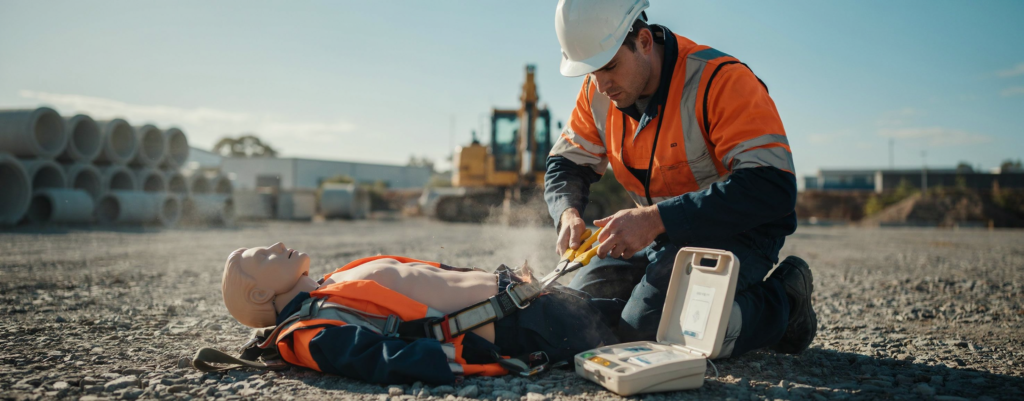
Most sites have one. It’s a yellow box on the wall of the crib room, bought to tick a line on the principal contractor’s checklist. The AED training course often gets treated the same way: box ticked, everyone back to work. Trouble is, owning a defib and opening it with confidence when one of your crew goes down are two very different things.
That gap is what proper training closes. You practise placing pads, following the voice prompts, acting on shock and no-shock advice, keeping CPR going between analyses, and handing over clean to QAS. You also practise it the way your site will throw it at you: wet or dusty ground, hi-vis and harnesses in the road, a tight spot down in an excavation, and an ambulance that’s a fair drive out to where you’re working.
Below we’ll cover what the course teaches under HLTAID014 and ANZCOR, and how it plays out around mobile plants and working at heights. Then we’ll get into what WorkSafe Queensland and principal contractors expect, and how to get your crew booked in.
🩺 New to AED training? Start with the basics.
What Do You Learn in an AED Training Course?
An AED training course teaches you to recognise a cardiac arrest and use an automated external defibrillator alongside CPR until paramedics take over. For construction and civil crews it’s assessed within HLTAID014 Provide Advanced First Aid and follows ANZCOR guidelines. You’ll learn to:
Under HLTAID014, you have to deliver at least one shock on a training AED to be assessed competent.
⚡ Hands on, not slides. HLTAID014 assessment includes delivering a shock on a training AED, so every person walks out having actually done it.
How AED Training Fits Into HLTAID014 Advanced First Aid
There’s no separate AED ticket sitting off to the side. HLTAID014 AED training is built into the advanced first aid unit, and it gets assessed like everything else in there.
What the Unit Actually Assesses
The assessment requirements for HLTAID014 on training.gov.au spell it out. To be signed off, you have to:
- Follow the AED's prompts and deliver at least one shock, if advised.
- Rotate operators with minimal interruptions to chest compressions.
- Perform CPR in adult, child and infant scenarios.
Nobody gets signed off for sitting through slides. You do the tasks hands on, and a trainer watches whether your compressions stall when you swap over. It’s like a plant ticket. Reading the manual won’t get you there, running the machine will.
How It Differs From AED Training in HLTAID011
HLTAID011 Provide First Aid includes HLTAID009 Provide CPR, so it covers AED use by one first aider. It’s a solid unit and the right fit for plenty of your workers. Our AED training course guide covers it.
HLTAID014 goes further. It adds team resuscitation, coordinating other responders and managing complex incidents. Working the defib is one job. Running the whole response is another, and on most sites that ends up being the supervisor, whether anyone asked him or not.
HLTAID009, HLTAID011 and HLTAID014 AED content compared
HLTAID009 | HLTAID011 | HLTAID014 | |
AED use with CPR | Yes | Yes (includes HLTAID009) | Yes, including at least one assessed shock |
Who’s using the AED | Individual first aider | Individual first aider | A team, with operators rotated |
Coordinating responders | No | No | Yes |
Complex incidents | No | No | Yes |
If you’re the one expected to take charge when something goes wrong, HLTAID014 is the advanced first aid course Brisbane site supervisors should be booking. Only need one seat? Book a Public Course.
That covers what the unit asks for on paper. Next up is what practising it actually looks like.

The Practical Skills You’ll Actually Practise
Reading about an AED and using one on a bloke in full PPE aren’t the same thing. Good defibrillator training for construction workers is built around the gear, the noise and the crew you’ve actually got on site.
Getting Pads On Through PPE and Workwear
The pads need a bare chest, and on your site nobody’s chest is bare. There’s a hi-vis vest, a work shirt, maybe a harness on top of all of it. In training you practise getting that gear off fast, or cutting through it when it won’t come off quick enough. Then you dry the chest and put the pads on.
It sounds simple. With your heart going, it’s not, so you practise until it feels boring.
Following Voice Prompts on a Noisy Site
The AED talks you through it, as long as you can hear it. With an excavator running nearby, you probably can’t. So shutting down plants becomes part of scene safety, and you learn to read the visual cues on the screen too.
Two-Rescuer CPR and Swapping Compressors
Compressions wear you out quicker than anyone expects, and when QAS is a long way off, one person can’t hold good CPR alone. So you practise rotating compressors with the least possible break. You also practise directing crew who’ve never done first aid, telling them where to kneel and when to swap. Most people will help if you give them a clear job.
Handing Over to QAS
When the paramedics turn up, they need facts fast. You’ll practise giving them a short, clear handover. Someone also needs to be at the gate so the ambulance isn’t driving around the laydown yard hunting for you.
QAS handover checklist
- Time of collapse.
- Number of shocks delivered.
- How long CPR has been underway.
- Someone waiting at the gate to meet the ambulance.
The skills are one side of it. The other side is your site, which usually makes all of this harder.
AED Scenarios That Reflect Real Worksites
A training room is warm, quiet and flat. Your site’s none of those things, so good scenarios make remote site first aid feel familiar before you ever need it.
Cardiac Arrest a Long Way From an Ambulance
Greenfield estates on the edge of town are a long way from the nearest ambulance. The roads aren’t finished, the street names aren’t on the maps yet, and QAS might be a while. So the questions are simple. Where’s the AED kept, and how quickly can it reach the person who’s down? If it’s locked in a site office at the far end of the job, that walk is a big part of your response.
Collapse After an Electric Shock
Every instinct says run in and help. Don’t. Power gets isolated first, as the Electrical Safety Office Queensland advises, then CPR and the AED. If your crew works anywhere near live electrical, pair this with Low Voltage Rescue (UETDRRF018), which covers getting someone off the source safely before first aid takes over.
Confined, Elevated or Awkward Positions
People don’t collapse in handy spots. They go down in a trench, on a scaffold, or folded up in a cab. The principle is to move them to a flat, firm surface where it’s safe, so CPR and the pads can work. Training covers the thinking behind that call, not a rescue technique for everything.
When the Cause Isn’t Clear
Sometimes you just don’t know. A fall, a crush, or someone found collapsed with nobody around to tell you what happened. The good news is that the AED makes that call for you. It only advises a shock when one is needed, so your job is to get it on and follow what it tells you.
Scenario | What to do |
🚑 Far From an Ambulance | Know where the AED is and how quickly you can get it to the person who’s down. |
⚡ Electric Shock | Isolate power first, then start CPR and use the AED. |
🏗️ Awkward Positions | Move them to a flat, firm surface where it’s safe to. |
❓ Cause Unclear | Get the AED on. It only advises a shock when one is needed. |
Want your crew practising these scenarios in their own site shed? Ask about on-site AED training Brisbane crews can do without leaving the job. Train Your Crew On Site.
Training’s one side of it. The next question is usually the one that comes up at audit time.
Do Queensland Construction Sites Need an AED?
The honest answer is that it depends on your site.
What Queensland WHS Law Actually Requires
The Work Health and Safety Act 2011 (Qld) puts a duty on you to provide adequate first aid. It doesn’t hand you a one-size-fits-all list. The Code of Practice is the benchmark that WorkSafe Queensland first aid requirements get measured against, and it asks you to look at your site’s risks and work back from there. A crew doing excavation, working at heights and running mobile plant out past the edge of town has a very different risk profile to a tidy office. Your first aid setup should reflect that.
What Principal Contractors and Tenders Expect
Plenty of principal contractors now name HLTAID014 in their pre-qualification and tender documents. Before you’re allowed on site, those certificates have to be uploaded to platforms like RapidGlobal, Cm3 or Avetta. If there’s a gap in the register, you don’t get in, and it doesn’t matter what the law technically says.
How Many Trained First Aiders Your Site Needs
The Code of Practice gives you a starting point. Treat it as a floor, though. Geography matters, because a site a long drive from QAS needs more cover than one close to a hospital. Shifts matter, because your first aider has to actually be on site for every shift. Subcontractors matter too, since you need to know who’s covering their crews.
How first aid provisions get decided
Step | What to look at |
1. Site Risk | Working at heights, mobile plant, excavation, electrical |
2. Distance From QAS | How far an ambulance has to travel to reach you |
3. First Aid Provisions | Trained first aiders per shift, AED, kits and training level |
This is general information, not legal advice. For your site’s specific obligations, check with WorkSafe Queensland and the Safe Work Australia Code of Practice.
Site First Aid Readiness Checklist
- AED service check.
- Pad and battery expiry dates.
- First aider coverage per shift.
- Qualifications register fields.
- QAS gate meeting point.
- Emergency contacts.
Once your site’s covered, the next job is keeping it that way.

Keeping Your AED and CPR Skills Current
CPR is a use-it-or-lose-it skill. Compressions get shallower and slower after a course, and most people don’t notice it happening. That’s why CPR needs a refresher more often than the full HLTAID014 unit, and why a CPR refresher in Brisbane is worth booking before the old one lapses.
Between renewals, the site AED makes a good toolbox talk. Pull it off the wall, show the crew how it opens, and check the pads and battery while you’re there. That way the defib isn’t a mystery box the day someone needs it.
The last piece is the qualifications register. Every expiry date goes in one spot, and one person owns it. Audit gaps rarely come from people refusing to renew. They come from a date slipping past unnoticed.
📅 Add renewal dates now, not the week before audit. Put every crew member's CPR and HLTAID014 expiry into your register today, using the register fields from the checklist above.
Keeping skills current is the easy bit. Getting the crew booked without losing time on site is where it gets tricky.
Keeping skills current is the easy bit. Getting the crew booked without losing time on site is where it gets tricky.
Conclusion
That yellow box on the crib room wall only counts for something if someone on shift can open it without freezing. Owning a defib and using one with confidence are two different things, and a good AED training course closes the gap between them.
It does that with assessed tasks, not slides. Under HLTAID014 you deliver at least one shock, rotate operators without long breaks in compressions, and coordinate everyone else while you do it.
The practical side is built around your site. Pads on through hi-vis and harnesses, plant shut down so you can hear the prompts, and someone waiting at the gate for QAS.
Then there’s the paperwork. WorkSafe Queensland expects first aid that matches your site’s risks, and principal contractors want HLTAID014 uploaded before you get through the gate.
Keeping it current is the easy bit to let slide. Regular CPR refreshers, a toolbox talk on the site AED, and every expiry date in one register someone owns.
For a supervisor, the certificate is the smaller part of it. The bigger part is knowing you can run the whole response when it’s your crew who’s down, and being ready if that day ever comes.
Book Your First Aid Training Now
Fast, affordable, and nationally accredited training delivered by professionals who care
AED Training Course FAQs
Q.Can you use an AED without training?
Yes, anyone can use an AED. The voice prompts talk you through it, and it only advises a shock when one is needed. Training is what gets you moving without hesitating, especially with PPE to cut through and a crew to direct.
Q.Does HLTAID014 include AED training?
Yes, AED use is assessed within HLTAID014. You follow the AED's prompts to deliver at least one shock on a training AED, rotate operators with minimal interruptions to compressions, and perform CPR in adult, child and infant scenarios.
Q.What's the difference between HLTAID011 and HLTAID014 AED training?
HLTAID011 covers AED use by one first aider. HLTAID014 adds team resuscitation, coordinating other responders and managing complex incidents, which suits supervisors who are expected to run the whole response on site.
Q.Can you train our crew on site?
Yes, Bill Hunter's team can deliver training at your site shed or depot. Your crew practices the scenarios where they actually work, and nobody has to leave the job to get to a venue.
Making first aid training more affordable for
every classroom
We believe every student deserves access to life-saving first aid knowledge. That’s why we offer specially reduced pricing for schools and educational groups. Whether you’re booking for a single class, a year group, or your entire school, our flexible packages make training more accessible and cost-effective — without compromising quality.
