
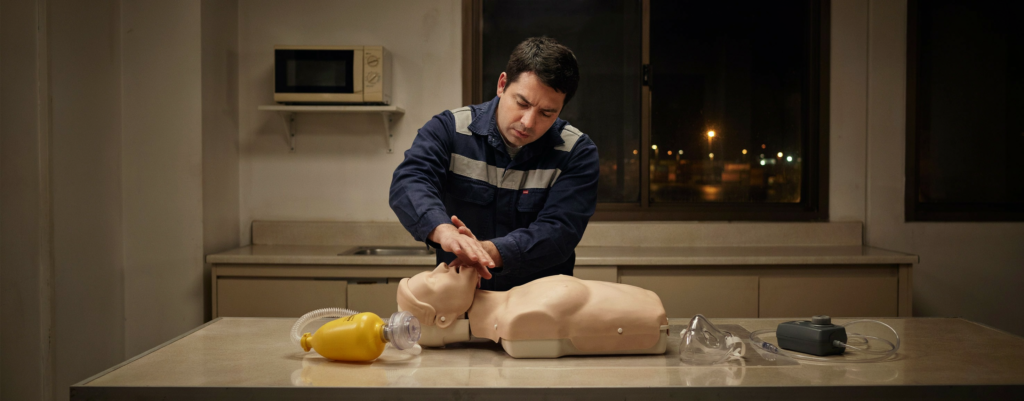
2am in a crib room at a port terminal. A worker slumps across the table, unresponsive, and the first thing you notice is the sound coming from his throat. Snoring, then gurgling. You have done CPR plenty of times. This is different. The airway is the problem, and what happens next depends on whether you clear it with suction, choose the right airway size and get a seal with the bag-valve-mask on the first attempt.
That moment is what airway management training in Brisbane should prepare you for. At first aid level, these skills are covered by HLTAID015 Provide Advanced Resuscitation and Oxygen Therapy, the nationally accredited unit for workers whose first aid room holds oxygen and airway equipment.
This guide explains which airway skills the unit includes and how they differ from the clinical airway courses that also appear in Brisbane searches. It covers where skill fade usually starts and what to check in a provider before you book a course for yourself or your ERT.
How Do You Size an Oropharyngeal Airway?
You size an oropharyngeal airway (OPA) by measuring it against the side of the patient’s face before it goes anywhere near the mouth.
If it’s too large, it can block the airway or cause vomiting. If it’s too small, it can push the tongue back and make the obstruction worse.
Airway adjunct sizing is taught and assessed hands-on in HLTAID015 Provide Advanced Resuscitation and Oxygen Therapy.
This is a refresher for people who have been trained. It supports formal training and does not replace it.
Reading about sizing only gets you so far. You can practise sizing and inserting an airway adjunct on real equipment in our HLTAID015 course.
What Airway Management Training Covers at First Aid Level
Sizing is only one small piece of the job. The bigger issue is that a Brisbane search for airway management training throws first aid courses and anaesthetist courses into the same results, and they aren’t the same thing.
First aid airway management vs clinical advanced airway courses
A lot of what ranks for this search is built for doctors. Programs like ACRRM’s advanced airway course and hospital-run workshops teach intubation, cricothyroidotomy and ventilator management. Good courses, wrong audience. Passing a tube isn’t part of an ERT leader’s job.
First aid level airway management is about keeping the airway open with the gear in your first aid room until the paramedics walk through the door. That’s what HLTAID015 covers, and it’s a very different course.
First aid level (HLTAID015) | Clinical advanced airway courses | |
Who it’s for | Workplace first aiders, ERT members, event first aiders | Doctors and clinicians |
Airway skills | Positioning, basic airway adjunct, suction | Intubation, cricothyroidotomy |
Breathing support | Bag-valve-mask (BVM) ventilation with oxygen | Ventilator management |
Also covers | AED use and pulse oximetry | Clinical procedures beyond first aid scope |
HLTAID015 doesn’t cover intubation.
Where airway skills sit within HLTAID015
The prerequisite is HLTAID011 Provide First Aid, so you’ll already have the basics when you walk in. The airway work runs across Element 2, performing resuscitation, and Element 3, delivering oxygen therapy. For the full breakdown, see the official unit listing on training.gov.au.
Who needs it in Brisbane
The same workers turn up on these courses again and again:
- ERT members and leaders at port, logistics and manufacturing sites
- Event first aiders working concerts and stadium games
- FIFO crews based in Brisbane
- Venue security, aquatic centre staff and dental practices
What they share is oxygen and airway equipment in the first aid room. Queensland’s First Aid in the Workplace Code of Practice says first aid training should match the equipment you hold onsite, and in my experience that’s what catches people out in an audit. HLTAID015 isn’t a blanket legal requirement, so check your workplace risk assessment to see what your site actually needs.
The Airway Skills You Practise in HLTAID015
With the scope settled, here’s what you’ll actually be doing on the day.
Skill | What the unit assesses |
Positioning | Positioning the unconscious, breathing casualty to reduce airway compromise |
Airway adjunct | Selecting and inserting a basic airway adjunct |
Suction | Managing regurgitation with positioning and suction |
BVM | Sustained BVM ventilation with oxygen |
Oxygen | Correct equipment, safe area, correct flow rate |
Malfunction | Managing an equipment malfunction |
Positioning the unconscious, breathing casualty
The unit requires you to position the casualty so the risk to their airway is reduced. On the day you’ll roll a manikin under pressure, then check the airway is actually open instead of assuming it is.
Remember the snoring from the crib room. That’s the tongue partly blocking the airway, and good positioning often fixes it. The mistake people make is getting the casualty on their side and then never listening again.
Selecting and inserting a basic airway adjunct
Sizing is covered up top, so this part is about getting the adjunct in and knowing when to leave it out. You’ll insert it using the method in ANZCOR guidance and your course materials, and you’ll need to explain the benefits, contraindications and complications of using one.
The big one is the gag reflex. If the casualty gags, the adjunct comes out straight away. The usual mistake is forcing it because you’ve started and want to finish.
Suction for vomit and fluid
The unit requires you to respond to regurgitation with positioning and suction. That’s the gurgling from the crib room. Gurgling is fluid, and air won’t get past fluid no matter how good your BVM seal is.
The most common mistake under pressure is ventilating before the airway is clear. It just pushes fluid further down.
Oxygen delivery and the pulse oximeter
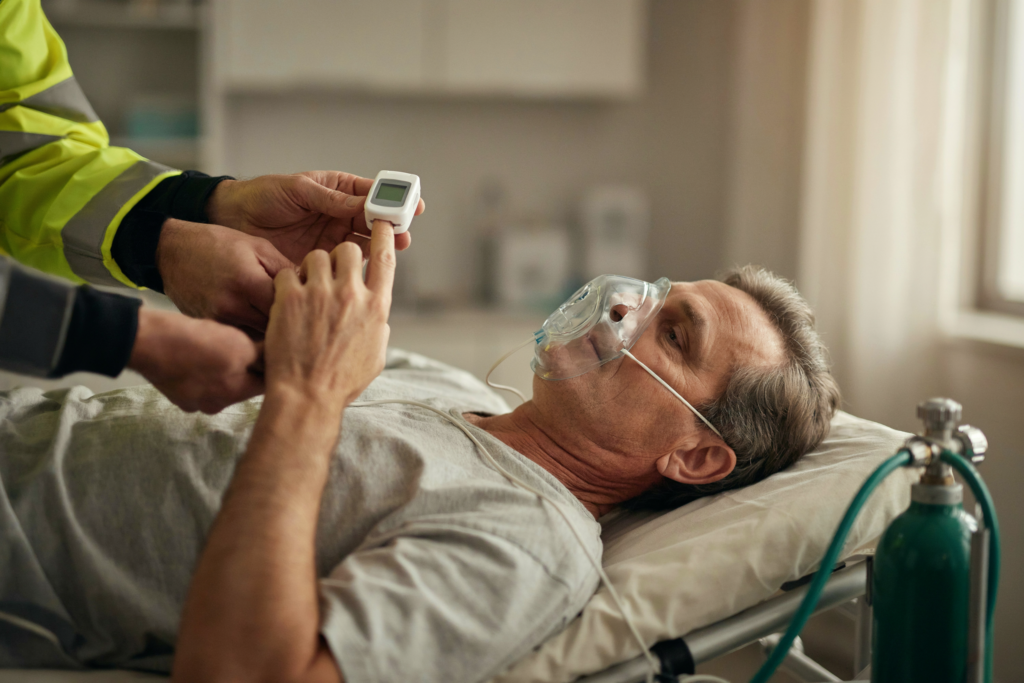
You’ll select and prepare the oxygen equipment, check the area for ventilation and ignition sources, set the correct flow rate and use the pulse oximeter. You’ll also be assessed on handling an equipment malfunction, and that’s the part people underestimate.
Plenty of experienced first aiders have had the regulator fight them. The cylinder gets cracked, the regulator won’t seat, hands are shaky and everything slows down. Practicing the malfunction on real equipment stops that happening again.
🎯 Key takeaway: The malfunction scenario is assessed for a reason. In a real incident, the equipment is the thing most likely to slow you down.
Bag-Valve-Mask Technique: Where Ventilation Goes Wrong
BVM is the skill people are least confident about. Most first aiders don’t touch one between renewals, and it shows. Good bag valve mask technique comes down to the seal, the pace and holding it together for longer than you’d expect.
Getting a mask seal
The seal is where most ventilations are won or lost. On your own, you’re holding the mask with one hand and squeezing the bag with the other, which is harder than it looks, especially on a beard or a face with no teeth.
With two rescuers, one person holds the mask with both hands and the other squeezes. That makes the seal far easier to keep. HLTAID015 covers two-rescuer procedures, and in a real incident I’d take the second pair of hands every time.
Ventilating too fast or too hard
Adrenaline makes people squeeze hard and fast. Air that doesn’t reach the lungs goes into the stomach, and a stomach full of air pushes vomit back into the airway you just cleared.
Aim for steady, controlled breaths with a visible chest rise, following ANZCOR guidance. Watch the chest, not the bag.
What sustained BVM actually feels like
The unit requires you to keep BVM ventilation with oxygen going for a set period, and it’s longer than it sounds when you’re kneeling on concrete. Your grip tires, the mask creeps and the seal you started with isn’t the seal you finish with.
That’s why team rotation matters. Swapping the person on the bag before they’re cooked keeps ventilations effective. The ANZCOR guidelines are the Australian reference for the technical detail.
🛠️ On the day: Every skill below is practised and assessed hands-on, with real equipment and realistic scenarios.
Why Airway Skills Fade Between Renewals
None of this is hard to learn. Keeping it is the hard part.
The skills you rarely use go first
Your CPR rhythm probably sticks because you refresh it often. Cracking an oxygen cylinder, sizing an airway adjunct or holding a BVM seal is different, and for most people the last time was their last course.
You’ll still remember what to do. What fades is the feel: how the regulator seats, how much pressure the seal needs, where the suction tubing sits. Those small things are what make you fumble at 2am.
How often should you renew?
The unit itself doesn’t set an expiry date. Your employer, insurer or principal client may set their own, so check their requirements before you rely on a general rule. If you’re starting to feel rusty, an HLTAID015 refresher in Brisbane is the quickest way to close the gap.
Keeping skills sharp between courses
Element 5 of HLTAID015 covers checking, cleaning and maintaining equipment, which gives you a reason to get hands-on between courses. Run a monthly first aid room check and actually handle the gear: connect the regulator, check the suction, open the airway adjunct kit and look at the sizes.
If you answered no to two or more, a refresher is worth booking.
Your score | What it means | Next step |
4 to 5 yes | You’re in good shape. Keep your renewal date in view. | Get a renewal reminder |
2 to 3 yes | Some skills are slipping. A refresher closes the gap. | Book HLTAID015 |
0 to 1 yes | Book a refresher before your next shift. | Book HLTAID015 or call us |
Airway Management Training for Brisbane ERTs
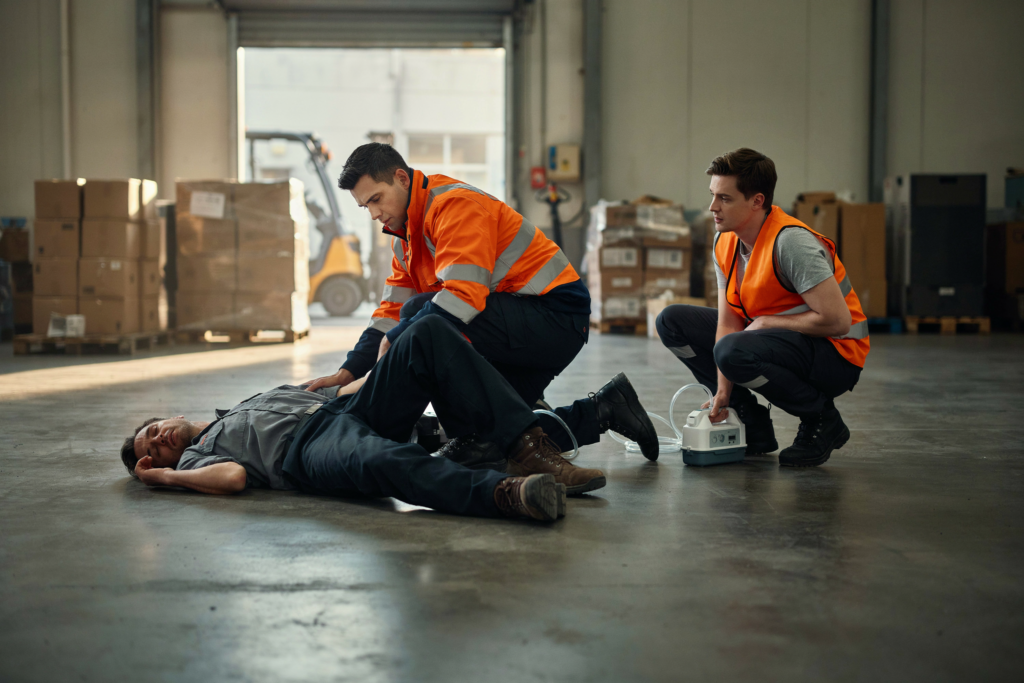
If you lead a response team, skill fade isn’t just your problem. One person rusty on the regulator slows the whole response. That’s why emergency response team training in Brisbane works best when the team trains together, to the same standard, on the gear they’ll actually use.
Training on your site’s own equipment
Every first aid room is set up a bit differently, from the cylinder size to the suction brand. Ask whether your airway management training in Brisbane can run on your own site’s equipment, so the team practises on what they’ll grab in a real incident.
Splitting sessions so the site stays covered
You can’t send the whole ERT offsite and leave the floor uncovered. Ask about splitting the team across sessions so enough trained people stay on shift.
Certificates that clear audits and contractor portals
Your insurer, principal client and auditors all want proof the team is current. Each Statement of Attainment shows the full unit code and title, HLTAID015 Provide Advanced Resuscitation and Oxygen Therapy, along with RTO 31106, so it uploads cleanly to contractor portals.
Choosing an Airway Management Course in Brisbane
Whether you’re booking for yourself or the whole team, the same checks apply. Most bad courses are easy to spot before you pay.
Check the equipment list
The unit’s assessment conditions set out the equipment a provider has to have. If a provider can’t confirm every item below, airway management training with them will probably mean a lot of watching and not much doing.
- Anatomical airway model for adjunct and suction practice
- Basic airway adjunct in a range of sizes
- Bag-valve-mask
- AED trainers
- Oxygen system with a cylinder and regulator
- Pulse oximeter
- Oxygen masks and tubing
- Suction equipment
- PPE
A good provider will confirm each item straight away.
Ask how much of the day is hands-on
Bad advanced resus courses are mostly slides and a rushed assessment. Ask how the course is split between theory and practice.
Who is running it
The trainer makes or breaks the course. At First Aid Alive, it’s led by Bill Hunter, our Principal Trainer, with more than 20 years’ experience. Ask any provider who’ll run your session and what their background is.
Verify the RTO
Any accredited provider has an RTO number you can look up. First Aid Alive is RTO 31106 on training.gov.au, and the Nationally Recognised Training logo appears on our Statements of Attainment.
That crib room won’t wait while you try to remember where the suction tubing goes. It rewards the first aider who has handled the gear recently and knows how it feels when it’s working. Start small this week. Check your own expiry date and your team’s, download the equipment checklist and run it in your first aid room, then book a course or call about training your ERT onsite. Airway management training only counts if it’s still in your hands when the radio goes.
Book Your HLTAID015 Course
Booking HLTAID015 Provide Advanced Resuscitation and Oxygen Therapy with First Aid Alive gets you hands-on airway, oxygen and BVM practice on real equipment, assessed in realistic scenarios. We’re a nationally accredited provider, RTO 31106.
HLTAID011 Provide First Aid is the prerequisite, so start there if you don’t hold it yet.
Questions first are fair enough. Call Bill’s team about equipment, prerequisites or dates.
ERT leaders can ask about onsite delivery, split sessions and portal-ready certificates.
If you need HLTAID014 too, ask about doing both.
If you’ve just renewed, sign up for a renewal reminder and run the equipment readiness checklist this month.
The next real incident won’t give you a warm-up. Book your HLTAID015 course or call us today.
Book Your First Aid Training Now
Fast, affordable, and nationally accredited training delivered by professionals who care
Frequently Asked Questions
Q.Is HLTAID015 the same as HLTAID014?
No. HLTAID014 Provide Advanced First Aid covers managing first aid incidents at an advanced level, while HLTAID015 focuses on resuscitation using oxygen, airway and BVM equipment, and plenty of ERT and event roles need both.
Q.Do I need HLTAID011 before doing HLTAID015?
Yes. HLTAID011 Provide First Aid is the prerequisite for HLTAID015 Provide Advanced Resuscitation and Oxygen Therapy.
Q.Does airway management training include intubation?
No. First aid level airway management under HLTAID015 covers positioning, basic airway adjuncts, suction, bag-valve-mask ventilation with oxygen and AED use. Intubation is taught in clinical courses for doctors and paramedics.
Q.How often should I renew HLTAID015?
The unit itself doesn't set an expiry date, so check your employer, insurer and principal client requirements, as these can be stricter, and book a refresher sooner if your skills feel rusty.
Q.Is HLTAID015 a legal requirement in Queensland?
Not as a blanket rule, but Queensland's First Aid in the Workplace Code of Practice says training should match the equipment you hold, so check your workplace risk assessment if your first aid room has oxygen and airway gear.
Q.What equipment will I use on the course?
The unit's assessment conditions call for an anatomical airway model, basic airway adjunct, bag-valve-mask, AED trainers, an oxygen system with cylinder and regulator, a pulse oximeter, masks and tubing, suction equipment and PPE.
Q.Will I learn to size an airway adjunct?
Yes, airway adjunct sizing is taught and assessed hands-on in HLTAID015, along with when not to use one, such as when the casualty has a gag reflex.
Q.Can our whole ERT train together?
Ask about onsite delivery on your own equipment and split sessions that keep your site covered while the team trains to the same standard.
Making first aid training more affordable for
every classroom
We believe every student deserves access to life-saving first aid knowledge. That’s why we offer specially reduced pricing for schools and educational groups. Whether you’re booking for a single class, a year group, or your entire school, our flexible packages make training more accessible and cost-effective — without compromising quality.
