

It’s late on a night shift, and you’re scrolling through advanced resuscitation training options on your phone during a rare quiet moment. You need to renew your ART certification before it expires, but you’re wondering: Will this actually refresh my skills, or is it just another basic CPR course with “advanced” slapped on the name?
If you’re an ICU nurse, emergency department clinician, or paramedic, you’ve probably sat through training that felt more like a compliance tick-box than genuine professional development. You don’t need someone teaching you when to call 000—you need to practice complex rhythm recognition, team leadership during codes, and updated ARC 2024 protocols that actually matter when someone arrests on your watch.
This guide walks you through exactly what happens in a legitimate advanced resuscitation training course: from the skills you’ll practice to the scenarios you’ll face, the assessment criteria, and how to identify courses that match your clinical expertise.
What Is Advanced Resuscitation Training?
Advanced resuscitation training (ART) is a nationally recognized course designed for healthcare professionals who need to perform complex emergency life support in clinical settings. Unlike basic CPR courses for the general public, ART covers advanced airway management, cardiac rhythm interpretation, drug administration protocols, and team leadership during medical emergencies.
Advanced resuscitation training includes:
- Recognition and management of cardiac arrest rhythms (VF, VT, PEA, Asystole)
- Advanced airway techniques (bag-valve-mask, laryngeal mask airways)
- Emergency medication administration (adrenaline, amiodarone, atropine)
- Defibrillation and manual defibrillator operation
- Post-resuscitation care and monitoring
- Team coordination and communication during codes
- ARC 2024 guideline updates and evidence-based protocols
This certification is mandatory for ICU nurses, emergency department staff, anaesthetists, and other healthcare workers who respond to medical emergencies.
Advanced vs Basic Resuscitation: Key Differences
This is the question that matters most when you’re trying to figure out if a course is worth your time: Is this actually advanced, or is it basic CPR with a fancy name?
What Makes Training “Advanced”?
The difference isn’t subtle—it’s the gap between teaching someone to recognize an emergency versus teaching someone to manage the emergency themselves.
Basic resuscitation (what the public learns):
- Recognize cardiac arrest
- Call 000
- Start chest compressions
- Use an AED if available
- Keep going until paramedics arrive
Advanced resuscitation (what healthcare professionals need):
- Identify arrest rhythms on a monitor without someone telling you what you’re looking at
- Lead a resuscitation team while managing your own stress response
- Operate manual defibrillators with precise energy settings
- Administer emergency drugs at correct doses via correct routes
- Manage advanced airways when basic techniques fail
- Make clinical decisions about when to continue versus when to call it
The Skills Gap
| Skill Area | Basic Resuscitation | Advanced Resuscitation Training |
|---|---|---|
| CPR Technique | Compressions + rescue breaths on training manikin | High-performance CPR with real-time feedback, team rotations, fatigue management |
| Defibrillation | Automated External Defibrillator (AED) with voice prompts | Manual defibrillator operation, energy selection, synchronized vs unsynchronized shocks |
| Airway Management | Head tilt-chin lift, recovery position | Bag-valve-mask, oropharyngeal airways, laryngeal mask airways, suctioning |
| Rhythm Recognition | "Shock advised" vs "no shock advised" from AED | ECG interpretation - VF, pulseless VT, PEA, asystole, bradycardia, tachycardia |
| Drug Administration | None (wait for paramedics) | Adrenaline, amiodarone, atropine - doses, timing, routes, contraindications |
| Team Dynamics | Single rescuer or basic 2-person CPR | Team leader role, task delegation, closed-loop communication, handovers |
The Clinical Scenarios That Define Advanced Training
Advanced courses throw you into situations that actually happen in hospitals, not just textbook cardiac arrests.
You’ll practice:
- Anaphylaxis during drug administration – patient goes into anaphylactic shock minutes after you give IV antibiotics
- Choking in the recovery room – post-op patient with reduced consciousness level aspirates and completely obstructs their airway
- Bradycardia deteriorating to arrest – elderly patient’s heart rate drops from 45 to 30 to asystole
- Post-cardiac surgery complications – patient arrests hours after CABG
These scenarios are messy, stressful, and don’t follow the neat algorithms in the textbook. That’s the point. When someone arrests on your shift, it won’t be neat either.
What Actually Happens During the Course
Let’s walk through exactly what your days look like. None of this vague “you’ll learn advanced skills” stuff—here’s the actual structure.
Day 1: Building the Foundation
Morning Session – Theory and Guidelines
You’ll start with ARC 2024 guideline review. This is the theory block covering what changed since you last certified and why the changes matter based on new evidence.
Then you move into Basic Life Support review. Yes, you’ve done CPR hundreds of times, but most people’s technique has drifted. Compression depth, rate, hand placement, recoil—small errors compound when you’re fatigued during a real code.
You’ll practice high-performance CPR with manikins that give real-time feedback. If your compressions aren’t deep enough or fast enough, it tells you immediately. It’s humbling for everyone, even experienced ICU nurses.
Advanced Airway Management
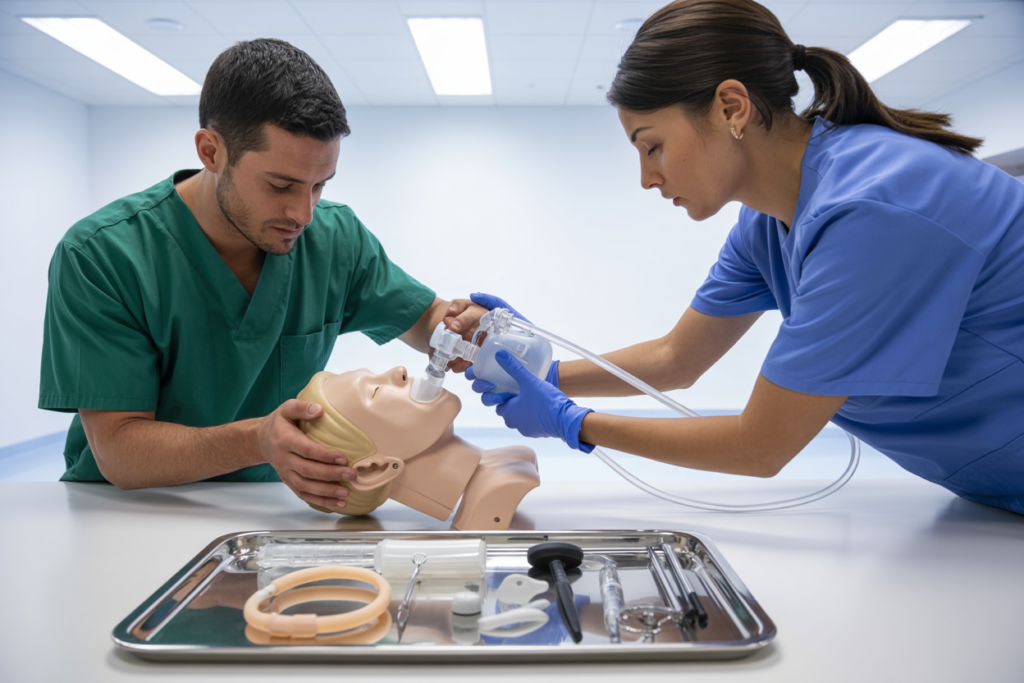
This is where it gets more interesting. You’ll practice bag-valve-mask ventilation (proper two-person technique, getting a seal on different face shapes), oropharyngeal airways (correct sizing and insertion), and laryngeal mask airways (when to use versus BVM, insertion technique, troubleshooting).
Afternoon Session – Rhythm Recognition and Defibrillation
The instructor shows ECG strips and you need to identify VF, pulseless VT, PEA, and asystole in under 3 seconds. During real codes, every second matters.
Then you practice on manual defibrillators—selecting energy levels, charging, delivering shocks safely. The manikins respond to treatment. Deliver the right shock and the rhythm converts. Get it wrong and nothing happens.
Drug Administration Protocols
You’ll learn exact doses, routes, and timing for adrenaline, amiodarone, and atropine. The instructor drills you on these because under stress, you’ll second-guess yourself.
Day 2: Putting It All Together
Team Dynamics and Communication
Before running scenarios, you learn team roles: Team Leader, Compressors, Airway Manager, Defibrillator Operator, Drug Administrator, Recorder.
You practice closed-loop communication where every instruction gets acknowledged and confirmed to prevent errors.
Running Full Scenarios
You’ll run multiple complex scenarios as a team:
- Standard cardiac arrest with VF requiring defibrillation
- Anaphylaxis requiring IM adrenaline
- Choking with progression to arrest
- Post-operative complications
The instructor watches everything, throws in complications, and debriefs after each scenario about what went well and what needs improvement.
Practical Assessment
The formal assessment happens after you’ve practiced all weekend. The instructor assigns you a role in a scenario and watches whether you can perform to competency standard.
Specific Skills You’ll Master
High-Performance CPR Technique
You’ll practice until the feedback device confirms you’re consistently achieving correct compression depth, maintaining proper rate, allowing full chest recoil, and minimizing interruptions. The course drills rotation strategies so compression quality doesn’t degrade when you’re fatigued.
Rhythm Recognition and ECG Interpretation
You need to identify shockable rhythms (VF, pulseless VT) versus non-shockable rhythms (PEA, asystole) instantly. The instructor flashes rhythm strips and you call it within seconds. At first, you’ll second-guess yourself. By the end, you’ll identify rhythms confidently.
Advanced Airway Management Skills
You’ll master bag-valve-mask ventilation (including troubleshooting air leaks and gastric insufflation), oropharyngeal airways (proper sizing and insertion), and laryngeal mask airways (insertion technique and recognizing when it’s not seated properly).
Defibrillation and Cardioversion
You operate manual defibrillators, selecting appropriate energy, performing safety protocols, and delivering shocks. You’ll also learn synchronized cardioversion for unstable patients with organized rhythms.
Emergency Drug Administration
You need to know exact doses, routes, and timing. Adrenaline for cardiac arrest versus anaphylaxis uses different doses and routes—this is where people make fatal errors under stress. The instructor drills this until you can recite it automatically.
Team Leadership and Communication
As team leader, you stand back, watch the whole picture, make decisions, and direct the team. You assign roles, monitor CPR quality, keep track of time, and communicate clearly. You’ll practice managing chaos—too many people, conflicting instructions, equipment failures.
ARC 2024 Guideline Updates: What Changed and Why
Key Changes in ARC 2024 Guidelines
Updated Compression-to-Ventilation Ratios
For healthcare professionals with advanced airways in place, continuous compressions with asynchronous ventilation is now more strongly recommended. Once an LMA or ET tube is in, you don’t pause compressions for ventilations.
Modified Drug Timing Protocols
Timing of adrenaline administration got more specific. For shockable rhythms, adrenaline after the 3rd shock if still in arrest. For non-shockable rhythms, adrenaline as soon as IV/IO access established.
New Evidence on Early Defibrillation
The guidelines place even stronger emphasis on early defibrillation for witnessed VF arrests. For witnessed arrests where you can get a defibrillator on the patient quickly, shock first, then start CPR.
Changes to Post-Resuscitation Temperature Management
Current recommendation: Target normothermia and actively prevent fever. You don’t need to cool patients down aggressively, but you absolutely need to prevent hyperthermia, which worsens brain injury.
Assessment and Certification Process
What “Competency-Based Assessment” Really Means
This isn’t a written exam where you memorize and regurgitate facts. It’s practical demonstration of skills. The assessor is asking: “Can this person safely manage a resuscitation in their workplace?”
You’re not competing against other participants. You either demonstrate competency or you don’t—and if you don’t on the first attempt, you get coaching and another chance.
What Gets Assessed
CPR Technique: The assessor watches you perform compressions on a manikin with real-time feedback, checking depth, rate, recoil, and hand placement.
Rhythm Recognition: You identify ECG strips correctly and state whether they’re shockable or not.
Defibrillation: You recognize a shockable rhythm, select appropriate energy, perform safety check verbally, deliver the shock, and immediately resume CPR.
Drug Administration: You state correct drug name, dose, route, and timing during scenarios.
Team Communication: The assessor watches how you communicate with team members, assign roles, and work cooperatively.
The Final Scenario Assessment
The assessor assigns you a role and starts a scenario. You need to perform your assigned role competently while the scenario runs. The assessor watches for safe practice, correct technique, appropriate decision-making, clear communication, and ARC guideline compliance.
Most people pass. If you don’t meet standard on your first attempt, you get immediate feedback, additional practice, and reassessment.
Your Certificate and What It Includes
When you pass, you receive a Statement of Attainment with nationally recognized RTO certification, AHPRA CPD documentation, and confirmation of hours earned. Most providers email digital certificates immediately so you can forward to your employer.

How to Choose the Right ART Provider
The Instructor Makes or Breaks the Course
The single most important factor is instructor credentials. Look for clinical experience in acute care settings—former or current ICU nurses, ED staff, paramedics, or critical care doctors who’ve actually managed codes, not just taught them.
If the website doesn’t list instructor names and credentials, that’s a red flag. Email and ask about their clinical background before booking.
Course Structure and Content Depth
Legitimate advanced resuscitation training needs substantial contact hours. Anything significantly shorter is cutting corners. The course should explicitly cover ARC 2024 guidelines, include detailed skill practice, and feature multiple different scenario types.
Ask to see the course outline. It should list specific skills, not generic statements about “life-saving techniques.”
Preparing for Your Course: Practical Tips
Before the Course
Spend a brief period reviewing basic CPR sequence, current drug doses you use in your work, and your employer’s code blue procedures. Don’t stress about being “perfect”—competency, not perfection, is the standard.
What to Bring
Bring photo ID, healthcare registration details, comfortable clothing suitable for kneeling on the floor, water bottle, pen and notebook. Check if the course provides food. You don’t need your stethoscope, textbooks, or medical equipment—everything’s provided.
During the Course
Ask questions immediately when confused. Practice more than required. Take notes on your common errors. Rotate through different roles during scenarios rather than practicing the same position repeatedly. Stay engaged even when tired.
After the Course
Review your notes within a week while information is still fresh. Practice scenarios mentally during quiet shifts. Check rhythm strips regularly to maintain recognition skills. Know where everything is in your crash trolley and how to operate your defibrillator.
Making Your Advanced Resuscitation Training Count
At some point in your healthcare career, someone will arrest on your watch. When it happens, you won’t have time to Google protocols or check the manual. You’ll need to know—immediately and instinctively—what rhythm you’re looking at, what drug to give, what energy to shock with, how to lead your team through chaos.
Advanced resuscitation training gives you that knowledge. Not theoretical understanding from a textbook, but practical muscle memory from doing compressions until your shoulders ache, from practicing rhythm interpretation until you can identify VF instantly, from running scenarios until managing a code feels automatic instead of terrifying.
The course isn’t about ticking a compliance box. It’s about being the healthcare professional who stays calm when everyone else is panicking. The one who knows exactly what to do when a patient’s monitor alarms. The one your colleagues want on their shift because they trust your competence.
Don’t wait until your certification expires and you’re scrambling to find any available course. Book your course now while you’re thinking about it. Your future patients—and your future self during the next code blue—will thank you.
Your next steps:
- Check your current ART certification expiry date
- Look at your roster and identify possible course dates
- Research providers using the criteria in this guide
- Verify instructor credentials and class sizes before booking
- Book your course and set calendar reminders
- Show up ready to learn and become genuinely competent
The difference between basic first aid and advanced resuscitation training is the difference between knowing when to call for help and being the help that arrives.
You’re a healthcare professional. You deserve training that matches your expertise and prepares you for the reality of clinical emergencies.
Now go book that course.
Book Your First Aid Training Now
Fast, affordable, and nationally accredited training delivered by professionals who care
Frequently Asked Questions About Advanced Resuscitation Training
Q.How hard is it to fail an ART course?
Honestly, you'd have to actively try to fail. The assessment is competency-based, which means you're demonstrating you can perform skills safely—not perfectly. Out of hundreds of healthcare professionals who take these courses, only a handful don't pass on their first assessment attempt, and they all pass after additional practice and reassessment. If you show up, participate in practice sessions, ask questions when confused, and put in basic effort, you'll pass.
Q.Is advanced resuscitation training really different from basic first aid?
Legitimate advanced resuscitation training is completely different. Basic courses teach the public to recognize cardiac arrest, call 000, and do compressions until help arrives. Advanced courses teach healthcare professionals to lead resuscitation teams, interpret ECG rhythms, operate manual defibrillators, administer emergency drugs, manage advanced airways, and make clinical decisions during codes. If a course spends the first half of Day 1 teaching you when to call for help, it's not genuinely advanced—walk out and demand a refund.
Q.Will I look stupid if my skills are rusty?
No, everyone's rusty—that's literally why you're there. The ICU nurse who's done CPR 50 times is rusty on rhythm recognition. The GP who reads ECGs daily is rusty on LMA insertion. The paramedic who manages airways constantly might be rusty on post-resuscitation protocols. Everyone has gaps, and the course is designed to refresh everything. Plus, you're training on manikins where the worst consequence of a mistake is mild embarrassment, not patient death.
Q.How long is ART certification valid?
ART certification is valid for 3 years from the date of issue, but here's the catch—most hospitals require 2-year renewal regardless of certificate validity, and some ICUs require annual refreshers. Check your enterprise agreement or hospital policy before assuming you've got the full 3 years. Set reminders for 8 weeks before expiry so you're not scrambling to find any available course at the last minute.
Q.Can I do advanced resuscitation training online?
No, you cannot do practical CPR assessment online. There's no legitimate way to demonstrate compression depth, rhythm recognition, or team communication skills via video call. The ARC specifically requires face-to-face practical assessment for advanced resuscitation courses. Some providers offer blended learning with online theory followed by substantial in-person practical assessment, but be extremely skeptical of any course claiming you can get ART certification entirely online—AHPRA and most hospitals won't accept it.
Q.How do I know if an ART provider is legitimate?
Check that they have a registered RTO number displayed on their website and certificates, verify the course follows ARC 2024 guidelines, and confirm the certificate includes AHPRA CPD documentation. Look at instructor credentials—you want former or current ICU nurses, ED staff, or paramedics with recent clinical experience, not just "qualified trainers" with no healthcare background. Ask to see a sample certificate before booking, and if they can't show you their RTO registration or won't tell you who's teaching, don't book.
Making first aid training more affordable for
every classroom
We believe every student deserves access to life-saving first aid knowledge. That’s why we offer specially reduced pricing for schools and educational groups. Whether you’re booking for a single class, a year group, or your entire school, our flexible packages make training more accessible and cost-effective — without compromising quality.
