

What would your educators do in the next 90 seconds if a child in your care went into anaphylactic shock right now?
Not what the laminated sheet on the wall says. What would they actually do, under pressure, with a child’s face swelling and their breathing changing?
For most childcare directors in Brisbane and South East Queensland, that question lands somewhere uncomfortable. Not because your team isn’t dedicated – they absolutely are. But knowing what to do and being able to execute it under pressure are two very different things. And that gap is what keeps directors like you awake at 3am.
An asthma and anaphylaxis emergency plan is more than a laminated sheet on the wall. It’s a living system: documented procedures, trained staff, accessible equipment, and the practiced confidence to act fast when a child’s life depends on it.
This guide breaks down what a compliant, practical emergency plan looks like for Queensland childcare centres – aligned with ASCIA guidelines and ACECQA requirements. You’ll learn the step-by-step response for both asthma and anaphylaxis emergencies, what your documentation must include, how often training needs to be renewed, and how to make sure your team is genuinely ready not just certified on paper.
What Is an Asthma and Anaphylaxis Emergency Plan for Childcare?
An asthma and anaphylaxis emergency plan is a documented, center-specific procedure that tells educators exactly how to recognize and respond to a severe asthma attack or anaphylactic reaction in a child. Under ACECQA requirements, every approved childcare service in Queensland must have these plans in place for any child with a known diagnosis.
A complete plan includes:
- The child’s individual ASCIA action plan, signed by their treating doctor
- The location of emergency medication – EpiPen, Anapen, or reliever inhaler
- A clear step-by-step response sequence for educators to follow
- Instructions for calling 000 and notifying parents
- Staff training records confirming current anaphylaxis and asthma competency
- A review schedule to keep the plan current as guidelines change
Understanding the Difference: Asthma vs Anaphylaxis Emergencies
Here’s something that doesn’t get talked about enough in childcare compliance circles: the two conditions your educators are most likely to face in a genuine emergency can look remarkably similar in the first few seconds. A child who’s wheezing and distressed could be having an asthma attack. Or it could be anaphylaxis. And the response your educator chooses in those first moments matters enormously.
What Is an Asthma Emergency in a Childcare Setting?
Asthma is a respiratory condition. What’s happening in the body is airway inflammation – the airways tighten, swell, and produce mucus, which makes it harder and harder to move air in and out. In a childcare setting, the signs your educators need to recognize are:
- Wheeze, persistent cough, shortness of breath
- Chest tightness, or a child who can’t speak in full sentences
- Pallor, sweating, visible distress
- In severe cases: blue lips, exhaustion, inability to speak at all
Triggers in a childcare environment are common – exercise, cold air, allergens, a respiratory illness that’s been brewing all week.
What Is an Anaphylaxis Emergency in a Childcare Setting?
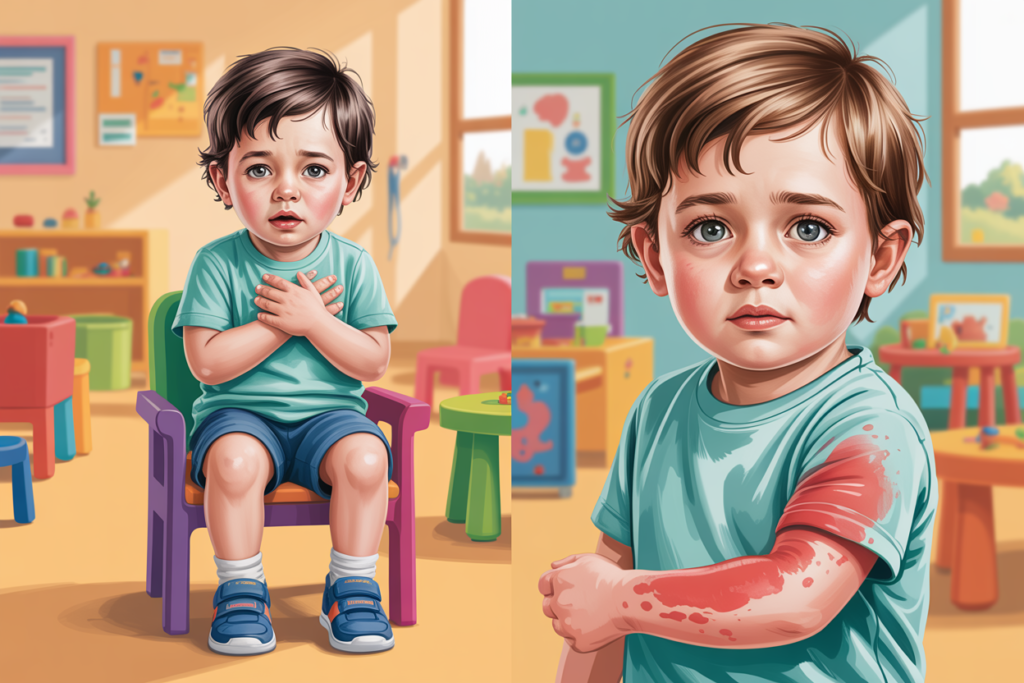
Anaphylaxis is a different beast entirely. It’s a severe, multi-system allergic reaction – meaning it can hit the breathing, the circulation, and the skin all at once. The onset can be within minutes of exposure to a trigger: a food, an insect sting, a medication. Unlike asthma, anaphylaxis can be fatal without immediate adrenaline administration.
Signs include hives, swelling of the lips, face or tongue, skin that looks pale or flushed, vomiting, abdominal pain, difficulty breathing, wheeze, hoarse voice, or collapse.
Why Knowing the Difference Matters Under Pressure
Both conditions can present with wheeze and distress. An educator who hasn’t trained recently can freeze in that moment of overlap – trying to identify which condition they’re dealing with before acting. And that hesitation costs time. ASCIA and ANZCOR guidance is clear: when in doubt, treat for anaphylaxis first.
⚠️
When symptoms overlap - act on anaphylaxis first
Anaphylaxis and asthma can present with overlapping symptoms - wheeze, distress, difficulty breathing. When in doubt, treat for anaphylaxis first. Adrenaline will not harm a child having an asthma attack. Delay in anaphylaxis treatment can be fatal.
| Asthma | Anaphylaxis | |
|---|---|---|
| Primary system affected | Respiratory | Multi-system (breathing, circulation, skin) |
| Common triggers | Exercise, cold air, allergens, illness | Food, insect sting, medication |
| Key symptoms | Wheeze, cough, chest tightness, breathlessness | Hives, swelling, vomiting, wheeze, collapse |
| First response | Reliever inhaler with spacer | Adrenaline auto-injector (EpiPen or Anapen) |
| Medication | Reliever inhaler (blue or grey) | EpiPen or Anapen |
| Call 000? | If no improvement after reliever | Immediately - always |
The Step-by-Step Anaphylaxis Emergency Response for Childcare Educators
If there’s one section of this guide to print out and put on the wall next to the ASCIA action plans, it’s this one. The anaphylaxis response sequence is not complicated – but it has to be automatic. When a child is deteriorating in front of you, there’s no time to think. Your educators need to have this in their bones.
Step 1: Recognise the Signs of Anaphylaxis
Look for hives, swelling of the lips, face or tongue, skin that looks pale or flushed, vomiting, abdominal pain, difficulty breathing, wheeze, hoarse voice, or collapse. Any of these following known or suspected exposure to a trigger – act immediately.
Step 2: Locate the Child’s ASCIA Action Plan
Every at-risk child must have their ASCIA action plan accessible immediately – not in a locked drawer, not filed somewhere it takes time to find. Your educators should know where it is before they ever need it.
Step 3: Administer the Adrenaline Auto-Injector
The adrenaline auto-injector – EpiPen or Anapen – goes into the outer mid-thigh and can be administered through clothing. Both devices deliver adrenaline, but use different techniques. Your educators need hands-on practice with both before they need to use one under pressure.
Step 4: Call 000 Immediately
Don’t wait to see if the adrenaline works. Call 000 the moment the auto-injector is administered. Say “anaphylaxis” – not just “allergic reaction.” Stay on the line.
Step 5: Position the Child Correctly
Lay the child flat with legs elevated. If breathing is difficult, sit them upright. Do not allow the child to stand or walk.
Step 6: Administer a Second Auto-Injector If Required
If there is no improvement and a second device is available, administer it.
Step 7: Contact Parents and Document the Incident
Notify parents as soon as practicable while QAS is in attendance. Every anaphylaxis incident must be recorded in writing a non-negotiable part of ACECQA compliance.
📋
Documentation is not optional
Every anaphylaxis incident must be recorded and reported. Keep a copy on file for ACECQA compliance. Notify parents as soon as practicable after the emergency is managed.
The Step-by-Step Asthma Emergency Response for Childcare Educators
Asthma feels more manageable than anaphylaxis to most educators. And in a lot of ways, it is – the progression is usually slower and the treatment is less confronting. But a severe asthma attack that isn’t responded to correctly can deteriorate fast. And the most common educator mistake in an asthma emergency isn’t hesitation – it’s reaching for the wrong inhaler.
Step 1: Recognise the Signs of a Severe Asthma Attack
Wheeze, persistent cough, shortness of breath, chest tightness, a child who can’t speak in full sentences, or a child who is pale, sweaty, and visibly distressed. These signs need attention now.
Step 2: Sit the Child Upright – Never Lay Them Flat
Sitting upright opens the airway. Laying a child flat during an asthma attack actively restricts their breathing. Get them sitting up, calm, and still.
Step 3: Administer the Reliever Inhaler with a Spacer
The reliever inhaler – blue or grey – provides immediate bronchodilation. Attach the puffer to the spacer before use. The spacer is not optional.
❌
The most common educator mistake in an asthma emergency
The preventer inhaler - brown, orange, or purple - does nothing in an emergency. Only the reliever (blue or grey) provides immediate bronchodilation. Make sure every educator in your centre knows the difference before they need to use it.
Step 4: Follow the 4x4x4 Rule
4 puffs of reliever via spacer, wait 4 minutes, then 4 more puffs if there is no improvement. Simple and repeatable under pressure.
Step 5: Call 000 If There Is No Improvement
Blue lips, inability to speak, visible exhaustion – these mean call 000 now. Keep giving four puffs every four minutes until QAS arrives. Do not stop.
Step 6: Do Not Use the Preventer Inhaler in an Emergency
The preventer – brown, orange, or purple – does not open the airway and has no role in an acute emergency. Put it down and reach for the reliever.
What Must Be Included in Your Childcare Asthma and Anaphylaxis Emergency Plan
Here’s where a lot of centres think they’re across it – and then an auditor arrives and they’re not. Having a folder labelled “Emergency Plans” is not the same as having a compliant, functional asthma and anaphylaxis emergency plan. The documentation has to be right, current, accessible, and backed up by trained staff.
Individual ASCIA Action Plans for Every At-Risk Child
Every child with a diagnosed asthma or anaphylaxis condition must have a current, individual ASCIA action plan on file – signed by their GP or treating specialist. Not a generic plan. Not one completed two years ago and left untouched. Free templates are available directly from ascia.org.au/resources.
Medication Storage, Training Records, and Centre Procedures
Emergency medication must be accessible within seconds – not locked away, not somewhere only the director can access. The storage location must be documented and known to every educator on duty. Check expiry dates regularly.
Training records must be filed and available for auditor inspection, with dates, names, and unit codes clearly referenced. The accepted units are 22300VIC and 22556VIC.
Your centre also needs a centre-wide emergency procedure covering who calls 000, who retrieves the medication, who manages the other children, and who contacts the parents. When an emergency happens, the last thing you want is two educators reaching for the same thing while nobody has called QAS.
Communication Protocols and Annual Review
Your plan needs to document how communication flows during and after an emergency – what information to have ready when calling QAS, parent notification timing, and the management notification chain. And your asthma and anaphylaxis emergency plan is not a set-and-forget document. Build a minimum annual review into your centre calendar.
How Often Does Training Need to Be Renewed?
ACECQA requires at least one educator with current anaphylaxis training present at all times – every session, every day. Training records must be available at compliance audit showing the educator’s name, date of training, and unit code. The accepted units are 22300VIC and 22556VIC. If your certificates reference anything else, confirm with your provider before relying on them at audit.
ASCIA recommends annual renewal. All educators need current certification – not just the nominated supervisor. New staff should be certified within their first month of employment. The gap between a new educator starting and their training being completed is exactly the kind of exposure that shows up badly at audit – and worse, in an actual emergency.
Build a forward training calendar at the start of each year. Book regular sessions so new staff can be certified promptly.
What to Look for in an ACECQA-Accepted Training Provider in Brisbane
Choosing a training provider shouldn’t feel like a gamble. But for a lot of childcare directors, it does – because they’ve either been burned themselves or heard from a peer about a course that turned out not to be accepted at audit, or a certificate that arrived late.
Here’s what to actually check before you book.
Any RTO delivering nationally recognised training must be registered with ASQA. Verify any provider at training.gov.au before committing. Brisbane First Aid Training – ASQA RTO Number [RTO NUMBER] – is listed on the national register.
Confirm in writing that the units being delivered are 22300VIC and 22556VIC and that they’ll appear on the certificate. Don’t assume. Ask. And ask whether the training is aligned to current ASCIA anaphylaxis guidelines – a provider who can’t answer that clearly is worth walking away from.
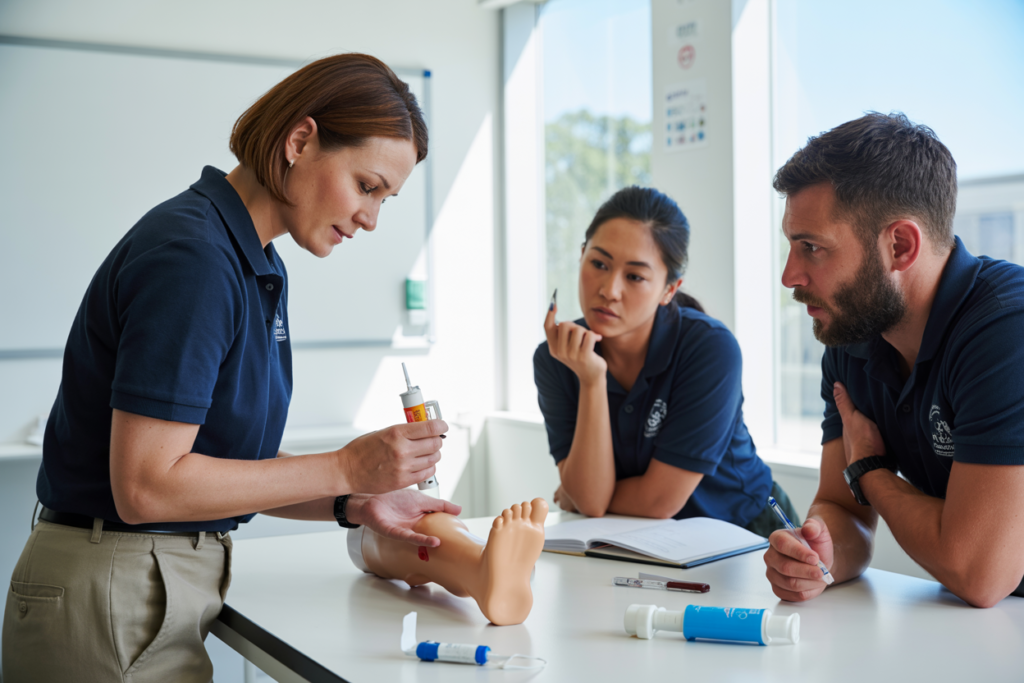
Look for practical components: EpiPen trainer devices allow your educators to physically practice the administration technique before they ever need to use it under pressure. Scenario-based practice builds genuine confidence – not just a certificate.
Certificates should be issued on the day – correctly named, correctly dated, unit codes referenced clearly. For a childcare director managing an audit timeline.
Book Your First Aid Training Now
Fast, affordable, and nationally accredited training delivered by professionals who care
Frequently Asked Questions
Q.What is an asthma and anaphylaxis emergency plan for childcare?
An asthma and anaphylaxis emergency plan is a documented, centre-specific procedure that tells educators exactly how to recognise and respond to a severe asthma attack or anaphylactic reaction. Under ACECQA requirements, every approved childcare service in Queensland must have these plans in place for any child with a known diagnosis, and they must include individual ASCIA action plans, medication locations, response procedures, staff training records, and a review schedule.
Q.What is the difference between asthma and anaphylaxis in a childcare emergency?
Asthma is a respiratory condition causing airway inflammation, wheeze, and breathlessness, managed with a reliever inhaler and spacer using the 4x4x4 rule. Anaphylaxis is a severe, potentially fatal multi-system allergic reaction requiring immediate administration of an adrenaline auto-injector (EpiPen or Anapen) and a call to 000. Both can present with overlapping symptoms - when in doubt, treat for anaphylaxis first.
Q.What should be included in a childcare anaphylaxis emergency plan?
A childcare anaphylaxis emergency plan must include individual ASCIA action plans for every at-risk child signed by their doctor, documented and accessible medication storage, a centre-wide emergency response procedure covering roles during an incident, staff training records showing current certification in 22300VIC or 22556VIC, communication protocols for contacting QAS and parents, and an annual review schedule aligned to current ASCIA guidelines.
Q.What is the difference between a reliever and preventer inhaler in a childcare asthma emergency?
A reliever inhaler - typically blue or grey - provides immediate bronchodilation and is the correct medication in an asthma emergency. A preventative inhaler - typically brown, orange, or purple - is taken daily to reduce inflammation over time and has no effect whatsoever in an acute emergency. Using a preventer instead of a reliever during an asthma attack is one of the most common and potentially dangerous educator errors, which is why hands-on training makes such a difference.
Q.Can an EpiPen be administered through clothing?
Yes - both EpiPen and Anapen can be administered through clothing into the outer mid-thigh, which matters when seconds count in an anaphylaxis emergency. The two devices deliver adrenaline but use different techniques, so your educators need hands-on practice with both using trainer devices before they ever need to use one under real pressure.
Making first aid training more affordable for
every classroom
We believe every student deserves access to life-saving first aid knowledge. That’s why we offer specially reduced pricing for schools and educational groups. Whether you’re booking for a single class, a year group, or your entire school, our flexible packages make training more accessible and cost-effective — without compromising quality.
