

Sarah’s hands were shaking.
Four-year-old Mia had just eaten a cookie containing hidden peanut traces, and her face was swelling rapidly. Sarah knew what to do—she’d completed her anaphylaxis training 14 months ago. She’d passed the assessment. Her certificate hung on the center wall.
But standing there with the EpiPen in her trembling hands, Sarah realized she’d only practiced on a trainer twice, over a year ago. Her brain knew the steps. Her body didn’t.
Those 10 seconds of frozen panic felt like an eternity. Mia was crying, struggling to breathe. Other educators were looking at Sarah—she was the one with current certification. The one who was supposed to know what to do.
This is why asthma anaphylaxis face to face training matters—not the certificate on the wall, but the repetition. The muscle memory. The confidence that comes from practicing EpiPen administration multiple times in one afternoon, not twice in three years.
Brisbane childcare educators face real emergencies with real children. Online theory courses don’t prepare you for the adrenaline rush when a child’s lips start swelling. Video demonstrations don’t teach your hands the exact pressure needed to activate an auto-injector. Quiz questions don’t build the split-second decision-making skills you need when a toddler’s wheeze suddenly turns serious.
Sarah did save Mia that day. The EpiPen worked. Paramedics arrived. Mia recovered fully.
But Sarah still wakes up at 3am sometimes, replaying those 10 seconds of hesitation. “What if I’d frozen longer? What if my hands had been shaking so badly I dropped it? What if Mia had died because I wasn’t truly prepared—just certified?”
You don’t want to find out the hard way that “certified” and “prepared” aren’t the same thing.
In this guide, you’ll learn why hands-on asthma anaphylaxis face to face training builds the genuine competence that keeps children safe, and what separates providers who just tick compliance boxes from those who actually prepare you for real emergencies.
Because when a child’s life depends on your response, you need more than a piece of paper. You need hands that know what to do when your brain freezes.
⚠️ Compliance Alert: Online anaphylaxis courses don’t meet ACECQA requirements for Queensland childcare educators. Face-to-face training with practical demonstration is mandatory — no exceptions.
What Is Face-to-Face Anaphylaxis Training?
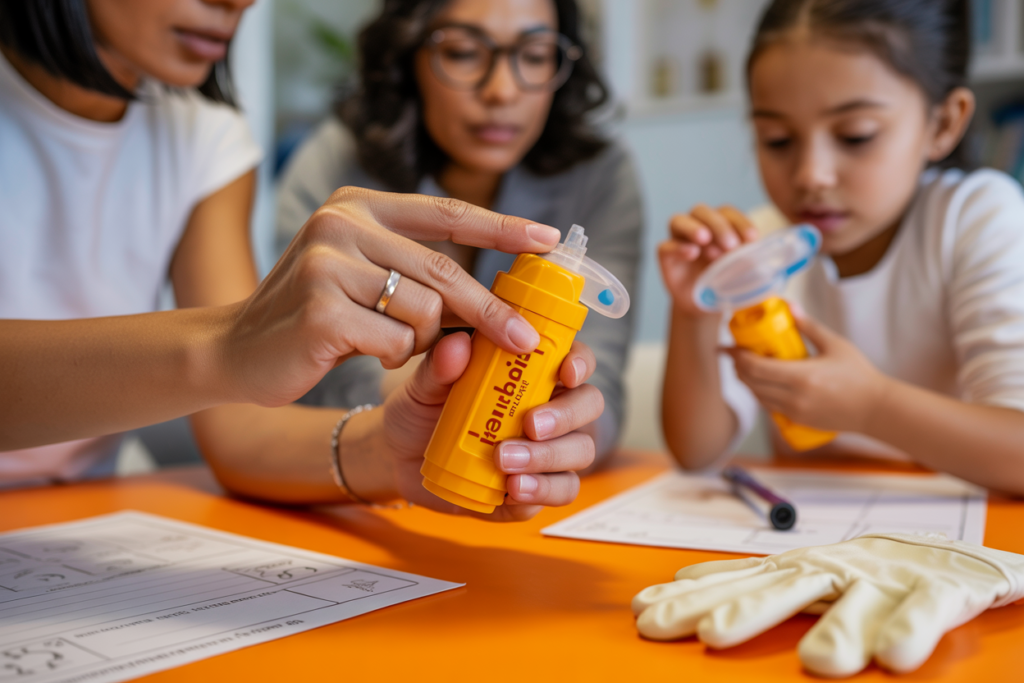
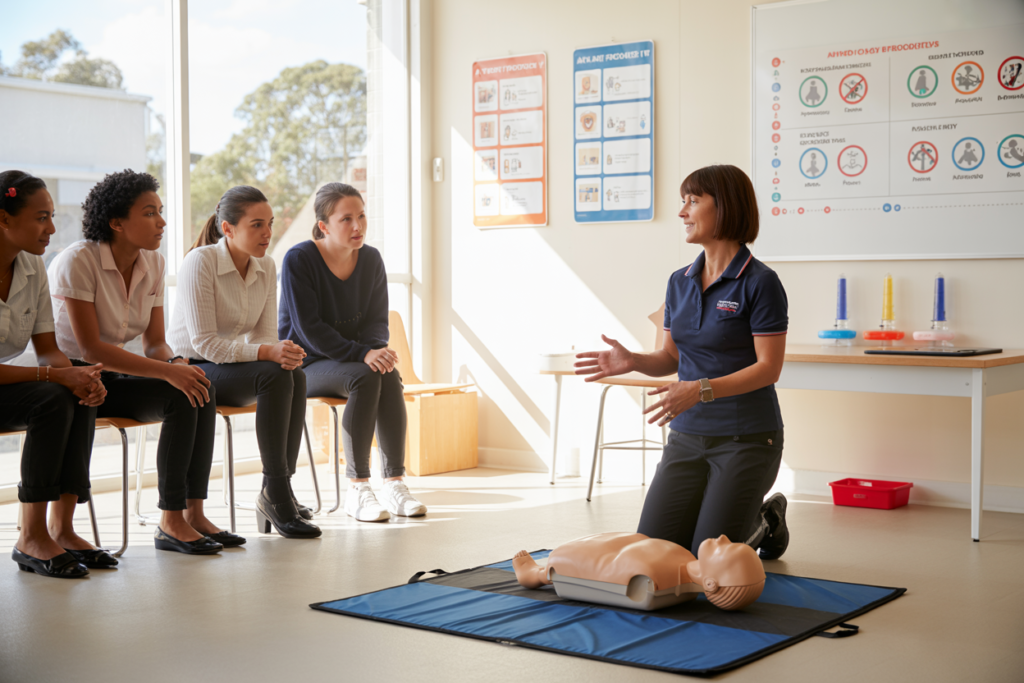
Face-to-face anaphylaxis training is hands-on, in-person emergency response education where you physically practice life-saving techniques under expert supervision. Unlike online courses that rely on videos and theory, asthma anaphylaxis face to face training puts actual EpiPen trainers in your hands and has you practice—over and over—until your body knows what to do without thinking about it.
What You’ll Actually Do:
- Practice EpiPen administration multiple times on trainers with real-time instructor feedback
- Learn asthma spacer techniques through hands-on demonstration
- Work through realistic childcare emergency scenarios (not generic “someone’s having an allergic reaction” situations, but actual toddler room contexts with ratio pressure and crying children)
- Receive immediate correction and coaching on technique
- Build muscle memory that works under pressure
- Ask “what if” questions specific to your center’s policies and your room’s high-needs children
Who Needs It:
Face-to-face training is mandatory for Brisbane childcare educators under ACECQA regulations. Both 22579VIC (Course in Anaphylaxis Management) and 22578VIC (Course in Management of Asthma Risks and Emergencies) must be completed in person—online-only courses don’t meet Queensland compliance requirements.
ACECQA doesn’t mess around with this requirement. They’ve seen what happens when educators try to respond to emergencies armed only with online theory knowledge. It doesn’t end well.
Why Face-to-Face Training Builds Real Confidence (Not Just Compliance)
The Critical Gap Between “Knowing” and “Doing”
You can watch a hundred YouTube videos on EpiPen administration. You can memorize every step of the anaphylaxis action plan. You can ace the online quiz with 100% accuracy.
But none of that prepares your hands for the weight of an actual EpiPen in a real emergency when a child’s face is swelling and your colleagues are watching you to act decisively.
This is the critical gap between cognitive knowledge and physical competence. Your brain might know the steps, but when adrenaline floods your system, when your hands are shaking, when every second counts—cognitive knowledge isn’t enough.
Face-to-face asthma anaphylaxis training bridges this gap through physical repetition. When you’ve practiced administering an EpiPen multiple times—feeling the click, adjusting your grip, getting feedback on your angle and pressure—your hands develop unconscious competence. Your muscles remember what your panicked brain might temporarily forget.
According to the Australian Resuscitation Council, effective emergency response training must include “hands-on practice with adrenaline auto-injector training devices” and participants should “practice until competent”—not practice once and hope for the best.
Research from Queensland Health shows that 68% of early childhood educators report feeling “somewhat unprepared” to respond to severe allergic reactions in real-world situations, despite having current certification. The problem isn’t lack of knowledge—it’s lack of confidence that comes from inadequate physical practice.
Repetition Creates Unconscious Competence
There are four stages of learning any physical skill:
Stage 1: Unconscious Incompetence – You don’t know what you don’t know
Stage 2: Conscious Incompetence – You’re aware you can’t do it well yet
Stage 3: Conscious Competence – You can do it, but you have to think about each step
Stage 4: Unconscious Competence – Your body does it automatically, even under stress
Most online courses and rushed face-to-face training leave you at Stage 3. You can administer an EpiPen if you think carefully through each step in a calm environment. But real emergencies aren’t calm or controlled.
Stage 4—unconscious competence—is what keeps children safe. It’s the muscle memory that kicks in when your brain freezes. It’s your hands knowing the exact pressure needed to activate the auto-injector without conscious thought.
You reach Stage 4 through repetition. Quality asthma anaphylaxis face to face training in Brisbane provides multiple practice rounds per student. Each practice round builds neural pathways. Each correction from your instructor refines your technique. Each successful administration builds confidence.
Real-Time Feedback You Can’t Get Online
When you practice EpiPen administration in face-to-face training, your instructor sees things you can’t:
- Your grip is too loose (the device might slip during activation)
- Your angle is slightly off (could result in shallow injection)
- You’re not pressing hard enough (auto-injector might not deploy)
- You removed your hand too quickly (medication didn’t fully deliver)
These micro-adjustments make the difference between effective emergency response and fumbled intervention. You can’t get this feedback from a video. You need an experienced instructor watching your technique and coaching you in real-time.
Quality instructors identify and correct your individual challenges. Maybe you have small hands and need a different grip. Maybe you’re unconsciously hesitating at the activation point and need specific coaching to push through that barrier.
This personalized feedback accelerates your progression to unconscious competence far faster than self-paced online learning ever could.
Scenario-Based Learning in Childcare Contexts
Generic emergency training uses generic scenarios. Face-to-face courses specifically designed for Brisbane childcare educators use scenarios that mirror your actual work environment—afternoon snack situations with multiple children, outdoor play during Brisbane summer heat, split-second decisions under ratio pressure.
You practice decision-making, not just technique. When do you use the EpiPen versus wait and monitor? How do you maintain room supervision while responding to a medical emergency? These are situations Brisbane educators face, and face-to-face training prepares you for this complexity.
Training Format Comparison
| What You Need | Online Course | Face-to-Face Training |
|---|---|---|
| ACECQA compliance | ❌ Not accepted | ✅ Fully compliant |
| Physical EpiPen practice | ❌ None or minimal | ✅ Multiple supervised rounds |
| Instructor feedback | ❌ No real-time coaching | ✅ Immediate correction |
| Muscle memory development | ❌ Can't build through screens | ✅ Builds through repetition |
| Emergency confidence | ❌ Theory only | ✅ Practical readiness |
Face-to-Face vs. Online Training: The Real Comparison
Let’s talk about online anaphylaxis training. Because you’ve probably seen the ads. “Complete your training from home!” “Finish quickly!” “No need to give up your weekend!”
But here’s what you need to know about online anaphylaxis training for Brisbane childcare educators: it doesn’t meet ACECQA requirements. Full stop.
What ACECQA Actually Requires
ACECQA specifically mandates that early childhood educators complete approved face-to-face anaphylaxis and asthma training. The regulation states that at least one educator with current anaphylaxis management training must be “physically present and immediately available” at all times children with diagnosed allergies are in care. That training must include “practical demonstration of adrenaline auto-injector administration.”
Translation: You must complete in-person training where an assessor watches you physically demonstrate correct technique. Online courses with video assessments don’t count.
Why is ACECQA so strict? Because they’ve seen what happens when educators try to respond to emergencies based purely on theoretical knowledge. Children die. That’s documented reality in cases where educators froze, hesitated, or fumbled administration because they’d never actually practiced with real supervision and feedback.
What Online Courses Are Missing
What’s Missing:
❌ Physical practice – You don’t actually hold an EpiPen trainer
❌ Real-time feedback – No instructor watching your grip, angle, pressure
❌ Repetition – Maybe one or two practice attempts
❌ Personalized coaching – You can’t ask immediate questions
❌ Confidence building – Videos don’t prepare you for real emergencies
Choosing Quality Face-to-Face Training in Brisbane
Not all asthma anaphylaxis face to face training is created equal. You can show up to two different courses in Brisbane, both claiming to be “ACECQA approved,” and leave with completely different experiences.
Red Flags: What to Avoid
🚩 Instructors With No Real Emergency Experience
Some training providers hire instructors straight out of “train the trainer” courses. They can demonstrate correct technique but they’ve never actually responded to a pediatric anaphylaxis emergency. They’ve never worked in childcare.
Quality instructors have real emergency experience—ideally pediatric nursing, paramedicine, or extensive childcare work with high-needs children.
🚩 Vague or Missing Reviews
Real businesses with good training have reviews accumulated over time, mentioning specific instructors by name and describing actual course experiences. If a provider has only a handful of generic reviews, that’s a red flag.
🚩 No Clear Certificate Delivery Timeline
Quality providers issue digital certificates within hours of course completion. If they say “within 7-10 business days,” that’s two weeks of unnecessary waiting.
Green Flags: What to Look For
✅ Instructor Credentials Prominently Displayed
Look for full instructor bios with real emergency experience, pediatric background, and childcare understanding.
✅ Specific Practice Commitment
The course description should say specifically how many times you’ll practice—not just vague “hands-on learning” language.
✅ Same-Day Digital Certificate Guarantee
Clear statements about when you’ll receive your certificate, with specific timeframes.
✅ Recent, Detailed Reviews
Google reviews from recent months mentioning specific outcomes and experiences.
The Same-Day Certificate Advantage
After you complete your asthma anaphylaxis face to face training, you need proof. Your director needs to update your compliance file. ACECQA could audit tomorrow—you need that certificate accessible, not “in the mail somewhere.”
Why This Matters
Compliance Anxiety Is Real
From the moment your certificate expires until you have proof of renewal in hand, you’re technically non-compliant. If ACECQA shows up during that window for a spot audit, your center has a problem.
Same-day certificates eliminate this anxiety window. You complete training, receive your certificate that afternoon, and you’re compliant immediately.
Directors Need Documentation NOW
Your director has deadlines. ACECQA submission deadlines. Insurance renewal deadlines. Staff file audit schedules. If she needs your updated certificate and you completed training recently, “it’ll arrive in a week” doesn’t help her.
Life Is Unpredictable
With traditional mailing, certificates get delayed, lost, or sent to wrong addresses. With same-day digital delivery, none of this happens. Email arrives. Certificate is yours. Done.
Your Next Step: Book Your Training
You’ve read this entire guide about asthma anaphylaxis face to face training.
You understand why it matters. You know what quality training looks like.
Now stop researching and start preparing.
Find a Brisbane provider with good reviews, experienced instructors, and same-day certificate delivery. Check their available dates. Pick one that fits your schedule.
Then book it.
Not “sometime soon.” Not “when I have time.” Right now. Today.
Your certificate expires whether you book training or not. Children with allergies are enrolled in your room whether you’re prepared or not. ACECQA audits happen whether you’re compliant or not.
The only variable you control is whether you’re genuinely prepared when it matters.
Your hands need to know what to do. Your body needs to remember the technique. A child’s life might depend on your confidence.
Don’t wait until panic sets in. Don’t wait until your certificate is already expired. Don’t wait until the night before an ACECQA audit.
Book your asthma anaphylaxis face to face training today. Because when a four-year-old’s face starts swelling and the EpiPen is in your shaking hands, you want muscle memory—not just a vague recollection of a video you watched three years ago.
Book Your First Aid Training Now
Fast, affordable, and nationally accredited training delivered by professionals who care
Frequently Asked Questions
Q. Is this course ACECQA approved?
Yes. Both 22579VIC (Anaphylaxis Management) and 22578VIC (Asthma Risks & Emergencies) are ACECQA-approved and nationally recognised. Your certificate meets all Queensland childcare compliance requirements and is accepted by all Brisbane early learning centres.
Q. Can I do this training online instead of face-to-face?
No. ACECQA specifically requires face-to-face training with practical demonstration for childcare educators. Online-only courses don’t meet compliance requirements, regardless of how convenient they seem. Your centre won’t accept an online certificate.
Q. My certificate expired last month. Can I still renew?
Yes. The renewal course is the same whether you’re one day expired or six months expired. However, you’re currently non-compliant and can’t work with children who have medical conditions until you complete renewal training and receive your new certificate.
Q. What’s the difference between initial training and renewal?
Certificates don’t distinguish between initial and renewal — both result in the same three-year certification. Quality providers, however, design renewal courses differently, focusing more on hands-on practice and less on theory you’ve already completed.
Q. What if I’m really nervous about the practical assessment?
Most students pass on their first attempt because you’ll practise each skill multiple times before assessment. There’s no written exam — just demonstration of techniques you’ve already practised. Quality instructors support nervous students individually until they’re genuinely confident.
Q. How long is the certificate valid?
Three years from your completion date. For example, if you complete training on January 15, 2025, your certificate expires January 15, 2028. There’s no grace period — the expiry date is a hard deadline for compliance.
Making first aid training more affordable for
every classroom
We believe every student deserves access to life-saving first aid knowledge. That’s why we offer specially reduced pricing for schools and educational groups. Whether you’re booking for a single class, a year group, or your entire school, our flexible packages make training more accessible and cost-effective — without compromising quality.
