

It’s 2:30pm snack time. A child in your room starts wheezing after running outside. Is this normal post-exercise breathlessness or the start of a serious asthma episode? You have seconds to decide—do you intervene now or monitor for another few minutes?
If you’re a childcare educator, you face these split-second decisions daily. While your asthma and anaphylaxis practical training certificate proves compliance, it doesn’t guarantee you’ll respond with confidence when a child’s airway is compromising.
The truth? Most training courses focus heavily on theory—histamine responses, immune system reactions, regulatory requirements—and provide minimal hands-on practice. You might administer an EpiPen trainer once or twice, then walk away “certified” but still terrified of freezing in a real emergency.
This guide reveals 10 practical training tips that bridge the gap between holding a certificate and having genuine competence. You’ll discover how to build muscle memory that works under pressure, recognize subtle warning signs, and develop the decision-making confidence that keeps children safe.
Whether you’re renewing your certificates or completing them for the first time, these evidence-based strategies will transform your emergency response skills.
🔑 Key Takeaway: One practice round doesn't build muscle memory. Your hands need minimum 5 repetitions before movements become automatic under pressure.
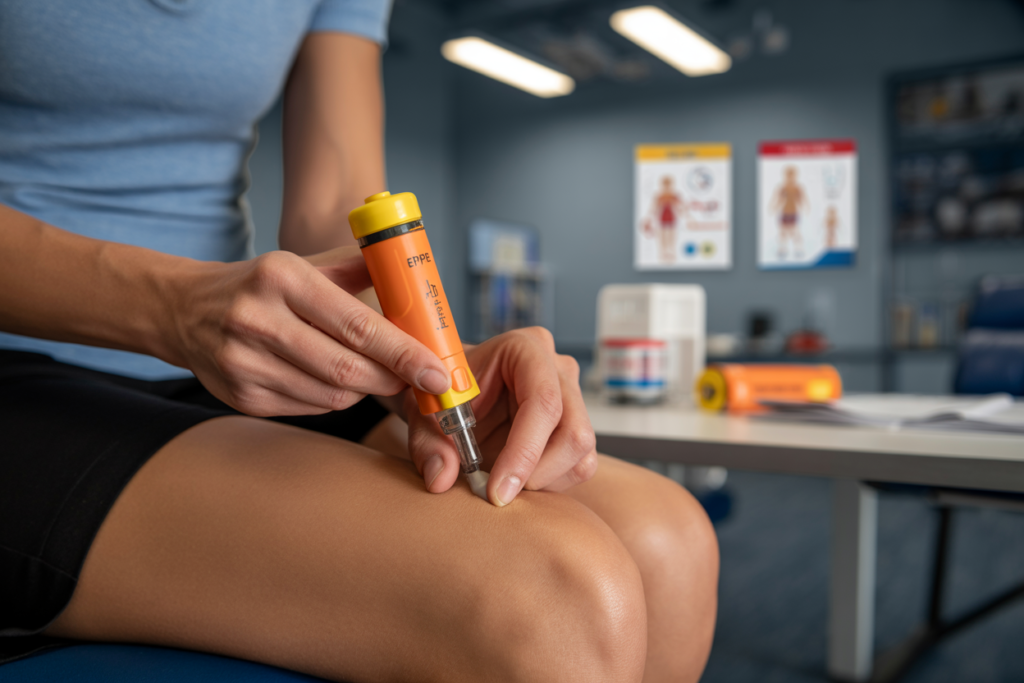
Tip #1: Practice EpiPen Administration Minimum 5 Times (Not Just Once)
Most anaphylaxis courses provide one, maybe two practice rounds with an EpiPen trainer. But here’s what happens in a real emergency: A child’s face is swelling, your hands are shaking, and your body freezes.
Why one practice round isn’t enough: Research shows motor skills require 5-7 repetitions before they transfer from conscious thought to unconscious competence. One practice develops awareness. Five practices develop muscle memory.
Quality training programs structure practice this way: instructor demonstration, your first coached attempt, second uncoached attempt, scenario-based practice with stress elements, and timed full emergency simulation. By the fifth round, your hands know the grip and your fingers find the safety cap without conscious thought.
When researching training providers, ask specifically: “How many times will I practice EpiPen administration?” If the answer is less than 5, keep looking. Your hands need repetition to build the muscle memory that works when your brain freezes.
Tip #2: Learn to Recognize Pre-Anaphylaxis Warning Signs (The 60-Second Window)
Every childcare educator knows the textbook signs of anaphylaxis: facial swelling, difficulty breathing, widespread hives. But there’s often a 30-90 second window of subtle warning signs BEFORE the obvious symptoms appear.
The pre-anaphylaxis warning signs most educators miss:
10-30 seconds after exposure: Child touches their mouth or lips repeatedly, says “my mouth feels funny,” excessive saliva, pulling at their throat.
30-60 seconds: Facial flushing, scratching at ears obsessively, complaining about belly pain, sudden behavior change, voice sounds slightly different.
60-90 seconds: Visible hives starting, wheezing becomes audible, persistent cough getting worse, child says “something’s wrong.”
Recognizing these pre-anaphylaxis indicators is the difference between administering an EpiPen while a child is still calm versus scrambling to inject a panicking, swelling, struggling child.
During your training, ask your instructor: “Can you walk us through real case studies showing what children said and did in the first minute?” Good instructors will have these examples prepared. You’ll start noticing patterns that your brain can recognize automatically.
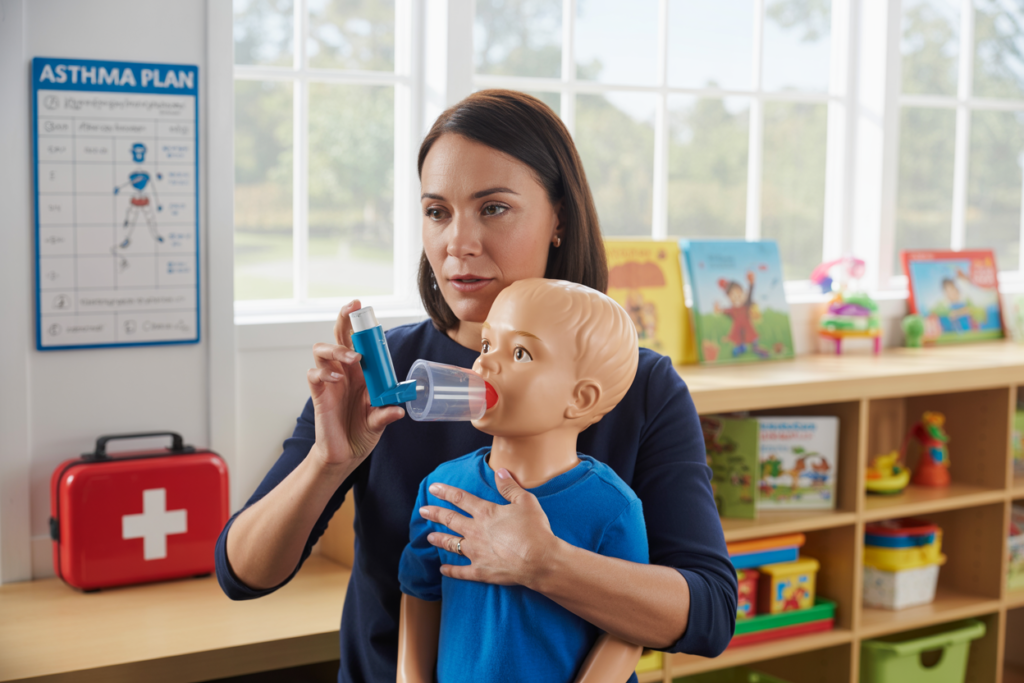
Tip #3: Master Spacer Technique for Effective Asthma Medication Delivery
You grab the blue reliever inhaler and spacer, shake it, press the inhaler once, tell the child “breathe in deeply,” and think you’re done. Except you just delivered maybe 20-30% of the medication dose.
The 6 common spacer mistakes that reduce effectiveness:
Mistake #1: Not shaking the inhaler enough (needs 5-10 seconds of vigorous shaking)
Mistake #2: Waiting too long between shaking and administering (suspension settles again after 30 seconds)
Mistake #3: Pressing the inhaler multiple times in one breath (creates aerosol overload—most deposits on chamber walls)
Mistake #4: Telling the child to “take a deep breath” (young children can’t coordinate this—normal breathing works better)
Mistake #5: Not creating a proper seal (gaps between lips and mouthpiece = medication escaping)
Mistake #6: Removing the spacer too quickly (child exhales medication before it fully absorbs)
✅ The correct protocol: One puff at a time. Press inhaler once, child takes 4-6 normal breaths through spacer, hold last breath for 5 seconds, remove spacer, wait 30-60 seconds, repeat for next puff. Four puffs done correctly takes 4-5 minutes, not 30 seconds.
Tip #4: Learn to Distinguish Normal Wheeze from Dangerous Asthma Escalation
Connor has asthma. He wheezes sometimes after running around. You’ve seen it dozens of times—he catches his breath, and he’s fine. So when Connor comes inside with his usual post-exercise wheeze, you think it’s normal.
Except today, the wheeze isn’t just post-exercise breathlessness. It’s early-stage asthma attack. And by the time you realize this isn’t “normal Connor,” he’s in serious respiratory distress.
The trajectory test removes guesswork:
Don’t assess the wheeze in isolation. Assess the trajectory over time.
At Minute 5: Is breathing easier or harder than 5 minutes ago?
- Easier/same = probably normal exercise wheeze, continue monitoring
- Harder = this is escalating, intervene now
At Minute 10: If you didn’t intervene at 5 minutes, reassess again.
- Breathing easier than 5 minutes ago = normal wheeze resolving
- Same or worse = you’ve waited too long, intervene immediately
The “Can They Finish the Sentence?” test is your simplest assessment tool. Ask a question requiring a full sentence answer. If the child can only speak in broken phrases or single words, they need reliever medication now.
Tip #5: Train with Scenario-Based Decision-Making Exercises (Not Just Theory)
Theory-based training says: “If a child shows signs of anaphylaxis, you should administer the EpiPen, call 000, and monitor the child.”
Scenario-based training says: “It’s 2:30pm afternoon snack. You’ve got 16 children in your room. Mia just took a bite of a cookie—you didn’t check ingredients first. Mia says ‘my tongue feels funny.’ Her face is flushing. Three other children are watching. Another educator asks if you can cover ratio next room. What do you do? Show me. You’ve got 30 seconds.”
See the difference? The scenario forces you to prioritize competing demands, manage stress, make decisions with incomplete information, communicate under pressure, and perform physical tasks while mentally processing.
The five scenario types every training should include:
- The ambiguous presentation (decision-making when you’re not 100% certain)
- The equipment failure (EpiPen doesn’t work—what’s plan B?)
- The multiple-child emergency (three children need help simultaneously)
- The uncooperative child (struggling, thrashing, won’t stay still)
- The communication breakdown (you’re alone, phone’s not accessible)
Before booking training, ask: “Do you provide scenario-based practice with realistic childcare distractions?” If practice happens in quiet, orderly environments, you’re not preparing for real emergencies.
Tip #6: Know When to Call 000 Immediately (Versus When to Monitor)
Connor is wheezing. You’ve given him reliever medication. Your brain is screaming: “Should I call 000 now or wait to see if the medication works?”
Both options feel risky. Call too early and you might waste emergency resources. Call too late and you’ve let Connor deteriorate.
Here are clear, specific criteria:
| Situation | When to Call 000 | Why No Waiting |
|---|---|---|
| Anaphylaxis | Immediately after EpiPen | Symptoms can return when adrenaline wears off |
| Severe asthma | Child can't speak, blue lips, silent chest | Child is in respiratory failure |
| Moderate asthma | After 2 rounds of reliever (8 puffs) with no improvement | 10 minutes is enough time for medication to work |
⏱️ The 10-minute rule: Reliever medication takes 5-10 minutes to work. If you're not seeing improvement by 10 minutes total, waiting longer won't help. Two rounds of reliever without improvement = call 000.
Tip #7: Build Muscle Memory Through Deliberate Repetition
You complete your training and walk out with certificates valid for three years. You feel confident. Fast forward 22 months later. A child has anaphylaxis. You grab the EpiPen, and you’re experiencing the terrifying realization: I can’t remember what I learned 22 months ago.
This is the 3-year gap problem. Your certificate is valid for 36 months, but your skills start degrading after 3 months. By month 22, you’re operating with maybe 20-30% of the competence you had after training.
The minimum viable practice protocol: 30 minutes every 3 months.
Quarter 1: EpiPen focus – Physical technique practice (3 times each), problem-solving scenarios, decision-making practice
Quarter 2: Asthma focus – Spacer technique practice (2 full puffs with wait times), wheeze assessment, reassessment timing with real timers
Quarter 3: Integration focus – Complex scenarios requiring multiple skills, action plan review, equipment checks
Quarter 4: Stress inoculation – Realistic distraction practice, speed drills, post-incident communication
That’s 2 hours annually to maintain emergency response skills. Without practice, your training investment is worthless by month 18.
Tip #8: Choose Training with Childcare-Specific Scenarios
Generic first aid teaches emergency response in generic contexts. It doesn’t prepare you for managing an emergency while supervising 15 other children, explaining to a three-year-old why their friend can’t play, maintaining ratios during medical emergencies, or following childcare-specific documentation requirements.
What makes training “childcare-specific”:
✅ Age-appropriate communication during emergencies (how to explain an EpiPen to a terrified four-year-old)
✅ Ratio management protocols (who treats the emergency, who supervises other children, who calls for help)
✅ Regulatory documentation requirements (incident reports, notification requirements, compliance templates)
✅ Parent communication strategies (what to say when parents arrive during emergencies)
✅ Multi-child considerations (four children with different allergen brands, simultaneous asthma cases)
Red flags: All scenarios involve adults, no mention of supervision or group management, generic documentation templates, no discussion of parent communication.
Green flags: Instructor with childcare background, scenarios explicitly mention childcare contexts, compliance mentioned, documentation templates provided.
Ask before booking: “Is this designed specifically for childcare educators, or is it general first aid?”
Tip #9: Review Action Plans Strategically (Not Just Superficially)
Four-year-old Mia has been in your room for 11 months. Her anaphylaxis action plan has been on the wall since she started. You think you know it.
But without looking, can you answer: Does her plan say antihistamine before or after EpiPen? What specific symptoms trigger EpiPen versus just antihistamine? Any other allergies besides her main one? What’s the exact medication dosage?
If you couldn’t answer immediately, you don’t actually know the plan as well as you think.
Strategic review means interrogating the plan with specific questions:
- What are ALL her allergens, not just the main one?
- What are the EXACT symptoms that trigger EpiPen?
- What symptoms get antihistamine only?
- Are there any special instructions I might miss under pressure?
- Who do I call after 000?
The emergency simulation method: Close your eyes and mentally simulate an emergency. Walk through the entire scenario step by step. If you get stuck, open the action plan and find the answer. Then simulate again. By the third simulation, your brain has the sequence memorized.
Set aside 30 minutes quarterly to review ALL action plans in your room strategically, not superficially.
Tip #10: Maintain Skills Between Renewals with Regular Practice
Your certificate is valid for 36 months, but your skills start degrading after 3 months. Without practice, you’re essentially paying for competence that lasts maybe 6 months, then degrades to near-uselessness until next renewal.
The skill degradation timeline:
- Month 0: 100% retention
- Month 3: 60-70% retention
- Month 6: 40-50% retention
- Month 12: 30-40% retention
- Month 18-36: 20-30% retention
Practice that requires no equipment:
Mental rehearsal (5 minutes weekly): Visualize the complete emergency response sequence with sensory details
Verbal walk-through (3 minutes daily): During supervision, mentally walk through protocols
Teaching others (10 minutes monthly): Explain protocols to new educators—teaching forces you to articulate the complete procedure
Case study review (15 minutes monthly): Read incident reports from other centers, analyze what could have been done differently
The goal isn’t perfect recall of every detail. The goal is maintaining unconscious competence—where your hands perform the technique automatically while your conscious brain handles higher-order tasks like calming the child and directing other educators.
That only comes from ongoing, deliberate practice between renewals.
Conclusion: From Certificate to Confidence
You’ve just learned 10 practical training tips that bridge the gap between holding a compliant certificate and having genuine competence to manage asthma and anaphylaxis emergencies.
These aren’t just tips. They’re the difference between educators who freeze during emergencies and educators who respond with automatic, confident, effective action.
The next time you book asthma and anaphylaxis practical training, you’ll know exactly what to look for: hands-on practice (minimum 5 times), pre-symptom recognition training, proper spacer protocols, trajectory assessment skills, scenario-based decision-making, clear 000 criteria, ongoing practice strategies, childcare-specific content, strategic action plan review, and skills maintenance plans.
Because the children in your care deserve more than compliance. They deserve educators whose training translated into genuine preparedness.
Your certificates prove you attended training. Your ongoing practice proves you’re actually ready.
Book Your First Aid Training Now
Fast, affordable, and nationally accredited training delivered by professionals who care
Frequently Asked Questions
Q.How many times should I practice EpiPen administration during training?
You should practice EpiPen administration a minimum of 5 times during your training course to build genuine muscle memory. Research shows that motor skills require 5-7 repetitions before they transfer from conscious thought to unconscious competence, meaning your hands will know what to do automatically under pressure. One or two practice rounds only develop basic awareness, not the automatic response you need when a child's face is swelling and your brain is overwhelmed with stress.
Q.What's the difference between normal post-exercise wheeze and dangerous asthma?
The key difference is trajectory over time, not the initial presentation. Normal exercise wheeze peaks within 5-10 minutes then improves, while dangerous asthma progressively worsens. Use the 5-minute comparison method: assess the child's breathing at minute 0, then reassess at minute 5. If breathing is harder than it was 5 minutes ago (not easier or the same), this is escalating asthma that needs immediate intervention with reliever medication.
Q.How often should I practice emergency skills between my 3-year renewal courses?
You should practice emergency response skills for 30 minutes every 3 months (quarterly) to maintain competence throughout your 3-year certificate validity. Without practice, your skills degrade from 100% retention immediately after training to just 20-30% retention by month 18. Quarterly practice sessions should rotate focus: Quarter 1 on EpiPen technique, Quarter 2 on asthma management, Quarter 3 on integration scenarios, and Quarter 4 on stress inoculation with realistic distractions.
Q.What makes training "childcare-specific" versus generic first aid?
Childcare-specific training includes scenarios that involve managing emergencies while supervising multiple children, ratio management protocols, age-appropriate communication strategies for scared young children, regulatory documentation requirements specific to early childhood settings, and parent communication strategies during and after incidents. Generic first aid focuses on individual adult patients in office or home settings without addressing the unique complexity of group care environments where you're simultaneously treating one child while maintaining supervision of 15 others.
Making first aid training more affordable for
every classroom
We believe every student deserves access to life-saving first aid knowledge. That’s why we offer specially reduced pricing for schools and educational groups. Whether you’re booking for a single class, a year group, or your entire school, our flexible packages make training more accessible and cost-effective — without compromising quality.
