

In Australia, a child is hospitalized for anaphylaxis every 20 minutes.
Read that again. Every twenty minutes.
If you’re a childcare director in Brisbane or anywhere across SEQ, that number probably landed somewhere in your chest – not just your head. Because you know those aren’t anonymous statistics. Those are kids who look exactly like the ones in your care right now. Kids with ASCIA action plans in their files, EpiPens in the medication box, notes on their enrolment forms about peanuts or dairy or bee stings.
The question for your centre isn’t if an episode will happen. It’s whether your team will be ready when it does.
The children at your centre with documented allergies and asthma action plans aren’t edge cases. They’re in every room, every session, every excursion. Asthma and anaphylaxis are daily realities in childcare – not hypotheticals to plan for someday.
This guide covers the top 7 asthma and anaphylaxis prevention strategies every Brisbane childcare centre should have in place in 2026, each aligned with current ASCIA guidelines and ACECQA requirements. From risk identification and action plans through to staff training and environment controls, each strategy is designed to protect the children in your care – and give your team the confidence to act.
What Are the Best Asthma and Anaphylaxis Prevention Strategies for Childcare Centres?
The most effective asthma and anaphylaxis prevention strategies for childcare centres include:
- Maintain up-to-date individual action plans – every child with a known condition must have a current ASCIA-format action plan on file
- Conduct a thorough risk assessment on enrolment and review it annually
- Store medications correctly – EpiPens and relievers must be accessible, labelled, and within expiry
- Eliminate or minimise known triggers within the centre environment
- Ensure all staff hold current, ACECQA-accepted training in asthma and anaphylaxis response
- Run regular scenario-based practice drills so staff can act under pressure
- Establish a clear emergency communication protocol including when to call QAS
Each strategy is covered in detail below.
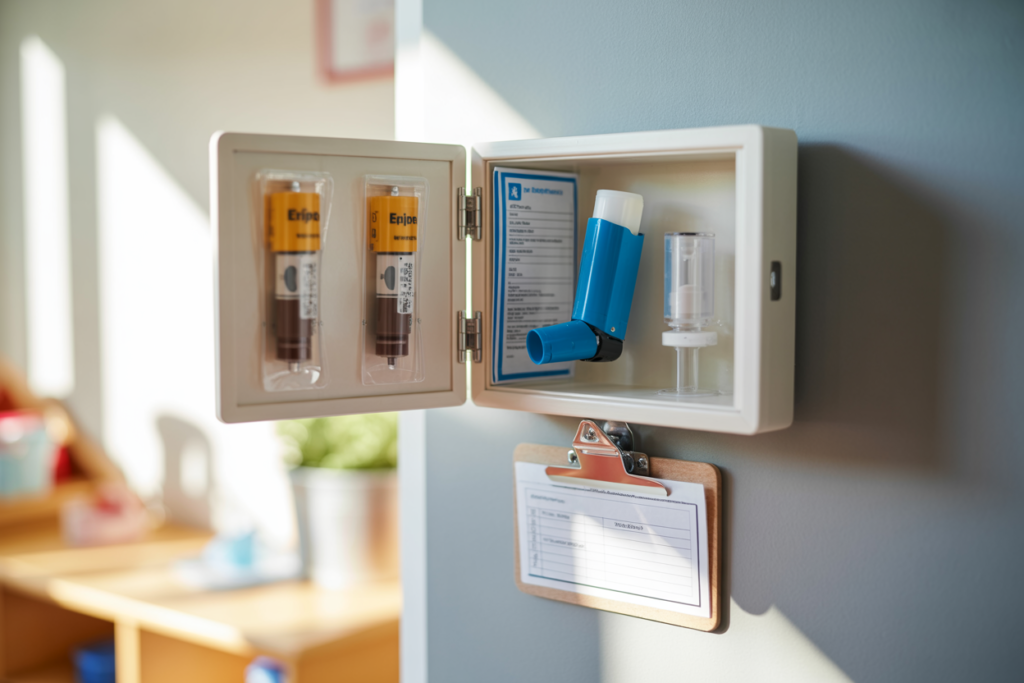
Strategy 1: Maintain a Current ASCIA Anaphylaxis Action Plan for Every At-Risk Child
An ASCIA action plan isn’t paperwork. It’s the document your educator is going to reach for in the first thirty seconds of a reaction when adrenaline is running high and clear thinking is hard. If that document is missing, outdated, or buried somewhere unhelpful, the consequences can be serious.
What an ASCIA Action Plan Must Include
ASCIA provides free, downloadable action plan templates at ascia.org.au/action-plans – the format auditors recognise and medical staff expect. One of the most common compliance gaps directors don’t see coming: the plan must be signed by the child’s treating physician, not a parent alone. If yours doesn’t have that signature, it’s worth fixing before your next audit.
How Often Action Plans Should Be Reviewed and Updated
At minimum, review every action plan annually. But a plan must also be updated immediately after any allergic reaction or change in the child’s medication. An outdated plan that still lists a medication the child no longer takes isn’t just an audit problem – it’s a liability.
Where Action Plans Must Be Stored and Who Must Have Access
Every educator on duty needs to be able to get to that plan fast. ACECQA auditors specifically check accessibility. A plan filed in the director’s office doesn’t satisfy the requirement, even if it’s perfectly formatted and up to date.
📋 ACECQA Audit Tip: Your action plans must be immediately accessible to any educator on duty. A plan filed in the director's office does not satisfy this requirement.
Strategy 2: Conduct a Thorough Allergy and Asthma Risk Assessment at Enrolment
Most directors do some version of a risk assessment at enrolment. The gap is usually in what gets captured – and what happens to that information after it’s collected. A risk assessment that sits in a file and never feeds into your emergency procedures or staff briefings isn’t doing the job it needs to do.
What the Risk Assessment Should Cover
This goes deeper than “any known allergies?” on an enrolment form. A proper risk assessment covers known allergens, asthma triggers, severity history, any previous anaphylaxis events, current medications, and where those medications are stored. It’s a living document – not a one-time form you complete at sign-up and never look at again.
| Category | What to Document |
|---|---|
| Known allergens | Specific allergens (e.g. peanuts, dairy, egg, insect stings) |
| Asthma triggers | Environmental and activity-based triggers specific to the child |
| Reaction history | Previous reactions, severity, whether EpiPen was used |
| Current medications | Medication names, doses, device type (EpiPen vs Anapen) |
| Medication location | Where devices are stored in the centre |
| Action plan status | Whether ASCIA action plan is on file and signed by treating physician |
| Emergency contacts | Parent/guardian contacts and child's treating doctor |
Integrating Risk Data into Your Centre’s Emergency Procedures
Feed the information you collect directly into your emergency procedures and staff briefings – particularly for educators who fill in casually or work across rooms. Under the Education and Care Services National Regulations 2011, Regulation 90 requires services to have policies and procedures for managing medical conditions. The risk assessment is the foundation those procedures are built on. See acecqa.gov.au for the full regulatory framework.
Reviewing Risk Assessments When a Child’s Condition Changes
Don’t wait for the annual review if something changes. Trigger a fresh assessment whenever a new medication is prescribed, reaction severity changes, the child moves rooms, or a new allergy is diagnosed.
Even the best-trained team can’t respond effectively if medications aren’t where they need to be. Strategy 3 covers exactly that.
Strategy 3: Store Asthma and Anaphylaxis Medications Correctly and Check Expiry Dates Regularly
Here’s a scenario that plays out in centres more often than anyone likes to admit. A child begins showing signs of a reaction. The educator on duty knows exactly what to do. She moves quickly – and then loses precious seconds at a locked cabinet trying to find the key. In an anaphylaxis event, every second matters.
Where Medications Must Be Stored
EpiPens need to be stored at room temperature, away from direct sunlight – that rules out cars, windowsills, and outdoor storage areas. Queensland regulations require that adrenaline auto-injectors be “immediately accessible” during an emergency. A locked cabinet that requires a key may not satisfy that requirement. Worth reviewing your setup before an auditor raises it first.
EpiPen and Anapen: What Educators Need to Know About Storage
Both EpiPen and Anapen are adrenaline auto-injectors in use across Brisbane childcare centers, and they work differently. Training must cover both. Expired EpiPens are one of the most common ACECQA non-compliance findings it comes up repeatedly in audit reports and it’s entirely preventable.
⚠️ Did you know? An EpiPen stored in a locked medication cabinet may not meet the "immediately accessible" requirement under Queensland regulations.
Building a Medication Audit into Your Monthly Checklist
A monthly audit closes the gap that causes non-compliance findings. Check every device for expiry date, correct labelling, and the correct child’s name. Document it in your quality improvement register – that trail shows auditors the centre is actively managing this.
Monthly Medication Audit – 5 checks:
- Expiry date confirmed on all auto-injectors and inhalers
- Device correctly labelled with child’s name
- Correct medication matches the child’s current action plan
- Storage location accessible without key or delay
- Audit documented in quality improvement register
Medication storage keeps your team response-ready. But even perfectly stored medications won’t help if a reaction is triggered by something preventable – which is what Strategy 4 is about.

Strategy 4: Identify and Minimize Asthma and Anaphylaxis Triggers in Your Centre Environment
Prevention gets less attention than response in most training conversations – but removing or reducing triggers is the one strategy that can stop an emergency from starting in the first place.
Common Anaphylaxis Triggers in Childcare Settings
The usual allergens show up on enrolment forms – tree nuts, peanuts, dairy, egg, sesame. But a few get overlooked. Insect stings are a genuine risk during outdoor play in Queensland’s warmer months. Latex can be present in some craft supplies, balloons, and disposable gloves.
A nut-free policy is a good start, but cross-contamination from home-packed lunches is a documented risk. Families need to be briefed on allergen policy at enrolment and reminded regularly – and that communication needs to be documented.
Common Asthma Triggers and Environmental Controls
Dust mites accumulate in soft furnishings and dress-up clothes. Mould grows fast in Queensland’s humidity. Pollen, pet dander, cold air, vigorous exercise, and chemical cleaning products are also common culprits. Asthma Australia at asthma.org.au has solid guidance on environmental trigger management.
Food Policy and Allergen Communication with Families
| Trigger Type | Examples | Control Measure |
|---|---|---|
| Food allergens | Peanuts, tree nuts, dairy, egg, sesame | Allergen-aware food policy, family briefings at enrolment |
| Environmental allergens | Dust mites, mould, pollen, pet dander | Regular cleaning schedule, ventilation checks, soft furnishing audits |
| Insect stings | Bees, wasps | Outdoor environment checks, EpiPen accessibility during outside time |
| Contact allergens | Latex (craft supplies, balloons, gloves) | Latex-free supply policy where a child with latex allergy is enrolled |
| Asthma triggers | Cold air, exercise, cleaning chemicals | Pre-activity checks, low-irritant cleaning products, warm-up protocols |
| Cross-contamination | Home-packed lunches | Documented family communication, supervised meal times |
Allergen communication with families isn’t a one-time conversation at sign-up. Revisit it when new children enrol, when policies are updated, and after any relevant incident. Document every communication – that paper trail matters at audit.
Strategy 5: Ensure All Staff Hold Current, ACECQA-Accepted Asthma and Anaphylaxis Training
If there’s one strategy on this list that Brisbane childcare directors get caught out on most often, it’s this one. Not because they don’t care – but because training currency is easy to lose track of across a team with normal turnover, leave, and shifting rosters.
What Training Is Required Under ACECQA and the National Regulations
Asthma and anaphylaxis training is a specific, separate requirement from general first aid. Directors sometimes assume a current HLTAID011 covers everything. It doesn’t satisfy the asthma and anaphylaxis requirement on its own.
Under the Education and Care Services National Regulations 2011, Regulations 136 and 137 set out the training obligations for approved services. The training must be delivered by an ASQA-registered RTO. A certificate from an unregistered provider – however professional the course appeared – will not be accepted at a compliance audit. That’s a centre being found non-compliant despite genuinely trying to do the right thing.
How Often Does Asthma and Anaphylaxis Training Need to Be Renewed?
ACECQA requires renewal every three years – the regulatory minimum, not a recommendation. ASCIA goes further, recommending annual refreshers on the basis that skills fade rapidly without regular practice. A staff member trained years ago and not practising since is carrying knowledge that may not hold under pressure. The three-year cert says they’re compliant. It doesn’t guarantee they’re ready.
What to Look for in a Compliant Training Provider
Not all providers are equal, and the differences matter when an auditor is sitting across from you.
- ASQA RTO registration – verify on the national register before booking, not after
- ASCIA-aligned content – current guidelines, not outdated protocols
- Practical component using EpiPen trainer devices – hands-on practice with both EpiPen and Anapen
- Same-day certificates – so you can file them immediately and not chase paperwork
- Flexible scheduling – weekends, early mornings, and on-site options for whole-centre sessions
🔎 Provider check: Not all courses are equal. A certificate from an unregistered provider will not satisfy an ACECQA auditor. Always confirm your provider's RTO number on the ASQA national register before booking.
Training gives your team the knowledge. Drills give them muscle memory. Here’s how to build both.
Strategy 6: Run Regular Scenario-Based Practice Drills with Your Team
There’s a version of preparedness that looks good on paper and falls apart in the moment. A staff member who completed their training, passed the assessment, received their certificate – but hasn’t thought about anaphylaxis since. Then a child begins reacting during outdoor play, and the knowledge that was solid months ago is suddenly harder to access than it should be.
That’s not a failure of the person. It’s what happens when knowledge isn’t reinforced with practice.
Why Scenario Practice Matters More Than Theory
Knowing the steps and executing them under pressure are two genuinely different skills. In a training room, with no child distressed in front of you, the sequence is clear. In an actual emergency, all of that changes. The educators who perform best in real events are almost always the ones who’ve been through the scenario enough times that the actions are close to automatic.
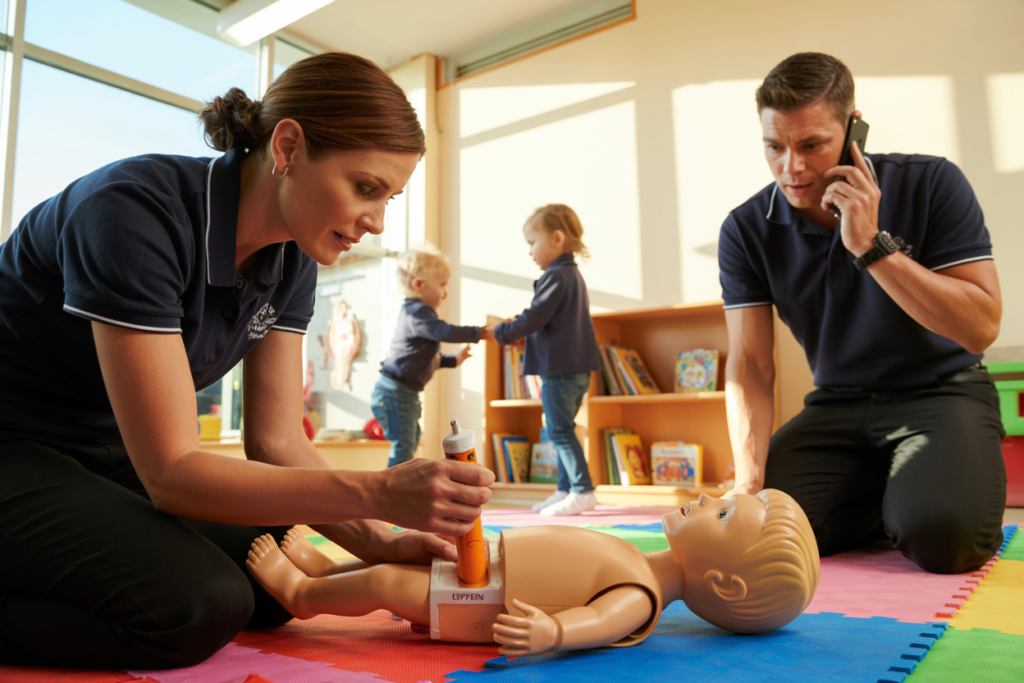
How to Run an Effective Anaphylaxis Drill at Your Centre
A drill doesn’t require shutting down the center. A tabletop scenario during a regular team meeting is enough to be genuinely useful walk the team through a realistic scenario and work through the response together.
The drill should cover four key roles:
- Who retrieves the EpiPen – and confirms they know where it is right now, today
- Who calls QAS – and knows what to say when the call connects
- Who stays with the child – maintaining calm, monitoring, administering if needed
- Who manages the remaining children and parent communication
Running the scenario out loud, with real names assigned to real roles, is what makes it stick.
Strategy 7: Establish a Clear Emergency Communication Protocol
Training and drills get your team ready to respond physically. But in the middle of an anaphylaxis or severe asthma event, several things need to happen simultaneously – and if nobody has thought through who does what, steps get missed. A clear communication protocol removes that hesitation before it happens.
The Chain of Communication During an Anaphylaxis or Asthma Emergency
Every educator on duty needs to know their role before an emergency starts – not during it. The protocol should assign four clear responsibilities:
- First responder – the educator who stays with the child, administers the EpiPen if indicated, and monitors the response
- QAS caller – the person who calls Triple Zero immediately, without waiting to see if things improve
- Parent contact – who calls the family, and when
- Group manager – who takes responsibility for the remaining children and keeps the session as calm as possible
In smaller centres where one educator might cover more than one role, that needs to be worked out in advance. The protocol should reflect the reality of your staffing, not an ideal scenario.
When to Call QAS and What to Tell Them
Call QAS immediately when anaphylaxis is suspected not after administering the EpiPen, not after waiting to see if symptoms settle. When the call connects, the educator needs to give:
- The centre’s full address
- The words “suspected anaphylaxis” or “severe asthma attack”
- The child’s age and weight if known
- Confirmation of whether the EpiPen has been administered
Under ASCIA guidelines, QAS must be called after any anaphylaxis event – whether the EpiPen was used or not. A seeming recovery can be followed by a second wave of symptoms, and the child needs paramedic assessment regardless of how they look at the moment.
🚨 Emergency Reminder: After any anaphylaxis event — whether EpiPen was used or not — QAS must be called. This is non-negotiable under ASCIA guidelines.
Get Your Team Trained
The seven asthma and anaphylaxis prevention strategies in this guide work together action plans, risk assessments, medication storage, trigger control, communication protocols, and drills all build on each other. But none of them carry the weight they should without the foundation of current, properly delivered staff training.
That’s where a lot of centres have a gap they don’t always know about. The certificates are on file. The training happened. But it was theory-heavy, and nobody’s touched an EpiPen trainer since. That’s a different kind of readiness to what your team actually needs.
We deliver ACECQA-accepted asthma and anaphylaxis training to childcare centres across Brisbane and SEQ, aligned with current ASCIA guidelines, with hands-on practice using EpiPen and Anapen trainer devices. Certificates are issued same day.
We also come to you. On-site training means your whole team can be trained together, without the rostering headache of getting everyone to an external venue.
Book Your First Aid Training Now
Fast, affordable, and nationally accredited training delivered by professionals who care
Frequently Asked Questions
Q.What are the best asthma and anaphylaxis prevention strategies for childcare centres?
The most effective asthma and anaphylaxis prevention strategies combine several layers of preparation - maintaining current ASCIA action plans for every at-risk child, conducting thorough risk assessments at enrolment, storing medications correctly and auditing expiry dates monthly, minimising known triggers in the centre environment, ensuring all staff hold current ACECQA-accepted training, running regular scenario-based drills, and having a clear emergency communication protocol that every educator knows before an incident occurs.
Q.How often does asthma and anaphylaxis training need to be renewed in childcare?
ACECQA requires asthma and anaphylaxis training to be renewed every three years, but that's the regulatory floor - not the recommended standard. ASCIA advises annual refreshers because skills fade rapidly without regular practice, particularly for high-pressure, low-frequency emergencies like anaphylaxis where the ability to act quickly and correctly under stress is what actually determines the outcome.
Q.Does anaphylaxis training satisfy ACECQA requirements?
Only anaphylaxis training delivered by an ASQA-registered RTO and aligned with current ASCIA guidelines will satisfy ACECQA requirements at a compliance audit - a certificate from an unregistered provider will not be accepted regardless of how professional the course appeared or what the certificate looks like, so always verify your provider's RTO number on the ASQA national register before booking.
Q.What should be in a childcare centre's anaphylaxis action plan?
Every anaphylaxis action plan must use the current ASCIA-format template, be signed by the child's treating physician (not a parent alone), list the child's known allergens and current medications including device type, and be stored somewhere immediately accessible to any educator on duty - not filed in the director's office or locked away. Plans must be reviewed at least annually and updated immediately after any reaction or change in medication.
Making first aid training more affordable for
every classroom
We believe every student deserves access to life-saving first aid knowledge. That’s why we offer specially reduced pricing for schools and educational groups. Whether you’re booking for a single class, a year group, or your entire school, our flexible packages make training more accessible and cost-effective — without compromising quality.
