

A staff member has just told you they’ve got a severe allergy. A committee member has flagged that literally nobody at the club knows how to use an adrenaline autoinjector. Or a WHS audit has quietly picked up asthma and anaphylaxis as a risk sitting there, unmanaged, and now it’s landed on your desk to sort out.
Maybe it’s none of those specific triggers. Maybe it’s just a nagging feeling that’s been sitting at the back of your mind for months, the kind that shows up when you’re closing up on a Friday night and realise you genuinely don’t know what your team would do if someone collapsed in front of them right now.
If you’re the one responsible for the safety of a team, a venue, or a club in Brisbane, an asthma and anaphylaxis RTO course is the quickest way to turn that uncertainty into something real. Genuine, defensible readiness, not a certificate that gets filed away and forgotten about until the next audit.
This isn’t a childcare course dressed up for adults, either. It’s built for hospitality teams, retail staff, and community and sporting clubs who need to respond with confidence in an emergency, without having to pull your whole roster off the floor just to get there.
Below we’ll walk through exactly what this nationally recognised course covers, who actually needs it, and how to book a session that fits around your shifts or your volunteers’ availability, not the other way around.
What Is an Asthma and Anaphylaxis RTO Course?
An asthma and anaphylaxis RTO course is a nationally recognized training program run by a Registered Training Organisation (RTO), and it teaches your team to recognize and respond to asthma attacks and severe allergic reactions, anaphylaxis, when it actually counts.
The course typically covers:
- Recognising the signs and symptoms of asthma attacks and anaphylaxis
- Administering reliever medication, including a puffer and spacer, for an asthma attack
- Using an adrenaline autoinjector, such as an EpiPen® or Anapen®, correctly
- Following an emergency action plan and knowing exactly when to call 000
- Providing post-incident care while waiting for emergency services to arrive
Because it’s delivered by an RTO, finishing the course gets you a nationally recognised statement of attainment. Not just a certificate that says you turned up.
That distinction matters more than people realise going in. A statement of attainment means an accredited assessor has actually watched your team demonstrate the skill, not just sat through a slideshow and clicked “next” a dozen times. If something ever goes wrong and questions get asked afterward, that difference is the whole ball game.
⚖️ Worth knowing: WHS duty of care applies the moment you're aware of a foreseeable risk, whether or not any regulator has set a deadline for you to act on it.

Why Brisbane Workplaces Need Asthma and Anaphylaxis Training
Your WHS Duty of Care, Explained Simply
Under the Work Health and Safety Act 2011 (Qld), you’ve got a general duty of care to manage foreseeable risks to your staff, your customers, or your members. Asthma and anaphylaxis fall squarely into that category once you know about them. That’s the bit people miss. It’s not some abstract legal phrase, it’s a real obligation the moment you’re aware there’s a risk sitting in your workplace.
Here’s the tricky part though. Unlike childcare licensing or an electrical ticket, there’s no external body forcing a deadline on you here. Nobody’s chasing you for a renewal date. And that’s exactly why this training gets pushed down the list, again and again, until something forces the issue.
Think about how many other WHS obligations run on a fixed cycle. Fire extinguishers get tagged. Electrical equipment gets tested. Those things happen because a date on a sticker forces the conversation. Asthma and anaphylaxis readiness doesn’t have that built-in prompt, which means it relies entirely on someone in your business actually noticing the gap and choosing to close it. That someone is usually you.
For the official guidance, Safe Work Australia and WorkSafe Queensland both have resources worth linking to on foreseeable risk management.
Common Triggers That Bring Workplaces Here
Most people booking this course aren’t browsing on a lazy Tuesday. Something’s happened, or something’s about to. The usual triggers look like this:
- A staff member discloses a severe allergy
- A near-miss incident happens on-site
- A WHS audit flags it as an unmanaged hazard
- An insurer or industry body recommends it
- A sporting club committee runs a risk-management review and realises there's a gap
Each of these lands a little differently. A staff disclosure feels personal, because now there’s a specific face attached to the risk. A near-miss feels urgent, because it was close enough to rattle whoever was standing there. Whatever the trigger, the honest answer is the same: the training should have happened before the trigger, not because of it.
Is This Different From a General First Aid Course?
Fair question, and one worth answering honestly rather than dodging it. A general first aid course, HLTAID011, covers broad emergency response, the kind of thing you’d use across all sorts of incidents. This course goes deeper specifically on asthma recognition and adrenaline autoinjector use. It’s not a replacement for general first aid. It’s a sharper, more focused layer on top of it, built for a specific and genuinely serious risk.
General First Aid (HLTAID011) | Asthma & Anaphylaxis RTO Course | |
Scope | Broad emergency response across many incident types | Focused specifically on asthma and anaphylaxis |
Autoinjector practice | Brief or general mention only | Dedicated hands-on practice with trainer devices |
Best suited to | General workplace first aid coverage | Workplaces with a known or foreseeable allergy/asthma risk |
Relationship to each other | Foundational course | A focused layer on top, not a replacement |
A lot of workplace coordinators assume their general first aid certificates already cover this ground well enough. Sometimes they touch on it briefly, but briefly isn’t the same as properly. Anaphylaxis moves fast, and hesitation at the wrong moment is exactly what this specific course is designed to remove. If your team has general first aid but nothing specific on asthma and anaphylaxis, there’s still a real gap sitting there.
Once you’ve confirmed training is the right call, here’s exactly what your team will walk away knowing how to do.
What’s Covered in the Course
Recognising Asthma Attacks and Anaphylaxis
This part isn’t taught as a clinical lecture, it’s taught as scenarios you’ll actually recognise. What does it look like when someone’s having a reaction behind the counter of a café? On a retail floor mid-shift? At the canteen during a club game? The signs and symptoms get broken down in a practical way, not a textbook way, so your team can actually spot the difference between “something’s off” and “this is an emergency, act now.”
That distinction is genuinely the hardest part for most people. Early symptoms can look mild, a bit of coughing, some redness, a complaint of feeling strange. The training focuses heavily on this grey area, because that’s exactly where hesitation costs the most time.
Hands-On Skills You’ll Practise
This is where the course earns its keep. You’re not just watching a slideshow.
- Puffer/spacer technique, practised properly
- Adrenaline autoinjector use (EpiPen®/Anapen®), hands-on with trainer devices
- Working through an emergency action plan from start to finish
Worth being upfront about this bit: ASQA requires a blended delivery model, meaning online theory paired with a mandatory in-person practical component. Online-only doesn’t satisfy the requirement, no matter what any shortcut course tries to tell you. If your team needs to actually use an autoinjector under pressure one day, they need to have physically practiced it first.
There’s a real difference between reading about how an autoinjector works and actually holding a trainer device in your hand, feeling the click, understanding exactly how much pressure it takes. Muscle memory matters here in a way that theory alone can’t replicate. People freeze less often when their hands already know what to do.
What You’ll Receive on Completion
Finish the course and you get a nationally recognised statement of attainment, not a flimsy certificate of attendance. That’s the document you’d produce if a regulator, insurer, or board member ever asked whether your team was properly trained, and it holds up because it reflects an actual assessed skill, not just attendance.
None of this is useful if it can’t fit around your roster, so here’s how flexible the format actually is.
📅 Worth knowing: Sessions run onsite or with evening and weekend options, built specifically so hospitality rosters and volunteer committees aren't disrupted.

Group Bookings & Flexible Scheduling
Onsite, Group & Volunteer-Friendly Scheduling
Training only works if people can actually get to it. So the scheduling needs to bend around real life, not the other way round.
- Evening and weekend sessions, flagged specifically for sporting clubs and committees running on volunteer time
- Onsite delivery for hospitality and retail teams, cutting down rostering disruption to almost nothing
- Group bookings that get your whole team or committee sorted in one session, rather than trickling people through one at a time
For a lot of workplace coordinators, this is the single biggest deciding factor. It’s one thing to accept that training is genuinely needed. It’s another thing entirely to find a way to actually book it without gutting a roster or asking volunteers to give up more of their own time than they already do. A provider that builds sessions around your reality, not their convenience, removes that entire objection.
Sector-Specific Relevance
This course isn’t one-size-fits-all content wearing different logos. It genuinely adjusts to where you work:
- Hospitality & café: front-of-house staff need to recognise a reaction fast, in a busy service environment, often with a customer they've never met before, sometimes without even a full history of what that person is allergic to
- Retail: staff need the same readiness, but often with less immediate access to a manager or first aider nearby, and sometimes only one or two people on the floor at any given moment
- Sporting/community clubs: canteen volunteers and away-game coordinators need to know what to do when there's no paid staff member on hand, and possibly limited phone reception depending on the venue
A café worker and a club canteen volunteer are dealing with the same underlying medical emergency, but the practical circumstances around them are different. Good training acknowledges that instead of pretending every workplace looks the same.
Before you book, it’s worth answering one honest question first.
Do You Need a Formal Course, or Is Awareness Training Enough?
This is genuinely the biggest hesitation people have before booking, and it deserves an honest answer rather than an upsell.
If there’s no specific, known at-risk person in your workplace right now, a general awareness session might be enough to get you started. But if a staff member has actually disclosed a severe allergy, or a club member has a documented condition, that’s a different situation entirely. That calls for formal training. A statement of attainment, hands-on autoinjector practice, the whole thing. Not a quick chat over morning tea.
The honest line is this: awareness training is a decent starting point when the risk is general. Formal training is what you need the moment the risk has a name and a face attached to it.
There’s also a middle ground worth mentioning. Some workplaces sit somewhere between “no known risk” and “a specific disclosed case.” A café with a rotating customer base and no fixed staff-level risk, for example, might still be a strong candidate for formal training simply because of how often they’re handling food around strangers with unknown allergies. In that setting, waiting for a specific disclosure before acting isn’t really proportionate. The risk is already there, it’s just distributed across every customer who walks in the door rather than attached to one known individual.
Building Standing Capability, Not Just a One-Off Booking
A lot of workplaces treat this training as a single event to tick off and move on from. That’s understandable, but it’s not really the goal. The stronger position is having enough trained people on a rolling basis that new staff or new volunteers get folded into training as a normal part of onboarding, rather than waiting for the next scare to prompt another rushed booking.
This matters even more in industries with high staff turnover, which describes most hospitality and a fair chunk of retail. A team that was fully trained can quietly become an untrained team again as people move on and new faces come through the door. Building this into your onboarding process, rather than treating it as a once-off project, keeps a workplace genuinely ready rather than technically compliant for a narrow window of time.
✅ Worth knowing: Booking is simple, enquire, pick a session time, and get your team confident and covered.
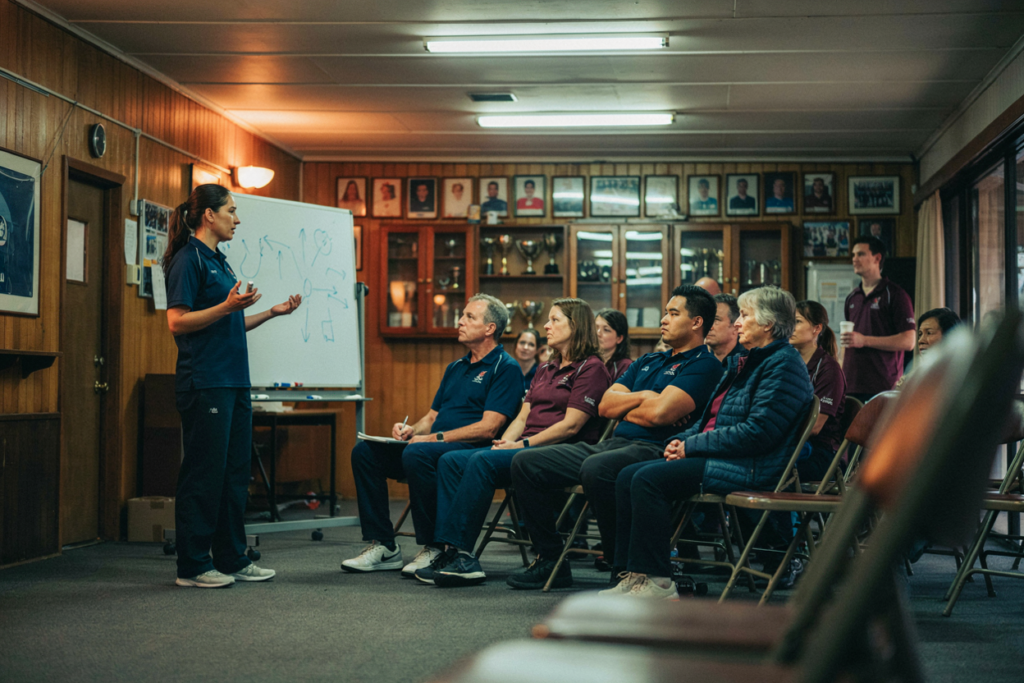
Get Your Team Ready and Book Your Asthma & Anaphylaxis Training
If you’ve read this far, you already know the risk in your workplace isn’t hypothetical anymore. Whether it’s a staff disclosure, a near-miss, or an audit finding, the next right move is the same: book the training and get it done properly.
Book Your Team’s Asthma & Anaphylaxis Training
Flexible scheduling for hospitality, retail, and community teams. Onsite and group options available.
Not sure yet whether formal training or awareness training is the right call for your situation? Have a look back through the section above, or give us a call and talk it through directly.
Give your team real confidence to act. Not just a certificate to file away.
Final Thoughts
Nobody plans for the moment someone stops breathing properly in front of them. It happens fast, usually when you least expect it, and usually with a room full of people who freeze because nobody actually knows what to do. That’s the gap this training closes. Not in theory, but in the actual seconds that matter.
The truth is, waiting for an external deadline to force your hand doesn’t really work here. There isn’t one. Nobody’s chasing you for a renewal date the way a regulator might for other compliance areas. Which means the responsibility sits with you, right now, to decide whether “we’ll get to it eventually” is good enough when someone’s safety is on the line.
The commitment isn’t a huge ask. It’s not going to gut your roster or blow out your budget. But it is the difference between a team that freezes and a team that acts, calmly, correctly, and without hesitation, when it actually counts.
If there’s already a specific person in your workplace with a known risk, a staff member, a club member, someone you can picture right now, that’s not a maybe anymore. That’s a yes. Formal training, hands-on practice, the real thing.
And if you’re still in the “should we do this” stage, that’s fine too. Better to ask the question now than to be asking it after something’s already gone wrong. A general awareness session might be the right starting point, but don’t let that become a permanent substitute for the real thing once a genuine risk shows up on your radar.
Either way, the goal isn’t a certificate sitting in a drawer somewhere. It’s a team that actually knows what to do, and the confidence to do it, when it matters most. That’s the entire point of building this capability properly, and keeping it current as your team changes and grows.
Book Your First Aid Training Now
Fast, affordable, and nationally accredited training delivered by professionals who care
Frequently Asked Questions
Q.What is an asthma and anaphylaxis RTO course?
It's a nationally recognized training program delivered by a Registered Training Organisation that teaches participants to recognize the signs of asthma attacks and anaphylaxis and respond correctly, including using a puffer/spacer and an adrenaline autoinjector, with a statement of attainment issued on completion.
Q.Is this course different from general first aid training?
Yes. General first aid, HLTAID011, covers broad emergency response across many situations, while this course focuses specifically and in depth on asthma and anaphylaxis recognition and adrenaline autoinjector use, making it a sharper layer on top of general first aid rather than a substitute for it.
Q.Does my workplace legally need this training?
There's no single external body mandating a deadline the way there is for childcare or electrical licensing, but the general WHS duty of care under the Work Health and Safety Act 2011 (Qld) still applies once a foreseeable risk like asthma or anaphylaxis is known in your workplace.
Q.Can we book training for our whole team or committee at once?
Yes, group bookings are available so your whole team or committee can be trained together in one session, rather than booking people through individually, and onsite delivery is available to minimise disruption to hospitality and retail rosters.
Q.Is awareness training enough, or do we need the formal course?
Awareness training is a reasonable starting point when the risk in your workplace is general and no specific individual has been identified, but once a staff member or club member has disclosed a known allergy or condition, formal training with a statement of attainment is what's genuinely needed.
Making first aid training more affordable for
every classroom
We believe every student deserves access to life-saving first aid knowledge. That’s why we offer specially reduced pricing for schools and educational groups. Whether you’re booking for a single class, a year group, or your entire school, our flexible packages make training more accessible and cost-effective — without compromising quality.
