
It’s Sunday evening. Your anaphylaxis certificate expired three weeks ago. Four children with severe allergies are in your room tomorrow morning. You’re scrolling your phone in bed, typing “asthma anaphylaxis safety course Brisbane” into Google—and the panic is real.
You’re not alone. Every week, hundreds of Brisbane childcare educators search for emergency training at the last minute, stressed about compliance deadlines and terrified of that moment when a child has an allergic reaction and their hands freeze.
This complete guide cuts through the confusion around asthma and anaphylaxis safety courses in Brisbane. You’ll discover exactly which certifications ACECQA requires, how to choose training that builds genuine confidence (not just ticks boxes), and where to find same-day certification when your director needs proof by Monday morning.
Whether your certificate expired months ago or you’re planning ahead for 2025 renewal, you’ll learn which course codes you actually need, what separates quality hands-on courses from boring PowerPoint lectures, and how to choose Brisbane training that fits your schedule.
What Are 22579VIC and 22578VIC? (Which Course Do Childcare Educators Need?)
22579VIC (Course in Anaphylaxis Management) and 22578VIC (Course in Management of Asthma Risks and Emergencies in the Workplace) are two separate nationally recognized training units required for Queensland childcare educators working with children who have allergies or asthma.
Key Differences:
| Course Code | Covers | ACECQA Requirement |
|---|---|---|
| 22579VIC | Anaphylaxis recognition, EpiPen administration, emergency response | Mandatory for educators caring for children with allergies |
| 22578VIC | Asthma triggers, reliever/preventer medication, spacer technique, emergency management | Mandatory for educators caring for children with asthma |
Do you need both? Yes. Most Queensland childcare centers require staff to hold both certifications, as children commonly have either allergies, asthma, or both conditions. Many Brisbane training providers offer combined courses covering both units in a single session.
Validity period: Both certificates must be renewed every 3 years.

Understanding ACECQA Requirements for Queensland Childcare
What ACECQA Actually Requires (No Legal Jargon)
If you work in a Queensland childcare center, kindergarten, or OSHC program, and you’ve got children enrolled with diagnosed asthma or anaphylaxis conditions, ACECQA expects you to have current emergency management training.
This comes from National Quality Standard Element 2.3.4, which sounds bureaucratic but really just means “your staff need to know what they’re doing when a child’s having an allergic reaction or asthma attack.”
Not every single person at your center needs both certificates—but here’s what ACECQA looks for:
- At least one educator with current anaphylaxis training on-site whenever children with diagnosed allergies are in attendance
- At least one educator with current asthma training on-site whenever children with diagnosed asthma are in attendance
- Room leaders and educational leaders? Yeah, you’re expected to have both
Most directors play it safe and require all direct-care educators to hold both certificates. Makes sense when you think about it—allergic reactions and asthma attacks don’t wait until the “certified person” is free.
The 2024 ACECQA updates clarified something important: online-only training doesn’t cut it anymore. You need hands-on practical assessment for both anaphylaxis and asthma management. That means actually demonstrating EpiPen technique and spacer administration in person—not just watching a video and clicking through a quiz.
22579VIC vs 22578VIC vs HLTAID012: Which Course Do You Actually Need?
Breaking Down the Course Codes (Simple Explanation)
22579VIC – Course in Anaphylaxis Management
This is your dedicated anaphylaxis training covering:
- How to recognize anaphylaxis in its early stages (before it’s obvious)
- The difference between mild allergic reactions and life-threatening anaphylaxis
- EpiPen administration technique—and you’ll practice this multiple times, not just once
- When to call 000 vs. when to monitor
- How to follow individual anaphylaxis action plans
- What to do while waiting for paramedics
The assessment is purely practical. You’ll demonstrate EpiPen technique on a trainer device, show you can interpret an action plan, and walk through an emergency scenario. No written exam. No trick questions.
22578VIC – Course in Management of Asthma Risks and Emergencies
This is your dedicated asthma training covering:
- Identifying asthma triggers in childcare environments (dust, pollen, exercise, weather changes)
- Recognizing mild vs. severe asthma (the stuff that looks “normal” vs. “call 000 right now”)
- Reliever medication administration using spacers—proper technique matters
- Understanding preventer vs. reliever medications
- When a wheeze is just a wheeze vs. when it’s an emergency
- Asthma action plan interpretation
Again, practical assessment. You’ll demonstrate spacer technique, show decision-making skills for different severity levels, and prove you can follow an asthma action plan.
HLTAID012 – Provide First Aid in an Education and Care Setting
This is your general childcare first aid course—covers everything from nosebleeds to CPR to fractures. It includes a brief section on anaphylaxis and asthma (maybe 15-20 minutes total for both topics).
Here’s where people get confused: “I’ve got HLTAID012, doesn’t that cover everything?”
No. HLTAID012 gives you surface-level awareness of anaphylaxis and asthma. You’ll learn “give EpiPen, call 000, do CPR if needed.” That’s it. Fifteen minutes of PowerPoint slides.
22579VIC and 22578VIC are deep-dive courses focused entirely on these specific emergencies. You’re learning decision-making, scenario practice, hands-on technique refinement—the stuff that actually prepares you for the 30 seconds of panic when a child can’t breathe.
Most Brisbane childcare centers require educators to hold all three certificates. You need HLTAID012 because kids have accidents unrelated to allergies and asthma. You need the specialized courses because general first aid doesn’t prepare you adequately for anaphylaxis and asthma emergencies.
Combined Courses vs. Separate Training
Here’s where you can actually save yourself some hassle. Booking anaphylaxis and asthma separately means two separate days, two separate bookings, more total training time. Combined courses cover both units in a single session, saving time and the mental load of coordinating different course dates.
The learning retention is actually better with combined training too. Anaphylaxis and asthma share some common ground—recognizing respiratory distress, emergency communication, action plan interpretation. When you learn them together, your brain connects the dots more effectively.
Most combined courses run them back-to-back with a quick break in between. You practice EpiPen technique, then spacer technique, in the same session. By the end you’re certified in both, walking out with two separate nationally recognized certificates.
Online vs. In-Person Training (What ACECQA Accepts)
This question comes up constantly: “Can I just do the course online? I’m busy, I don’t want to give up my Saturday.”
ACECQA’s current position as of 2025: online-only anaphylaxis and asthma training is not acceptable for educators working with children who have diagnosed conditions.
Here’s why: you can’t practice EpiPen administration on a computer screen.
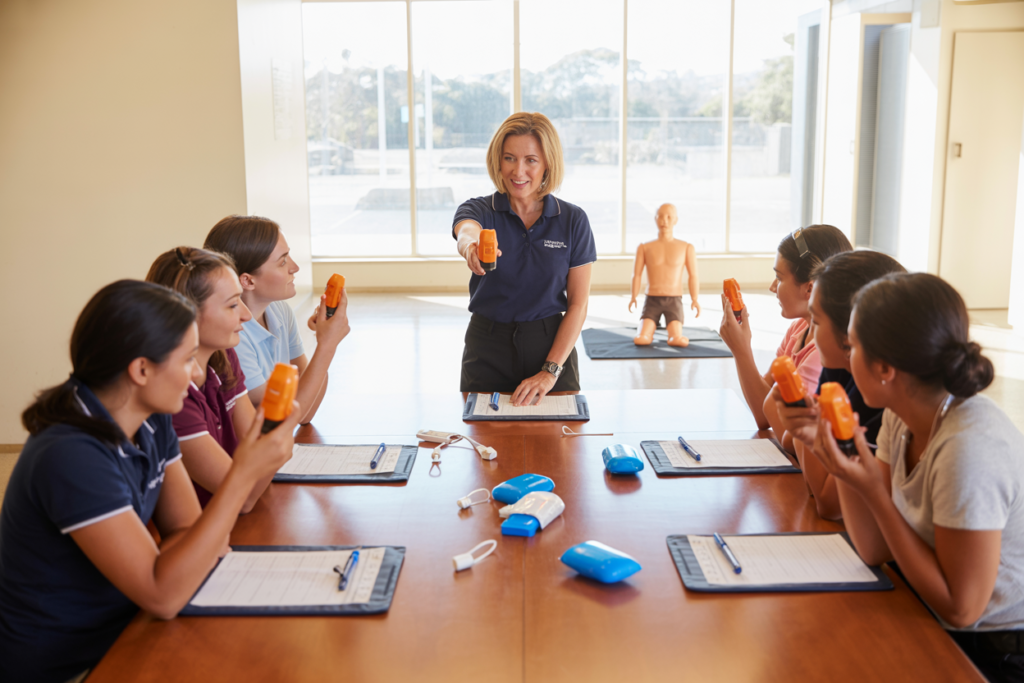
The whole point of 22579VIC and 22578VIC is building practical competence—muscle memory, physical technique, decision-making under pressure. You need to hold the EpiPen trainer in your hands. You need an instructor watching your grip, your angle, your follow-through, giving you feedback.
Some RTOs offer “blended learning”—theory component online, practical assessment in-person. You complete the knowledge sections on your own time, then attend a shorter in-person session for hands-on practice and assessment.
The safest bet? Full in-person training. You know you’re meeting ACECQA requirements. You know you’re getting quality hands-on practice. You know your certificate will be accepted without question.
Plus—and this matters—in-person training is where you actually build confidence. When you practice EpiPen administration multiple times with an instructor coaching your technique, your hands learn what to do. When you watch a video online and click “I understand,” your brain might get it but your body doesn’t.
The whole point of this training is preparing you for the moment when a child is having an allergic reaction and you need to act. That moment requires physical competence, not theoretical knowledge.
💡 The Real Goal: You're not just getting a certificate to satisfy ACECQA. You're building the muscle memory and confidence so your hands know what to do when a child's lips start swelling and your brain is screaming.
What to Expect in a Quality Asthma & Anaphylaxis Safety Course
Theory Component: What You’ll Actually Learn
Good training starts with understanding what’s actually happening in a child’s body during anaphylaxis or an asthma attack. Not a biology lecture—just enough so your response makes sense.
Anaphylaxis theory covers:
The trigger part is straightforward—nuts, eggs, shellfish, bee stings, whatever’s listed on the child’s action plan. But recognizing anaphylaxis in its early stages? That’s where quality courses spend time.
You’ll learn the progression: starts with tingling lips or itchy mouth, moves to hives or swelling, then respiratory symptoms (tight throat, wheezing, difficulty breathing), then cardiovascular symptoms (pale skin, weak pulse, dizziness). The timeline can be minutes or seconds depending on the allergen and exposure amount.
The response protocol is drilled into you: recognize symptoms, locate EpiPen, administer into outer thigh, call 000, stay with child, prepare for second dose if no improvement after 5 minutes. Then communication—what to tell paramedics, what to document, how to inform parents without causing panic.
Asthma theory covers:
Triggers in childcare settings matter more than you’d think. There’s exercise-induced asthma (common during outdoor play), but also cold air, humidity changes (hello Brisbane summer), dust from craft activities, and emotional stress (tantrum leading to asthma attack).
The mild-to-severe spectrum is what trips people up. Mild asthma looks like: slight wheeze, child still playing, normal speech. Moderate asthma: obvious wheeze, child slowing down, short sentences. Severe asthma: struggling to breathe, can’t complete sentences, visible chest retractions, pale or blue lips.
When to call 000? Quality courses teach the decision tree: if reliever doesn’t improve symptoms after 4 puffs, call. If child can’t speak in sentences, call. If you’re unsure, call.
Hands-On Practice: The Part That Actually Matters
Here’s where quality courses separate themselves from box-ticking exercises.
EpiPen practice rounds:
First time you hold an EpiPen trainer, your hands shake. You’re nervous about the technique. You fumble with the safety cap. Your instructor corrects your grip.
Second time, slightly better. Still thinking about each step. Third time, muscle memory starts forming. Fourth time, it’s smoother. By the fifth or sixth time, your hands know what to do without your brain micromanaging every movement.
That’s when confidence builds. That’s when you can actually imagine yourself doing this in a real emergency without freezing.
Spacer and puffer technique:
Same principle. You’ll practice attaching the spacer to the puffer, creating a good seal over the child’s mouth and nose, timing the puff with breathing.
Common mistakes get corrected: holding the spacer upside down (yep, people do this under stress), not shaking the puffer first, not waiting between puffs, poor seal allowing medication to escape.
Scenario-based learning:
This is where childcare-specific training shines. Generic courses give you: “Adult having allergic reaction at office workplace, administer EpiPen.”
Quality childcare courses give you: “Two-year-old at afternoon snack time, eating crackers, starts crying about itchy tongue, other toddlers still eating, you’re the only educator in the room. Go.”
You practice while managing the scenario complexity—settling other children, locating the EpiPen in the locked medical cabinet, maintaining ratio supervision, calling 000, documenting while caring for the child.
Assessment Format: What You Need to Pass
Let’s talk about the part that makes people anxious.
No written exam. Read that again if you need to.
22579VIC and 22578VIC assessments are competency-based practical demonstrations. You show you can do the skills. That’s it.
Your instructor isn’t trying to trick you. They’re confirming you can perform the skills you’ve been practicing. If you’ve done the practice rounds, you’ll pass the assessment—it’s literally the same techniques you’ve been doing.
Quality instructors build in extra time. If you’re struggling with EpiPen technique, they’ll slow down, demonstrate again, coach you through additional practice rounds until you’ve got it.
No one “fails” and gets sent home. You practice until you’re competent. That’s the whole point.
Choosing the Right Brisbane Training Provider
Red Flags: What Poor Training Looks Like
Theory-heavy PowerPoint marathons: If the instructor spends most of the course on slides about histamine response and immune system function, you’re in the wrong course. Anaphylaxis training should be heavily hands-on practice. Slides don’t build muscle memory.
Vague certificate delivery: “You’ll receive your certificate within 7-10 business days” means you’re waiting two weeks. Quality providers email digital certificates within hours of course completion.
No RTO number displayed: Every legitimate training provider operates under an RTO (Registered Training Organization) number. It should be prominently displayed.
Instructors with no early childhood background: A general first aid trainer who’s never worked in childcare doesn’t understand your reality. Look for instructors with pediatric nursing backgrounds or former educator experience.
Green Flags: Signs of Quality Providers
Detailed course agenda: When a provider breaks down exactly what you’ll do hour-by-hour, that’s transparency.
Instructor credentials visible: “Your instructor: Sarah Chen, RN, 8 years pediatric emergency” tells you this person knows pediatric emergencies.
Specific testimonials from childcare educators: Detailed testimonials from actual educators at named centers showing the training worked in real situations.
Same-day digital certificate: Quality providers have streamlined systems for immediate certification delivery.
Clear ACECQA compliance statements: “ACECQA-approved training” and “Meets NQS Element 2.3.4 requirements” stated clearly.
Book Your Asthma & Anaphylaxis Safety Course Now
You came here stressed about an expired certificate and ACECQA compliance. That’s valid—compliance matters, audits happen, directors need proof.
But here’s what you’re actually getting from quality asthma and anaphylaxis training: the confidence to handle the moment when a child in your care can’t breathe.
You’re not buying a certificate. You’re buying competence.
The piece of paper gets you past ACECQA requirements and keeps your director happy. The hands-on practice—practicing EpiPen administration until your hands stop shaking, running through scenarios until the decision-making feels automatic—that’s what actually protects children.
And honestly? It protects you too.
Professional protection: Your certificate proves you met training requirements. Your documentation shows you followed protocols. If the worst happens and a parent is upset, you’ve got evidence you were prepared and acted appropriately.
Personal protection: You sleep better knowing you’re genuinely ready. You don’t lie awake at 3am replaying “what if” scenarios. You don’t avoid rooms with high-needs allergic children because you’re scared of freezing during emergencies.
Stop overthinking this. You know you need the training. Your certificate is expired or expiring soon. Your director needs proof. Just book it.
Search for Brisbane providers offering asthma anaphylaxis safety courses. Look for same-day digital certificate delivery, hands-on practice emphasis, ACECQA compliance statements, and instructor credentials. Find a provider that checks those boxes. Book it.
Quality instructors work with you until you’re confident. Same-day digital certificates solve your compliance emergency.
This isn’t scary. This isn’t complicated. It’s training that gives you three years of certification and genuine confidence managing emergencies.
Stop procrastinating. Book the course. Get certified. Get back to doing the job you love without compliance stress hanging over your head.
Brisbane educators: your next step is booking that course. You’ve got this.
Book Your First Aid Training Now
Fast, affordable, and nationally accredited training delivered by professionals who care
Frequently Asked Questions
Q.Do I need both 22579VIC and 22578VIC, or just one?
You need both. ACECQA requires separate certification for anaphylaxis management (22579VIC) and asthma management (22578VIC) if you're working with children who have either condition. Since most childcare centers have children with allergies and asthma, directors typically require all educators to hold both certificates. The good news is most Brisbane providers offer combined courses covering both units in a single session, so you can get both certifications done at once.
Q.What happens if I fail the assessment?
You won't "fail" in the traditional sense. The assessment is competency-based, meaning you demonstrate the skills until you're competent. Quality instructors build in extra practice time, so if you're struggling with technique, they'll work with you one-on-one until you've got it. Around 97% of participants pass on first attempt, and the remaining 3% just need a bit more practice. No one gets sent home without certification.
Q.How long is the certificate valid?
Both 22579VIC and 22578VIC certificates are valid for 3 years from the date of issue. You'll need to complete renewal training before the expiry date to maintain compliance. Most providers send reminder emails 60-90 days before expiry, but it's your responsibility to book renewal training in time. Set a calendar reminder for 2-3 months before expiry so you're not scrambling at the last minute.
Q.What should I bring to the course?
Bring photo ID (driver's license or passport) for certificate issuance, a water bottle, and comfortable clothing since you'll be practicing physical techniques. Course materials, EpiPen trainers, and spacer devices are provided. You don't need to bring lunch since most courses run 3-4 hours with just a short break. Some providers ask you to bring your current First Aid certificate if you have one, but this isn't always required.
Q.What if my certificate already expired? Can I still book a course?
Absolutely. Expired certificates are one of the most common reasons educators book training. Look for providers offering weekend courses with same-day digital certificate delivery—you can book Friday, attend Saturday, receive your certificate Saturday afternoon, and submit it to your director Monday morning. While you're technically non-compliant until you complete renewal, most centers temporarily adjust your room placement to keep operations running until you're re-certified.
Q.Is this course the same as EpiPen training?
EpiPen administration is a major component of the 22579VIC anaphylaxis course, but the course covers much more than just EpiPen technique. You'll learn how to recognize early symptoms of anaphylaxis, when to administer the EpiPen versus when to monitor, emergency communication protocols, action plan interpretation, and documentation requirements. The hands-on EpiPen practice is the part most educators remember, but the decision-making framework around when and how to use it is equally important.
Making first aid training more affordable for
every classroom
We believe every student deserves access to life-saving first aid knowledge. That’s why we offer specially reduced pricing for schools and educational groups. Whether you’re booking for a single class, a year group, or your entire school, our flexible packages make training more accessible and cost-effective — without compromising quality.
