

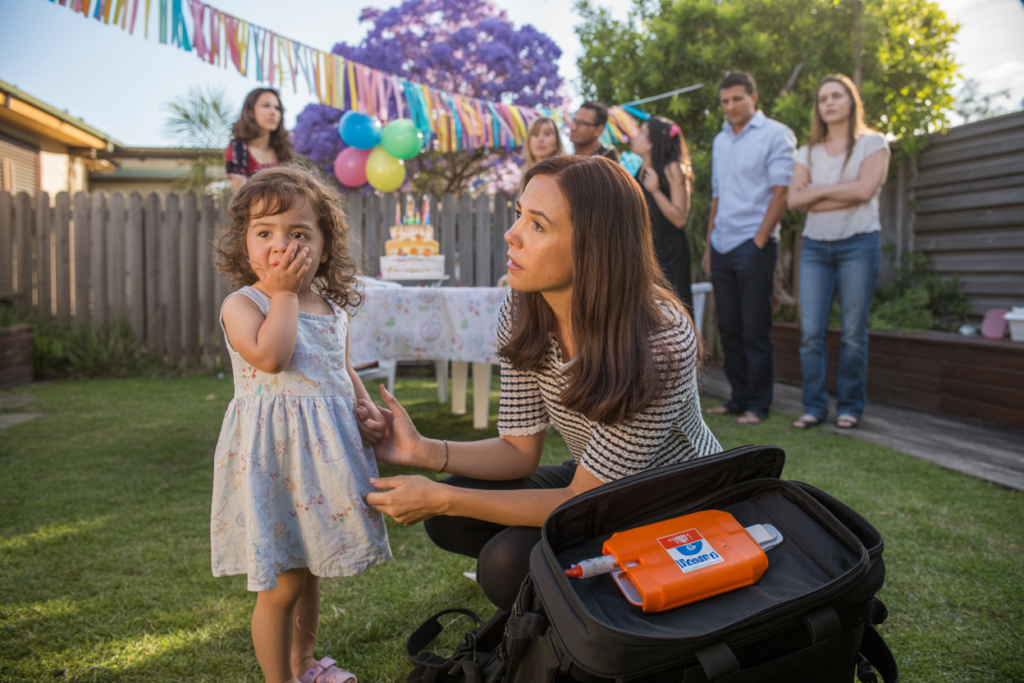
Picture your daughter’s 5th birthday party. Twenty kids running around, cake on the table, and suddenly someone’s well-meaning grandma offers her a cookie that wasn’t on the approved list. Your daughter takes a bite.
Thirty seconds later, she says her mouth feels funny.
In this moment, most parents freeze. Their brain knows what’s happening—anaphylaxis—but their hands don’t know what to do. They’ve got the EpiPen in the bag, they’ve read the action plan a dozen times, but actually doing it when your child’s face is swelling? That’s different.
Now imagine a different version. Same scenario, but this time your hands don’t shake. You grab the EpiPen, remove the blue cap, inject into her outer thigh through her party dress, hold for three seconds, call 000, and you’re already explaining the situation to the operator while other parents are still processing what just happened. Your daughter’s okay because you didn’t hesitate.
That’s what proper asthma anaphylaxis training for Brisbane parents gives you—not just a certificate, but actual confidence when seconds count.
Do Parents Need Asthma and Anaphylaxis Training?
While there’s no legal requirement for Brisbane parents to complete formal asthma and anaphylaxis training, it’s highly recommended if your child has severe allergies or asthma. The gap between having an EpiPen prescribed and actually knowing how to use it under pressure can be the difference between a managed emergency and a tragedy.
You should seriously consider getting trained if:
- Your child’s been prescribed an EpiPen or adrenaline auto-injector
- Your child has severe asthma requiring daily preventers or frequent reliever use
- Your child’s experienced anaphylaxis or serious allergic reactions before
- You’re a grandparent, nanny, or babysitter caring for children with medical action plans
- You want genuine confidence managing emergencies at home, birthday parties, parks, or playdates
Childcare educators in Queensland need to complete specific courses (22579VIC for anaphylaxis, 22578VIC for asthma) to meet ACECQA compliance requirements. But as a parent, you’re not chasing compliance. You’re chasing competence. You want to know your hands won’t freeze when your kid needs you most.
📊 THE NUMBERS: 1 in 10 Australian infants have food allergies. Anaphylaxis hospitalizations increased 350% over the past 20 years. QCH treats 60+ anaphylaxis cases monthly—that's 2 kids a day in Brisbane alone.
Why Brisbane Parents Are Seeking Training
The Diagnosis Moment: When Everything Changes
There’s a before and after when you hear “your child has severe allergies.”
Before, you packed whatever snacks were on sale. You said yes to birthday party invitations without reading ingredients lists. Playgrounds were just playgrounds, not places where another kid might be eating peanut butter crackers three metres from your daughter.
After the diagnosis, everything becomes a risk assessment.
One in ten Australian infants now have food allergies according to ASCIA‘s 2024 data. That’s double what it was fifteen years ago. Anaphylaxis hospitalizations have increased 350% over the past twenty years based on Australian Institute of Health and Welfare research. Queensland Children’s Hospital treats more than 60 anaphylaxis cases every single month—that’s two kids a day in Brisbane alone.
Your child’s allergist hands you an EpiPen, explains the action plan, and sends you home. But nobody actually shows you how to use that EpiPen until you take it out of the package. Nobody makes you practice until your hands remember what to do when your brain’s in panic mode.
The Gap Between Having an EpiPen and Knowing How to Use It
Most Brisbane parents with EpiPens sitting in their bags have never practiced using one. Not even on a trainer device. They’ve watched the instructional video on YouTube maybe, or the pharmacist showed them once at pickup, but that’s not the same as doing it.
There’s a massive difference between intellectual knowledge and muscle memory.
Research published in the Journal of Allergy and Clinical Immunology in 2023 found something telling: Parents who practiced EpiPen administration five or more times demonstrated correct technique 87% of the time during assessments. Parents who only received a demonstration without hands-on practice? Just 34% got it right.
That gap—87% versus 34%—could be your child’s life.
One Brisbane mum told us she froze for almost twenty seconds during her daughter’s first reaction at a shopping centre. Twenty seconds of her brain screaming “do something” while her hands wouldn’t move. The EpiPen was right there in her bag. She knew she needed to use it. But the muscle memory wasn’t there, and terror took over.
Her daughter was okay—other parents called 000, paramedics arrived fast, they administered adrenaline. But that mum signed up for training the following week because she never wanted to feel that helpless again.
Brisbane’s Allergy Reality: Local Triggers Parents Face
Living in Brisbane means dealing with specific allergy and asthma triggers you won’t find in Melbourne or Sydney.
Our subtropical climate creates unique challenges. Spring (August-November) brings pollen from trees, grasses, and weeds. Summer (November-December) is thunderstorm asthma season—those massive afternoon storms break up pollen into smaller particles that go deeper into airways. Year-round humidity creates mould growth in homes, especially in older Queenslanders or anywhere with poor ventilation.
Understanding these local triggers helps, but it doesn’t replace knowing how to respond when your child’s having an actual emergency.
What Parents Actually Learn vs. What Educators Learn
Course Codes Explained
22579VIC – Course in Anaphylaxis Management covers how to recognize anaphylaxis, administer adrenaline auto-injectors (EpiPens, EpiPen Jrs, Anapen), follow ASCIA action plans, and manage someone having a severe allergic reaction.
22578VIC – Course in Management of Asthma Risks and Emergencies teaches you to recognize asthma symptoms, use relievers and spacers correctly, understand asthma action plans, and know when to call 000 versus when to monitor.
HLTAID012 – Provide First Aid in an Education and Care Setting is the comprehensive first aid course that childcare educators need, including basic first aid, CPR, plus specific modules for anaphylaxis and asthma management.
The course code matters way less than the quality of hands-on practice you get. Most Brisbane providers offer 22579VIC and 22578VIC as a combined course in a single session. You walk out with both certificates.
Parent-Focused Training vs. Compliance-Driven Training
When childcare educators take these courses, they’re doing it for ACECQA compliance. You don’t care about ACECQA compliance. You care about not freezing when your child can’t breathe.
| Parent Training Focus | Educator Training Focus |
|---|---|
| Managing emergencies at home, parks, and parties | Following workplace protocols and documentation |
| Responding to your own child’s specific triggers | Managing multiple children with various needs |
| Single-child emergency response | Maintaining ratios during emergencies |
| Processing the emotional weight as a parent | Maintaining professional composure |
The actual techniques—how to administer an EpiPen, how to use an asthma spacer, when to call 000—are identical. But the context you practice in should match your reality.
The Real Skills You’ll Develop
EpiPen Administration: Building Muscle Memory
You’ll practice this until you could do it in your sleep. When your child’s having anaphylaxis, you need muscle memory doing the work while your conscious brain is barely functioning.
Quality courses give you multiple practice rounds. Research shows you need five-plus repetitions for technique retention.
You’ll also learn the variations:
- EpiPen vs EpiPen Jr (different doses for different weights)
- Anapen (slightly different mechanism, same principles)
- Administering through clothing (yes, you can inject through jeans, leggings, school uniforms)
- One-handed technique (if you’re holding your child with your other arm)
- Giving a second dose if the first doesn’t work after 5 minutes
You’ll practice on your non-dominant hand too. If you’re holding your child with your right arm, you need to be able to administer the EpiPen left-handed.
Recognizing Anaphylaxis vs. Mild Reactions
This is the skill that keeps Brisbane parents up at night. Your child develops a rash around their mouth twenty minutes after eating. Is this the start of anaphylaxis? Or just a mild contact reaction that’ll settle on its own?
The training teaches you the decision framework that emergency pediatric nurses use.
Mild allergic reaction signs (monitor closely, don’t inject yet):
- Hives or welts on skin
- Rash around mouth where food touched
- Mild swelling of lips
- Itching or tingling mouth
Anaphylaxis signs (use EpiPen immediately, call 000):
- Difficulty breathing, wheezing, persistent cough
- Swelling of tongue or throat
- Difficulty talking or hoarse voice
- Persistent dizziness or collapse
- Pale and floppy (in young children)
Anaphylaxis can start with mild symptoms and escalate fast. Really fast. Like, within five minutes fast.
The training teaches you the “watch and act” protocol. If your child’s showing mild symptoms, you don’t immediately inject—but you’re getting the EpiPen out of the bag and into your hand. You’re watching for progression.
If symptoms stay mild after 5 minutes and your child’s acting relatively normal, you continue monitoring. If ANY breathing symptoms develop, if swelling increases, if they become dizzy or pale—you don’t wait. You act.
Asthma Management: Spacer Technique and When to Escalate
Most Brisbane parents aren’t using asthma spacers correctly. Not because they’re careless, but because nobody’s ever actually shown them proper technique.
The spacer method you’ll learn:
- Shake the puffer (4-5 good shakes)
- Attach puffer to spacer (make sure it clicks in properly)
- Put spacer mouthpiece in child’s mouth
- Press puffer once—one puff into spacer
- Child takes 4 breaths through spacer
- Wait about 30 seconds
- Repeat for second puff
- Continue until you’ve given 4 puffs total
Severe asthma signs that need 000:
- Blue lips or fingernails
- Can’t speak in full sentences
- Breathing very fast or working hard to breathe
- Reliever isn’t helping after 4 puffs
- Child is exhausted, drowsy, or confused
Emergency Response Protocol: The First 5 Minutes
Training teaches you the systematic approach that prevents you from forgetting steps when you’re terrified:
For Anaphylaxis:
- Recognize symptoms, get EpiPen, administer to outer thigh
- Call 000, say “anaphylaxis emergency” immediately
- Position child lying flat (or sitting if breathing is difficult), elevate legs
- Monitor breathing and consciousness
- Prepare second EpiPen in case first dose doesn’t work
For Severe Asthma:
- Sit child upright, start reliever medication (4 puffs with spacer)
- Reassure child, keep them calm
- Assess response—is breathing easier or still difficult?
- If not improving, call 000 and continue giving reliever
- Monitor closely until paramedics arrive
You’ll practice these protocols in timed scenarios during training. By the end, these protocols become reflexive.
🚩 RED FLAGS: No instructor qualifications listed? Only 1-2 practice rounds? Vague course descriptions? Keep looking—you deserve better training.

Choosing the Right Training Course
Not all training courses are created equal. The difference comes down to how the course is structured and delivered.
What Makes Quality Training
The instructor’s background matters.
You want someone who’s actually managed pediatric emergencies. A pediatric nurse who’s worked in emergency departments? Perfect. A paramedic who’s responded to anaphylaxis calls? Excellent. An early childhood educator who’s seen real incidents? Also good.
Ask: “Who’s teaching the course and what’s their background?”
Practice rounds need to be sufficient.
Some courses give you one or two practice goes with the EpiPen trainer and move on. That’s not enough for muscle memory to develop.
Ask directly: “How many times will I practice EpiPen administration?”
Scenario-based learning beats PowerPoint lectures.
You’re paying for realistic scenarios where you practice decision-making under pressure. The instructor should present situations that match your actual life and guide you through the correct protocol.
Red Flags That Signal Poor Training Quality
- The website doesn’t show instructor names or qualifications
- No reviews or only 5-star reviews from the same month
- Vague course descriptions that don’t specify what you’ll actually do
- Pressure tactics or “limited time offers”
- Certificate delivery is unclear or slow
You’re More Capable Than You Think
Here’s what most Brisbane parents don’t realize: You’re already handling incredibly complex parenting situations every single day. Learning to administer an EpiPen or manage an asthma attack is just one more skill in the extensive toolkit you’ve already built as a parent.
The difference between reading the ASCIA action plan on your fridge and actually being trained is the difference between knowing what you should do and knowing you can do it.
Here’s what you’ll walk away with:
The muscle memory to administer an EpiPen without thinking, even when your hands are shaking. The decision-making framework to recognize when symptoms need immediate intervention. The asthma management technique to give your child medication properly. The emergency response protocol that works even when your brain’s frozen with fear.
And something less tangible but equally valuable—the ability to sleep at night without that constant background anxiety of “what if something happens and I don’t know what to do?”
You’ll know what to do. Your hands will remember even if your mind goes blank.
So what’s stopping you from booking?
Your child’s allergy or asthma isn’t going to wait until you feel ready. The emergency that needs these skills doesn’t send advance warning.
Pull out your phone right now. Google “asthma anaphylaxis training Brisbane.” Look at the next available course dates. Pick one that fits your schedule. Done.
Your child with severe allergies or asthma needs you trained. Not just educated—trained. Not just aware—capable. Not just concerned—confident.
Book it today.
Book Your First Aid Training Now
Fast, affordable, and nationally accredited training delivered by professionals who care
Common Questions About Asthma & Anaphylaxis Training
Q.How long does the certification last?
The certificates from 22579VIC and 22578VIC don't technically expire for parents using them for personal knowledge. However, best practice is to refresh your training every 3 years—that's how often childcare educators renew, and it's a good timeline for parents too. If you don't practice something for three years, your hands forget the technique and you start second-guessing yourself during emergencies.
Q.Can I do this training online or does it need to be in-person?
Anaphylaxis and asthma training must be done in-person for the hands-on components—there's no way around that. Some providers offer "blended learning" where you do theory modules online at home, then attend a shorter in-person session for practical skills, but you're still doing face-to-face practice on the day. You need to physically practice removing the EpiPen cap, gripping it correctly, and pressing it into the trainer device because your hands need to do it repeatedly until it's automatic.
Q.What if I have multiple children with different allergies or asthma?
The training covers general principles that apply to all allergic reactions and all asthma emergencies, so you're learning the same techniques regardless of whether your child's allergic to peanuts or eggs or dairy. If you've got one child with severe allergies and another with asthma, the combined anaphylaxis and asthma course covers both situations in one session. During practice scenarios, mention to your instructor that you're managing multiple children with different needs so they can tailor some scenarios to your specific family situation.
Q.What's the difference between an EpiPen and Anapen?
Both are adrenaline auto-injectors that contain the same medication (epinephrine/adrenaline) and do the same job—stop anaphylaxis—but they have different delivery mechanisms. EpiPen (most common in Australia) has a blue safety cap and orange tip, you press down until it clicks and hold for 3 seconds. Anapen is red and grey with a black safety cap, and you hold it for 10 seconds. The training covers both devices, and your child's ASCIA action plan will tell you exactly which device they have and how long to hold it.
Making first aid training more affordable for
every classroom
We believe every student deserves access to life-saving first aid knowledge. That’s why we offer specially reduced pricing for schools and educational groups. Whether you’re booking for a single class, a year group, or your entire school, our flexible packages make training more accessible and cost-effective — without compromising quality.
