

It’s 9:47pm on a Sunday night. You’re lying in bed scrolling your phone, and the realization hits: your anaphylaxis certificate expired three weeks ago. Tomorrow morning, you’ll walk into a room with four children who have severe allergies, and you’re not current. The panic sets in.
If this sounds familiar, you’re not alone. Every week, hundreds of Brisbane childcare educators search for “asthma and anaphylaxis course” in the final weeks before their certification expires—or worse, after it’s already lapsed.
This complete guide answers every question you have about asthma and anaphylaxis courses in 2025: which qualifications you actually need, how to choose the right training provider, what to expect on course day, and how to book a course that builds genuine confidence—not just ticks a compliance box.
Whether you’re booking your first anaphylaxis course or renewing for the fourth time, you’ll find everything you need to get certified quickly and walk into work Monday morning feeling genuinely prepared to handle emergencies.
Let’s get you certified—and confident.
What Is an Asthma and Anaphylaxis Course?
An asthma and anaphylaxis course is specialized emergency management training that teaches childcare educators, teachers, and healthcare workers how to recognize and respond to life-threatening allergic reactions and asthma emergencies.
Here’s what you’re actually learning:
Anaphylaxis recognition and response
- Identifying symptoms of severe allergic reactions including facial swelling, breathing difficulties, and shock
- EpiPen administration with hands-on practice using adrenaline auto-injectors
- Following ASCIA action plans correctly when a child’s having a reaction
Asthma emergency management
- Using spacers and recognizing when wheeze becomes dangerous
- Knowing the difference between “just needs their puffer” and “we need to call 000 right now”
- Implementing asthma action plans in childcare settings
Legal compliance for Queensland childcare
- Meeting ACECQA requirements so your center stays compliant
- Understanding your legal responsibilities when managing medical emergencies
In Queensland, childcare educators must complete both 22579VIC (Anaphylaxis Management) and 22578VIC (Asthma Risks and Emergencies) courses. These certifications are valid for three years and must be renewed before expiry to maintain compliance.
Most Brisbane training providers offer these as a combined course, which saves you having to book two separate sessions.
⚡Quick Fact: Both certifications are mandatory for Queensland childcare educators. You can't choose one or the other—ACECQA requires both for full compliance under the National Quality Framework.
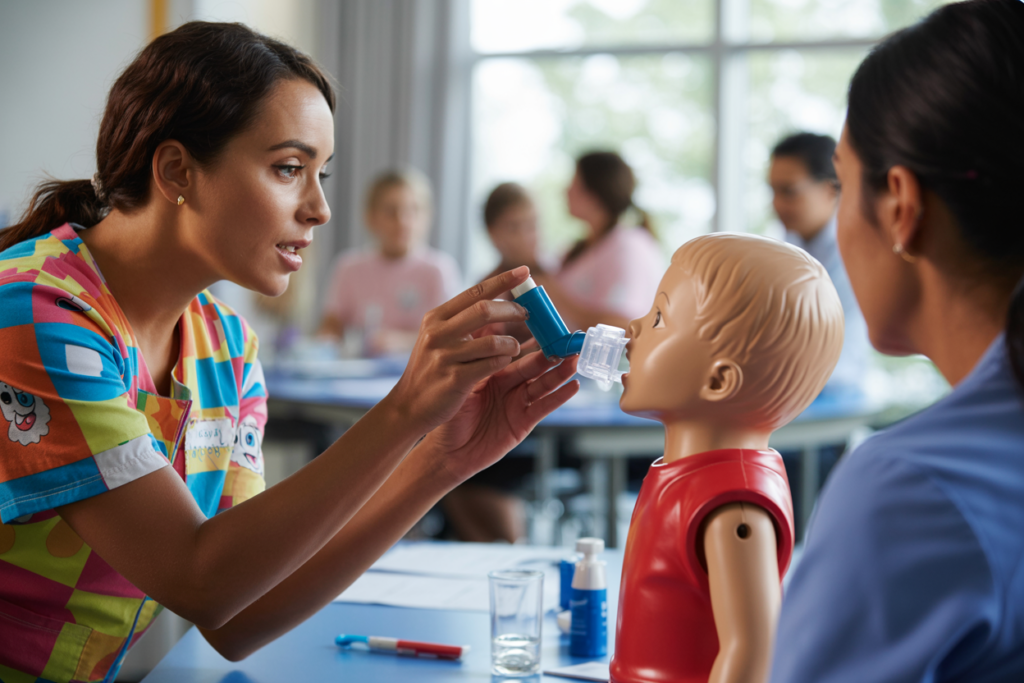
Which Asthma and Anaphylaxis Course Do You Actually Need?
Let’s clear up the confusion because this is where most educators get stuck staring at Google results wondering which course code they’re supposed to book.
Understanding Queensland Childcare Requirements
If you work in a Queensland childcare center, kindergarten, or OSHC, ACECQA requires you to hold current certifications in both anaphylaxis and asthma management. Not one or the other. Both.
This is National Quality Framework compliance. Every service caring for children under the Education and Care Services National Law needs staff trained in both emergency response areas.
Here’s where it gets confusing: you’ll see HLTAID012 (Provide First Aid in an Education and Care Setting) advertised everywhere. That’s a broader first aid course that touches on anaphylaxis and asthma, but it doesn’t meet the specific ACECQA requirements for dedicated emergency management training.
Think of HLTAID012 as general first aid. The 22579VIC and 22578VIC courses? Those are the specialist training that digs deep into allergic reactions and asthma emergencies.
The Two Essential Certifications Explained
| Certification | What It Covers | Who Needs It | Validity Period |
|---|---|---|---|
| 22579VIC | Anaphylaxis Management: EpiPen administration, ASCIA action plans, severe allergic reaction response | All childcare educators working with children who have allergies | 3 years |
| 22578VIC | Asthma Risks & Emergencies: Spacer devices, asthma action plans, recognizing severity levels | All childcare educators (asthma is extremely common) | 3 years |
| HLTAID012 | General first aid in education settings (includes brief anaphylaxis/asthma overview) | Useful but doesn't replace 22579VIC + 22578VIC | 3 years |
What You’ll Learn in an Asthma and Anaphylaxis Course
Let’s talk about what you’ll actually learn in a properly run asthma and anaphylaxis course—the skills that matter when you’re standing in front of a child whose face is swelling.
Anaphylaxis Management Skills (22579VIC)
Recognizing symptoms
You’ll learn to spot the subtle signs: tingling around the mouth, persistent scratching, facial flushing, or a child saying their “tongue feels funny.” These early symptoms are your window to act before anaphylaxis progresses to the life-threatening stage.
The course teaches you the difference between mild allergic reactions and anaphylaxis that requires immediate EpiPen administration—breathing difficulties, throat swelling, significant facial swelling, rapid pulse, or that terrifying moment when a child goes pale and their lips start turning blue.
EpiPen administration
You need to practice administering EpiPens multiple times, not watch a video once and call it done. A good course gives you repeated practice rounds with trainer devices until your hands know what to do even when your brain’s panicking.
You’ll learn the proper technique—orange end to the outer thigh, blue end pointing to the sky. How to remove the blue safety cap without dropping it. How hard to push. How long to hold it. Whether you inject through clothing (yes, you do—there’s no time to remove tights or tracksuit pants).
ASCIA Action Plan interpretation
Every child with diagnosed allergies should have an ASCIA action plan displayed in your room. The course walks you through reading these plans correctly, understanding the difference between mild-moderate reactions and anaphylaxis, and knowing when to give antihistamine versus when to go straight for the EpiPen.
Emergency response protocols
Who do you call first—000 or the parents? (Answer: 000, then parents.) What information do paramedics need? You’ll practice these scenarios so the responses become automatic.
Asthma Emergency Management Skills (22578VIC)
Identifying asthma triggers
Brisbane weather’s a nightmare for asthma—one day it’s hot and humid, the next day a cold change blows through and suddenly half your room’s wheezing. You’ll learn to recognize environmental triggers: exercise, allergens like pollen or dust, weather changes, and viral infections.
Recognizing mild vs. severe asthma attacks
This is where a lot of educators get stuck—when does “just a bit wheezy” become “we need to call an ambulance”?
Mild asthma: Slight wheeze, child can speak in full sentences, breathing slightly faster than normal, responds well to reliever puffer
Moderate asthma: Obvious breathing difficulty, can only speak in short phrases, using shoulder muscles to breathe
Severe asthma: Can’t speak more than a few words, gasping for breath, lips or nail beds turning blue, confused or drowsy
Spacer device technique
You’ll practice proper spacer technique: shake the puffer, insert it in the spacer, one puff at a time, child takes slow deep breaths through the spacer before the next puff. For younger kids who can’t coordinate breathing, you’ll learn to watch for the spacer valve moving.
Hands-On Practical Components
Multiple practice rounds build muscle memory
You should get multiple attempts at administering EpiPen trainers. Not one demonstration where you nervously fumble through it and hope you remember later. Repeated practice until your hands know what to do without thinking.
Scenario-based learning
The best courses run through situations you’ll actually face—anaphylaxis during afternoon snack, asthma attack during outdoor play, managing multiple children needing care simultaneously.
Assessment format
There’s no written exam. The assessment is practical demonstration of skills you’ve been practicing all day. You’ll demonstrate recognizing symptoms, administering EpiPen correctly, following action plans, using spacer devices, and explaining when to call 000.
By the time you reach assessment, you’ve done each of these things multiple times. It’s showing you can do what you’ve been practicing.
⚠️Important: Quality courses dedicate 70-80% of time to hands-on practice, not theory lectures. If a provider spends hours on PowerPoint slides about immune system biology, you're not getting adequate practical preparation.
How to Choose the Right Asthma and Anaphylaxis Training Provider in Brisbane
You’ve Googled “asthma and anaphylaxis course Brisbane” and you’ve got 15 tabs open with different providers all saying basically the same thing. How do you actually tell which ones are good?
Essential Accreditation and Compliance
RTO (Registered Training Organization) verification
Every legit training provider needs to be a registered RTO. You can verify their RTO status yourself at training.gov.au. If they’re legitimate, they’ll display their RTO number prominently on their website. If you can’t find an RTO number anywhere, that’s a massive red flag.
ACECQA approval confirmation
You want to see clear statements: “ACECQA approved 22579VIC” and “ACECQA approved 22578VIC.” Not vague language like “meets childcare requirements”—specific confirmation that ACECQA recognizes these qualifications.
Instructor Qualifications That Matter
Pediatric emergency experience
There’s a massive difference between someone who’s worked pediatric emergency at Brisbane Children’s Hospital and someone whose only qualification is generic first aid training.
Pediatric emergency nurses understand how children’s bodies respond to anaphylaxis differently than adults. They’ve seen severe allergic reactions in real time. They know what terrified four-year-olds do when they can’t breathe.
Current childcare knowledge
Your instructor should understand ACECQA requirements, speak the language of National Quality Framework, and know what room ratios mean when you’re trying to respond to an emergency while supervising other children.
They should reference real childcare scenarios naturally. If the instructor’s examples are all “imagine you’re at a restaurant,” they probably don’t work with childcare centers regularly.
What to Expect on Course Day
You’ve booked your course. Let’s walk through exactly what’s gonna happen so there’s no surprises.
Before You Arrive: What to Bring
Required items:
- Photo ID (driver’s license or passport)
- Unique Student Identifier (USI) number if you have one
- Your phone
Recommended:
- Water bottle
- Notebook and pen if you like taking notes
- Snack if you get hungry
Dress comfortably. You’ll be sitting and standing, practicing techniques, potentially kneeling or bending.
Course Structure
Theory foundation
The first part covers foundational knowledge—what anaphylaxis and asthma are, common allergens, how quickly reactions can progress, and why immediate response matters. This should be concise and focused.
Hands-on EpiPen practice
This is where the course earns its value. You’ll spend significant time practicing with EpiPen trainers. Your first attempt will feel awkward. By the fourth or fifth attempt, your hands know what to do without conscious thought.
The instructor runs different scenarios—child is thrashing, you’ve administered but child’s not improving, you’re outside with multiple children. This repetition builds genuine confidence.
Asthma management training
You’ll practice with actual spacers and reliever puffer trainers in different scenarios—a calm child who cooperates, a distressed child who’s fighting you, a very young toddler who can’t coordinate breathing properly.
Scenario-based learning
Now you’re putting everything together in realistic scenarios. The instructor sets scenes and you walk through your thought process and physical response.
Assessment
By this point, you’ve practiced every skill multiple times. The assessment’s just demonstrating what you’ve been doing all day. Quality instructors will coach you through it if you’re nervous.

Brisbane-Specific Considerations
Brisbane isn’t Sydney or Melbourne. Our climate, our allergens, our environmental triggers—they’re different. And that matters when you’re managing asthma and allergies in childcare settings.
How Brisbane Weather Impacts Asthma Management
The humidity factor
Brisbane’s subtropical climate means humidity levels that make asthma management challenging. High humidity makes airways feel tighter, increases mold and dust mite populations, and combines with heat to create physical stress that triggers attacks.
You need to know: when a child’s sitting on the bench after running, breathing heavily on a humid morning, is that normal heat exhaustion or early asthma?
Thunderstorm asthma events
Brisbane gets spectacular electrical storms. What most educators don’t realize: thunderstorms can trigger mass asthma events. Pollen grains absorb moisture, swell up, and burst into tiny particles during storms. Those microscopic particles get inhaled deep into lungs, triggering asthma.
Rapid temperature changes
Brisbane’s famous for mornings where it’s cool early and hot by mid-morning. Kids’ airways struggle with rapid temperature changes. Watch for asthma flare-ups during these transitions.
Local Allergen Profiles
Grass pollen season
Brisbane’s grass pollen season runs roughly August-February, peaking September-November. Common grass types triggering reactions include couch grass, bahia grass, and kikuyu grass (used in many childcare center playgrounds).
Tree pollens and food allergies
We’ve got paperbarks, bottlebrush, grevilleas, and wattles that aren’t as common in southern states. For allergic children, they’re trigger sources.
Brisbane’s multicultural population means diverse dietary exposures. Most common severe food allergies include peanuts, tree nuts, eggs, cow’s milk, shellfish, and sesame.
Final Thoughts: This Is About More Than Compliance
You now have everything you need to make an informed decision about asthma and anaphylaxis training in Brisbane. You understand which certifications ACECQA requires (both 22579VIC and 22578VIC), what you’ll actually learn in a quality course, and how to choose a provider who’ll genuinely prepare you.
But here’s what matters most: this isn’t about ticking a compliance box. This is about building genuine confidence to handle emergencies when a child’s life depends on your response.
The educators who thrive in childcare invest in quality training, practice until their hands don’t shake, and walk into work each day knowing they’re genuinely prepared for whatever happens.
You became an early childhood educator because you care about keeping kids safe. That’s what this training helps you do—not perfectly, not without fear or stress, but competently and confidently when it matters most.
Your next step is simple: Book your combined 22579VIC + 22578VIC course this week. Choose a provider with qualified instructors and adequate practice time. Attend with an open mind and willingness to practice. Leave certified and confident.
The children in your care deserve an educator who’s genuinely prepared.
You deserve to sleep peacefully without emergency nightmares keeping you awake.
Your hands deserve to know what to do when your brain temporarily freezes.
Don’t wait another week. Don’t procrastinate until your certificate’s expired. Don’t choose inadequate training and hope it’ll be enough.
A child’s face might be swelling three months from now. Your hands will either know what to do or they won’t. That decision gets made right now, when you’re choosing your training provider and committing to genuine preparation.
Book today. Get certified. Walk into work feeling genuinely prepared.
Book Your First Aid Training Now
Fast, affordable, and nationally accredited training delivered by professionals who care
Frequently Asked Questions
Q.Can I do the asthma and anaphylaxis course online?
You can find online-only courses, but ACECQA specifically requires practical demonstration of skills—you need to physically practice administering EpiPens and using spacer devices, not just watch videos. Some providers offer blended learning (online theory plus in-person practical session), which can work if the in-person component meets ACECQA requirements. Check with your director before booking any online-only course, as they might not accept it for compliance.
Q.What happens if I fail the assessment?
Quality courses have 97%+ pass rates because by assessment time, you've practiced every skill multiple times that day. If you're struggling with a particular technique, instructors provide extra coaching and practice attempts until you demonstrate competency. You're not walking out without certification—instructors work with you individually. In extremely rare cases where someone needs significantly more time, they'd be offered a free return to another course date.
Q.Do I need separate courses for anaphylaxis and asthma?
You need both 22579VIC (anaphylaxis) and 22578VIC (asthma) certifications for ACECQA compliance. Most Brisbane providers offer these as a combined course where you complete both certifications in one session, which is easier and more cost-effective than booking two separate days. Unless you only need to renew one certificate (because you completed them separately last time and they expire at different dates), book the combined course.
Q.What if I'm nervous about the practical assessment?
About 70% of participants feel nervous at the start—it's completely normal. By assessment time, you've practiced each skill 5+ times that day, so you're demonstrating techniques your hands already know. Quality instructors create supportive, pressure-free environments and provide individual coaching if you're uncertain. There's no time pressure, no trick questions, and instructors genuinely want you to succeed. If you need extra practice during the course, just ask—that's what they're there for.
Q.What's the difference between 22579VIC and HLTAID012?
HLTAID012 (Provide First Aid in an Education and Care Setting) is broader first aid training that briefly covers anaphylaxis and asthma among many other topics. The 22579VIC (Anaphylaxis) and 22578VIC (Asthma) courses are specialist, in-depth training focused exclusively on these emergencies. ACECQA requires the specific 22579VIC and 22578VIC certifications—HLTAID012 alone doesn't meet childcare compliance requirements for anaphylaxis and asthma management, though it's useful general first aid training.
Q.How long is my certificate valid for?
Both your 22579VIC and 22578VIC certificates are valid for exactly 3 years from the date you complete the course. There's no grace period—once the expiry date passes, you're immediately non-compliant and cannot work with children who have allergies or asthma until you complete renewal training.
Q.Can I do the course online?
No, you cannot complete this training entirely online. ACECQA requires face-to-face practical assessment for both anaphylaxis and asthma management. Some providers offer blended learning (online theory component plus mandatory face-to-face practical session), but fully online courses without hands-on practice don't meet ACECQA requirements and won't be accepted by your center.
Q.Do I need both 22579VIC and 22578VIC or just one?
You need BOTH certificates to work in Queensland childcare. ACECQA regulations specifically require separate certification for anaphylaxis management (22579VIC) and asthma management (22578VIC). Most Brisbane providers offer these as a combined course so you complete both in one session, but both certificates are mandatory—having just one isn't enough.
Q.What's the difference between HLTAID012 and 22579VIC/22578VIC?
HLTAID012 is "Provide First Aid in an Education and Care Setting" and covers general first aid with basic anaphylaxis and asthma content. However, ACECQA requires the specific 22579VIC (anaphylaxis) and 22578VIC (asthma) certifications for childcare staff. HLTAID012 alone doesn't meet the requirement—you need all three certifications for most childcare positions.
Q.What if I fail the practical assessment?
You won't fail if you attend a quality training provider. The assessment involves demonstrating skills you've practiced 5-7 times during the course, so by assessment time, you've already built muscle memory. The 3% of students who need extra coaching simply practice more with the instructor until they're confident—nobody gets "failed" and sent home without certification.
Q.Can I work with an expired certificate while waiting for my renewal course?
No. Once your certificate expires, you cannot be counted in staff ratios for rooms with children who have allergies or asthma, regardless of whether you've booked renewal training. Many centers will remove you from direct care work or suspend you without pay until you complete renewal and provide your updated certificate.
Q.What should I bring to the course?
You need photo ID (driver's license or passport) for registration and a water bottle. That's it. Wear comfortable clothes that allow you to move around easily—jeans and a t-shirt are perfect. The training provider supplies all course materials, EpiPen trainers, spacers, and everything else you need for the practical components.
Making first aid training more affordable for
every classroom
We believe every student deserves access to life-saving first aid knowledge. That’s why we offer specially reduced pricing for schools and educational groups. Whether you’re booking for a single class, a year group, or your entire school, our flexible packages make training more accessible and cost-effective — without compromising quality.
