
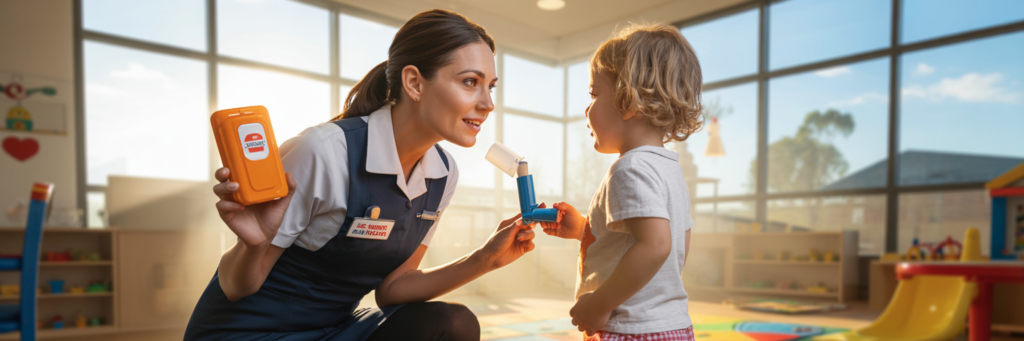
What would your staff do if a child stopped breathing in the next five minutes?
It’s not a hypothetical most chi affecting Australian children, the question of whether your team can respond correctly, calmly, and wildcard directors can afford to dismiss. With allergies and asthma among the most common chronic conditions without hesitation sits at the intersection of compliance and genuine child safety.
Asthma and anaphylaxis management has evolved heading into 2026. Updated ASCIA guidelines, revised ACECQA expectations, and a growing body of evidence around adrenaline auto-injector technique mean that training completed even 12 months ago may no longer reflect best practice.
This guide covers the most important asthma and anaphylaxis management principles your Brisbane childcare team needs to know right now. You’ll find out exactly what ACECQA requires, how often training must be renewed, and what to look for when booking a course that will actually hold up at audit.
What Is Asthma and Anaphylaxis Management?
Asthma and anaphylaxis management refers to the skills, protocols, and emergency response procedures used to recognize and treat two of the most common life-threatening conditions affecting children in Australian childcare settings. Effective management combines early recognition of symptoms, correct use of medications such as reliever inhalers and adrenaline auto-injectors, and activation of emergency services when required. In Queensland childcare centers, staff are required to hold current, ACECQA-accepted training in both conditions.
Effective asthma and anaphylaxis management includes:
- Recognizing early and severe symptoms of both conditions
- Knowing when and how to administer a reliever inhaler or EpiPen
- Following an individual child’s ASCIA Action Plan
- Calling 000 at the correct point in the emergency response
- Documenting the incident and notifying parents and regulators
- Holding current, ACECQA-accepted certification for all educators on duty
Understanding Asthma and Anaphylaxis: What Every Brisbane Childcare Educator Must Know
Asthma and anaphylaxis can look similar in the first thirty seconds. Both can cause a child to struggle for breath. Both can escalate fast. And an educator who hasn’t been trained to tell them apart is going to hesitate, and hesitation is exactly what neither condition can afford.
Asthma is a chronic respiratory condition where the airways become inflamed and narrowed, making it hard to breathe. It’s triggered by things like dust, pollen, exercise, or cold air, and it’s managed with reliever and preventer inhalers. Most asthmatic children in your care will have a known diagnosis and an action plan on file.
Anaphylaxis is a different beast entirely. It’s a severe, whole-body allergic reaction that can begin within minutes of exposure to a trigger and turn life-threatening before QAS arrives. It requires immediate adrenaline, not a wait-and-see approach, not antihistamines first. Adrenaline, then 000.
Both conditions can present with breathing difficulty in the early stages. That’s where untrained staff freeze. They’re not sure what they’re looking at, so they’re not sure what to reach for. That single moment of uncertainty is what good training is designed to eliminate.
Common Asthma Triggers in a Childcare Environment
Children with asthma can be triggered by more things than most educators realize. Common triggers in a childcare setting include:
- Dust and dust mites
- Pollen from outdoor play areas
- Pet dander from class pets or visiting animals
- Cold air during outdoor sessions
- Physical activity and running games
- Mould in older or poorly ventilated buildings
- Chemical cleaning products used in centre hygiene routines
Common Anaphylaxis Triggers in a Childcare Environment
Food allergies are the most common cause, but triggers also include insect stings, latex, and certain medications. The list is broader than many expect, and triggers can be hidden in unexpected foods, a birthday cupcake from a well-meaning parent, a shared snack, a cooking activity. According to ASCIA, approximately 1 in 20 children under 5 in Australia has a food allergy. Common food triggers include peanuts, tree nuts, cow’s milk, egg, and sesame.
Key Differences Between Asthma and Anaphylaxis Symptoms
| Feature | Asthma | Anaphylaxis |
|---|---|---|
| Onset speed | Gradual to moderate | Rapid - minutes after exposure |
| Primary symptoms | Wheezing, coughing, chest tightness | Multiple body systems affected simultaneously |
| Skin involvement | Rare | Common - hives, swelling, flushing, pale/floppy appearance |
| Respiratory involvement | Yes - airway narrowing | Yes - throat swelling, stridor, breathing difficulty |
| Correct first response | Follow Asthma Action Plan, administer reliever via spacer | Administer adrenaline auto-injector (EpiPen/Anapen), call 000 immediately |
⚠️ Compliance Alert: ACECQA requires at least one educator with current asthma and anaphylaxis training to be present at all times when children are in care. Is your roster covered?

2026 ASCIA Guideline Updates: What’s Changed and Why It Matters
Guidelines are not static. What was considered correct technique two years ago may not reflect what ASCIA recommends today, and if your team’s training is based on outdated protocols, the certificate on file is giving you a false sense of security. ASCIA, the Australasian Society of Clinical Immunology and Allergy, is the peak body that sets the clinical standard for anaphylaxis and asthma management in Australia, and when they update their guidance, your training needs to follow.
EpiPen vs Anapen – What Childcare Educators Need to Understand in 2026
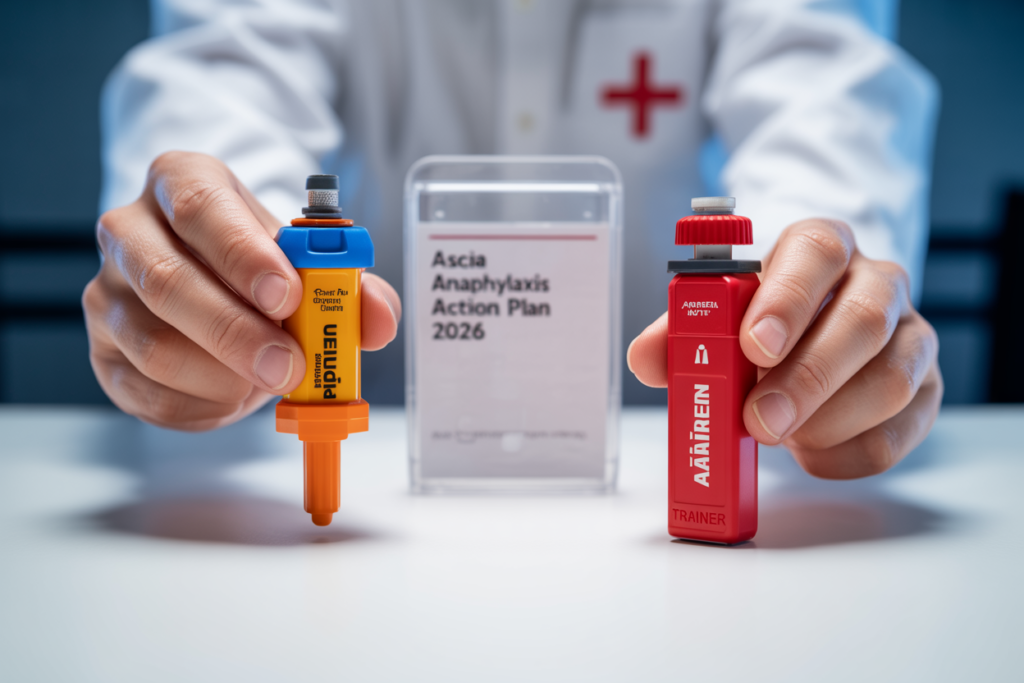
Both devices are adrenaline auto-injectors used to treat anaphylaxis, but they work differently. The EpiPen requires removing the blue safety cap and pressing the orange tip to the outer mid-thigh. The Anapen requires removing caps from both ends and pressing a red button to trigger the injection. Children on your enrolment roll may have either device prescribed, and if your staff have only ever practised on one, they are not fully prepared.
Positioning and the Second Dose
ASCIA’s current positioning guidance is based on symptoms. If the child has breathing difficulty, allow them to sit up. If they show signs of circulatory compromise such as a pale or floppy appearance, lay them flat with legs elevated. If unconscious and not breathing, recovery position and CPR. If there is no improvement five minutes after the first dose, current ASCIA guidance supports administering a second dose provided a second device is available. That window is precise, not approximate.
Step-by-Step Asthma Emergency Response for Childcare Settings
Knowing that a child is having an asthma episode is one thing. Knowing exactly what to do in the right order, without panicking, is something else entirely. That’s what training builds, not knowledge, muscle memory.
The steps below follow current ASCIA Asthma First Aid guidance. Sit the child upright, do not lay them down. Locate the child’s ASCIA Asthma Action Plan immediately and administer four puffs of a blue/grey reliever inhaler (usually Ventolin) through a spacer, one puff at a time with four breaths between each. Wait four minutes. If there is no improvement, give four more puffs. If there is still no improvement after eight puffs total, call 000 immediately. Do not delay this call. Continue four puffs every four minutes until QAS arrives.
How to Use a Spacer and Reliever Inhaler Correctly
Poor spacer technique is one of the most common errors in untrained staff. When an inhaler is used without a spacer or with a broken seal, most of the medication never reaches the lungs. The child must place their lips firmly around the mouthpiece, no gaps, take four slow deep breaths per puff, and the sequence must be repeated as directed by the action plan. Every child with a known asthma diagnosis must have an ASCIA Asthma Action Plan on file, signed by their GP, current, and stored where every educator on shift can reach it immediately.
Asthma response is manageable with the right training. Anaphylaxis demands an even faster, more precise reaction.
Step-by-Step Anaphylaxis Emergency Response for Childcare Settings
Anaphylaxis response is about executing the protocol fast. There is no waiting to see if symptoms settle. The window between first symptoms and a life-threatening reaction can be measured in minutes, sometimes less.
Recognizing the Signs of Anaphylaxis in a Child
Anaphylaxis doesn’t always announce itself with hives and a swollen face. Symptoms can be subtle in the early stages and then escalate with almost no warning.
Mild to moderate symptoms:
- Swelling of the lips, face, or eyes
- Hives or welts on the skin
- Tingling or numbness around the mouth
- Abdominal pain, vomiting, or nausea
Severe symptoms act immediately:
- Difficult or noisy breathing
- Swelling of the tongue or throat
- Pale, floppy appearance or loss of consciousness
- Young children may become suddenly very quiet or scratch at their throat without being able to explain why
Any severe symptom, or a rapid progression from mild to moderate in a child with a known allergy, is grounds to administer the adrenaline auto-injector and call 000.
How to Administer an EpiPen – Step-by-Step for 2026
The EpiPen can be administered through clothing. Educators sometimes lose time trying to remove clothing before injecting, and that time is not available. Call for help so another staff member can dial 000 while you act. Remove the blue safety cap, hold the orange tip pointing down, press firmly against the outer mid-thigh through clothing if needed, hold for a count of ten, then remove and note the time. Massage the injection site and position the child based on symptoms, flat with legs elevated if pale or floppy, upright if breathing difficulty. Stay with the child and monitor until QAS arrives.
What to Do While Waiting for QAS
The educator’s job does not end after EpiPen administration. Adrenaline buys time, it does not resolve the reaction. Monitor the child continuously, administer a second dose if there is no improvement within five minutes and a second device is available, do not give antihistamines, call parents only after 000 has been called, and document everything including time of reaction onset, symptoms observed, time of administration, and the child’s condition on QAS arrival.
🚨 Emergency Reminder: Always call 000 immediately after administering an EpiPen, even if the child appears to be improving. Adrenaline is a temporary measure. QAS must assess the child.
ACECQA Requirements for Asthma and Anaphylaxis Training in Queensland
A lot of childcare directors book training in good faith, file the certificates, and assume they’re covered. Then an auditor arrives and asks about unit codes, provider registration, or the practical component, and the answer isn’t as straightforward as expected. The gap between “we did training” and “we did the right training” is what gets centres caught out.
The regulatory foundation is the Education and Care Services National Regulations 2011. Regulations 136, 137, and 168 require Queensland childcare centres to have at least one educator present at all times who holds current, approved training in first aid, anaphylaxis management, and asthma emergency management, delivered by an ASQA-registered RTO resulting in a nationally recognised certificate.
Which Staff Members Must Hold Asthma and Anaphylaxis Training?
The requirement is ratio-based, at least one trained educator must be present per group of children at all times. In practice this means most centres need multiple staff members holding current certificates, because a single trained educator can’t cover two rooms simultaneously, and a group can’t be left uncovered when that person is on a break, off sick, or has resigned.
The full HLTAID012 qualification covers both asthma and anaphylaxis as part of a broader first aid package and is the most comprehensive option for childcare educators. Standalone units 22300VIC and 22556VIC can satisfy the specific components for staff who already hold a current general first aid certificate. When in doubt, check directly with ACECQA or your RTO.
How Often Must Training Be Renewed?
| Course | Valid Period | Renewal Trigger |
|---|---|---|
| HLTAID012 (full qualification) | 3 years | Expiry date on certificate |
| 22300VIC - Asthma management | 3 years | Expiry date on certificate |
| 22556VIC - Anaphylaxis management | 3 years | Expiry date on certificate |
| ASCIA-recommended refresher | Annually | Recommended regardless of certificate expiry |
The three-year validity is the regulatory minimum. ASCIA recommends annual refresher training for both conditions given how regularly guidelines are updated.
✅ Compliance Checklist
- Current certificates on file for all educators on duty
- Correct unit codes confirmed (HLTAID012, 22300VIC, or 22556VIC)
- Practical component completed, not online only
- Renewal dates calendared for every staff member
Book Your Asthma and Anaphylaxis Training Today
If you’ve read this far, you already know what good asthma and anaphylaxis management looks like. You know what ACECQA requires. You know what a certificate needs to include. You know the questions to ask before you book. The only thing left is actually booking it.
ASQA-registered RTO delivering ACECQA-accepted asthma and anaphylaxis training for Brisbane childcare centres. Every session includes a practical component using EpiPen trainer devices and spacer technique demonstrations, certificates are issued on the day, and on-site training is available for centres who need us to come to them.
Don’t wait until an audit notice lands on your desk or an incident forces the issue. Book your team’s training today, get the certificates filed, and get back to running your centre knowing your staff are actually ready, not just compliant on paper.
Book Your First Aid Training Now
Fast, affordable, and nationally accredited training delivered by professionals who care
Frequently Asked Questions
Q.What is asthma and anaphylaxis management?
Asthma and anaphylaxis management refers to the skills, protocols, and emergency response procedures used to recognise and treat two of the most common life-threatening conditions affecting children in Australian childcare settings, combining early symptom recognition, correct use of medications such as reliever inhalers and adrenaline auto-injectors, and timely activation of emergency services when required.
Q.How often does asthma and anaphylaxis training need to be renewed in childcare?
ACECQA requires training to be current at all times, and ASCIA recommends annual refresher training for both conditions regardless of certificate expiry, because the full qualification such as HLTAID012 is technically valid for three years but guidelines and device techniques can change within that window, so annual review keeps your team genuinely up to date rather than just compliant on paper.
Q.What does ACECQA require for anaphylaxis training in Queensland childcare?
Under the Education and Care Services National Regulations 2011, Regulations 136, 137, and 168, Queensland childcare centres must have at least one educator with current approved training in first aid, anaphylaxis management, and asthma emergency management present at all times when children are in care, and that training must be delivered by an ASQA-registered RTO resulting in a nationally recognised certificate with the correct unit codes.
Q.What is the difference between asthma and anaphylaxis?
Asthma is a chronic respiratory condition causing airway inflammation and breathing difficulty that is managed with reliever and preventer inhalers, while anaphylaxis is a severe, rapid-onset allergic reaction affecting multiple body systems that requires immediate adrenaline via an auto-injector and activation of emergency services, and although both conditions can present with breathing difficulty in the early stages the correct first response for each is completely different.
Q.Can an EpiPen be administered through clothing?
Yes, current ASCIA guidelines confirm that an EpiPen or Anapen can be administered through light clothing into the outer mid-thigh, removing clothing is not necessary and may delay treatment, and this is one of the key practical skills childcare educators should practise during training using an EpiPen trainer device so the technique becomes automatic under pressure.
Q.What should I do if a child's anaphylaxis action plan is missing?
If a child with a known allergy does not have a current ASCIA Anaphylaxis Action Plan on file, follow up with the family immediately and do not wait for an incident before resolving the gap, because in an emergency without a plan your staff are making decisions without the clinical guidance the treating doctor has specifically prepared for that child.
Making first aid training more affordable for
every classroom
We believe every student deserves access to life-saving first aid knowledge. That’s why we offer specially reduced pricing for schools and educational groups. Whether you’re booking for a single class, a year group, or your entire school, our flexible packages make training more accessible and cost-effective — without compromising quality.
