
What if someone collapsed right in front of you today—would you know what to do? Like, actually know what to do, not just have a vague memory of watching someone do chest compressions on TV once?
For thousands of Brisbane professionals, parents, and first-time learners, this question creates genuine anxiety. You imagine the scenario playing out—someone goes down at the gym, at your kid’s soccer game, during a family BBQ. Everyone’s looking around. Someone yells “does anyone know CPR?” And you’re standing there, heart racing, completely frozen because you’ve never actually learned it.
Here’s the good news, though. A basic CPR course gives you actual life-saving skills in just three hours. No medical background required. No complicated exams. Just practical, hands-on training that sticks with you when you need it most.
Whether your employer just told you CPR certification is now mandatory (surprise!), you’re a parent wanting peace of mind around the pool, or you’re entering a profession that requires it—this complete guide walks you through everything beginners need to know about CPR training in Brisbane.
You’ll discover exactly what happens in a basic CPR course, how long it actually takes, what you’ll learn (and practice), and how to choose the right training provider without getting overwhelmed by options. We’ll answer the most common beginner questions that keep people from booking—like “What if I do it wrong and break someone’s ribs?” and “Do I have to practice on a real person?” (spoiler: no, you practice on a mannequin).
By the end of this guide, you’ll understand exactly what to expect and feel confident booking your first CPR course without that nagging voice saying “maybe I should just wait a bit longer.”
What Is a Basic CPR Course?
A basic CPR course is a short training program that teaches you how to perform cardiopulmonary resuscitation on adults who’ve stopped breathing or whose heart has stopped beating. It’s designed for complete beginners with zero medical background—seriously, you don’t need to know the difference between an artery and a vein.
What you actually learn in a basic CPR course:
- How to recognize when someone needs CPR (not as obvious as you’d think)
- Proper hand placement and compression technique (there’s a specific spot)
- Correct compression depth and speed (100-120 per minute—think “Stayin’ Alive” tempo)
- When and how to call emergency services (000 in Australia)
- How to use an automated external defibrillator (AED)—those machines at shopping centres
- Basic airway management (checking the airway is clear)
Most basic CPR courses in Brisbane run on weekends and weekday evenings, with same-day digital certificates available. So you can literally get certified on Saturday morning and email it to your boss by Saturday afternoon.
Why Learn Basic CPR? (The Real Reasons Brisbane Residents Get Certified)
Let’s be honest—most people don’t wake up one morning thinking “you know what would be fun today? Learning CPR!” There’s usually a trigger. Something specific that pushes you from “I should probably do that someday” to actually booking a course.
Job Requirements That Need CPR Certification
This is the big one. You got the job offer, or you’re already working, and suddenly HR sends an email: “All staff must have current CPR certification by [date that’s somehow already next week].” Cue the panic Googling.
Here’s who typically needs CPR certification in Brisbane:
Fitness & Recreation: Personal trainers and fitness instructors (Fitness Australia won’t let you work without it), lifeguards and swim instructors, sports coaches and recreation officers, yoga and Pilates instructors at commercial studios.
Education & Childcare: Teachers and teacher aides (Queensland Department of Education requirement), childcare educators (ACECQA compliance—must have valid CPR within the last 12 months, no exceptions), before and after school care workers.
Healthcare & Allied Services: Aged care and disability support workers, massage therapists and beauty therapists, allied health students, dental nurses and assistants.
Other Professions: Real estate agents conducting open homes, security guards and crowd controllers, retail and hospitality managers, event staff and venue managers, community volunteers (Scouts, sports clubs), babysitters and nannies working professionally.
⚠️ IMPORTANT: Most Brisbane employers require current CPR certification as a condition of employment or insurance coverage. Your boss isn't being difficult—their insurance company literally won't cover workplace incidents if staff aren't trained.
Peace of Mind for Parents and Families
Here’s a statistic that hits different when you have kids: 70% of cardiac arrests happen at home, according to the Australian Resuscitation Council. Not at hospitals where there’s help nearby. At home. Where it’s just you and your family.
Sarah from Carindale learned this the hard way. Her dad had a heart attack during a family BBQ in the backyard. She called 000 immediately, but the ambulance took 11 minutes to arrive. Eleven minutes of standing there, not knowing if she should do something, scared she’d make it worse. He survived, thankfully. But she booked a CPR course the following weekend because she never wanted to feel that helpless again.
Parents with young children learning to swim have this fear constantly. Drowning is silent—there’s no splashing, no yelling for help like in the movies. If you know CPR and rescue breathing, you’ve got a fighting chance. If you don’t, you’re just waiting for the ambulance.
What You’ll Actually Learn in a Basic CPR Course
This is the part where people get nervous. “What if I can’t do it? What if I forget everything the moment someone actually needs help?”
Here’s the thing—CPR isn’t complicated. It’s repetitive, physical, and way more straightforward than you’re imagining.
The DRSABCD Action Plan (Your CPR Checklist)
Every CPR course in Australia teaches the DRSABCD approach. It’s an acronym that walks you through exactly what to do when you find someone who might need help.
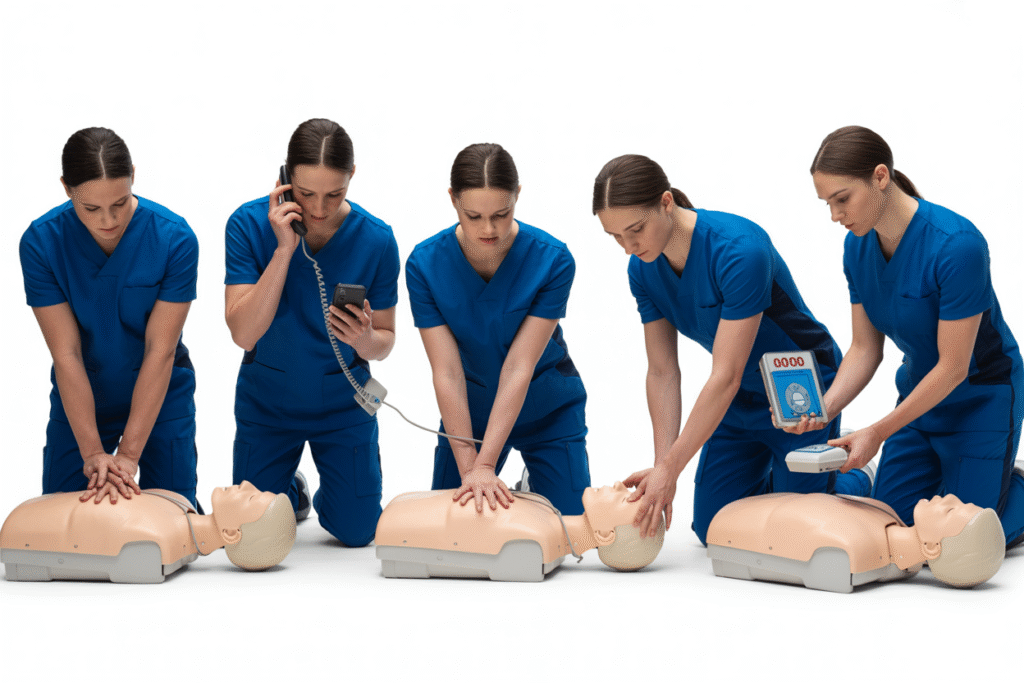
D – Danger: Check for danger before you do anything. Is there live electricity? Traffic? Fire?
R – Response: Check if the person responds. Talk to them loudly, gently shake their shoulders.
S – Send for help: Call 000 immediately, or get someone else to call while you start helping.
A – Airway: Open the person’s airway by tilting their head back gently and lifting their chin.
B – Breathing: Check if they’re breathing normally. Look, listen, feel for no more than 10 seconds.
C – CPR: Start chest compressions if they’re not breathing.
D – Defibrillation: If there’s an AED nearby, use it.
💡 PRO TIP: You'll run through DRSABCD scenarios multiple times during training. By the end of three hours, you won't need to think about the steps—your hands will just know what to do next.
Hands-On Practice: What to Expect
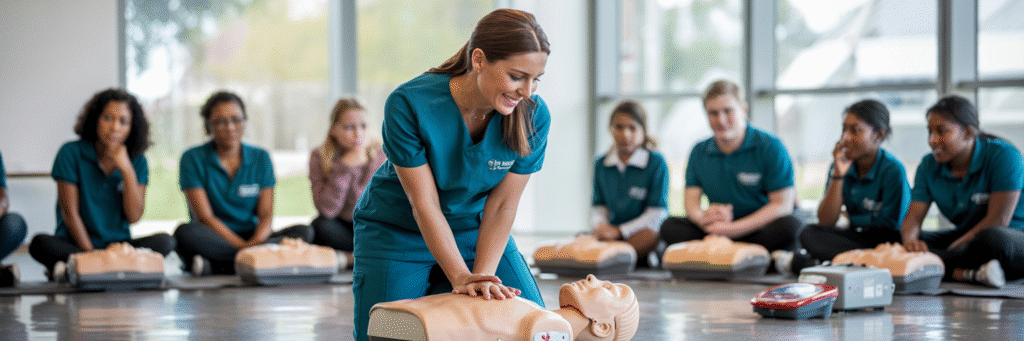
You practice on mannequins specifically designed for CPR training. They’re called “CPR manikins” and they’re designed to feel realistic—there’s resistance when you compress the chest, the head tilts back like a real person’s would.
You’ll be in a small group (usually 8-12 people max in Brisbane courses). Everyone’s in the same boat. Everyone’s a beginner. Nobody’s watching you critically because they’re too busy concentrating on their own practice.
The actual CPR technique:
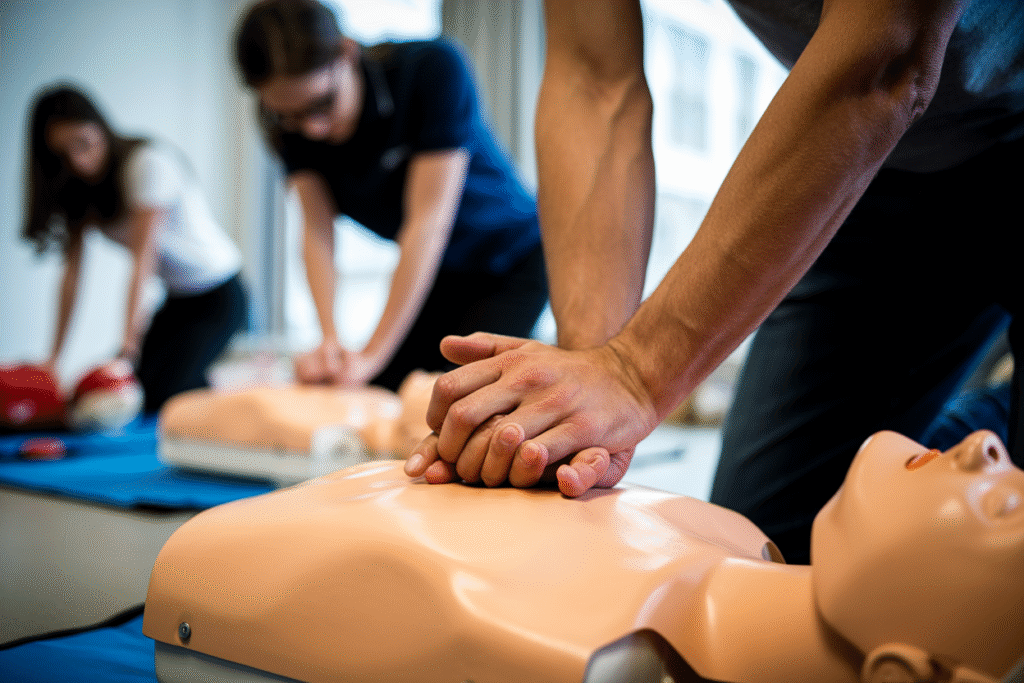
- Position yourself – Kneel beside the person, level with their chest
- Hand placement – Heel of one hand on the centre of their chest, other hand on top, fingers interlocked
- Body position – Shoulders directly above your hands, arms straight, elbows locked
- Compression depth – Push hard and fast, about 5-6 centimeters deep
- Compression rate – 100-120 compressions per minute (think “Stayin’ Alive” by the Bee Gees)
- Let the chest recoil – Release pressure completely after each compression
- Keep going – Continue until help arrives or the person starts breathing
Using an Automated External Defibrillator (AED)
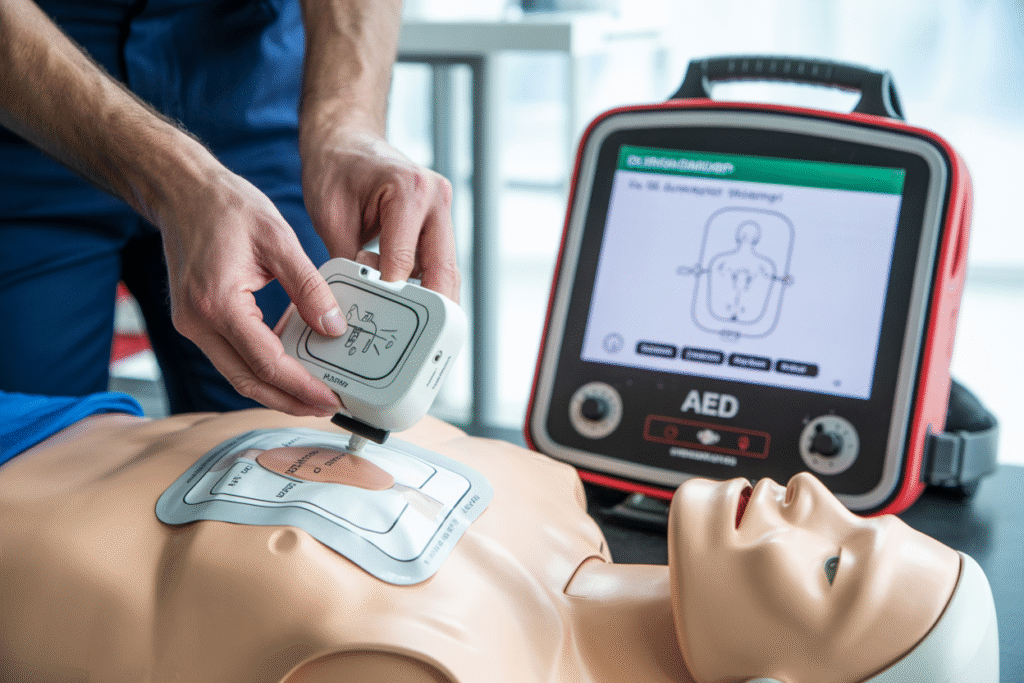
AEDs are those machines you see mounted on walls at shopping centres, gyms, and airports. They look intimidating, but they’re literally designed for untrained people to use.
When you open an AED, the machine turns on automatically and starts talking to you. Actual voice instructions. “Remove clothing from chest.” “Place pads as shown.” It walks you through every single step.
Who Should Take a Basic CPR Course in Brisbane?
Short answer: pretty much everyone. But realistically, some people need CPR certification more urgently than others.
If you work in these industries: Personal trainers need it for Fitness Australia registration. Childcare educators need it for ACECQA compliance. Teachers need it for Department of Education requirements. Aged care workers, massage therapists, real estate agents, security guards, retail managers—the list goes on.
If you’re a parent or caregiver: Parents with young children learning to swim. Grandparents providing regular childcare. Parents with teenagers playing contact sports. Carers for elderly parents or relatives. Professional babysitters and nannies.
If you just want to be prepared: You’re done feeling unprepared. You’ve reached that point where you want to be capable and self-reliant. You volunteer in the community. You’ve had a close call that made it real.
How to Choose a CPR Training Provider in Brisbane
Brisbane’s got dozens of CPR training providers. Here’s how to tell the good ones from the average ones.
Check They’re a Registered Training Organization (RTO)
This is non-negotiable. Your CPR provider must be a registered RTO with the Australian Skills Quality Authority (ASQA). If they’re not, your certificate is literally worthless. Look for their RTO number on their website and verify it on training.gov.au.
Look for Brisbane-Based Trainers
Some national training companies run courses in Brisbane, but instructors fly in from other cities. Brisbane-based trainers know where the nearest public AEDs are located, understand Brisbane ambulance response times, and can give you relevant local examples.
What Happens After You Complete Your CPR Course?
Getting Your Certificate
Most Brisbane providers email your digital certificate within 2-4 hours of completing the course. This is a PDF with your details, the course code (HLTAID009), the issue date, and the expiry date.
This digital certificate is legally valid and accepted by all employers, registration bodies, and insurance companies. Save that PDF somewhere you can find it again. Email it to yourself at multiple addresses. You’ll need to produce it multiple times over the next year.
How Long Is Your CPR Certificate Valid?
12 months. Not a day longer.
Your certificate expires exactly 12 months from your course completion date. If you completed your course on November 15, 2024, your certificate expires November 15, 2025. Not November 30th. The 15th.
Your certificate becomes invalid immediately on the expiry date. You can’t legally work in a role that requires CPR certification. Set your own calendar alert for 30 days before expiry.
💡 PRO TIP: Don't wait until your certificate expires to book your renewal. Book it 2-3 weeks before expiry so you've got buffer time if something comes up and you need to reschedule.
Steps to Book Your First CPR Course in Brisbane
Step 1: Confirm What You Actually Need
Check your requirement. If it’s for work, ask HR: “What’s the exact course code I need?” They should tell you HLTAID009 (basic CPR) or HLTAID011 (full first aid which includes CPR).
Step 2: Find Available Dates That Work for You
Pick a date at least 3-5 days out if possible. Last-minute bookings are possible, but you’re limited to whatever spots are still available.
Step 3: Choose Your Location
Choose based on convenience. A course that’s $10 cheaper but 40 minutes further away probably isn’t worth it when you factor in fuel and time.
Step 4: Complete the Online Booking
You’ll need:
- Full legal name (as it should appear on certificate)
- Date of birth
- Email address (where certificate will be sent)
- Phone number
Step 5: Pre-Course Requirements
Some Brisbane providers require online pre-course work (30-60 minutes of reading and videos). You’ll also need a Unique Student Identifier (USI) which you can create free at usi.gov.au in about 5 minutes.
Step 6: What to Bring on the Day
Required: Photo ID, USI number, confirmation email
Recommended: Water bottle, comfortable clothes (you’ll be kneeling on the floor)
Avoid: Tight jeans, short skirts, excessive jewelry
Step 7: Arrive on Time
Get there 10 minutes early. You’ll need to sign paperwork, find parking, and settle in before the course starts.
Ready to Get CPR Certified?
You’ve read through the guide. You understand what CPR training involves, how long it takes, and why it matters. Now it’s decision time.
If You Need CPR for Work
Stop procrastinating. Pick a date in the next 2 weeks. Book it now. You’ll thank yourself later.
If You’re a Parent or Family Member
That nagging feeling saying “I really should learn CPR”—that’s your instinct telling you something important. Block out 3 hours in the next month and actually get it done.
The investment: 3 hours of your time. What you get: Skills that could save your child, your parent, your partner.
If You Just Want to Be Prepared
Brisbane’s got a lot of people. Most of them don’t know CPR. When someone collapses in public, there’s maybe a 5% chance someone nearby knows what to do.
You can be one of those 5%. Three hours of training and you’re someone who can actually help.
The Simple Booking Process
- Pick a date in the next 2-4 weeks
- Choose a convenient Brisbane location
- Book online (takes 5 minutes)
- Complete any pre-course work
- Show up in comfortable clothes
- Complete 3 hours of training
- Get your digital certificate same day
That’s it. You’re CPR certified.
Final Thought
Right now, only 5% of cardiac arrest victims in Australia receive bystander CPR. That means 95% of the time, when someone collapses, nobody helps. Not because people don’t care, but because they don’t know how.
Book the course. Learn the skill. Be prepared.
You won’t regret it.
Ready to get CPR certified in Brisbane? Find a registered training provider near you, check their available dates, and book your basic CPR course today. Your future self (and potentially someone who needs your help) will thank you.
Book Your First Aid Training Now
Fast, affordable, and nationally accredited training delivered by professionals who care
Frequently Asked Questions About Basic CPR Courses in Brisbane
Q.How long is a CPR course valid for?
12 months from the date you complete the course, not from when you receive the certificate or the end of the month—from the exact date you did the training. If you complete your course on November 15, 2024, it expires November 15, 2025. You need to renew annually with no grace period, and the day after expiry, you're not certified.
Q.Can I fail a CPR course?
Technically yes, but realistically almost nobody fails because the pass rate is close to 100% and the course is designed to get you to competency, not to filter people out. You'd only fail if you refused to participate, completely ignored instructor feedback, or couldn't demonstrate basic competency after multiple attempts with guidance, but if you show up, pay attention, practice, and make a genuine effort, you'll pass—instructors give you feedback and let you try again if you're struggling with the technique.
Q.Is CPR certification the same as first aid certification?
No, they're different courses with different certification codes: CPR only (HLTAID009) is 3 hours covering cardiopulmonary resuscitation only and valid for 12 months, while full first aid (HLTAID011) is 6-8 hours covering CPR plus wound care, burns, fractures, allergic reactions, choking, and shock, valid for 3 years (but the CPR component expires after 12 months). Some jobs require just CPR while others require full first aid, so check your specific requirement before booking.
Q.Can I do CPR training online?
Not entirely, because CPR certification requires face-to-face practical assessment and you can't learn the hands-on technique properly through a computer screen. Some providers offer blended learning with an online theory component (30-60 minutes at home) and a face-to-face practical session (2-2.5 hours in person), but the practical component is mandatory, so anyone offering "fully online CPR certification" is either running a scam or offering non-recognized certification that won't be accepted by employers.
Q.What should I wear to a CPR course?
Comfortable, casual clothing that allows you to kneel on the floor and move freely—good choices include jeans or casual pants, activewear/gym clothes, t-shirt or casual top, and comfortable shoes (you'll probably remove them for floor practice). Avoid tight restrictive clothing, short skirts or dresses (you'll be kneeling), and excessive jewelry (might scratch manikins or get in the way)—think "what would I wear to a yoga class" for that level of comfort.
Q.Will I be confident to use CPR in a real emergency?
Honest answer: maybe, maybe not, because confidence comes from the training but real emergencies are scary regardless of how prepared you are. What the training does give you is the physical skills locked in through muscle memory, a mental checklist (DRSABCD) to follow when your brain is panicking, knowledge that you're legally protected if you help in good faith, and experience practicing the technique multiple times—you'll be significantly better prepared than someone with no training, and when everyone's standing around frozen, you'll at least know what to do physically even if you're scared while doing it.
Making first aid training more affordable for
every classroom
We believe every student deserves access to life-saving first aid knowledge. That’s why we offer specially reduced pricing for schools and educational groups. Whether you’re booking for a single class, a year group, or your entire school, our flexible packages make training more accessible and cost-effective — without compromising quality.
