

Your employer asked for HLTAID010, the booking page says “blended”, and now there’s an online component you weren’t expecting. A basic emergency life support blended course simply splits the unit into two parts: theory you do online at your own pace, and a face-to-face practical where a trainer assesses your CPR and emergency response on a manikin.
You need to finish both parts before you can be assessed as competent and get your Statement of Attainment. Think of it a bit like getting your L’s. The theory comes first, then someone watches you actually do it.
And honestly? The format suits shift workers really well. The reading and quizzes happen whenever it suits you, on a day off or after the kids are in bed, which cuts down your time in the training room. The catch is the online part has to be done before you arrive. Leave it til the night before and you risk turning up unprepared, tired and flustered.
It’ll also show you how to check HLTAID010 is the course your employer actually wants, before you book anything.
How Does a Blended Basic Emergency Life Support Course Work?
A blended basic emergency life support course (HLTAID010) combines self-paced online theory with a face-to-face practical session. You complete the online learning first, then attend a shorter hands-on session where a trainer assesses your CPR and emergency response skills before issuing your certificate.
- 1. Book and enrol. Choose a practical date and provide your USI.
- 2. Complete the online learning. Work through the theory modules and quizzes before your session.
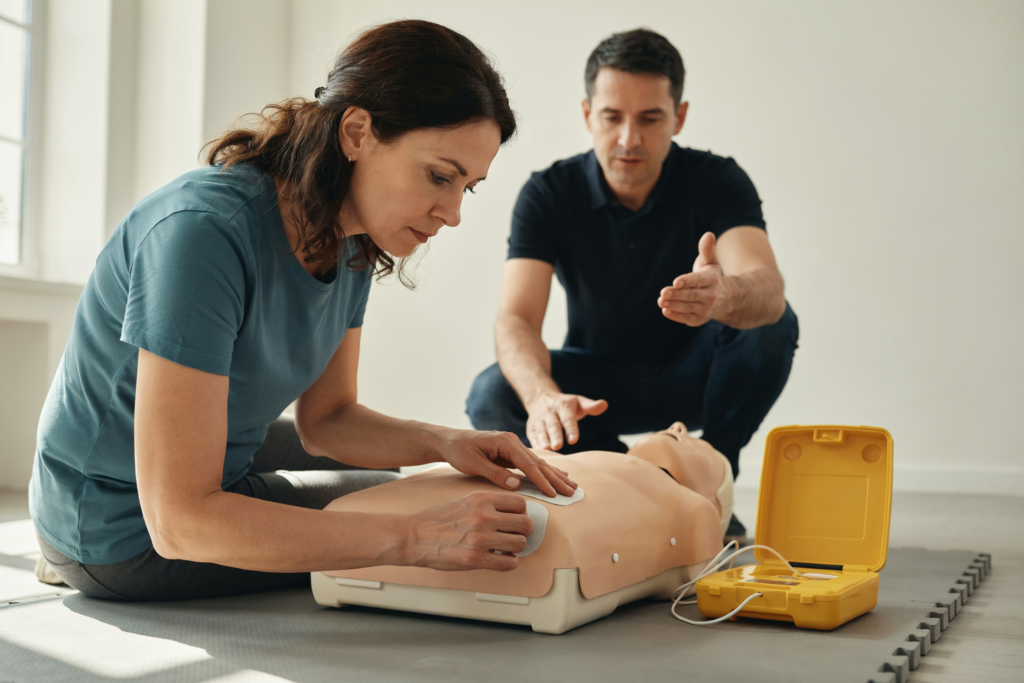
- 3. Attend the practical session. Practice DRSABCD, CPR on adult and infant manikins, and AED use.
- 4. Complete your assessment. Show your skills in a simulated emergency scenario.
- 5. Receive your Statement of Attainment. It's issued once both parts are complete and assessed.
That’s the whole journey, really. Five steps, and only one of them needs you in a training room. Most people find the basic emergency life support blended format a lot less overwhelming once they see it laid out like this.
A few terms you’ll see along the way
Term | What it means in plain English |
Blended learning | Part of the course is online at your own pace, part is face to face with a trainer |
Statement of Attainment | The nationally recognized certificate showing you’ve completed HLTAID010 |
USI (Unique Student Identifier) | A free government number every student needs before an RTO can issue a certificate |
Practical assessment | The trainer watches you perform CPR and respond to a simulated emergency |
What “Blended” Means for HLTAID010
HLTAID010 is the unit code for Provide Basic Emergency Life Support, or BELS for short. When a course is called “blended”, it just means the learning is split across two places: your couch and the training room.
Blended vs fully face-to-face delivery
With blended, you do the online theory first and then come in for a shorter practical. With face-to-face, everything happens on the day, so the session runs longer. Neither one is better or worse. It really comes down to how your week looks.
Blended | Face-to-face | |
Time in the room | Shorter practical session | Longer, everything on the day |
Flexibility | Theory whenever suits you | Fixed session time |
Preparation needed | Online learning before you arrive | Just turn up |
Who it suits | Rotating rosters, busy households | People who’d rather do it all in one go |
If your roster changes every week, blended is usually the friendlier option.
Why BELS can’t be done 100% online
CPR and emergency response skills have to be shown in person, to a trainer. There’s no way around it, because nobody can check your compressions through a screen. We’ve written a separate post on doing HLTAID010 online if you want the longer answer.
One thing I’d genuinely warn you about: if you see an “online-only HLTAID010” offer, treat it as a red flag. Check the provider on training.gov.au before you hand over any money.
Who the blended format suits
- Shift and casual workers booking around rosters
- People with family commitments who can't lose a whole day
- Anyone who likes reading at their own pace
It may not suit you if you don’t have reliable computer access at home. If that’s you, give us a call and we’ll talk through your options.
Once you know blended suits your week, the next job is making sure HLTAID010 is the course your employer actually wants.
Step 1: Before You Book, Check HLTAID010 Is the Right Course
This is the step most people skip, and it’s the one that saves you money. HLTAID010 (Provide Basic Emergency Life Support) sits in the middle of three units that sound almost the same, so it’s really easy to book the wrong one. Honestly, nobody knows these codes by heart. You’re not meant to.
HLTAID009 vs HLTAID010 vs HLTAID011 at a glance
Unit | What it covers | Typical roles |
HLTAID009 Provide Cardiopulmonary Resuscitation | CPR and AED use | Roles that only need CPR |
HLTAID010 Provide Basic Emergency Life Support | CPR, AED use and responding to life-threatening emergencies | NDIS and disability support, aged care, security, aquatic staff |
HLTAID011 Provide First Aid | Everything in HLTAID009 and HLTAID010, plus broader first aid | Workplace first aid officers |
The thing to remember is it only works one way. HLTAID011 includes HLTAID010 and HLTAID009. HLTAID010 does not include HLTAID011. You can check the exact scope of each unit on training.gov.au.
I work in disability or aged care: HLTAID010 is often what providers ask for. Book your HLTAID010 course, but confirm with your employer first.
I’m a first aid officer: You’ll usually need the full first aid unit. See our HLTAID011 first aid course and confirm with your employer.
I only need CPR: HLTAID009 covers CPR on its own. Check the exact wording in your email and confirm with your employer.
Already hold a current HLTAID011? You may not need BELS
If your HLTAID011 Statement of Attainment is still current, it already includes HLTAID010. So before you pay for anything, flick your coordinator a quick message and ask. Paying twice for the same thing is the worst.
Get your USI ready
A USI (Unique Student Identifier) is a free government number every student needs, and you can set one up at usi.gov.au. No USI means no certificate, full stop.
Invoices, employer reimbursement and tax
Hang on to your invoice after you book. It’s worth asking your employer if they’ll reimburse you. Work-related training may also be deductible, so check with the ATO or your tax agent.
Not sure HLTAID010 is what your employer wants? Call us and we’ll confirm it for you. Moving into a team leader role? HLTAID011 Provide First Aid includes everything in BELS, plus more.
With your USI ready and the course confirmed, online learning is the first real step.
Step 2: Completing the Online Learning
This is the part you do at home. The HLTAID010 pre-course online learning covers the theory side of basic emergency life support, so your practical session can focus on actually doing the skills.
What the online learning covers
At a high level, you’ll work through:
- Responding to an emergency
- DRSABCD, the action plan you'll use on the day
- CPR principles
- AED use
- Managing an unconscious casualty
- Reporting the incident afterwards
Doing it at your own pace
You don’t have to do it all in one go. Split it across a couple of sittings if that’s easier, whatever fits around your shifts.
Use a computer or tablet, not your phone, if you can
A bigger screen is easier to read, and you’re less likely to get timed out halfway through a quiz. Phones do work in a pinch, and plenty of people get it done that way.
💡 Tip: Use a computer or tablet if you can.
Can’t find your login email?
It happens more than you’d think.
- 1. Check your spam and promotions folders.
- 2. Still nothing? Call or text us.
What happens if you don’t finish before your session
The online part needs to be done before your practical, so don’t leave it to chance. My honest advice is to aim to have it finished well ahead of the day, not the night before. That way, if something goes wrong with a login or the wifi drops out, there’s time to sort it.
If English isn’t your first language
If you’re feeling unsure, give us a call before you book and have a chat.
📋 Your pre-course checklist: ☐ USI ready ☐ Online learning finished ☐ Login details saved ☐ Clothes sorted for the practical
Finish the online part and the practical session is where it all comes together
.
Step 3: Your Practical Session in Brisbane
This is the hands-on part of your HLTAID010 course, and for most people it’s the bit they’re most nervous about.
What happens on the day
Here’s the rough flow:
- Arrival and ID check so the trainer knows who's who
- Skills practice on DRSABCD, CPR and the AED
- A simulated scenario to put it all together
What to wear and bring
Wear comfortable clothes you can kneel in and closed shoes. Then bring:
- Photo ID
- Your USI
- A water bottle
- Your glasses, if you need them
Worried about kneeling for CPR?
I’ll be straight with you here. The assessment requires CPR on a manikin on the floor. If you’ve got dodgy knees or a sore back from years of care work, that’s a completely fair thing to worry about.
The best move is to contact us before you book and tell us about any knee, back or other injuries. It won’t make it effortless, but at least there’s no surprise when you walk in.
The practical and the assessment usually happen in the same session, so here’s what the trainer is looking for.
Step 4: How the Assessment Works
The word “assessment” makes a lot of people tense up. For HLTAID010 (Provide Basic Emergency Life Support), it’s really just the trainer checking you can do what you’ve practised.
The practical assessment
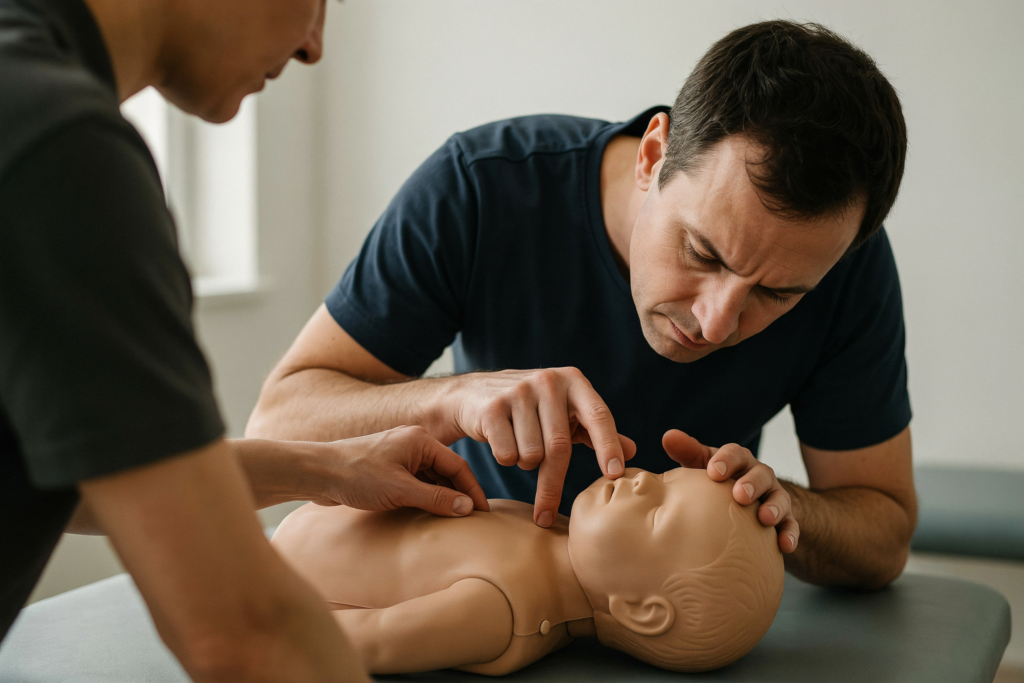
Your trainer watches you perform CPR, use the AED and respond to a simulated scenario. Think of it less like an exam and more like showing someone how you’d handle it. You’re not up on a stage with everyone staring at you. The whole room is busy doing the same thing.
The knowledge assessment
Your theory knowledge gets checked too. The online learning covers a lot of that, and if you’re unsure what’s checked online and what’s checked on the day, just ask us before you book.
What if you don’t get it right the first time?
Remember, the practice time comes before anything is assessed. Your trainer will coach you through it, correct your hand position, tell you to push a bit harder or a bit faster. By the time you’re assessed, you’ve already done it a few times with someone guiding you.
Step 5: Getting Your Certificate and Staying Current
This is the finish line. Once you’re assessed as competent in HLTAID010 (Provide Basic Emergency Life Support), your Statement of Attainment is on its way.
When your Statement of Attainment arrives
It’s issued once both parts are complete and assessed. My tip is to upload it to your employer’s system the same day you get it. Don’t let it sit in your inbox. Future you, the one getting a chasing email from rostering, will be grateful.
What your employer needs to see on it
Your certificate should show:
- The unit code HLTAID010
- The unit title Provide Basic Emergency Life Support
- RTO 31106
- Your name
- The date of issue
How often you need to renew
There’s two timeframes to keep in your head:
- CPR every 12 months, in line with Australian Resuscitation Council and ANZCOR guidance
- The full unit commonly every 3 years, in line with the WorkSafe Queensland First Aid in the Workplace Code of Practice
At the end of the day though, your employer’s policy is what counts, so check what they want.
📱 Reminder: Never let your CPR lapse. Get a text reminder before your CPR is due so you're not caught out again.
Your Next Steps
Getting your basic emergency life support blended course sorted doesn’t need to take over your week. It really comes down to three small jobs, and you can knock most of them over from your phone between shifts.
Start by confirming with your coordinator that HLTAID010 is the course they actually need. A quick message now saves you paying for the wrong unit later.
Next, have your USI ready. If you’ve studied before, you’ve probably already got one, so dig it out. If not, you can create one for free at usi.gov.au.
Then book a practical date that fits your roster. Pick a day you’re not coming straight off a double shift if you can.
Finally, finish your online learning before you arrive, well ahead of the night before. Walk in with that done and the practical is just you, a trainer and a manikin, working through skills you’ll be glad to have if a client ever needs you.
Book Your First Aid Training Now
Fast, affordable, and nationally accredited training delivered by professionals who care
Frequently Asked Questions About Blended BELS
Q.Can I do HLTAID010 completely online?
No. The theory can be done online, but CPR and emergency response skills have to be shown in person to a trainer, so every HLTAID010 course needs a face-to-face practical.
Q.How long does the whole blended course take, start to finish?
It mostly comes down to you. The online part goes at your own pace, and the practical is one shorter session, so the sooner you finish the theory, the sooner you're done.
Q.Can I do online learning on my phone?
Yes, phones work in a pinch. A computer or tablet is easier though, because the screen's bigger and you're less likely to get timed out halfway through a quiz.
Q.What if I have to cancel or change my practical date?
Rosters change, that's life in care work. Give us a call as soon as you know and we'll help you find another date that fits.
Q.Does my employer pay for BELS?
Some employers reimburse it and some don't, so ask your coordinator before you book. Keep your invoice either way, and check with the ATO or your tax agent about claiming it.
Q.Is HLTAID010 the same as a first aid certificate?
Not quite. HLTAID011 Provide First Aid is the full first aid unit and includes everything in HLTAID010. It doesn't work the other way round, so confirm with your employer which one they need.
Making first aid training more affordable for
every classroom
We believe every student deserves access to life-saving first aid knowledge. That’s why we offer specially reduced pricing for schools and educational groups. Whether you’re booking for a single class, a year group, or your entire school, our flexible packages make training more accessible and cost-effective — without compromising quality.
