
The email from your rostering coordinator was short. “Your BELS is due.” That’s it. No explanation, no link, just four letters and a deadline, and you had to scroll back through old emails just to figure out it meant HLTAID010. If that’s you right now, you’re not the only one. This is basic emergency life support for beginners, written for support workers, aged care staff and first-timers across Brisbane who got handed a course code and not much else.
And honestly, feeling a bit nervous is normal. Most beginners we train worry about the same three things. Kneeling on the floor to do CPR. Getting through online learning. And paying for the wrong course by mistake, which nobody can afford.
So here’s what this guide walks you through. What BELS covers, and how it’s different to CPR and full first aid. What happens on the day, start to finish. How to prepare, including if your knees are sore or English is your second language. Then how to book once you’re sure.
By the end you’ll know what to expect, and you’ll be ready to walk in, do the course, and have your certificate reach your inbox.
What Happens in a Basic Emergency Life Support Course?
HLTAID010 teaches you how to respond to an emergency and keep someone alive until the paramedics arrive. For beginners, a typical course runs like this:
- 1. Complete the online theory at home before your course day.
- 2. Arrive, sign in and bring your USI (Unique Student Identifier) and photo ID.
- 3. Watch your trainer demonstrate DRSABCD, the step-by-step emergency action plan.
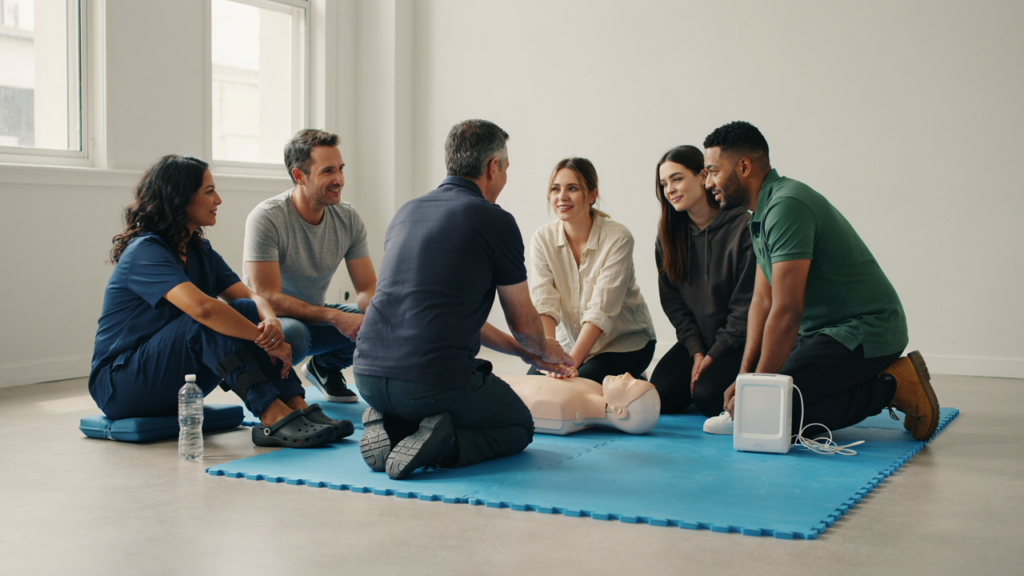
- 4. Practise CPR on adult and infant manikins on the floor, without stopping.
- 5. Use an AED (defibrillator) and roll someone into the recovery position.
- 6. Respond to a simulated emergency like choking, a severe allergic reaction or heavy bleeding.
- 7. Complete your assessment and receive your Statement of Attainment.
Most beginners walk out saying the day was way more hands-on than they thought, and a lot friendlier too. Each step is explained below.
What Is Basic Emergency Life Support? A Beginner’s Summary
The name alone trips up plenty of people. You’re not imagining it, the paperwork really does make it harder than it needs to be.
BELS, Basic Life Support and HLTAID010: One Course, Three Names
Your employer might write BELS. They might write basic life support. Or they might just paste the code, HLTAID010. It’s all the same unit, the full title being HLTAID010 Provide basic emergency life support.
One thing to watch for though. If you google “BLS” you’ll hit a lot of American websites. US “BLS” is a different certification altogether, and it won’t be what your Australian employer’s asking for.
💡 Good to know: BELS = HLTAID010. Same course, different names.
What the Course Covers
Here’s the short version of what you’ll learn:
- DRSABCD, the emergency action plan
- CPR on adults and infants
- Using an AED (defibrillator)
- The recovery position
- Choking
- Bleeding, asthma and anaphylaxis
- Handing over to paramedics
Who Usually Needs It
Most people doing HLTAID010 work in jobs where someone’s life could depend on them in the first few minutes. That’s disability support, aged care, community and youth work, security and aquatic staff. Plenty of people heading down a health career pathway do it too.
The requirement usually comes from your employer’s own policy, not one rule that covers everyone. So if your coordinator’s asked for it, that’s the one to go by.

HLTAID009 vs HLTAID010 vs HLTAID011: Which One Do Beginners Need?
Knowing what BELS covers is one thing. Knowing it’s the right one for your job is another, and that’s where most people get stuck.
The Three Courses Side by Side
Think of them like a set of nesting boxes. CPR sits inside BELS, and BELS sits inside full first aid.
HLTAID009 | HLTAID010 | HLTAID011 | |
Plain name | CPR | Basic emergency life support | Provide first aid |
CPR and AED | ✓ | ✓ | ✓ |
Emergency response, life-threatening conditions | ✓ | ✓ | |
Full first aid | ✓ | ||
Typical user | Fitness, aquatics | Care and support workers | Workplace first aiders, team leaders |
So on hltaid009 vs hltaid010, the difference is that BELS adds the emergency response side on top of CPR. And on hltaid010 vs hltaid011, full first aid adds everything else.
Already Have HLTAID011? You May Not Need BELS Separately
Here’s one that catches people out. HLTAID011 has HLTAID009 and HLTAID010 built into it as component units. So if you already hold the full first aid course, you might already be covered.
Check the date on your certificate first. Then confirm with your employer before you book anything.
Your First BELS Course, Step by Step
Once you’re sure HLTAID010 is the right one, here’s how the whole thing plays out, start to finish.
Before the Day: Finishing Your Online Learning
The hltaid010 online component is the bit that trips up the most people, and it’s not because it’s hard. It’s because it gets forgotten.
- Use a computer or tablet if you can. Your phone works, but it's fiddly.
- Find your login email now. Check your junk folder, that's where they love to hide.
- Don't leave it until the night before. After a double shift, that's the last thing you'll feel like doing.
What to Wear and Bring
You’ll be up and down off the floor a fair bit, so dress for it.
What to bring
- Comfortable clothes you can kneel in
- Closed shoes
- Your USI, which you can find or create at usi.gov.au
- Photo ID
- Your glasses, if you need them for reading
- A water bottle
- Knee pads, if you've got them
On the Day: How the Session Runs
You sign in, grab a seat, and your trainer gets things going. From there it’s a pretty simple rhythm. The trainer shows you a skill. You have a go. You get feedback. Then you have another go. That cycle repeats for each skill, so nothing gets thrown at you cold.
The nerves usually settle fast once you’re actually doing it.
How the Practical Assessment Works
The assessment is competency-based. That means you show you can do each skill correctly. There’s no score, no ranking, and no one’s comparing you to the person next to you.
You’ll do CPR on the floor on an adult manikin and an infant manikin. You’ll also work through a simulated emergency and hand over to paramedics at the end.
And here’s the thing a lot of beginners don’t realise. Most of the assessment happens while you’re practising. By the time it feels “official”, you’ve usually already shown the trainer what they need to see.
After the Course: Your Certificate
Your Statement of Attainment gets emailed to you. Once it lands:
- Forward it to your coordinator, or upload it to your employer's system
- Save a copy somewhere you'll find it again, like your phone and your email
The Life-Saving Skills You’ll Learn as a Beginner
The practical part is where the skills that matter most actually sink in, and it’s the heart of basic emergency life support for beginners. Everything below is taught in line with current ANZCOR guidelines.
DRSABCD: Your Action Plan
When something goes wrong, your brain can go blank. DRSABCD gives you something to hold on to, like a handrail in the dark. It follows the Australian Resuscitation Council’s Basic Life Support flowchart.
- Danger: check it's safe for you and them
- Response: talk to them, squeeze their shoulders
- Send for help: call 000
- Airway: open it and check it's clear
- Breathing: look, listen and feel
- CPR: start if they're not breathing normally
- Defibrillation: grab an AED as soon as you can
CPR for Adults and Infants
It’s 30 compressions to 2 breaths, at 100 to 120 compressions a minute, pushing down about one-third the depth of the chest. For infants you use two fingers instead of your hands (ANZCOR Guideline 8).
Imagine a client collapsing on a community access outing. This is the skill that keeps blood moving until the ambos get there.
Using an AED
A lot of people are scared of defibrillators. They shouldn’t be. The device talks you through it, telling you where the pads go and what to do next (ANZCOR Guideline 7).
The Recovery Position
This is for someone who’s unconscious but still breathing (ANZCOR Guideline 3). It keeps their airway open while you wait for help.
Choking
Mealtime choking is something care workers worry about a lot, so this one really matters. Encourage them to cough. If that’s not working, give up to 5 back blows, then up to 5 chest thrusts. If they go unconscious, start CPR (ANZCOR Guideline 4).
You won’t be taught abdominal thrusts or the Heimlich. That’s not how it’s done in Australia.
Bleeding, Asthma and Anaphylaxis
Emergency | What you do | Guideline |
Heavy bleeding | Apply firm, direct pressure | ANZCOR 9.1.1 |
Asthma attack | Sit them upright, give their reliever | ANZCOR 9.2.5 |
Anaphylaxis | Lay them flat, use their autoinjector, call 000 | ANZCOR 9.2.7 |
If you support a client with a known allergy, having done it once on a trainer device makes the real thing a whole lot less frightening.

Nervous About Your First Course? Common Beginner Worries
If all that sounds like a lot, you’re in good company. Nearly every first-timer walks in with at least one worry sitting in their stomach. Here are the big ones, answered straight.
“I Have Bad Knees. Can I Still Do CPR?”
We’ll be upfront with you. CPR on the floor is part of the course, and it has to be done on the floor. But there’s plenty that makes it easier.
- Bring knee pads, or a folded towel works too
- Tell your trainer about your knees or back before you start
- Got an injury or condition you're worried about? Call us before you book and we'll talk it through
“English Is My Second Language.”
You won’t be the only one in the room. Trainers show you each skill with their hands, not only with words, so you can learn by watching and copying. Where it’s appropriate, questions can be asked out loud instead of written down.
If you’re unsure, ring us before you book and ask. There’s no silly question.
“What If I Don’t Pass?”
This is the one that keeps people up the night before. Remember, the assessment is competency-based. Your trainer is there to coach you until you get it right, not to catch you out. There’s no competition and no one’s comparing scores, because there aren’t any.
“What If I Book the Wrong Course?”
Head back up to the course comparison if you haven’t already. And if you’re still second-guessing, call us and we’ll confirm it with you before you pay anything.
Still feeling nervous? Talk to us before you book. A quick chat usually does more for the nerves than any amount of googling.
How Often Do You Need to Renew BELS?
Once you’ve passed, the next thing most people ask is how long does HLTAID010 last. The answer’s a bit different to what you’d expect.
Your Statement of Attainment doesn’t have an expiry date printed on it. The renewal timing comes from industry guidance and your employer’s own policy, not from the certificate itself.
The usual guide comes from Safe Work Australia’s Model Code of Practice: First aid in the workplace. It recommends:
When | What to do |
Every 12 months | CPR refresher |
Every 3 years | Redo the full course |
Your employer might set a shorter cycle than that, and their policy is always the one that wins. If you’re not sure, ask your coordinator.
📱 Tip: The day your certificate lands, set a reminder in your phone for 11 months' time. That gives you a month to book your refresher before anyone has to chase you.
Ready for Your First BELS Course?
That’s basic emergency life support for beginners in Brisbane, from the first confusing email right through to the certificate in your inbox.
You now know three things most first-timers don’t. BELS and HLTAID010 are the same course. The day is hands-on, with plenty of practice before anything counts. And the assessment is about coaching you until you get it right, not catching you out.
From here, you’ve got a few easy options. You can see BELS dates near you, call us to check it’s the right course for your job, or grab the beginner’s checklist so you’ve got everything on your phone.
Whichever you pick, you’ll walk in knowing what to expect. And you’ll walk out knowing that if a client ever chokes or collapses in front of you, your hands will know what to do.
Book Your First Aid Training Now
Fast, affordable, and nationally accredited training delivered by professionals who care
Basic Emergency Life Support FAQs for Beginners
Q.Is the HLTAID010 assessment hard?
Most beginners find it manageable. It's competency-based, so you show each skill correctly instead of chasing a score, and your trainer coaches you during practice before you're assessed.
Q.Can I do basic emergency life support completely online?
No. You can do the theory online, but CPR and the other practical skills have to be shown in person on manikins to get a nationally recognized HLTAID010 Statement of Attainment.
Q.Do I need first aid experience before a BELS course?
No. HLTAID010 has no prerequisites and is made for people with no previous first aid training, so your trainer starts from the very beginning.
Q.What should I wear to a BELS course?
Wear comfortable clothes you can kneel in and closed shoes. You'll practice CPR on the floor, so skip short skirts or tight clothing and bring knee pads if your knees get sore.
Q.Does HLTAID010 include full first aid?
No. HLTAID010 covers emergency life support, including CPR and AED use. Full first aid is HLTAID011 Provide first aid, which already includes HLTAID010.
Making first aid training more affordable for
every classroom
We believe every student deserves access to life-saving first aid knowledge. That’s why we offer specially reduced pricing for schools and educational groups. Whether you’re booking for a single class, a year group, or your entire school, our flexible packages make training more accessible and cost-effective — without compromising quality.
