
Not sure what actually happens when you walk into an HLTAID010 practical session? You’re not alone. Most care workers know they need the certificate but very few know what the day actually looks like until they’re already there.
If you’re working in aged care, disability support, or the NDIS sector, HLTAID010 Basic Emergency Life Support is one of the most important qualifications you’ll hold. But between the booking confirmation and walking through the door, there’s often a gap: what exactly am I about to do?
This guide answers that question completely. You’ll learn what a typical basic emergency life support practical session covers, what the hands-on components involve, and what you can do beforehand to feel prepared and confident on the day. Whether you’re completing HLTAID010 for the first time or renewing an expired certificate, this walkthrough is written specifically for care sector workers.
What Happens in an HLTAID010 Practical Session?
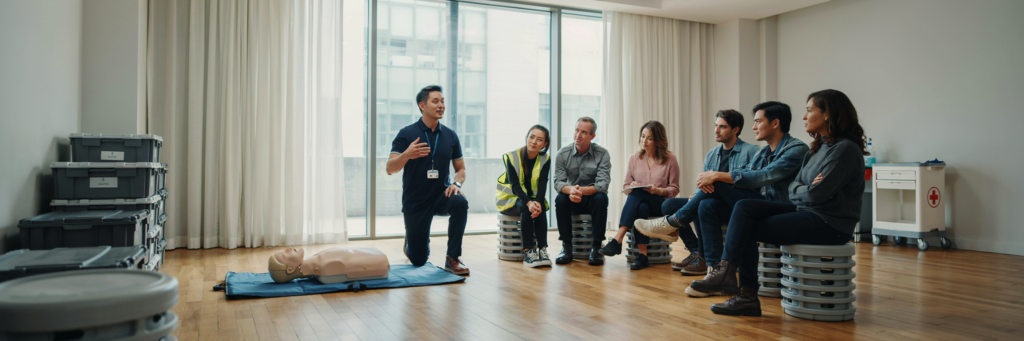
An HLTAID010 practical session is a hands-on training day where you learn and demonstrate basic emergency life support skills under the guidance of a qualified trainer. Here’s what you can expect on the day:
What Is HLTAID010 And Why Does It Matter for Care Workers?
If you’ve been told by your employer that you need “basic first aid” or “life support training,” HLTAID010 is almost certainly what they’re referring to. But what exactly is it, and why do aged care and NDIS employers treat it as non-negotiable?
The Nationally Recognised Qualification Behind the Certificate
HLTAID010 is the official unit code for Provide Basic Emergency Life Support, listed on the national training register at training.gov.au. It’s not a generic first aid course. It’s a specific, nationally recognised unit of competency with a defined scope: DRSABCD, CPR technique, and AED use.
The only certificate your employer’s compliance team will accept is a Statement of Attainment issued by an ASQA-registered RTO. First Aid Alive is registered with ASQA (RTO [RTO_NUMBER]), which means every certificate we issue meets that standard.
HLTAID010 is also distinct from HLTAID011 Provide First Aid which covers a broader range of emergency scenarios and is required for higher-risk roles and first aid officer designations. If you’re a personal care worker, home care worker, or disability support worker, HLTAID010 is most likely what your employer requires. Worth confirming before you book.
HLTAID010 | HLTAID011 | |
Full name | Provide Basic Emergency Life Support | Provide First Aid |
Who it’s for | Aged care workers, NDIS support workers, community care staff | First aid officers, team leaders, higher-risk workplaces |
What it covers | DRSABCD, CPR, AED | All of HLTAID010 + broader first aid scenarios |
Certificate | Statement of Attainment | Statement of Attainment |
Why Aged Care and NDIS Employers Require It
Under the NDIS Practice Standards, registered NDIS providers must demonstrate that their workers hold current, relevant training. The Aged Care Quality Standards carry similar expectations.
What that means in practice: if your HLTAID010 lapses, your employer may stand you down from client-facing duties until it’s renewed. No certificate, no shifts. It’s not a threat. It’s just how compliance works in the care sector.
The good news is that renewing is straightforward. One practical session, same-day certificate, and you’re back on the roster.
What You’ll Actually Do in the Practical Session Step by Step
This is the part most people want to know about before they show up. And it’s the part that causes the most unnecessary anxiety. So let’s walk through it properly.
The DRSABCD Framework: Your Emergency Response Roadmap
Every HLTAID010 practical session is built around one foundational framework: DRSABCD.
It stands for Danger, Response, Send for help, Airway, Breathing, CPR, Defibrillation and it’s the step-by-step sequence you follow when you arrive at the scene of an emergency. Whether a client collapses in their home, loses consciousness in a residential facility, or stops breathing in the middle of a community program, DRSABCD is the mental roadmap that stops you from freezing and gets you moving in the right order.
Your trainer walks through each step in plain language before anyone demonstrates anything. You’ll understand what each letter means, why the order matters, and how it applies to the real situations you face as a care worker. Then the trainer demonstrates the full sequence before you have a go yourself.
CPR on a Manikin: What to Expect Physically
This is the component that makes some people nervous, particularly if you’ve got a bad knee, a dodgy back, or you’ve been out of training for a few years.
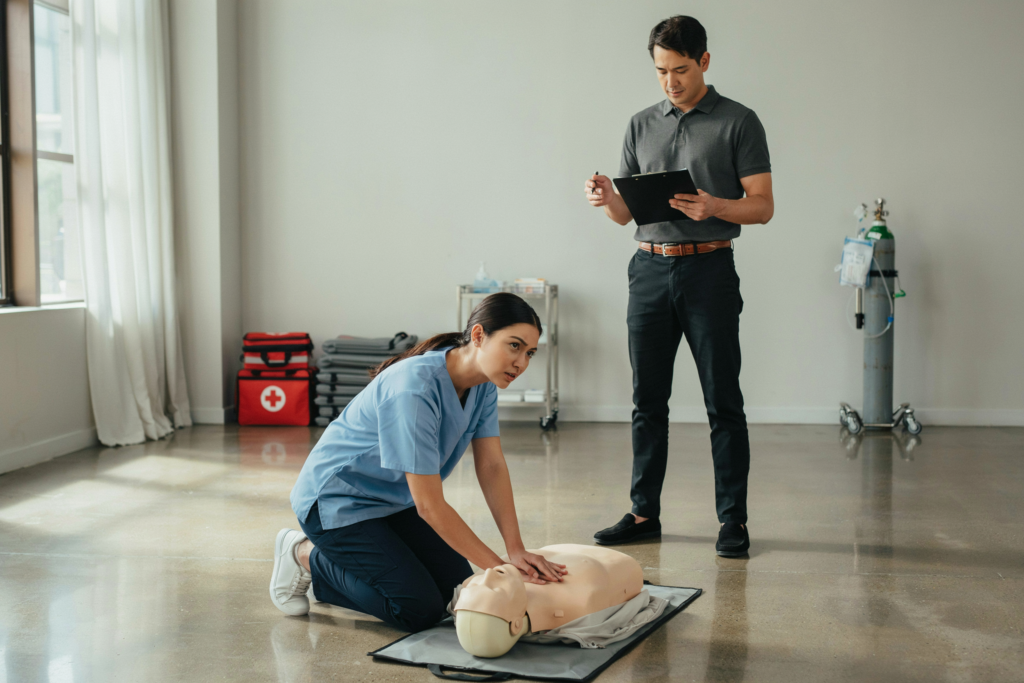
You’ll be working on a CPR manikin on the floor. The trainer demonstrates first. You watch, ask questions if you have any, then you have a go. The compression rate is 30 compressions to 2 rescue breaths, at 100-120 compressions per minute. That’s the current ANZCOR Guideline 8 standard, and it’s what every HLTAID010 session in Australia is trained and assessed to.
It’s a little physically demanding. Real CPR is hard work and the training reflects that honestly. But it’s not a fitness test.
First Aid Alive trainers work with students of all fitness levels. If floor-based activity is genuinely difficult for you, whether that’s a knee injury, a back condition, or anything else, chair-based CPR assessment options are available where appropriate. The key is to let us know when you book, not when you arrive. That gives your trainer time to prepare the right adjustments in advance.
If you have a physical limitation or health condition, disclose it at booking. Your trainer can prepare support in advance and you’ll feel a lot better walking in knowing it’s already been sorted.
AED Training: You Don’t Need to Be Technical
A lot of people assume AED training is going to be complicated. It’s not.
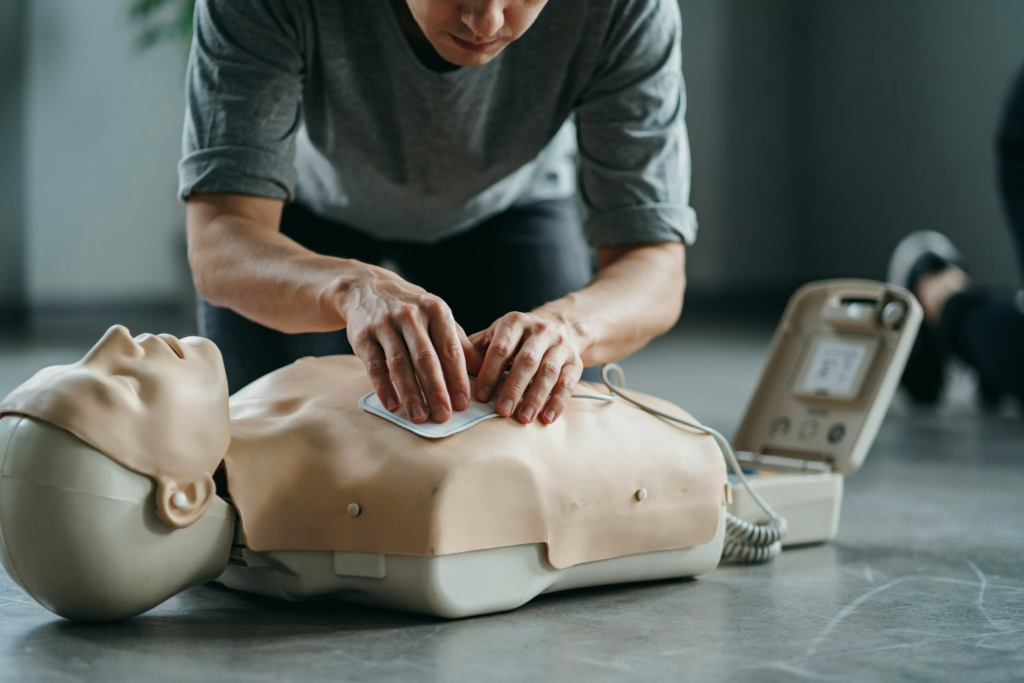
An AED, automated external defibrillator, is a voice-prompted device. It tells you exactly what to do, step by step, out loud. Your job in an emergency isn’t to know the machine inside out. Your job is to not be afraid of it.
You’ll practise attaching the pads to the manikin and following the device prompts through a simulated shock sequence. The goal isn’t technical mastery. It’s that you’d actually reach for the AED in a real emergency instead of standing next to it. In aged care and disability support settings, knowing how to use one confidently could genuinely be the difference for one of your clients.
How to Prepare for Your HLTAID010 Practical Session
There’s not a lot of preparation required. This isn’t an exam you need to study for. But a few small things done the night before will make the whole day go a lot smoother.
What to Wear and Bring on the Day
You’ll be getting down on the floor for CPR practice. Skirts, restrictive workwear, and anything that makes kneeling awkward are going to make your day harder than it needs to be. Jeans, leggings, or loose pants and a comfortable top are ideal. Flat shoes or trainers over heels or thongs.
What to bring:
- Photo ID required for identity verification at sign-in
- Booking confirmation email or screenshot on your phone is fine
- Pre-work completion record if your session uses a blended delivery model, bring evidence that you've completed the online component
- Water and a snack the session runs for several hours and there may not always be a cafe nearby
Parking and access details will be in your booking confirmation. Check before the day, not when you’re already running late.
Completing Any Online Pre-Work Before You Arrive
Do it the night before. Not the morning of. The pre-work gives you a foundation so your face-to-face time is spent on skills practice, not theory. Thirty quiet minutes the evening before is all it takes.
If You Have a Physical Limitation or Health Condition
Bad knees, back problems, shoulder injuries, recent surgery. All of these are manageable in an HLTAID010 session, but your trainer needs to know about them in advance. Chair-based CPR assessment options are available where floor-based activity isn’t appropriate.
Disclose at booking, not on the day. If you let us know when you book, First Aid Alive can make sure the right setup is ready for you before you walk through the door.
First Time vs Renewal: What to Review Beforehand
If you’re completing HLTAID010 for the first time, you don’t need to do anything beforehand. Your trainer covers everything from scratch. Show up, listen, and be willing to have a go.
If you’re renewing, a five-minute refresh of the DRSABCD sequence the night before is worth doing. Having it front of mind means you’re not shaking the rust off in the first twenty minutes. The muscle memory for CPR comes back fast once your hands are on the manikin.
What Happens After the Practical Session Your Certificate and Next Steps
You’ve done the hard part. Here’s what the end of the day looks like and what you need to do with your certificate once you have it.
When Will I Receive My Statement of Attainment?
Once you’ve been assessed as Competent, First Aid Alive will issue your Statement of Attainment, a nationally recognized certificate issued under ASQA RTO.
Your certificate is emailed to you on the same day. [CERTIFICATE_DELIVERY_DETAIL]. If you’ve been stood down from shifts pending renewal, a same-day certificate means you can be back on the roster by Monday morning. You can send the PDF to your coordinator before you’ve left the car park.
When you receive it, save a copy somewhere accessible. Some employers want it uploaded to a platform like PRODA; others just want it emailed to HR. Check with your coordinator beforehand so you know exactly where it needs to go.
How Long Is HLTAID010 Valid and When Do I Need to Renew?
Your HLTAID010 certificate is valid for 3 years from the date of issue.
However, the Australian Resuscitation Council (ARC) recommends that the CPR component be refreshed annually. CPR is a perishable skill. The compression rate, the ratio, the confidence to actually start compressions on a real person, all of that degrades faster than a three-year renewal cycle accounts for.
Many aged care and NDIS employers now require annual CPR refreshers as part of their internal compliance framework, even when the full HLTAID010 certificate is still technically current. Check your employer’s requirements now rather than finding out at your next performance review that you were due for a refresher six months ago.
Should I Also Consider HLTAID011?
If your role is changing, or if you’re moving into a team leader position, a senior care role, or a workplace that designates a formal first aid officer, you may find that HLTAID010 isn’t enough for where you’re heading.
HLTAID011 covers everything in HLTAID010 plus a broader range of emergency scenarios. It’s the qualification required for first aid officer designation and higher-risk workplace environments. If your employer or a new role requires “Provide First Aid” rather than “Basic Emergency Life Support,” HLTAID011 is the next step.
Conclusion
Walking into your HLTAID010 practical session is a lot less daunting when you know what’s waiting for you. A structured day, a trainer who’s there to get you competent not to trip you up, skills you’ll genuinely use, and a certificate in your inbox before the day is out. That’s what the basic emergency life support practical session looks like in reality.
The skills you’re walking in to learn are built for the exact situations you face every shift. A client who collapses during a home visit, an elderly resident who stops breathing in the corridor, a participant who needs help while QAS is still minutes away. DRSABCD, CPR, the AED you’ve walked past a hundred times without touching. After your session, you’ll know what to do and you’ll have done it, hands on a manikin, assessed to a national standard.
HLTAID010 isn’t just a compliance checkbox. It’s the qualification that keeps you on the roster and keeps the people you care for safer every shift. The certificate matters. But so does the confidence that if something goes wrong, you’re not the person standing there hoping someone else steps forward.
Renewal students, this applies to you just as much as first-timers. Your muscle memory is closer to the surface than you think. A five-minute DRSABCD refresh the night before, comfortable clothes, your ID, and you’re ready. The session will move faster than you expect, and you’ll walk out wondering why you waited as long as you did to get it done.
Book when you’re ready. Weekend sessions are available, spots fill up, and your employer’s deadline isn’t going to move. If you’ve got questions before you book, reach out. First Aid Alive responds to all enquiries within hours. And if you’re not quite sure yet whether you need HLTAID010 or HLTAID011, the comparison guide will sort that out in about three minutes. Either way, the next step is simple: pick a date that fits your roster and get it done.
Book Your First Aid Training Now
Fast, affordable, and nationally accredited training delivered by professionals who care
Frequently Asked Questions
Q. What happens in an HLTAID010 practical session?
An HLTAID010 practical session is a face-to-face, hands-on training day covering the DRSABCD emergency response framework, CPR technique on a manikin to current ANZCOR guidelines, AED familiarisation, and a scenario-based competency assessment. On successful completion you receive a nationally recognised Statement of Attainment issued the same day by First Aid Alive, an ASQA-registered RTO.
Q. Do I need any prior knowledge or experience before attending?
No prior knowledge is required. If you're completing HLTAID010 for the first time, your trainer covers every component from scratch and you'll practise each skill before being assessed. If you're renewing, a quick review of the DRSABCD sequence the night before is all that's helpful, your hands remember more than you think once you're on the manikin.
Q. What should I wear to the practical session?
Wear comfortable clothing that allows for floor-based movement. Avoid skirts, restrictive workwear, or anything that makes kneeling awkward, as you'll be getting down on the floor for CPR practice. Jeans, leggings, or loose pants with a comfortable top and flat shoes or trainers are ideal.
Q. How long is my HLTAID010 certificate valid?
Your HLTAID010 Statement of Attainment is valid for 3 years from the date of issue. However, the Australian Resuscitation Council recommends the CPR component be refreshed annually, and many aged care and NDIS employers enforce that as an internal compliance requirement. Check your employer's policy so you know whether you need an annual CPR refresher in addition to your three-year renewal.
Q. What's the difference between HLTAID010 and HLTAID011?
HLTAID010 covers basic emergency life support: DRSABCD, CPR, and AED use. It's the qualification required for most aged care workers, disability support workers, and NDIS personal care staff. HLTAID011 covers everything in HLTAID010 plus a broader range of first aid scenarios and is required for first aid officer roles, team leaders, and higher-risk workplace environments. If you're not sure which one your employer requires, our comparison guide has the answer.
Making first aid training more affordable for
every classroom
We believe every student deserves access to life-saving first aid knowledge. That’s why we offer specially reduced pricing for schools and educational groups. Whether you’re booking for a single class, a year group, or your entire school, our flexible packages make training more accessible and cost-effective — without compromising quality.
