
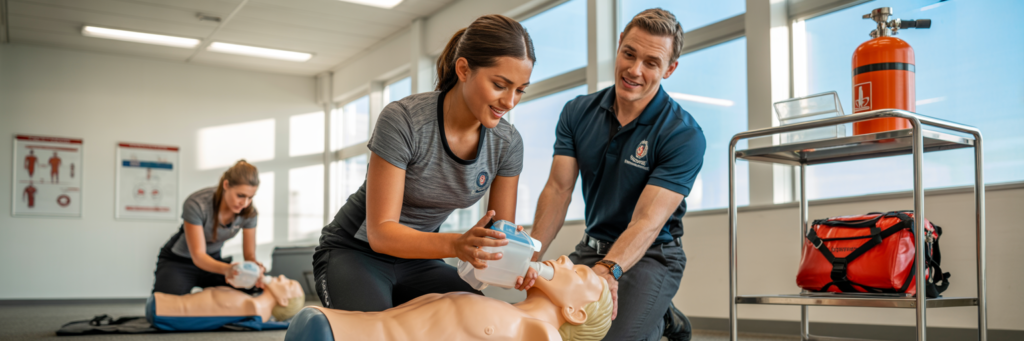
You know that paramedic interview scenario you keep running through your head at 3am? The panel leans forward and asks: “Walk us through your emergency response training.”
Do you mention a basic first aid certificate and hope that’s enough—or do you confidently discuss oxygen therapy, advanced airways, and BVM ventilation from actual hands-on experience?
Basic emergency response skills separate aspiring healthcare professionals from those who actually get accepted into competitive programs. While standard first aid covers CPR and bleeding control, real emergency response competency includes advanced life support techniques that paramedics, nurses, and patient transport officers use every single day.
This guide breaks down which emergency response skills actually matter for career advancement and real-world scenarios. We’re gonna look at the difference between basic first aid and emergency life support training, what ambulance service recruiters are looking for, and give you a clear roadmap for mastering skills that translate to genuine emergency competency.
Whether you’re preparing for paramedic recruitment, advancing your healthcare career, or making sure you can respond effectively when seconds matter—this guide provides the clarity you need.
What Are Basic Emergency Response Skills?
Basic emergency response skills are life-saving techniques used to stabilize patients during medical emergencies before advanced care arrives. These skills go beyond standard first aid to include advanced airway management, oxygen therapy, and emergency equipment operation.
The 6 core emergency response skills include:
- Cardiopulmonary Resuscitation (CPR) – Chest compressions and rescue breathing for cardiac arrest
- Automated External Defibrillator (AED) Operation – Electrical shock delivery for cardiac emergencies
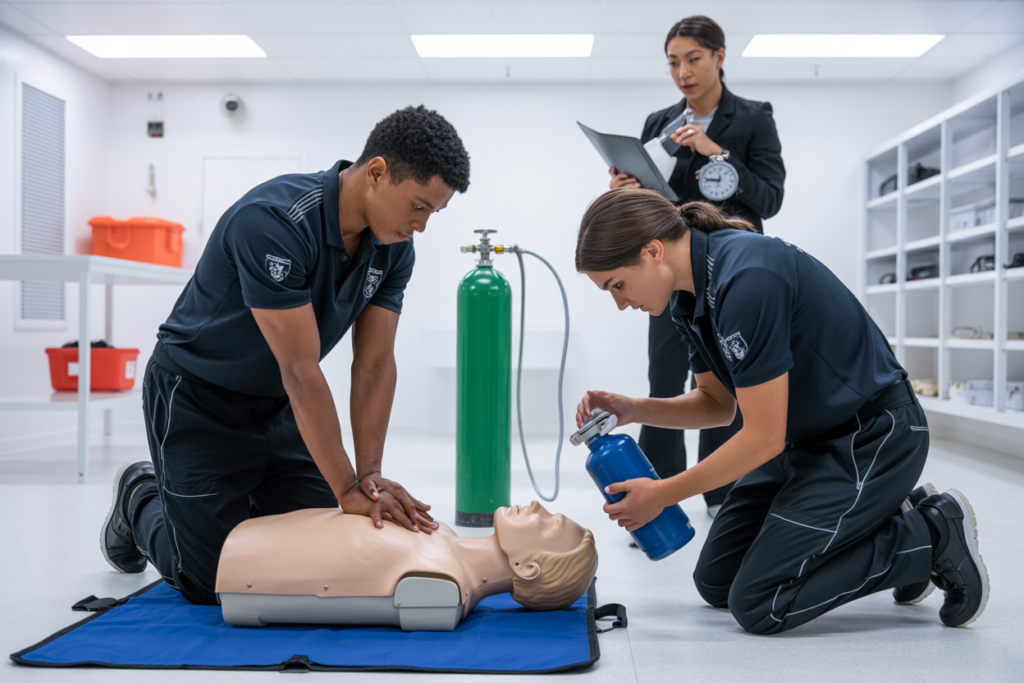
- Oxygen Therapy Administration – Using oxygen cylinders, regulators, and delivery masks
- Advanced Airway Management – Oropharyngeal airways, suction devices, and airway positioning
- Bag-Valve-Mask (BVM) Ventilation – Manual ventilation for patients unable to breathe adequately
- Emergency Patient Assessment – DRSABCD protocol, vital signs monitoring, and handover procedures
In Australia, these skills are formally taught in HLTAID010 (Provide Basic Emergency Life Support) courses, which exceed standard first aid certification requirements.
| Skill Category | HLTAID011 (First Aid) | HLTAID010 (BELS) |
|---|---|---|
| CPR & AED | ✓ Basic | ✓ Advanced team coordination |
| Oxygen Therapy | ✗ Not covered | ✓ Full equipment training |
| Advanced Airways | ✗ Not covered | ✓ OPAs, suction, positioning |
| BVM Ventilation | ✗ Not covered | ✓ Manual ventilation skills |
| Paramedic Readiness | Entry level | Professional preparation |
Basic First Aid vs. Emergency Life Support Skills
Here’s the thing that trips up most people preparing for paramedic recruitment—they think all first aid certifications are basically the same. They’re not.
The difference between HLTAID011 (Provide First Aid) and HLTAID010 (Basic Emergency Life Support) is like comparing a driver’s license to a heavy vehicle endorsement. Sure, both let you drive, but one opens doors the other doesn’t.
What Standard First Aid Covers (HLTAID011)
Standard first aid training covers the basics you’d need if someone gets hurt at a BBQ or collapses at the shopping centre. You’re learning how to recognize emergencies and provide care until paramedics arrive.
HLTAID011 courses teach you:
- CPR and AED basics – Chest compressions, rescue breaths, and using an automated defibrillator
- Bleeding control – Direct pressure, bandaging, wound management
- Burns and fractures – Basic treatment for thermal injuries and broken bones
- Anaphylaxis management – Recognizing severe allergic reactions and using an EpiPen
- Asthma emergencies – Helping someone during an asthma attack
- Soft tissue injuries – Sprains, strains, and basic musculoskeletal care
But here’s the limitation that matters if you’re on a paramedic pathway: there’s zero oxygen therapy training and no advanced airway management. You’re not touching the equipment paramedics use in those first few minutes when everything matters most.
“First aid certification teaches you to recognize emergencies and provide basic care. Emergency life support training teaches you to operate the same equipment paramedics use in the first critical minutes,” says a clinical director with years of ambulance service experience.
What Emergency Life Support Adds (HLTAID010)
HLTAID010 takes everything from standard first aid and adds the equipment-based skills that separate “I can help” from “I’m trained on what you’ll actually use as a paramedic.”
This course includes everything from HLTAID011, plus:
- Oxygen therapy systems – How to safely operate oxygen cylinders, regulators, flow meters, non-rebreather masks, and nasal cannulas
- Advanced airway management – Inserting oropharyngeal airways (OPAs), using suction equipment, and maintaining airways in unconscious patients
- Bag-valve-mask (BVM) ventilation – Manually ventilating patients who can’t breathe adequately on their own
- Medical gas safety – Handling pressurized oxygen, understanding flow rates, recognizing equipment failures
- Extended patient monitoring – More detailed vital signs assessment, documentation, and handover procedures
Think of it this way: HLTAID011 prepares you to call 000 and keep someone stable. HLTAID010 prepares you to do what the paramedics do when they arrive.
If you’re applying for ambulance service recruitment, patient transport roles, or nursing programs that include emergency placements—the equipment skills from HLTAID010 are what interviewers are looking for when they ask about your “practical emergency experience.”
The 6 Core Emergency Response Skills Explained
Let’s break down each skill in a way that actually makes sense for what you’ll face in real emergencies—not just what the textbook says.
1. Cardiopulmonary Resuscitation (CPR)
You already know CPR from standard first aid, but HLTAID010 takes it further by teaching you how to integrate it with advanced equipment.
What changes at the BELS level:
- CPR techniques while managing oxygen equipment
- Coordinating compressions with BVM ventilation
When you’re doing CPR in an ambulance scenario, you’re part of a team. HLTAID010 teaches you that coordination.
2. Automated External Defibrillator (AED) Operation
AEDs are straightforward—you turn them on, follow the voice prompts, and let the machine analyze the heart rhythm. But here’s what people don’t realize: AED operation is about timing and coordination with everything else happening.
What HLTAID010 adds:
- Continuing CPR while someone else sets up the AED
- Understanding when the AED will and won’t deliver a shock
- Safely operating AEDs in wet environments or on patients with pacemakers
The common mistake: stopping CPR as soon as the AED arrives, losing valuable seconds of compressions. HLTAID010 teaches you to keep compressions going until the pads are actually ready to analyze.
3. Oxygen Therapy Administration
This is where BELS training separates itself from standard first aid. You’re not just learning theory—you’re physically handling oxygen cylinders, adjusting regulators, and selecting the right delivery method for different patient conditions.
Equipment you’ll actually use:
- Oxygen cylinders with regulators and flow meters
- Non-rebreather masks (for high-concentration oxygen delivery)
- Nasal cannulas (for lower-flow oxygen)
- Hudson masks (for moderate delivery)
💡 Why this matters for paramedic recruitment: When a panel asks about oxygen therapy experience, you can walk them through actual decision-making. "I'd assess the patient's respiratory rate and SpO2 levels. For someone with chest pain and low oxygen saturation, I'd start with a non-rebreather mask at 10-15 litres per minute for high-concentration oxygen delivery."
4. Advanced Airway Management
When someone’s unconscious, their tongue can fall back and block their airway. Standard first aid teaches you head-tilt-chin-lift. BELS training teaches you what to do when that’s not enough.
Oropharyngeal Airways (OPAs): These are curved plastic tubes you insert into an unconscious patient’s mouth to keep their tongue from blocking their airway. Sounds simple, but there’s technique involved—wrong size or incorrect insertion can make things worse.
What you’re learning:
- Sizing an OPA correctly (corner of mouth to angle of jaw)
- Inserting it without causing trauma or gagging
- Recognizing when a patient’s too conscious for an OPA (they’ll gag and possibly vomit)
- Using suction equipment to clear secretions before inserting
5. Bag-Valve-Mask (BVM) Ventilation
BVM ventilation is what paramedics do when someone stops breathing or isn’t breathing adequately. It’s one of the hardest skills to master because it requires proper technique to actually work.
What makes BVM difficult:
- Getting a proper mask seal on the patient’s face
- Delivering the right volume of air
- Timing ventilations with compressions during CPR
- Recognizing when ventilations aren’t working
The two-person technique works better than solo: one person holds the mask seal with both hands while maintaining the airway, the other squeezes the bag. This is what you’ll use in real team-based emergencies.
6. Emergency Patient Assessment (DRSABCD)
You’ve seen DRSABCD before (Danger, Response, Send for help, Airway, Breathing, CPR, Defibrillation), but BELS training takes it from a checklist to a systematic assessment with vital signs monitoring and proper documentation.
Extended assessment skills:
- Taking accurate vital signs (pulse rate, respiratory rate, blood pressure)
- Recognizing abnormal findings
- Documenting your findings clearly for handover
- Communicating effectively with incoming paramedics
That’s what paramedics need. Compare it to “Um, he said his chest hurt so we called you.”
Common Misconceptions About Emergency Response Training
Let’s clear up some stuff that trips people up when they’re trying to figure out which certification they actually need.
Misconception #1: “All First Aid Courses Are Basically the Same”
This is probably the most expensive mistake aspiring paramedics make. They see “first aid certification” on requirements lists and think any first aid course ticks that box.
Technically? Sure, HLTAID011 meets the minimum requirement. But here’s what they don’t tell you: minimum requirements get you considered. They don’t get you selected.
The certification hierarchy for emergency services:
- HLTAID009 (CPR only) – Meets absolute minimum for some workplaces
- HLTAID011 (Provide First Aid) – Standard requirement for most jobs
- HLTAID010 (Basic Emergency Life Support) – What healthcare and emergency services professionals get
- Advanced certifications (HLTAID013, 014, 015) – Specialized roles
If you’re serious about paramedic work, you’re aiming for HLTAID010 minimum. Anything less and you’re competing with one hand tied behind your back.
Misconception #2: “I Need Emergency Services Experience Before I Can Do BELS Training”
Nope. This stops so many people from getting the training they actually need.
HLTAID010 is designed for people preparing to enter healthcare or emergency services roles. You don’t need existing experience—that’s literally the point of the course. You’re there to gain experience with equipment and procedures before you need them.
The course is structured to build skills progressively. Instructors assume you’re starting from zero with the advanced equipment. The assessment is pass/fail based on competency. Instructors are looking for safe technique and proper procedure, not perfection.
Real-World Applications: When These Skills Actually Matter
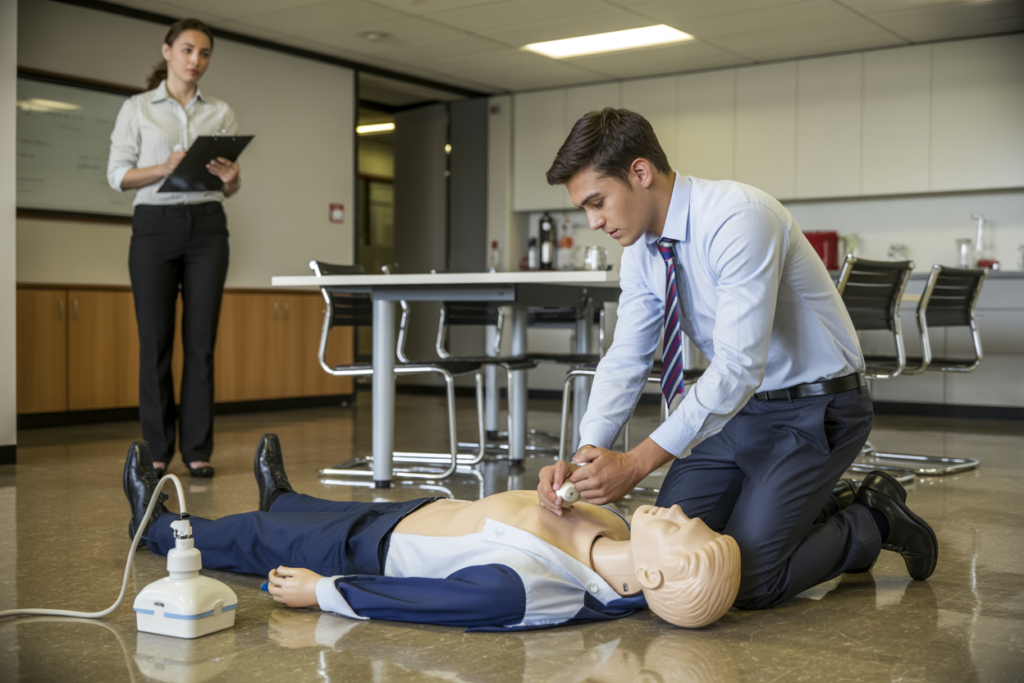
Let’s talk about the scenarios where BELS training actually makes a difference—not hypothetical textbook situations, but the kind of emergencies that happen in real life.
Workplace Emergency: The Break Room Scenario
You know that colleague who had a seizure? The one that keeps you up at night because you froze?
What happened (without training): Your colleague starts seizing. You freeze trying to remember what you’re supposed to do. Another person with first aid takes charge. You feel helpless and question whether you’re cut out for paramedic work.
What happens (with BELS training): Your colleague starts seizing. Your training kicks in immediately:
- Clear the area around them (move chairs, create space)
- Time the seizure duration on your phone
- Position them on their side once the active seizing stops
- Check their airway—they’re breathing but there’s some saliva pooling
- You know exactly where the suction equipment is and how to use it
- You’re monitoring their breathing and responsiveness while someone else calls 000
- When ambulance crews arrive, you provide a clear handover: “Witnessed tonic-clonic seizure, approximately 90 seconds duration, stopped on its own, patient now post-ictal, airway maintained, breathing adequate, no injuries from fall”
See the difference? You’re not a bystander hoping someone else handles it. You’re the person who handles it.
Family Emergency: Cardiac Symptoms
Someone close to you suddenly clutches their chest, goes pale, starts sweating.
With BELS training: You recognize cardiac emergency symptoms immediately. You stay calm because you’ve practiced this scenario. You help them into a comfortable position, send someone for aspirin while you call 000, and ask about medical history. You check their respiratory rate—it’s elevated. If you have oxygen equipment available, you set it up confidently and start oxygen therapy with a non-rebreather mask.
When ambulance crews arrive, you provide a professional handover: “58-year-old male, sudden onset central chest pain, rating 8/10, pain radiating to left arm, pale and diaphoretic, respiratory rate was 24 now 20, administered oxygen at 10 litres per minute via non-rebreather approximately 8 minutes ago, symptoms slightly improved, no known allergies, takes medication for high blood pressure.”
That’s exactly what paramedics need to know.
The Confidence Gap That Actually Matters
Here’s what BELS training really gives you: It’s not just the skills. It’s the confidence that comes from having practiced under realistic conditions with actual equipment.
When an emergency happens, you’re not thinking “What do I do?” You’re thinking “I’ve done this before.”
That confidence shows in paramedic interviews. It shows during graduate training. It shows in your first month on road when you’re nervous about everything but at least the oxygen equipment and airways feel familiar.
⏰ The Timeline Reality: If you're applying for recruitment in 3-6 months, you need BELS training booked this month. Certificates aren't instant—you need completion time, certificate processing, and time to practice before interviews.
Taking Action: Your Next Steps
You understand the difference between HLTAID011 and HLTAID010. You know why oxygen therapy and airway management matter. You’ve seen how BELS training translates to real emergencies and paramedic recruitment.
Now you’re thinking: “Should I book this now or wait until…”
Wait until what? Until you feel more ready? Until you have more time?
Here’s what “waiting” actually means:
- Your application lists HLTAID011 (same as hundreds of other applicants)
- You can’t discuss oxygen equipment or airway management in interviews
- You potentially miss recruitment windows
BELS training is how you become more ready.
Stop Researching, Start Moving
The difference between people who become paramedics and people who stay in admin roles isn’t talent or intelligence. It’s action.
Your competition is booking BELS courses this week. Some of them are building competitive advantages while you’re still deciding.
The Last Thing Worth Saying
That emergency that keeps you up at night happened because you weren’t prepared. You didn’t have the training. You didn’t have the confidence.
That’s not your fault. You can’t respond effectively to emergencies you haven’t been trained for.
But if it happens again and you still freeze—that’s choosing not to prepare when you know preparation is available.
You’re aiming for a career where people’s lives depend on your skills and confidence. BELS training is where that confidence starts.
Book the course. Do the work. Build the skills. Become the person who responds.
Book Your First Aid Training Now
Fast, affordable, and nationally accredited training delivered by professionals who care
Frequently Asked Questions
Q.Is HLTAID010 required for paramedic applications or just recommended?
Technically, most paramedic recruitment listings only require HLTAID011 (Provide First Aid) as the minimum qualification. However, HLTAID010 gives you a significant competitive advantage when you're competing against hundreds of other applicants. It demonstrates initiative, shows you understand paramedic equipment, and gives you practical talking points during interviews that candidates with only basic first aid simply can't match.
Q.How long does HLTAID010 certification stay valid?
HLTAID010 certification is valid for 12 months from the date of issue, compared to three years for standard HLTAID011. The shorter validity period reflects the fact that these are advanced clinical skills that need regular practice and refreshing to maintain competency. Most training providers offer shorter renewal courses that focus on skills refresh rather than starting from scratch.
Q.Can I do HLTAID010 online or does it need to be face-to-face?
HLTAID010 requires mandatory face-to-face practical training and assessment. While some providers offer online theory components you can complete beforehand, the hands-on skills with oxygen equipment, airways, BVM, and other medical devices must be demonstrated in person under instructor supervision. Be wary of any provider claiming to offer fully online BELS certification—it doesn't meet Australian training standards.
Q.Do I need HLTAID011 before I can do HLTAID010?
No, you don't need to complete HLTAID011 first. HLTAID010 includes all the content from standard first aid plus the advanced life support components, so you're getting both qualifications in one course. If you already have current HLTAID011, some providers might offer a shorter bridge course, but most people just do the full HLTAID010 which supersedes the basic first aid anyway.
Q.What's the difference between BELS and Advanced First Aid?
BELS (Basic Emergency Life Support - HLTAID010) focuses specifically on oxygen therapy, advanced airways, and equipment that paramedics use in the first few minutes of care. Advanced First Aid (HLTAID014) covers extended care scenarios, spinal management, advanced trauma, and managing casualties over longer periods before help arrives. For paramedic recruitment, BELS is more relevant because it teaches the specific equipment and procedures you'll use in ambulance work.
Q.Is HLTAID010 recognized in other Australian states?
Yes, HLTAID010 is a nationally recognized qualification across all Australian states and territories. It's part of the national training framework, so certification earned in Queensland is valid in Victoria, NSW, or anywhere else in Australia. However, some specific employers or services might have additional requirements or prefer certain training providers, so it's worth checking if you're planning to apply for roles in different states.
Making first aid training more affordable for
every classroom
We believe every student deserves access to life-saving first aid knowledge. That’s why we offer specially reduced pricing for schools and educational groups. Whether you’re booking for a single class, a year group, or your entire school, our flexible packages make training more accessible and cost-effective — without compromising quality.
