

You’re supporting an elderly client at home when they suddenly go quiet mid-meal. They’re clutching their throat. They can’t speak. What do you do in the next 30 seconds?
If you paused before answering that even for a second you’re not alone. Most care workers who’ve sat through basic emergency life support training will say they’d know what to do. But in that moment, when someone’s face is going red and they can’t make a sound, it’s a different story. Knowing the correct basic first aid choking treatment could be the difference between life and death, especially when you’re working alone with a vulnerable client.
This guide walks you through the exact steps recommended by the Australian Resuscitation Council (ARC/ANZCOR), written in plain language for aged care workers, disability support workers, and anyone who wants to be genuinely prepared, not just compliant on paper.
You’ll learn how to recognise a choking emergency, what to do for adults, children, and infants, when to call 000, and why hands-on training through HLTAID010 builds real confidence before an emergency happens.
Choking First Aid for Infants and Children
The steps for helping a choking adult are one thing. Infants and children are in a different situation entirely: different technique, different force, different positioning. Getting this wrong can cause serious harm, so it’s worth understanding the differences clearly.
Choking First Aid for Infants (Under 12 Months)
An infant who is choking cannot tell you what’s happening. You’re reading cues sudden silence during feeding, difficulty breathing, colour change, distress without an obvious cause.
If you suspect a severe obstruction in an infant:
- Call 000 immediately or have someone else call while you act.
- Position the infant face-down on your forearm with their head lower than their chest, supported firmly with your hand cradling their jaw. Do not let the head drop.
- Deliver 5 back blows using two fingers (not the heel of your hand) between the shoulder blades. Use firm pressure scaled to the size of the infant.
- Turn the infant face-up while keeping their head lower than their chest, positioning them along your other forearm.
- Deliver 5 chest thrusts using two fingers on the centre of the chest, just below the nipple line. Use chest thrusts, not abdominal thrusts.
- Check after each cycle and look in the mouth only if you can clearly see an object. If visible and easy to remove, do so. Do not perform blind finger sweeps.
- Alternate 5 back blows and 5 chest thrusts until the object clears or emergency services arrive.
⚠️ Important Safety Warning: Never hold an infant upside down by the ankles. This is an outdated technique that is no longer recommended and can cause serious injury. It has no place in current Australian first aid guidelines.
Choking First Aid for Children (1 Year and Older)
For children over 12 months, the approach mirrors the adult technique but with scaled force. A back blow for a five-year-old is not the same as a back blow for an adult. You’re using the same heel-of-hand technique, the same forward-leaning position, the same alternating sequence of back blows and chest thrusts. You’re just calibrating how hard you hit the size of the child in front of you.
Never use abdominal thrusts on children under 12 months. For children over 1, ARC/ANZCOR paediatric guidelines should be your reference point and hands-on training is the only way to actually build the feel for appropriate force across different age groups.
If your work involves children whether in a childcare, disability support, or family day care setting, childcare-specific first aid training including paediatric choking response through HLTAID012 goes into this in much greater depth.
Key Differences Between Adult and Paediatric Choking Response
Technique | Adult | Infant (under 12 months) |
Back blows | 5 heel of hand | 5 two fingers, face-down |
Chest thrusts | 5 heel of hand | 5 two fingers, face-up |
Abdominal thrusts | Not recommended (ARC) | Never |
Position | Leaning forward | Head lower than chest |
Force | Firm and deliberate | Gentle scaled to size |
Call 000 | Immediately if severe | Immediately if severe |
The underlying principle is the same across all ages back blows and chest thrusts, alternating, until the obstruction clears. What changes is how you hold them, how hard you act, and the tools you use to do it.
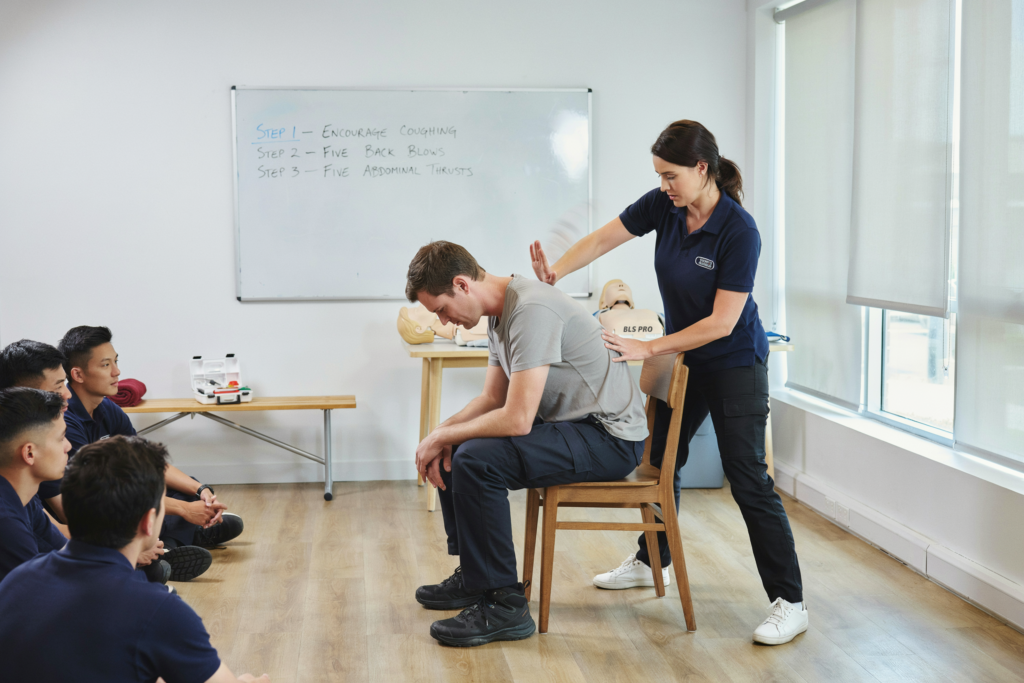
What to Do If You’re the One Choking
Most first aid training focuses on helping someone else. For care workers who sometimes eat alone between visits or work solo in a client’s home, it’s worth knowing what to do if you’re suddenly the one in trouble.
If coughing isn’t clearing the obstruction, thrust your upper abdomen against a hard edge like a chair back or bench corner to replicate the force of a back blow. Keep coughing as long as you physically can. The cough reflex generates more internal pressure than most external interventions.
If you can’t speak, call Triple Zero and stay on the line. QAS dispatchers are trained in silent call protocols and will send help even if you can’t make a sound. Tap the phone, make any noise you can, and don’t hang up.
Choking Risks in Aged Care and Disability Support Settings
If you work in aged care or disability support, choking is a real and present hazard in almost every shift. The clients you support are at significantly higher risk than the general population, and understanding why is part of doing your job well.
Why Aged Care Clients Are at Higher Choking Risk
There’s a combination of factors that make elderly and disabled clients more vulnerable to choking than the average person, and most of them are invisible to anyone who hasn’t worked in the sector.
- Dysphagia (difficulty swallowing) is extremely common in residential aged care. It can be caused by stroke, dementia, Parkinson's disease, head and neck cancer, or the natural weakening of swallowing muscles with age. Many clients have dysphagia that has not been formally assessed or documented.
- Reduced saliva production makes swallowing more difficult because saliva acts as a natural lubricant. Many medications commonly used in aged care can cause dry mouth as a side effect.
- Dental issues such as missing teeth, ill-fitting dentures, or pain when chewing can prevent food from being properly broken down before swallowing.
- Dementia can affect the neurological coordination required for swallowing, increase distraction during meals, and may lead clients to place non-food items in their mouths.
- Parkinson's disease can directly affect the swallowing mechanism due to tremors, muscle rigidity, and reduced muscle control.
- Medications that cause dry mouth including antihistamines, antidepressants, diuretics, and antipsychotics are commonly used in aged care and can significantly reduce saliva production.
Common Choking Hazards in Residential and Home Care Settings
Some of these will be immediately familiar if you’ve done mealtime assistance:
- Food that has not been modified to the correct texture can create a significant choking risk for clients with dysphagia who require texture-modified diets.
- Large tablets or capsules may be difficult to swallow whole and can become lodged in the throat or airway.
- Eating while reclined or in a poor postural position can increase the risk of food entering the airway instead of the oesophagus.
- Rushed meal assistance may not give the client enough time to chew and swallow safely between mouthfuls.
- Mixed-texture foods such as soup containing chunks are particularly difficult for people with swallowing difficulties because they require different swallowing actions for liquids and solids.
- Distractions during meals such as television, conversations, or activity in the room can reduce concentration on chewing and swallowing safely.
These are everyday realities in care settings, which is why choking is one of the leading causes of preventable death in residential aged care in Australia.
How to Reduce Choking Risk for Your Clients (Prevention Strategies)
The good news is that most choking incidents in care settings are preventable. The strategies aren’t complicated, they just require consistency.
- Modified texture diets should follow the IDDSI (International Dysphagia Diet Standardisation Initiative) framework, which provides a standardised system for categorising food and drink textures from regular through to liquidised. If a client has a texture prescription, follow it precisely, as even a single deviation can create significant risk.
- Upright positioning during meals is essential. Clients should be as upright as possible when eating and drinking, ideally at a 90-degree angle. Never assist with oral intake while a client is reclined.
- Appropriate pacing gives the client enough time to swallow safely. Offer one mouthful at a time and wait for a complete swallow before providing the next bite. Observe the swallow rather than assuming it has occurred.
- Supervision during meals is important for high-risk clients who should not eat unsupervised. If adequate mealtime supervision cannot be provided, this should be raised with the appropriate coordinator or supervisor.
- A calm mealtime environment helps minimise distractions. Keep meals focused, unhurried, and free from unnecessary interruptions to support safe chewing and swallowing.
💡 Pro Tip for Care Workers: If a client regularly coughs or chokes during meals, document it and escalate it to your supervisor or clinical lead. This is a swallowing assessment flag, not a normal mealtime behaviour. One incident might be nothing, but a pattern is a clinical concern.
When to Escalate to a Speech Pathologist or GP
This is where understanding your scope of practice matters.
Your job as a support or personal care worker is to observe, document, and escalate not to diagnose or independently manage swallowing disorders. If you notice any of the following, it needs to go up the chain:
- Repeated coughing or choking during meals across multiple shifts may indicate an underlying swallowing difficulty that requires assessment and review.
- A wet or gurgly voice after eating or drinking can be a sign that food or fluid is affecting the airway and should be reported promptly.
- Food or liquid coming back through the nose may indicate impaired swallowing function and requires further assessment.
- A client refusing food or expressing fear around eating may be experiencing swallowing difficulties, discomfort, or anxiety related to previous choking episodes.
- Unexplained weight loss in a client with known swallowing difficulties may indicate inadequate nutritional intake and should be investigated.
- Recurring chest infections may be a sign of aspiration pneumonia, a serious complication that can occur when dysphagia is not effectively managed.
A speech pathologist can conduct a formal swallowing assessment and prescribe appropriate texture modifications and positioning strategies. A GP can review medications that may be contributing to dry mouth or swallowing difficulties. Your role is to make sure the right people know what you’re seeing.
What Does HLTAID010 Teach You About Choking?
There’s a significant gap between reading about back blows and being able to deliver them correctly under pressure. That gap is what HLTAID010 closes.
Choking Response as a Core HLTAID010 Skill Unit
HLTAID010 Basic Emergency Life Support covers three core areas: DRSABCD, CPR, and foreign body airway obstruction, which is the clinical term for choking. It’s not a bonus topic or an optional add-on. It’s a core component of the qualification, assessed via practical demonstration.
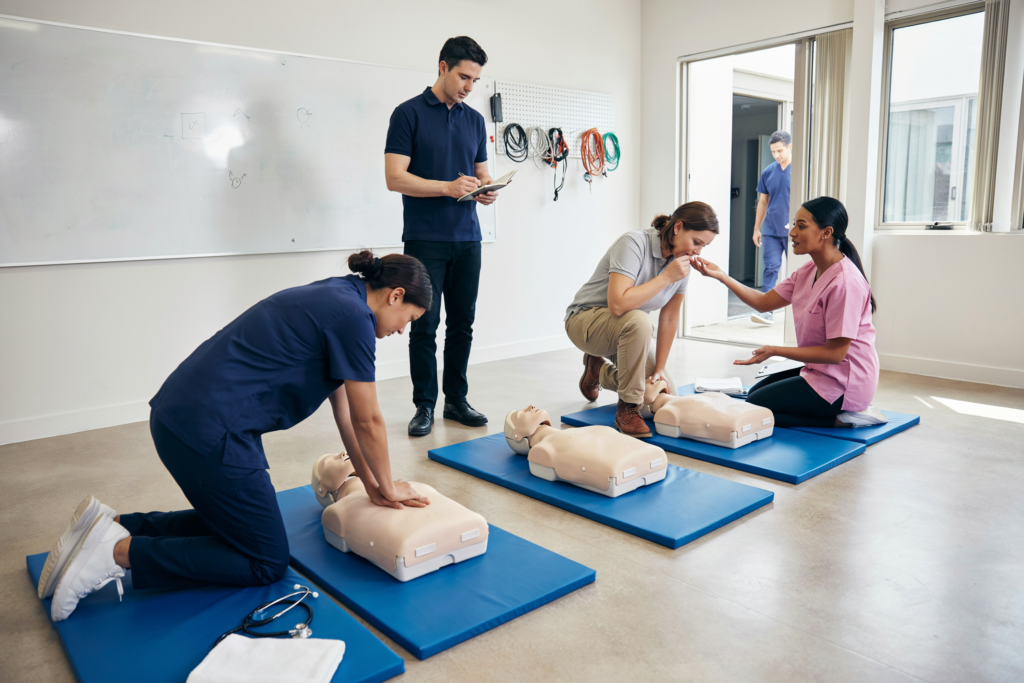
That means you don’t just watch a video about it. You practice the positioning, the back blow technique, the chest thrust sequence, the transition to CPR. You do it until your hands know what to do without thinking.
Why Hands-On Practice Makes the Difference
Muscle memory doesn’t come from a screen. The heel-of-hand position for a back blow, the force required to be effective without causing injury, the feel of correct chest thrust placement – these are physical skills. You build them through repetition with a qualified trainer, not by watching someone else do it on a video.
How HLTAID010 Prepares You for Real Emergencies in the Care Sector
A good trainer contextualises the skills for your actual working environment. That means:
- Understanding how choking presents differently in elderly clients and those living with dementia or dysphagia helps you recognise emergencies early and respond appropriately.
- Knowing when to call 000 and understanding what information to provide to emergency services ensures a faster and more effective response when every second matters.
- Understanding the connection between choking and CPR is critical because a choking incident can rapidly progress to unconsciousness, respiratory arrest, and cardiac arrest.
- Being the person on your team who doesn't freeze means having the confidence, knowledge, and practical skills to take action quickly during a choking emergency.
The course is assessed via practical demonstration against the nationally recognised unit of competency on training.gov.au. Completion through an ASQA-registered RTO means a Statement of Attainment your employer’s compliance team will accept.
HLTAID010 vs HLTAID011: Do You Need the Full First Aid Course?
This is one of the most common questions care workers ask before booking and it’s worth getting right, because booking the wrong course is a genuine risk.
HLTAID010 | HLTAID011 | |
Who it’s for | Aged care, NDIS, disability support workers | First aid officers, senior and team leader roles |
What it covers | DRSABCD, CPR, choking, AED basics | All HLTAID010 content plus anaphylaxis, wounds, fractures, burns |
Validity | 3 years (CPR component: annually) | 3 years (CPR component: annually) |
Accepted by | Aged care, NDIS, community services | All settings including higher-risk workplaces |
For most personal care workers, support workers, and community care aides, HLTAID010 is exactly what your employer requires. If you’re moving into a team leader role, a first aid officer position, or a higher-risk workplace, HLTAID011 is the one to look at.
First Aid Alive is an ASQA-registered RTO delivering nationally recognized training verified on training.gov.au and accepted by aged care providers and NDIS organizations across Queensland.
Are You Actually Ready for the Moment That Counts?
Reading a guide like this one puts you ahead of most people. You now know the difference between mild and severe choking, why the Heimlich manoeuvre has no place in Australian first aid anymore, how to help an adult, a child, and an infant, and why elderly clients in your care are at higher risk than almost anyone else you’ll encounter in daily life. That’s not nothing. That’s a real foundation.
But here’s the honest truth: knowledge sitting in your head, unattached to any physical experience, has a way of disappearing exactly when you need it most. The pressure of a real emergency does something to the brain. Time distorts. Hands shake. The confident mental walkthrough you did reading this article doesn’t always show up when someone in front of you can’t breathe.
That’s the version of prepared you want to be. Not the version that can describe the steps correctly when asked. The version whose body responds before the panic has a chance to set in. For the clients you support elderly, vulnerable, often unable to advocate for themselves in an emergency, that distinction is everything.
So if this article has left you feeling like you understand choking first aid better than you did an hour ago, that’s a good sign. The next step is turning that understanding into something you can actually rely on when it counts.
Book Your First Aid Training Now
Fast, affordable, and nationally accredited training delivered by professionals who care
Frequently Asked Questions About First Aid Choking
Q. What is the basic first aid treatment for choking?
The correct basic first aid choking treatment in Australia starts with assessing whether the obstruction is mild or severe. If the person can still cough, speak, or breathe, encourage coughing and monitor closely. If they can't cough, speak, or breathe, call 000 immediately, lean them forward, and deliver up to 5 firm back blows between the shoulder blades using the heel of your hand. If back blows don't clear the obstruction, follow with up to 5 chest thrusts and alternate until the object is dislodged or QAS arrives. If the person loses consciousness, lower them to the floor and commence CPR.
Q. Is the Heimlich manoeuvre used in Australia?
No. ARC/ANZCOR no longer recommends abdominal thrusts in Australia due to the risk of rib fractures and internal organ damage, particularly in elderly patients. Current Guideline 7 specifies back blows and chest thrusts as the correct response. If your previous training included the Heimlich manoeuvre, that training is out of date and an HLTAID010 renewal will bring you current with Australian guidelines.
Q. What do you do if an infant is choking?
Call 000 immediately, then position the infant face-down along your forearm with their head lower than their chest. Using two fingers, deliver up to 5 back blows between the shoulder blades, then turn them face-up and deliver up to 5 chest thrusts using two fingers on the centre of the chest just below the nipple line. Alternate until the object clears or QAS arrives. Never use abdominal thrusts on an infant and never hold them upside down by the ankles as that is an outdated and dangerous technique.
Q. Does HLTAID010 cover choking responses?
Yes. Choking response, clinically referred to as foreign body airway obstruction, is a core skill unit within HLTAID010 Basic Emergency Life Support and is assessed via practical demonstration. You physically practise the back blow technique, chest thrust sequence, and the transition to CPR, not just watch a demonstration. HLTAID010 is the nationally recognised unit of competency most aged care and NDIS support workers are required to hold, and completion through an ASQA-registered RTO produces a Statement of Attainment your employer will accept.
Q. When should you call 000 for a choking emergency?
Call Triple Zero (000) immediately if the person cannot cough, speak, or breathe. Don't wait to see if back blows clear the obstruction before calling. Put the phone on speaker so your hands are free to act, and stay on the line even if you can't speak. QAS dispatchers are trained in silent call protocols and will send help regardless. If you're working alone with a client and can't call, do what you can to attract attention while you act.
Making first aid training more affordable for
every classroom
We believe every student deserves access to life-saving first aid knowledge. That’s why we offer specially reduced pricing for schools and educational groups. Whether you’re booking for a single class, a year group, or your entire school, our flexible packages make training more accessible and cost-effective — without compromising quality.
