
You’ve just enrolled in a basic first aid course Australia training providers run every week, and now you’re lying awake wondering: what actually happens during the training? Will I be performing CPR on mannequins in front of strangers? What if I freeze during the practical assessment?
I get it. In my years teaching HLTAID011 courses, I’ve seen this exact anxiety hundreds of times. Last month, a young guy applying for paramedic roles told me he’d been watching CPR videos on YouTube at 3am for two weeks, convinced he’d mess up and prove he “wasn’t cut out for emergency work.”
Here’s what I told him: the course isn’t designed to test what you already know. It’s built to teach you skills from scratch, then give you enough practice that you actually feel confident using them.
This guide walks you through every component of a basic first aid course in Australia, from the moment you arrive to receiving your nationally recognized HLTAID011 certificate. You’ll discover what skills you’ll practice, how assessments work, and most importantly—how courses are structured to build your confidence, not expose your gaps.
What Does a Basic First Aid Course Cover in Australia?
A basic first aid course Australia training providers deliver covers essential emergency response skills across medical emergencies, injuries, and life-threatening situations. The nationally recognized HLTAID011 certification includes everything from cardiac arrest response to managing burns, fractures, and anaphylaxis.
Core Skills You’ll Learn:
| Skill Category | What You'll Practice | Why It Matters |
|---|---|---|
| CPR | Chest compressions on mannequins, correct hand position, depth (5-6cm), rate (100-120/min) | Most important life-saving skill you'll use |
| AED Use | Opening device, pad placement, following voice prompts, safety protocols | Devices are simple—they tell you what to do |
| Choking | Back blows, abdominal thrusts, unconscious choking response | Happens more often than you'd think |
| Bleeding Control | Direct pressure, pressure bandaging, tourniquet use | Prevents shock and saves lives |
| Burns & Fractures | Thermal/chemical/electrical burn treatment, immobilization, slings | Common workplace and home injuries |
| Medical Emergencies | Asthma, anaphylaxis (EpiPen), diabetic episodes, seizures, strokes, heart attacks | Recognition and immediate response |
| DRSABCD | Systematic emergency approach, calling 000, patient handover | Your framework when brain is panicking |
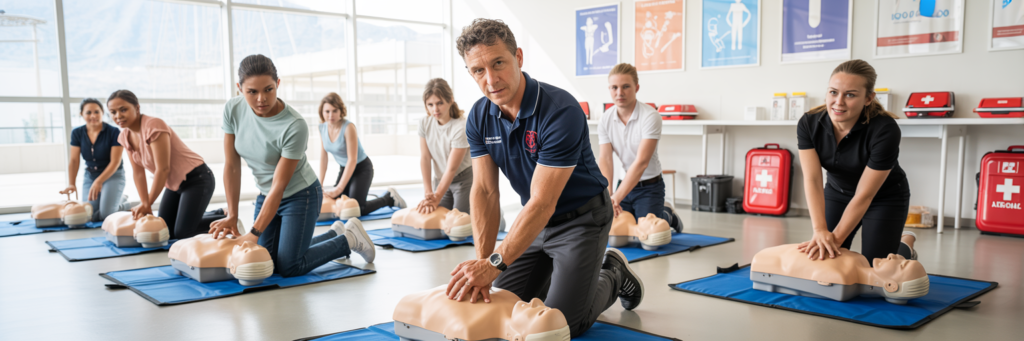
The course combines theory with hands-on practice. You’re not just watching PowerPoint slides—most of your time is spent practicing on mannequins, using real equipment, and working through scenarios like “your colleague collapses in the lunchroom.”
Here’s what relieves most anxiety: you practice each skill multiple times in a low-pressure environment before any assessment. By the time you demonstrate competency, you’ve already done the same technique several times that day.
Certification: HLTAID011 – Valid for 3 years (CPR component requires annual renewal)
Pass Rate: Around 98% on first attempt when students attend the full course
Understanding HLTAID011 Certification
HLTAID011 is Australia’s nationally recognized baseline for emergency response competency. The code breaks down as: HLT (Health training package), AID (First Aid category), 011 (the specific unit number). It replaced the old HLTFA311A qualification in 2016 when the Australian Resuscitation Council updated their guidelines.
Your certificate works Australia-wide—what you earn in one state is valid in every other state and territory. Over 180,000 Australians complete HLTAID011 annually, and it’s required for a significant percentage of job postings in healthcare, education, and trades sectors.
HLTAID011 vs Other Qualifications:
- HLTAID009 (Provide CPR) – CPR and AED only. This is the annual refresher, not full first aid.
- HLTAID011 (Provide First Aid) – Full first aid response. This is what most workplaces require.
- HLTAID010 (Basic Emergency Life Support) – Adds oxygen therapy and advanced airways for healthcare workers.
- HLTAID012 (First Aid in Education/Care) – Pediatric focus, mandatory for childcare workers.
If your workplace says “first aid certificate” without specifying which code, they almost certainly mean HLTAID011. When in doubt, ask your manager for the specific unit code—saves you booking the wrong course.
One thing that surprises people: HLTAID011 doesn’t expire like your driver’s license. Instead, it “lapses” for currency purposes. You still learned the skills, but workplaces want evidence you’ve refreshed that knowledge within the past 3 years. The CPR component needs annual renewal because resuscitation guidelines change more frequently.
What Happens During the Course
Most HLTAID011 courses follow a similar structure. Here’s what your training day looks like:
Pre-Course (1-2 Weeks Before)
You’ll receive pre-course learning materials—usually a PDF workbook or online modules. This isn’t optional. The pre-course reading covers terminology and foundational concepts so the actual course day can focus on hands-on practice. Most people spend around an hour on these materials. Do them the night before, not weeks early—information retention is better when it’s fresh.
Arrival & Welcome
You’ll arrive at the training venue, sign in, show your USI (Unique Student Identifier), and settle in. The instructor introduces themselves and explains the key thing that reduces anxiety: this course is designed to teach you skills from scratch, not test what you already know. The assessment checks for competency, not perfection.
DRSABCD & Scene Safety
The systematic approach to any emergency:
- Danger – Check for hazards before approaching
- Response – Check if the person is conscious
- Send for help – Call 000
- Airway – Open the airway using head-tilt-chin-lift
- Breathing – Check for normal breathing
- CPR – Start chest compressions if not breathing normally
- Defibrillation – Apply an AED as soon as available
You’ll practice this sequence multiple times until it becomes automatic.
CPR Training
This is the big one. You’ll spend substantial time on CPR because it’s the most important skill. The instructor demonstrates on a mannequin, then it’s your turn. Here’s what happens: the first compressions feel awkward, your arms start to ache, but eventually the rhythm clicks. Your body remembers the technique even when your brain is tired.
The mannequins provide feedback—most have clickers or lights showing whether you’re compressing deep enough. By the end of this block, you’ll have performed hundreds of compressions. Your arms will be tired, but you’ll have the muscle memory.
AED, Choking, and Other Skills
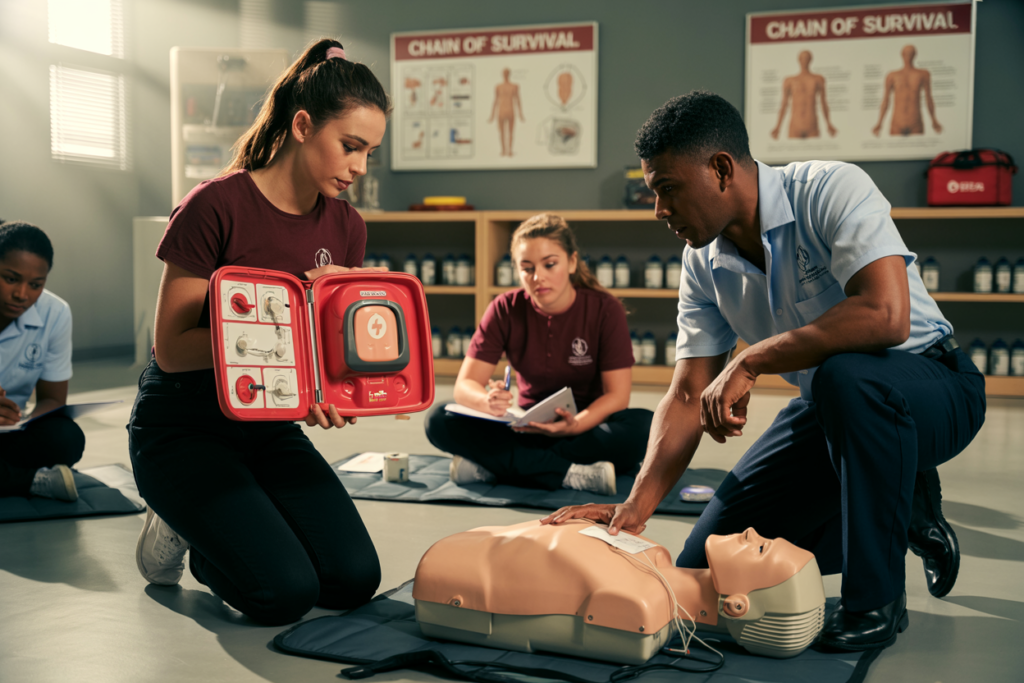
You’ll practice with training AEDs (surprisingly simple—they tell you exactly what to do). You’ll learn choking management on other students. After a break, the afternoon covers wound care, bleeding control, burns, fractures, and medical emergencies like asthma and anaphylaxis. You’ll practice with training EpiPens and apply slings to other students.
Scenario Practice
This is where everything clicks. The instructor sets up realistic scenarios and you work through them: “Your colleague collapses in the office kitchen. What do you do?” You’re not being assessed yet—this is practice time. The instructor watches and provides feedback. This practice is where anxiety melts away because you realize you can actually do this.
Assessment
The formal assessment comes next. You’ll demonstrate CPR with AED, or choking management, or bleeding control—usually scenarios similar to what you practiced. You don’t need to be perfect. If you make a minor mistake, the instructor will ask you to try again. They’re looking for competency, not flawless performance.
After the practical assessment, you’ll complete a short written knowledge check (usually multiple choice, open book). If you attended the course and paid attention, you’ll pass.
🚨 WARNING: Not all providers are legitimate. Some issue certificates that employers reject. The single most important check? Verify ASQA registration at asqa.gov.au before booking. No RTO number = invalid certificate = wasted money.
Choosing the Right Training Provider
Picking a provider isn’t as simple as googling “basic first aid course Australia” and booking the first result. The certification code might be the same, but training quality varies massively.
RTO Registration – Non-Negotiable
Before you even look at course dates, verify the provider is ASQA-registered. This is the single most important factor.
How to verify:
- Go to asqa.gov.au
- Search the provider’s business name or RTO number
- Confirm status is “Current”
- Check HLTAID011 is listed in their scope
Every legitimate provider displays their RTO number on their website. If you can’t find it, that’s a red flag. Unregistered providers issue certificates that employers reject. I’ve met people who paid for courses from unregistered providers, submitted the certificate to their employer, and got told “this isn’t valid.” They had to redo everything.
Red Flags to Avoid
🚩 “100% online first aid certification” – Impossible. HLTAID011 requires hands-on practical assessment.
🚩 No physical address listed – Legitimate providers tell you exactly where training occurs.
🚩 Vague or missing RTO number – “We work with a registered RTO” isn’t the same as being one.
🚩 No instructor qualifications listed – Ask about instructor backgrounds. The best come from emergency services or healthcare.
🚩 “Fast-track” promises – HLTAID011 has mandated content. Anyone offering shortcuts isn’t delivering proper training.
What to Look For
Qualified Instructors – The best instructors come from paramedic, nursing, or emergency services backgrounds. When you’re learning CPR from someone who’s performed it on actual cardiac arrests, the instruction has weight.
Small Class Sizes – Classes under 12-14 students mean everyone gets multiple practice attempts and individual feedback. Large classes mean you might only practice CPR a few times the entire day.
Quality Equipment – Modern CPR mannequins with feedback systems, multiple mannequins (not sharing one among many students), training AEDs, and clean equipment with disposable face shields.
Good Reviews – Look for specific praise about instructors and course structure across multiple platforms. Be wary of all perfect reviews posted in the same time period.
What to Bring & How to Prepare
Required Items:
- Photo ID (driver’s license, passport)
- USI (Unique Student Identifier – create free at usi.gov.au)
- Pre-course materials completed
- Comfortable clothing you can move in
Recommended:
- Water bottle
- Snacks (if you have dietary restrictions)
- Notebook and pen
What to Wear:
- Casual trousers or jeans (you’ll be kneeling a lot)
- T-shirt or casual shirt (you need to move your arms freely)
- Flat, comfortable shoes
- Avoid tight clothing, short skirts, high heels, or dangly jewelry
Think “going to the gym” not “going to the office.”
Pre-Course Anxiety:
Most people worry about failing, freezing during assessment, or being the least experienced person there. Reality check: 98% of students pass on first attempt. The course is designed to teach you, not trick you. Everyone in the room is learning from scratch—nobody’s judging your skill level.
If you show up, pay attention, practice when given opportunities, and ask questions when unsure, you will pass.
📜 CERTIFICATES: Digital certificates arrive within 1-2 days via email—this is your official certification. Physical wallet cards get posted within a week. Your qualification is also lodged to the national USI database permanently.

After Your Course
Certificate Delivery: You’ll receive a digital certificate via email within a day or two. This is your official certification—you can submit it to employers immediately. A physical wallet card gets posted within a week or so. Your certification also gets lodged to the national USI database, creating a permanent record.
Renewal Requirements:
Your HLTAID011 has two renewal timelines:
- CPR (HLTAID009) – Every 12 months – Skills degrade quickly without practice
- Full HLTAID011 – Every 3 years – Complete refresher covers all content
Set calendar reminders. Don’t wait until expiry—some employers require current certification at all times.
Using Your Skills:
The first time you respond to a real emergency will feel different than training. Real emergencies involve adrenaline, emotional load, and chaos. What actually helps? The DRSABCD framework you practiced repeatedly. When your conscious brain is panicking, the systematic approach kicks in.
When to Call 000:
Always call immediately for: cardiac arrest, severe difficulty breathing, severe bleeding that won’t stop, suspected spinal injury, chest pain, stroke symptoms, anaphylaxis, severe burns, unconsciousness, prolonged seizures, or poisoning.
Building Confidence:
Having a certificate doesn’t automatically mean you feel confident. That’s normal. Practice scenarios in your head, refresh CPR technique every few months on a pillow, review DRSABCD monthly, and take the annual CPR refresher seriously. The students who maintain competency years later are the ones who actively engage with the material.
What If You Freeze?
Even experienced healthcare workers sometimes freeze in unexpected emergencies. If you freeze briefly, that’s a normal human response to stress. Take one breath, say DRSABCD out loud to activate your training memory, and do the first step only. Don’t think about the entire emergency—just check for danger. Then the next step.
Australia has Good Samaritan laws protecting people who provide first aid in good faith. If you attempt to help and something goes wrong, you’re legally protected as long as you acted in good faith and within your level of training.
Final Thoughts
Your basic first aid course Australia training gives you genuine skills that could save someone’s life. The certificate isn’t just a compliance document—it represents competency in emergency response that most Australians don’t have.
But skills require maintenance. Set those renewal reminders now, practice periodically, and actually use your knowledge when minor injuries occur around you. The confidence to help in emergencies doesn’t come from the certificate—it comes from keeping those skills active.
Most people arrive at these courses anxious about failing or looking incompetent. By the end of training, you’re certified, exhausted, and genuinely more capable than you were at the start. That feeling of “I actually know what to do now” is what you trained for.
The 98% pass rate isn’t because the standard is low—it’s because the course teaches you exactly what you need to know and gives you multiple practice opportunities. Show up, pay attention, practice when given the chance, and ask questions when unsure. You’ve got this.
Book Your First Aid Training Now
Fast, affordable, and nationally accredited training delivered by professionals who care
Frequently Asked Questions
Q.What if I fail the assessment?
The 98% pass rate isn't because the standard is low—it's because the course genuinely teaches you what you need to know. If you don't demonstrate competency on first attempt (which is rare), the instructor provides additional coaching on that specific skill, you practice again, and reattempt assessment. Most providers don't charge extra for reassessment. You're not being tested on what you already know; you're being taught skills and then assessed on what you just learned.
Q.I'm worried I'll freeze during a real emergency. Does that mean the training failed?
Freezing briefly is a normal human response to sudden stress—even experienced healthcare workers freeze sometimes in unexpected situations. If it happens, take one breath, say "DRSABCD" out loud to activate your training memory, and do just the first step (check for danger). Don't think about the whole emergency—just one step at a time. The framework you practiced repeatedly will kick in. And remember: Australia's Good Samaritan laws protect you when you act in good faith.
Q.Do I need any medical background or previous first aid experience?
Absolutely not. The course is designed for people learning from scratch. I've trained 19-year-old retail workers alongside 60-year-old grandparents, office workers, tradies, and career changers. Nobody's judging your background. Everyone starts at the same level, and the instructor teaches every skill from the beginning. Your willingness to learn matters way more than your previous experience.
Q.My workplace says I need "current first aid." Does that mean HLTAID011?
Almost certainly yes. "First aid certificate" or "current first aid" typically means HLTAID011 (Provide First Aid), not just HLTAID009 (CPR only). When in doubt, ask your HR department for the specific unit code they require. Some workplaces need HLTAID012 if you work with children, or HLTAID010 if you're in healthcare roles. Get the exact requirement before booking.
Q.What happens if my certificate expires?
Your certificate doesn't become "invalid" the day it expires—you still learned the skills. But employers won't accept expired certificates, you can't work as a workplace first aid officer, and regulatory bodies reject them. The CPR component expires annually, the full HLTAID011 expires after 3 years. If it's expired, you need to complete the full course again—there's no quick catch-up option.
Q.Can I use my HLTAID011 in other states if I move?
Yes. HLTAID011 is nationally recognized across all Australian states and territories. A certificate earned in Queensland works in Western Australia, Victoria, Tasmania—everywhere. This is one of the advantages of the national training package system. Your USI follows you too, so your qualifications are permanently on record no matter where you move.
Q.How do I know if a provider is legitimate?
Check one thing: their RTO (Registered Training Organization) registration. Go to asqa.gov.au, search their business name or RTO number, confirm the status is "Current" and HLTAID011 is in their scope. Every legitimate provider displays their RTO number on their website (usually in the footer). If you can't find it or they're evasive about it, walk away. Unregistered providers issue worthless certificates that employers reject.
Making first aid training more affordable for
every classroom
We believe every student deserves access to life-saving first aid knowledge. That’s why we offer specially reduced pricing for schools and educational groups. Whether you’re booking for a single class, a year group, or your entire school, our flexible packages make training more accessible and cost-effective — without compromising quality.
