
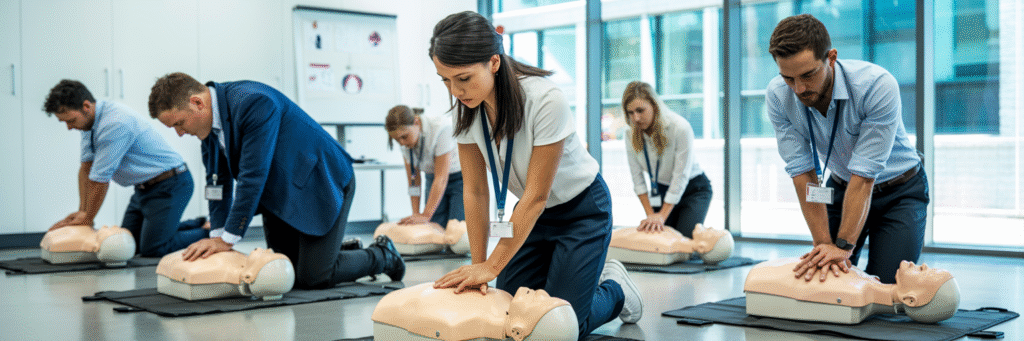
Here’s something I hear about 15 times a week: “I need to get my CPR done, but I’ve got literally zero time. What’s faster—this blended thing or just doing it the old way?”
If you’re reading this at 11pm on a Sunday because your CPR certificate expires next week, you’re not alone. About 70% of Brisbane professionals are juggling work, kids, and life, trying to figure out which CPR format won’t completely destroy their already chaotic schedule.
Whether you’re a personal trainer who can’t afford to miss client sessions, a teacher aide who needs to squeeze training into school holidays, or a parent trying to find 5 hours somewhere between soccer practice and grocery shopping, this article breaks down the real time commitment and which format gets you certified faster.
By the end, you’ll know exactly which option works for your life. Let’s get into it.
What Is a Blended CPR Class?
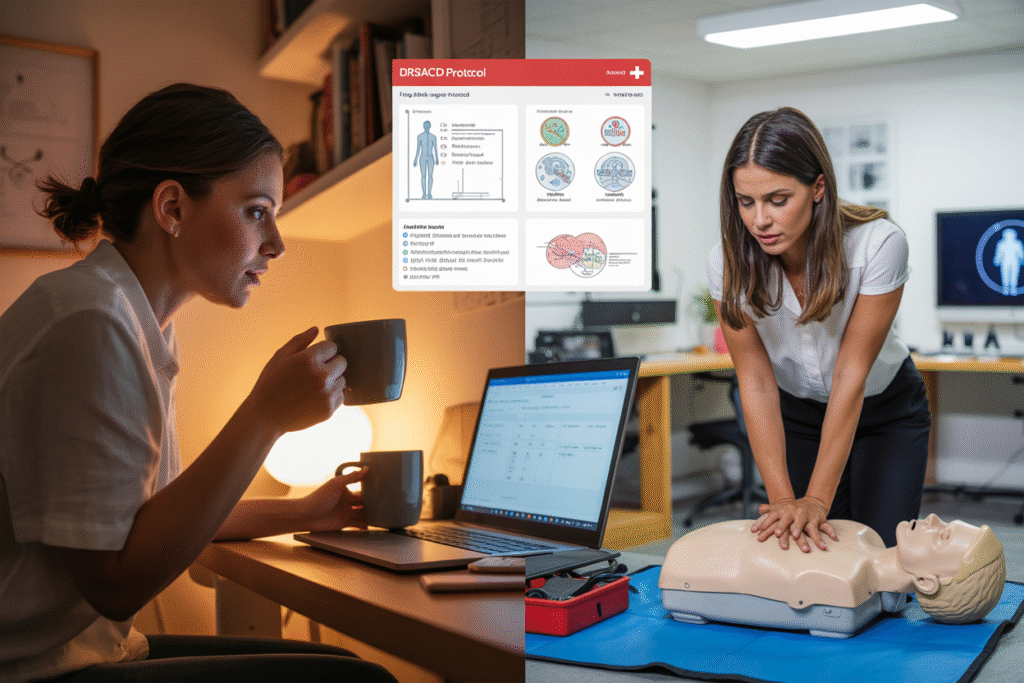
A blended CPR class combines online learning with face-to-face practical training. Instead of spending 4-8 hours in a classroom, you split it into two parts: theory online and hands-on practice in person.
Here’s the breakdown. You start with the online component—about 2-3 hours of self-paced learning covering the DRSABCD protocol, compression techniques, and AED use. You do this on your own time, from anywhere with internet access.
Then you book a practical session—another 2-3 hours where you practice CPR on manikins, use an AED, and get assessed by a qualified instructor.
The big advantage? You’re cutting your in-person time by about 50% compared to traditional training. Instead of blocking out a full day, you only need 2-3 hours away from work or family for the practical.
And yes—you get the exact same nationally recognized certificate (HLTAID009 or HLTAID011) as traditional training. There’s no difference on the certificate. Your employer can’t tell which format you did.
How Blended CPR Classes Work (Step-by-Step Breakdown)
Alright, let’s walk through exactly what happens when you book a blended CPR course. No surprises, no hidden steps—just the straight-up process from start to finish.
Step 1: Complete Online Theory Component
Once enrolled, you get login details to access the learning portal. You can jump in from your laptop, tablet, or phone (though laptop’s easier for videos).
You’ll work through modules covering DRSABCD, compression techniques, AED use, and emergency scenarios. This takes most people 1-2 hours, but you can pause and come back whenever. Got 20 minutes at lunch? Smash out a module. Can’t sleep at 11pm? Do another one.
The online component stays valid for 30-90 days depending on which RTO you book with.
Step 2: Pass Online Knowledge Assessments
Throughout the online modules, you’ll hit some multiple choice assessments. Nothing crazy—just checking you’ve actually absorbed the key stuff. If you fail one, no drama. You get unlimited retakes and about 95% of people pass first go.
You’ve gotta pass these before you can book your practical session though, so don’t just click through without paying attention.
Step 3: Book Practical Session
Once you’ve finished the online bit, you pick a date and time for your hands-on session. Most Brisbane RTOs run practicals 6 days a week across multiple locations—Chermside, CBD, Carindale, wherever’s convenient.
Class sizes are smaller than traditional—usually 8-12 people instead of 15-20, which means more manikin time and less waiting.
Step 4: Attend Hands-On Practical
This is the 2-3 hour in-person session. Your instructor does a quick theory recap (15 minutes max), then you’re straight into practicing CPR on adult, child, and infant manikins, plus AED practice.
After practicing, you do the practical assessment. It’s not stressful—they just need to see you can do compressions properly and follow the protocol. You get immediate feedback, so if something’s not quite right, they’ll correct you on the spot.
Step 5: Receive Certificate Same Day
Pass the assessment and you walk out with your certificate—digital version emailed straight away, physical copy posted or handed to you depending on the RTO.
Your certificate shows HLTAID009 or HLTAID011, valid for 12 months. There’s no “blended” notation on it. Nobody can tell you didn’t do traditional training.
⚠️ IMPORTANT: You must complete the online component BEFORE you attend the practical session. If you rock up without finishing the online bit, they'll send you home and you'll forfeit your booking.
How Traditional CPR Classes Work
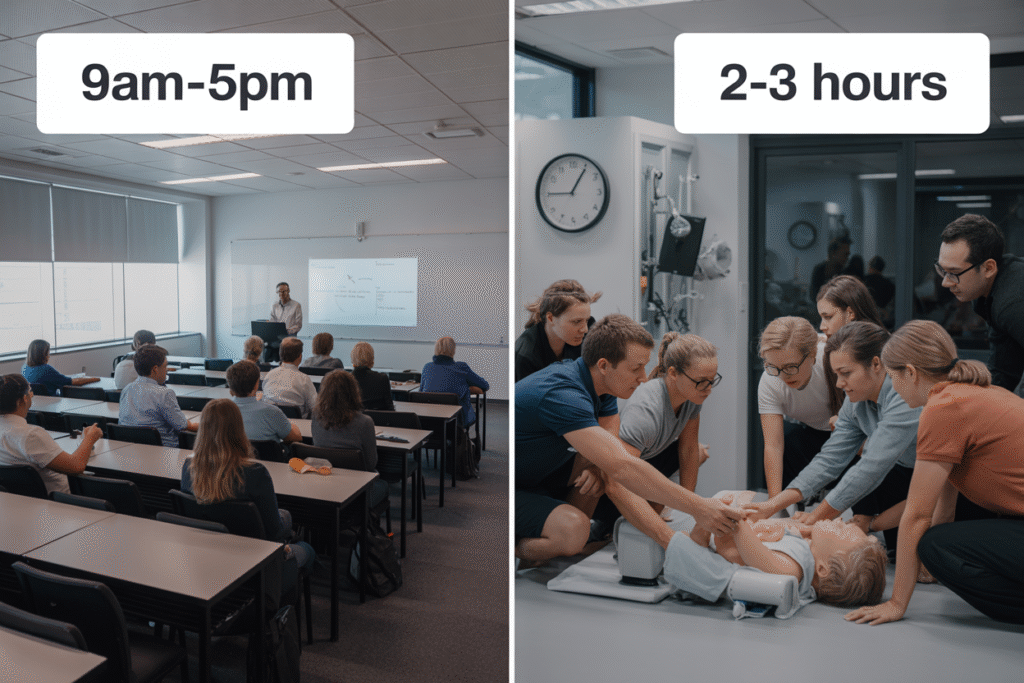
Traditional CPR training is the “old school” way—everything happens in one session, usually 4-6 hours for a basic CPR course (HLTAID009) or 6-8 hours if you’re doing the full first aid combo (HLTAID011).
You rock up to the venue, sit down with 15-20 other people, and the instructor takes you through all the theory face-to-face. They’ll cover the same stuff as the blended online component—DRSABCD, compression techniques, AED use, choking, bleeding, all of it—but you’re sitting there listening to them explain it instead of watching videos at home.
Once the theory’s done, you transition straight into the practical bit. Same deal as blended—you practice on manikins, use the AED, get assessed, and if you pass, you walk out certified that same day.
The big difference? No homework, no pre-work, no logging into online portals. You show up, do everything in one hit, and you’re done. Your certificate gets issued on the spot (or emailed within 24 hours), and you don’t have to think about it again for 12 months.
Class sizes are usually bigger—15-20 people is pretty standard—which means a bit more waiting for your turn on the manikins, but you’re getting the exact same certification as blended training.
Blended CPR Classes: Pros and Cons
Let’s break down the actual advantages and disadvantages of blended training—not the marketing fluff, but the real stuff you’ll experience.
ADVANTAGES:
✅ Flexibility for busy schedules
You can knock out the theory whenever you’ve got a spare hour. Lunch break at work, after the kids go to bed, Sunday morning with a coffee—doesn’t matter. You’re not locked into a specific day and time for the whole course.
✅ Learn theory at your own pace
If you need to rewatch a video three times because you keep forgetting the compression rate, go for it. You can take extra time on assessments, pause when you need to think, and there’s zero pressure from an instructor or other students.
✅ Shorter practical session
Approximately 2 hours in person vs 4-6 hours is a massive difference when you’re trying to fit training around shift work or parenting. Less fatigue, more focused hands-on time, and you’re not mentally checked out by the end.
✅ Better for introverts
If the thought of sitting in a classroom with 20 strangers while an instructor puts you on the spot makes you anxious, blended’s your friend. You process all the theory privately, arrive at the practical already prepared, and spend way less time in the group environment.
✅ Better retention
There’s actual research backing this—spaced learning (theory one day, practical another day) improves memory retention compared to cramming everything into one marathon session. You’ve got more time to absorb the theory before you have to demonstrate it.
✅ Cost-effective for employers
If you’re managing a team, blended means less workplace disruption. Your staff can do the online bit during quiet periods, and you only need to cover them for approximately 2 hours instead of a full day.
DISADVANTAGES:
❌ Requires self-discipline
Nobody’s chasing you to finish the online component. If you’re a procrastinator, you’ll book the course with good intentions and then suddenly it’s 2am the night before your practical and you haven’t started the theory. Not ideal.
❌ Two separate commitments
You’ve gotta schedule two things instead of one—the online completion AND the practical session. That’s double the travel time, and if you don’t finish the online part before your practical, you forfeit the booking. Some people find this more hassle than just doing everything in one hit.
❌ Technology requirements
You need reliable internet, a computer or tablet (phone’s technically possible but annoying), and basic digital literacy. If you’re not comfortable navigating online learning platforms, this can be frustrating.
❌ Limited immediate clarification
Got a question about something in the online module? You can email or call the RTO, but you’re not getting instant answers like you would with an instructor standing in front of you. There’s a risk of misunderstanding something without that live clarification.
❌ Not ideal for everyone
If you’re a hands-on learner who struggles with video-based theory, blended can feel disconnected. Some people genuinely prefer the structure of “sit down, learn everything together, leave certified”—and that’s totally fine.
💡 Blended works best for: Self-motivated learners who need flexibility and can manage their own deadlines.
Traditional CPR Classes: Pros and Cons
Now let’s look at what traditional training gets right—and where it falls short.
ADVANTAGES:
✅ Everything done in one day
No homework, no logging into portals, no remembering to finish online modules. You walk in knowing nothing, walk out certified. There’s something satisfying about ticking the whole thing off your list in one go.
✅ Immediate instructor support
Question pops into your head during the theory? Ask right there and then. Instructor can adapt their explanation if the whole class is confused about something. That real-time clarification is gold for some learners.
✅ No technology barriers
Don’t have a computer? Internet’s dodgy? Not comfortable with online learning? None of that matters with traditional training. Everything happens face-to-face with physical materials.
✅ Structured learning environment
There’s no risk of procrastination when you’re sitting in a scheduled class. The fixed schedule forces you to focus—you can’t get distracted by Netflix or “just quickly checking” your emails. Some people need that external structure.
✅ Social learning benefits
You practice with classmates, learn from other people’s questions, and there’s a bit of camaraderie in doing it together. If you work in the same industry (like aged care or fitness), you might even do some networking.
DISADVANTAGES:
❌ Requires larger time block
Blocking out 4-8 hours is tough if you’re a shift worker, parent, or running your own business. You need to take half a day or full day off work, arrange childcare, cancel clients—it’s a bigger logistical puzzle.
❌ Less flexibility
The course runs at a specific time on a specific day. Can’t pause beyond scheduled breaks, can’t come back tomorrow if you’re not feeling it. Miss the session and you’re rescheduling everything.
❌ Slower pace for fast learners
The instructor has to pace the class for everyone, including the slowest learner. If you already know most of the theory (like if you’re renewing), sitting through stuff you already understand gets boring fast. You can’t skip ahead.
❌ Larger class sizes
15-20 participants means less individual attention and more waiting around for your turn on the manikins. If you’re shy about asking questions, it’s easier to just stay quiet and miss important clarifications.
❌ One-shot learning
Theory gets delivered once and that’s it. No rewind button if you zoned out during the AED section. By hour 6, you’re tired and retention drops. You can’t go back and review.
📌 Traditional works best if: You can block out a full morning or afternoon, want everything done in one session, and prefer face-to-face learning.
Which CPR Format Is Right for You?
Choose Blended CPR If:
You’re a personal trainer who can’t lose a full day of client sessions. Do the online theory between clients, smash out the practical on a Sunday.
You’re a shift worker with unpredictable hours. Do theory at 2am when you can’t sleep, book a practical whenever you’ve got a day off.
You’re a parent juggling school activities. Squeeze online modules into gaps, book the practical when someone can watch the kids for 3 hours.
You’re renewing and don’t need a full theory refresher. Blast through the online component in under 2 hours.
Choose Traditional CPR If:
You can easily block out a Saturday morning or weekday afternoon. Traditional is simpler—one session, done.
You’re not confident with online learning. Showing up to a classroom is easier than navigating a learning portal.
You want instant answers to questions. Having an instructor there to clarify things is worth the longer session.
You’re booking for a whole workplace team. One session is easier than coordinating multiple individual bookings.
Final Verdict: Which CPR Training Format Wins?
There isn’t a universal winner—it genuinely depends on your circumstances and learning style.
Blended wins for:
- Time-poor professionals who can’t spare a full day
- Self-motivated online learners who don’t need hand-holding
- People with fragmented free time (lunch breaks, evenings)
- Anyone who prefers learning at their own pace
- People who need evening or weekend practical sessions
Traditional wins for:
- People who want one-session completion
- Anyone who prefers immediate instructor support
- People uncomfortable with technology
- Anyone who can block half a day easily
- People who thrive in structured classroom environments
Don’t overthink this decision. Both work equally well for teaching life-saving skills. The best CPR training is the one you’ll actually complete—so pick whichever format removes the most barriers for you personally.
Wrapping This Up: Get Certified and Stop Stressing
Both blended and traditional CPR training give you the exact same certification, follow the same Australian standards, and teach you the same life-saving skills. There’s no quality difference, no employer preference—just two different approaches that get you to the same outcome.
Your certificate looks identical regardless of which method you pick. What matters: the RTO’s accredited (check training.gov.au), the course fits your schedule, and you complete it before your certificate expires.
Don’t let decision paralysis stop you from booking. Pick the format that removes the most barriers—whether that’s time, technology, or learning style—and just book it.
Your workplace, colleagues, and family depend on you being CPR-ready. Get certified, stay compliant, and stop stressing about which format’s “better.”
Bottom Line:
Both formats deliver identical certificates. Your employer doesn't care which one you chose. What actually matters: the RTO's properly accredited, the course fits your schedule, and you complete it before your certificate expires.
Book Your First Aid Training Now
Fast, affordable, and nationally accredited training delivered by professionals who care
Frequently Asked Questions About Blended CPR Classes
Q.Is a blended CPR certificate the same as traditional?
Yes. Identical. Your certificate doesn't say "blended" or "traditional" anywhere on it. Employers can't tell which format you did and they don't care. Both teach the same content, follow the same Australian Resuscitation Council guidelines, and assess you on the same practical skills.
Q.What if I fail the online assessment?
You get unlimited retakes. Most RTOs let you review the material and try again as many times as needed. The pass rate's around 95%—these aren't trick questions. If you're struggling, slow down and actually watch the videos instead of skipping through.
Q.Can I do my CPR certification entirely online?
No. ASQA requires face-to-face practical assessment for all CPR courses. You physically have to demonstrate CPR on a manikin in front of a qualified assessor. "Fully online CPR courses" are scams—those certificates won't be accepted by employers.
Q.What equipment do I need for the online component?
Computer, laptop, or tablet (phone works but it's annoying), reliable internet, and an updated browser. You'll need speakers or headphones for videos. No webcam required. Set aside 30-60 minute blocks where you won't get interrupted.
Making first aid training more affordable for
every classroom
We believe every student deserves access to life-saving first aid knowledge. That’s why we offer specially reduced pricing for schools and educational groups. Whether you’re booking for a single class, a year group, or your entire school, our flexible packages make training more accessible and cost-effective — without compromising quality.
