

Traditional first aid courses eat up a full day sitting in a training room. Blended first aid training cuts that in-person time in half by shifting the theory online—giving you back hours that you actually need for, you know, everything else in your life.
Here’s how it works: you complete the theory modules online whenever it suits you (lunch breaks, Sunday morning on the couch, late at night after the kids are asleep), then you show up for a shortened practical session where you actually practice the hands-on stuff. Same HLTAID011 Provide First Aid certificate at the end, just way less time sitting in a classroom listening to lectures.
Look, we get it. You’re busy. Taking a full day off work or sacrificing your only day off for training feels like a big ask. That’s exactly why blended learning exists – it respects the fact that you can read about CPR theory on your phone during your commute, but you can’t exactly practice chest compressions on a mannequin while sitting on the bus.
This guide breaks down everything you need to know about blended first aid training – how it actually works, whether employers accept it (spoiler: they do), and whether it’s the right fit for your situation.
💡 Quick Answer: Blended first aid training combines online theory (study at home on your schedule) with a shorter in-person practical session (hands-on practice and assessment). You get the same HLTAID011 certificate as traditional courses, just with way more flexibility and less time away from work or home.
What Is Blended First Aid Training?
Blended first aid training is basically a mix of online study and in-person practical work. You do the theory part online at your own pace – all the stuff about emergency response, CPR knowledge, how to treat different injuries – then you rock up for a shorter face-to-face session where you actually practice the physical skills and get assessed.
Here’s what you get with blended learning:
Online theory: Work through the HLTAID011 course content from home – wound care, medical emergencies, safety protocols, all that stuff. It’s self-paced, so you can do it in one sitting or spread it across a week of lunch breaks.
In-person practical: This is where you practice CPR on mannequins, learn bandaging techniques, and do your assessment with an actual instructor. They’re checking that you can physically do the skills, not just that you know about them.
Same certification: You walk away with the exact same nationally recognized HLTAID011 Provide First Aid certificate. Your employer can’t tell the difference between someone who did blended learning and someone who sat through a traditional full-day course.
Flexible scheduling: Study the theory whenever works for you, then book your practical session around your actual availability instead of having to clear an entire day.
The whole approach cuts your in-person training time significantly while meeting the same Australian qualification standards that employers require.

How Blended First Aid Training Works
Alright, let’s break down what actually happens when you sign up for blended first aid training. It’s pretty straightforward – three steps, and you’re done.
Step 1 – Complete Online Theory Modules
After you enroll, you’ll get login details for the online platform. It works on whatever device you’ve got – laptop, tablet, phone, doesn’t matter. Some people smash through it all in one go on a Saturday morning. Others chip away at it during lunch breaks over a week. Both work fine.
The platform’s got all your HLTAID011 theory content broken into chunks:
- DRSABCD & Emergency Response – The basic action plan for any emergency situation
- CPR Theory for Adults, Children & Infants – Compression rates, techniques for different ages, when to stop
- Wounds, Bleeding & Burns – Pressure bandages, burn treatment, serious bleeding control
- Fractures & Soft Tissue Injuries – Immobilization, splinting, strains vs sprains
- Medical Emergencies – Recognizing heart attacks, strokes, anaphylaxis, what to do for each
- Legal Considerations & Workplace Compliance – Your duty of care, Good Samaritan laws, documentation
Each module’s got video demonstrations, interactive scenarios where you make decisions, and knowledge checks to make sure you’re getting it. You can pause whenever you want, rewind if something didn’t click, watch demonstrations multiple times – whatever you need.
At the end, there’s an online assessment. You need 80% to pass, but don’t stress about it – you can retake it as many times as you need until you’re comfortable. The questions are straightforward: “What’s the first step in DRSABCD?” “How deep should chest compressions be for an adult?” Stuff you’ve just learned.
Step 2 – Book Your Practical Training Session
Once you’ve knocked out the online modules (or when you first enroll if you want to lock in a date), you book your practical session. Most providers offer multiple locations and various times throughout the week – weekdays, weekends, morning and afternoon options.
The practical session’s significantly shorter than traditional courses because you’ve already done the theory. You’re not sitting through PowerPoint presentations about the circulatory system – you’re jumping straight into actually doing the skills.
Step 3 – Attend Hands-On Training & Assessment
On your practical day, show up wearing comfortable clothes you can kneel in. You’ll be on the floor practicing CPR, so maybe skip the tight jeans.
The instructor does a fast review of the key concepts from the online modules and answers any questions. They’re not re-teaching everything – they’re assuming you’ve already learned it.
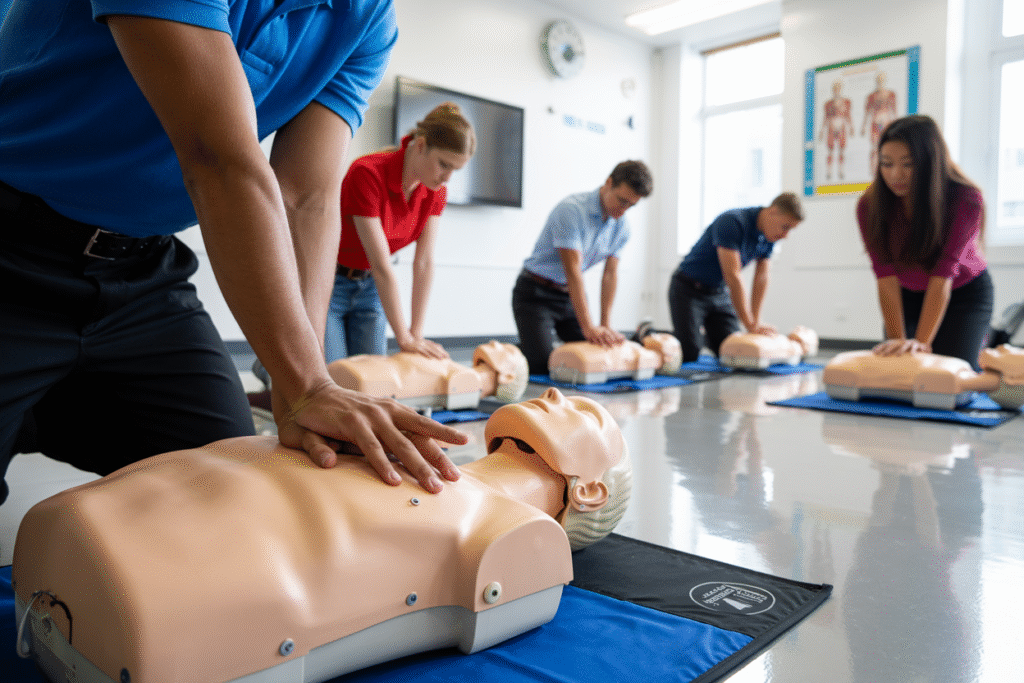
Then you’re getting hands-on, practicing on professional training mannequins:
- Adult CPR – Getting your hand position right, compression depth, keeping the right rhythm
- Child CPR – Adjusting your technique for smaller bodies
- Infant CPR – Two-finger technique, being way more gentle
- Using an AED – The defibrillator basically talks you through what to do
Your instructor works with you one-on-one, fixing your hand position, making sure you’re pushing hard enough, correcting your rhythm. You’ll do CPR over and over – by the end of it, your arms might be a bit tired, but the movements feel automatic.
You’ll also practice bandaging and first aid techniques:
- Deep cuts and serious bleeding – Applying pressure bandages, elevating limbs
- Burns – Cool running water, proper covering techniques
- Fractures and sprains – Immobilization techniques, making slings
- Snake bites – Pressure immobilization technique specific to Australia
The instructor gives you scenarios: “This person’s got a deep cut on their forearm that’s bleeding heavily – show me what you’d do.” You talk through your thinking while demonstrating the technique.
Then comes the individual assessment with your instructor. You’ll demonstrate CPR with proper technique, correct bandaging for injury scenarios, and recognition of medical emergencies. 98% of students pass first go. If your technique needs tweaking, the instructor gives you more practice time right there.
Done. Your digital certificate gets emailed within hours. Physical card arrives in the mail within days.
Benefits of Blended First Aid Training
Fits Around Your Actual Schedule
Traditional courses demand a full day on a fixed date. If they’re running Tuesday but you work Tuesdays, you’re burning a day off or waiting for the next available session.
Blended learning splits the commitment. Complete theory modules whenever suits you—Sunday night, early mornings, lunch breaks across multiple days. The content’s always available.
The practical session is only half the time. A Saturday morning instead of the entire day. A few hours instead of your whole day off. You keep your afternoon free.
Less Time Sitting in Lectures
Traditional courses involve hours of sitting through slides about the circulatory system, infection control procedures, legal considerations. Essential information, but not engaging.
With blended learning, you work through theory online at your own pace. Content that makes sense? Move through quickly. Confusing sections? Reread, rewatch videos, take notes until it clicks.
Your in-person session is all action—practicing CPR, wrapping bandages, working through scenarios. No lengthy lectures, just hands-on skill development.
Learn at Your Own Speed
Traditional courses pitch to the middle. Fast learners wait around; slower learners get left behind.
Online modules adapt to you. Grasp concepts quickly? Move ahead. Need extra time on CPR theory? Review videos and diagrams as many times as necessary. No one’s waiting or rushing you.
Review Content Anytime
Miss something during a traditional lecture? You’ve lost it unless you ask for re-explanation.
Online content stays accessible. Someone gets burned at work three months later? Log back in and refresh your knowledge on burn treatment. Most providers give extended platform access post-completion for ongoing reference.
Better for Anxious Learners
Practicing CPR for the first time in front of a group is intimidating for many people.
Blended learning means you arrive at the practical session already understanding the theory. You know what you’re doing—you just need physical practice. That’s far less stressful than walking in completely unprepared.
Shorter, skills-focused sessions mean less time sitting anxiously in a group. You stay busy and active rather than stuck in your head worrying.
Is Blended First Aid Training Nationally Recognized?
Short answer: Yes. Blended first aid training is fully recognized across Australia and meets identical compliance standards to traditional courses.
It’s the Same Qualification
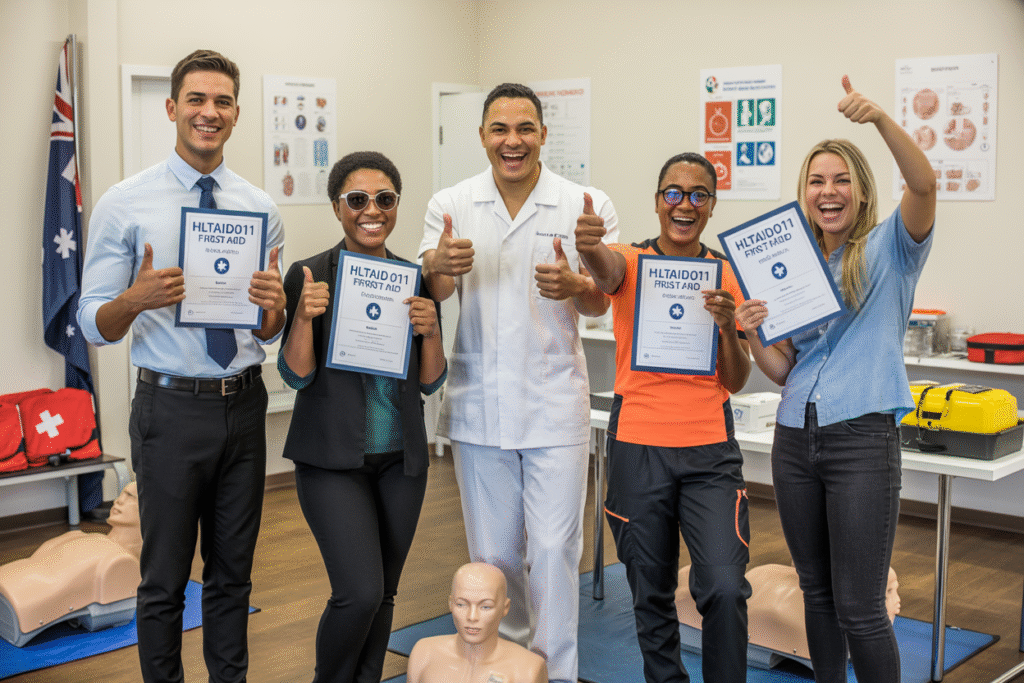
You receive an HLTAID011 Provide First Aid certificate—the exact same nationally recognized qualification as traditional courses. There’s no “online” or “blended” designation. Your certificate is identical in format and cannot be distinguished from one earned through full-day classroom training.
Employer Acceptance
Employers care about one thing: a current, valid HLTAID011 certificate from a registered provider. The delivery method is irrelevant.
Accepted by retail, Fitness Australia, childcare services, hospitality, offices—any industry requiring first aid compliance. Your certificate proves you’ve met requirements and passed assessment, regardless of how you learned the theory.
Same Standards
All Australian first aid training follows Australian Skills Quality Authority (ASQA) standards. The HLTAID011 unit specifies what you must know and demonstrate, not how theory is delivered.
Both formats cover identical content, practical skills, and assessment standards. Only the theory delivery method differs—and that’s not part of compliance requirements.
Provider Legitimacy
Your provider must be an ASQA-registered RTO (Registered Training Organization). This registration means they’ve been audited and approved to deliver HLTAID011 in blended format. Always verify the RTO number is displayed on their website before enrolling.
Blended vs Traditional First Aid Training
Let’s actually compare these two formats side by side. Because they’re both legit options and both get you certified – it’s more about which one fits your situation better.
The Basic Breakdown
Traditional First Aid Course:
- Full day, all in one session
- Everything happens face-to-face with an instructor
- Theory lectures + hands-on practice + assessment all together
- You show up knowing nothing, leave knowing everything
- Need to block out an entire day
Blended First Aid Course:
- Online theory on your schedule + shorter in-person practical
- Theory at home, practical with an instructor
- Total time is similar, but split across different days
- You show up already knowing the theory
- Only need to block out half a day
Learning Style Fit
Some people learn better in different environments. Neither format is objectively “better” – it depends on how your brain works.
You might prefer traditional if you:
- Learn better with an instructor physically there explaining things
- Find it hard to focus on self-paced online learning
- Want to ask questions in real-time while learning theory
- Prefer getting everything done in one shot
- Like the structured environment of classroom learning
You might prefer blended if you:
- Learn fine from videos and written content
- Like going at your own pace (speed up or slow down as needed)
- Get distracted easily in group settings
- Have unpredictable schedules that make blocking full days difficult
- Prefer reading/watching over listening to lectures
Assessment Comparison
This is important: the practical assessment is identical for both formats.
Whether you did traditional or blended, you’re demonstrating:
- CPR with proper technique
- Correct bandaging for injury scenarios
- Recognition of medical emergencies
The assessor doesn’t go easier on you because you did blended learning. The standards are the standards. You need to demonstrate competency regardless of how you learned the material.
Pass rates are virtually identical for both formats. Students are equally prepared whether they learned theory in a classroom or online.
🤔 WHICH FORMAT IS RIGHT FOR YOU?
Choose Blended if:
- You can't easily spare a full day
- You prefer learning at your own pace
- You have unpredictable work schedules
- You learn well from videos and online content
Choose Traditional if:
- You've got a full day available
- You prefer face-to-face instruction for theory
- You like getting everything done in one session
- You struggle with self-paced online learning
Either works if:
You just need the certificate for compliance - both give you identical HLTAID011 qualification
Choosing a Quality Blended First Aid Provider
Not all first aid training providers are created equal. Some are great, some are adequate, and some are cutting corners in ways that’ll bite you later. Here’s how to tell the difference.
Check They’re Actually Registered
This is non-negotiable. Your provider MUST be a registered RTO with ASQA.
How to check:
- Go to training.gov.au
- Search for the provider’s name or RTO number
- Verify they’re currently registered (not expired or suspended)
- Check that HLTAID011 is listed in their scope
Why this matters: An unregistered provider might issue you a certificate, but it’s worthless. Your employer can verify your certification through the national database. If the provider isn’t registered, your certificate won’t be in that database. You’ll have wasted your time and money.
Look at Their Online Platform Quality
Since half the course is online, the platform quality actually matters. A terrible online experience makes learning harder.
Good signs:
- Modern, easy-to-navigate interface
- Works on mobile devices (not just desktop)
- Videos load quickly without buffering
- Progress saves automatically
- Clear module structure
- Interactive elements (not just walls of text)
Bad signs:
- Website looks like it’s from 2005
- Videos constantly buffer or won’t play
- Platform only works on specific browsers
- Frequently crashes or logs you out
- No mobile compatibility
Most providers offer a demo or preview of their platform. Take a few minutes to look at it before enrolling. If it’s frustrating in the preview, it’ll be frustrating during the actual course.
Ready to Get Certified?
You’ve got all the information you need. You know how blended first aid training works, whether employers accept it, what to expect, and how to choose a provider.
Now you’ve just got to actually do it.
Blended learning makes it easier. Theory on your schedule, shorter practical session. Same certificate, less time commitment. If you’ve been putting this off because you “don’t have time,” that excuse doesn’t really work anymore.
What happens next:
- Choose a provider
- Enroll online
- Complete online modules over the next week
- Attend one practical session
- Get your certificate
Two weeks from now, this can be completely done. Certificate submitted to your employer, compliance box ticked, stress gone.
Or you can keep procrastinating, keep worrying about it, keep having that nagging anxiety about your expired certificate or upcoming deadline. Your choice.
Don’t put yourself through unnecessary stress. Book your course this week. The online modules will still be sitting there tomorrow. And next week. And next month. You know what you need to do.
Go do it.
Book Your First Aid Training Now
Fast, affordable, and nationally accredited training delivered by professionals who care
Frequently Asked Questions About Blended First Aid Training
Q.Is blended first aid training actually recognized by employers?
Yes, absolutely. Blended first aid training gives you the exact same HLTAID011 Provide First Aid certificate as traditional courses. Your employer can't tell which delivery method you used - the certificate is identical. It's accepted by all Australian employers, industry bodies like Fitness Australia, and meets workplace compliance requirements nationwide.
Q.What happens if I fail the online assessment?
You can retake it as many times as you need. The online assessment is open book (you can refer back to the modules), and there's no limit on attempts. Most people pass first go, but if you don't, just review the content you're unclear on and try again. There's no penalty or extra charges for retaking it.
Q.Is the practical assessment harder in blended learning?
No, the practical assessment is identical whether you do blended or traditional learning. Same standards, same requirements, same pass rate (around 98%). You're demonstrating CPR technique, bandaging skills, and emergency recognition - the assessor doesn't care how you learned the theory, only that you can perform the practical skills competently.
Q.How long is the HLTAID011 certificate valid for?
Three years for the full first aid certificate. However, the CPR component requires annual renewal. So you'll need to do a CPR refresher course (usually just a few hours) every year, and the full first aid course every three years.
Q.Is blended learning suitable for complete beginners?
Yes, absolutely. Blended learning is designed for people with zero first aid experience. The online modules explain everything from scratch with videos and demonstrations. By the time you show up for practical, you'll have all the theory knowledge you need - you're just learning to physically perform the skills.
Q.Can I do blended learning for CPR-only certification?
Some providers offer blended CPR courses (HLTAID009), but not all. CPR-only courses are already quite short (just a few hours), so the time-saving benefit of blended learning is less significant. Check with providers if you specifically need just CPR rather than full first aid.
Q.Will my workplace accept a certificate from blended learning?
Yes. If your workplace requires HLTAID011 Provide First Aid certification, a blended learning certificate meets that requirement. It's the same qualification, issued by registered training organizations, and uploaded to the national database. Your workplace can verify it the same way they'd verify any first aid certificate.
Making first aid training more affordable for
every classroom
We believe every student deserves access to life-saving first aid knowledge. That’s why we offer specially reduced pricing for schools and educational groups. Whether you’re booking for a single class, a year group, or your entire school, our flexible packages make training more accessible and cost-effective — without compromising quality.
