
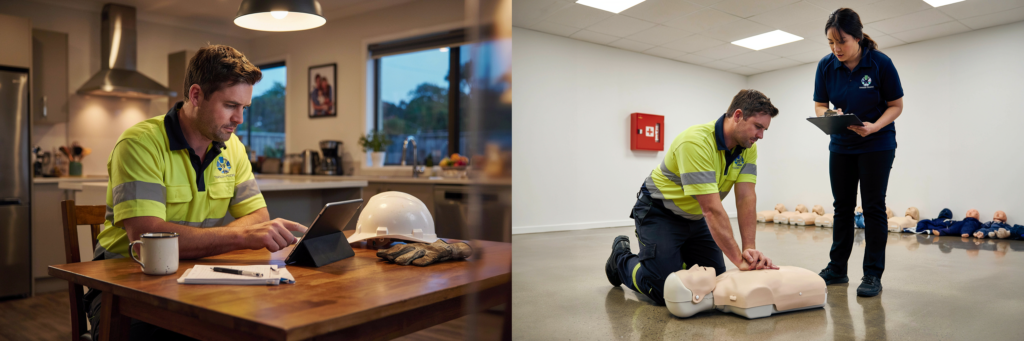
A site supervisor we worked with last year had a leading hand booked into a face-to-face course three days before a tender closed. Wet weather pushed the schedule back, the course date got bumped, and suddenly he was choosing between losing a worker for a full shift during a make-up week or missing the compliance deadline on the tender altogether. Neither option was good. That’s the exact bind advanced first aid blended learning was built to solve.
Pulling a leading hand off-site for face-to-face training can set a project back more than the course itself, especially when wet weather, plant deliveries, or a tender deadline are already eating into your schedule. That’s why advanced first aid blended learning has become the go-to option for site supervisors who need HLTAID014 compliance without losing a full shift, regardless of where their crew happens to be working.
But “blended” can mean different things depending on the provider, and not every online component actually prepares your crew for a real injury well away from emergency services. So which format, blended learning or traditional face-to-face, actually gets your team certified faster, without watering down the practical skills that matter when something goes wrong on-site?
This guide breaks down exactly how each format works, what you’ll need to budget in site downtime, and which option principal contractors and WorkSafe Queensland audits actually accept.
What Is the Difference Between Blended Learning and Face-to-Face First Aid Training?
Blended learning combines self-paced online theory with a shorter, hands-on practical session in person, while face-to-face training delivers all theory and practical skills in one classroom session. For HLTAID014 Advanced First Aid, blended learning cuts in-person attendance down considerably compared with a full face-to-face day, because participants complete the knowledge-based components, things like anatomy, legal obligations, and incident management theory, online beforehand. Both formats lead to the same nationally recognized Statement of Attainment. The difference is in how much time your crew spends away from site, not in the qualification itself.
How Advanced First Aid Blended Learning Works (HLTAID014)
Here’s the part most supervisors actually want to know: what does your crew sit through, and where.
What You Complete Online
This is the theory half, and it’s done before anyone sets foot in a classroom:
- Anatomy and physiology basics, understanding what is happening inside the body during a serious injury
- Legal and WHS obligations, knowing your responsibilities as a first aider and where your duty of care begins and ends
- Incident management frameworks, learning how to assess a scene and make confident decisions under pressure
- DRSABCD principles, the essential emergency response sequence that forms the foundation of first aid
It’s self-paced, done in your own time, and completed before the booked practical date. No classroom, no instructor standing over anyone’s shoulder. It’s also accessible from a phone or tablet, which matters more than it sounds, a lot of supervisors and workers in this industry aren’t sitting at a desktop in the evening, they’re on their phone in the ute or at the kitchen table, and a course that doesn’t work properly on a small screen just won’t get finished.
What Happens in the Face-to-Face Practical Session
The online component gets the theory out of the way so the in-person session can focus entirely on hands-on skills:
- CPR and AED use, with proper practical assessment rather than just theory discussion
- Wound management, including appropriate first aid response for different types of injuries
- Fracture and spinal immobilisation, learning how to manage serious musculoskeletal injuries safely
- Anaphylaxis and EpiPen response, understanding how to recognise symptoms and provide emergency support
And this is where it matters that the scenarios reflect real injury types, not generic classroom examples. Falls from height, crush injuries, mobile plant incidents, these aren’t hypothetical on a lot of sites, and a practical session that walks through them properly is the difference between a certificate and actual confidence. The in-person component is noticeably shorter than a full face-to-face day, because the theory’s already done.
Timeline From Booking to Statement of Attainment
In practice, the path looks like this:
- Online component, completed any time within a set window before the booked practical session
- Practical session, a single supervised block, completed on-site or in-classroom
- Certificate, digital delivery provided soon after the practical session wraps up
That last point matters more than it might seem at first glance. A lot of contractor management platforms won’t grant site access until the Statement of Attainment is uploaded. If the certificate takes ages to land, you’ve got a worker sitting idle even after they’ve done the training. A fast turnaround is what actually closes that gap.
⚠️ A fear worth addressing directly: Some supervisors hear "online component" and assume it means the practical skills get watered down too. They don't. ASQA's training package rules confirm blended delivery is an approved method for HLTAID014, provided the practical assessment is conducted face-to-face, and ARC/ANZCOR guidelines are clear that CPR and AED skills must be physically demonstrated and assessed in person. Online-only is never compliant, for any provider. The online portion only covers the theory; the hands-on skills are always tested with a real instructor watching.

How Face-to-Face Advanced First Aid Training Works
Blended learning isn’t the right fit for every site, though, here’s where face-to-face still makes more sense.
One Session, Start to Finish
This is the format most people picture when they think of first aid training. Everything, theory and practical both, gets delivered in one session. There’s no pre-work required, which means no online modules to chase up, no half-finished theory components holding up the day. For a worker who’d rather not study outside paid hours, or a site where reliable internet just isn’t a given, that’s a real advantage.
Who This Format Actually Suits
Face-to-face isn’t a worse option, it’s a different tool for a different job. It tends to suit:
- Crews with low digital literacy or limited reliable internet access, which is a genuine factor on many remote sites
- Sites where a stand-down is easier to schedule than splitting attendance across two dates, such as a wet-weather day or planned shutdown
- Supervisors who want zero ambiguity about whether everyone completed their online pre-work before attending
Choose face-to-face if…
- Your crew is already stood down and you want to use the time productively
- Internet access on-site is unreliable or non-existent
- You want one date, one session, with no need to chase workers to complete modules beforehand
Worth being straight about the trade-off here: the full-session format means more lost productivity per worker than the blended option. There’s no way around that. What you get in return is zero risk of pre-work non-completion holding up the practical session on the day. And in some cases, that’s actually the better deal, plenty of principal contractor induction schedules are already built around a single session anyway, which can make face-to-face the logistically simpler choice in those specific situations.
Blended Learning vs Face-to-Face: Side-by-Side Comparison
So how do the two actually stack up side by side?
Comparison Table
Factor | Blended Learning | Face-to-Face |
Time away from site | Shorter in-person session, after online pre-work | Longer, single in-person session |
Pre-work required | Yes, self-paced online | No |
Best for | Minimising on-site downtime, larger crews | Limited connectivity, single stand-down sessions |
Statement of Attainment | Digital delivery soon after the practical session | Digital delivery soon after the session |
Suitability for remote/low-connectivity sites | Lower, requires reliable internet | Higher, no online dependency |
Which Format Satisfies WorkSafe Queensland and Principal Contractor Requirements
Here’s the part that actually matters most to a lot of supervisors reading this: both formats result in the identical nationally recognised HLTAID014 Statement of Attainment. Neither one is “lesser” for compliance or audit purposes. WorkSafe Queensland doesn’t care which path your crew took to get there, and neither does a properly run audit.
What this comes down to is a logistics decision, not a compliance-risk decision. You’re not choosing between “the real certificate” and “the easy certificate,” you’re choosing between two ways of arriving at the same one.
The one exception worth flagging: some principal contractors specify a delivery mode in their tender documents, though this is rare. If you’re working under a tender that’s specific about training delivery format, it’s worth confirming directly with the contractor before booking, just so there’s no surprise later.
💡 Why this matters more than it might seem: ASQA's position is that delivery mode is a decision for the provider and the RTO, as long as the assessment requirements are actually met. Choosing blended over face-to-face (or the other way around) is not cutting corners. It will not create an audit issue when delivered correctly. It is simply a scheduling decision based on what works best for your team.
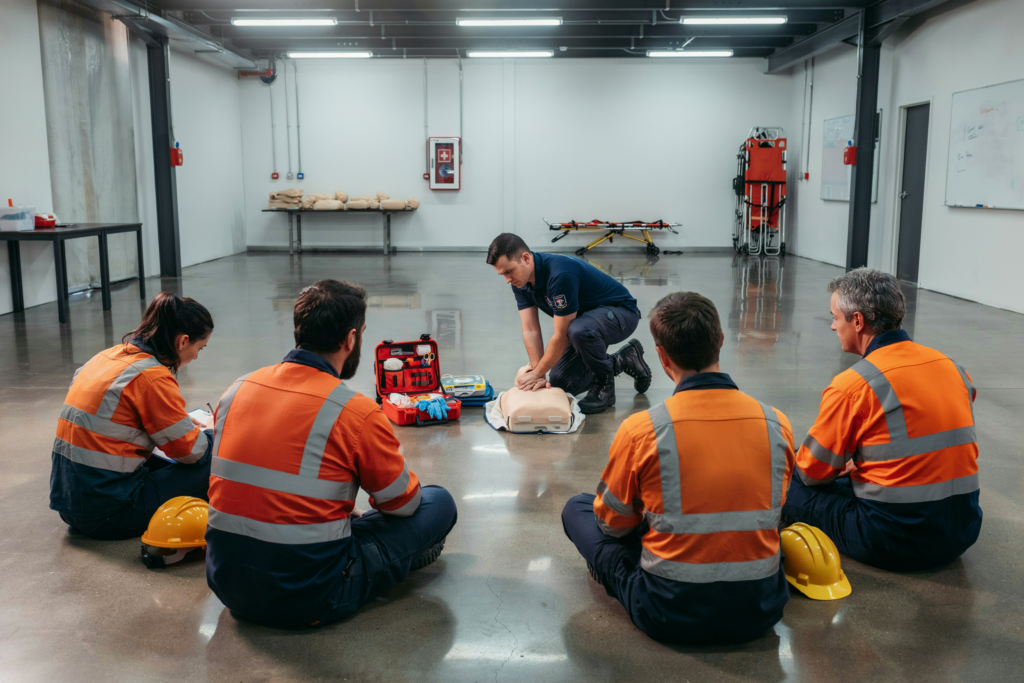
Which Format Gets Your Crew Compliant Fastest: Decision Guide
With the mechanics and the trade-offs clear, here’s how to decide which format suits your crew.
Choose Blended Learning If…
- You need to minimise on-site downtime per worker
- Your crew has reasonable phone or internet access to complete pre-work
- You're booking a group and want to stagger online completion before a shared practical session
Choose Face-to-Face If…
- Your site has limited connectivity, or your workers prefer not to complete self-study
- You're filling a stand-down period anyway, such as wet weather or a planned shutdown
- You want a single-date, fully supervised process with no pre-work compliance risk
Either format gets your crew to the exact same Statement of Attainment. There’s no version of this where one path is the “compliant” one and the other isn’t, WorkSafe Queensland and your principal contractor both accept either, every time.
What actually separates the two comes down to two things: how much of your crew’s time you’re willing to spend, and how much internet access your site can actually rely on. A worker with a phone and a bit of spare time can knock over the online theory without ever touching paid time. A site with patchy reception and a crew that’d rather not study after a long shift is better served by getting it all done in one sitting.
There’s also something to be said for matching the format to the kind of disruption you’re already managing. A genuine wet-weather stand-down is the easiest session you’ll ever schedule, because the time is already lost either way. A live, running site with deadlines stacking up is a different story, and that’s usually where trimming the in-person component down actually changes whether the deadline gets hit at all.
None of this needs to be agonised over. It’s not a decision with a wrong answer sitting underneath it, just two paths that ask different things of your week. The crew still walks away knowing how to manage a serious bleed, a fracture, a chest injury, or someone unconscious until help arrives, regardless of which one gets picked.
For most crews of any real size, the shorter path tends to win simply because it’s easier to fit around a working site. But a single, fully supervised session has its place too, especially when a stand-down is happening anyway. Pick the one that disrupts your week the least, and trust that either one gets the job done properly.
Book Your First Aid Training Now
Fast, affordable, and nationally accredited training delivered by professionals who care
Frequently Asked Questions About HLTAID014 Blended Learning
Q.Is blended learning a recognized pathway for HLTAID014?
Yes. ASQA's training package rules confirm blended delivery is an approved method for HLTAID014, provided the practical assessment is conducted face-to-face by a qualified instructor. Both blended and face-to-face pathways lead to the same nationally recognized Statement of Attainment, so neither one is treated as a lesser qualification.
Q.Can the practical skills be assessed online?
No. ARC and ANZCOR guidelines are clear that CPR, AED use, and other hands-on skills must be physically demonstrated and assessed in person. The online component only covers theory, including anatomy, legal obligations, and incident management, never the practical assessment itself.
Q.Will WorkSafe Queensland or a principal contractor accept either format?
In almost every case, yes. Both formats produce the identical Statement of Attainment, and WorkSafe Queensland and most principal contractors don't distinguish between delivery modes for compliance or audit purposes. The rare exception is a tender document that specifies a delivery mode by name, which is worth confirming directly with the contractor if you're unsure.
Q.What happens if a worker doesn't finish the online component in time?
The practical session generally can't proceed for that worker until the online theory is complete, since the practical assessment builds on it. This is one of the trade-offs of blended learning worth planning around, particularly for group bookings where one person falling behind can affect the shared session date.
Q.Is blended learning suitable for sites with poor internet access?
Not ideally. Blended learning relies on workers being able to complete self-paced study from a phone or tablet, so sites or crews without reliable connectivity are usually better served by face-to-face training, which has no online dependency at all.
Making first aid training more affordable for
every classroom
We believe every student deserves access to life-saving first aid knowledge. That’s why we offer specially reduced pricing for schools and educational groups. Whether you’re booking for a single class, a year group, or your entire school, our flexible packages make training more accessible and cost-effective — without compromising quality.
