

Your LVR ticket’s coming up for renewal. Your next job kicks off Monday. Do you really have time to block out two full days for face-to-face training?
For most licensed electricians across Australia, the answer is no. You’re running jobs, chasing quotes, managing subbies, and trying to get invoices out before the end of the month. Training is something you do because you have to, not because you’ve got a spare week sitting around doing nothing.
That’s where blended LVR training changes the equation.
A mate of mine, qualified sparky, got the call one morning. Site supervisor on the other end. “Mate, your LVR’s expired. Can’t let you on site tomorrow.” He’s standing there on a job he’d spent three weeks quoting, watching it unravel in real time. He pulled out his phone, found a blended LVR course, knocked out the theory that night on his couch. Showed up Saturday. Certificate in his inbox the same day. Back on site Monday.
That’s the whole point of blended delivery. Instead of burning your entire Saturday sitting through theory and practical back to back, blended LVR training lets you complete the theory online, on your phone, at whatever hour suits you, then show up to the face-to-face session ready to get assessed and get out. Certificate emailed same day. Back on site the next working week.
This guide breaks down exactly how blended LVR training works in Australia. What the online component covers. What happens on the practical day. And what to look for when picking a registered RTO so you don’t end up with a certificate that gets knocked back on site.
If your ticket is due, or already overdue, keep reading.
What Is Blended LVR Training?
If you’ve never done it this way before, the format is pretty straightforward. Blended LVR training is a delivery method for the Low Voltage Rescue unit of competency, UEECD0007, that splits the course into two components: online theory and face-to-face practical assessment.
Here’s how it breaks down:
- Online theory – Completed before the course day via your RTO’s learning portal. Covers electrical safety legislation, rescue procedures, and hazard identification. Self-paced, on any device, done whenever it suits you.
- Face-to-face practical – Completed in person on a Saturday. Covers hands-on rescue scenarios, CPR practice on a manikin, and your final competency assessment.
- Same-day digital certificate – On successful completion, your UEECD0007 certificate is issued and emailed the same day. Forward it straight to the site super or principal contractor.
Two components, one qualification, one day of your actual weekend gone.
And before anyone asks, yes, it’s fully compliant. Blended delivery sits within Queensland’s Electrical Safety Regulation 2013 and is accepted by principal contractors across Australia when issued by a registered RTO. The regulation specifies competency outcomes, not how those outcomes are delivered. So the piece of paper you walk away with carries exactly the same legal weight as a certificate from a full face-to-face course.
Why Electricians Are Switching to Blended LVR Training
Nobody’s switching to blended delivery because they suddenly got passionate about online learning. They’re switching because the old way costs them time they don’t have.
The Real Value of a Compressed Saturday
A traditional face-to-face LVR course ties up your whole Saturday. Theory in the morning, practical in the afternoon. That’s your one real day off gone, and if you’re a sole trader, Saturday is often the only day you can catch up on quotes or sort materials for the following week.
Blended doesn’t mean cutting corners. The qualification outcome is identical regardless of delivery mode. You still get assessed. You still have to demonstrate the rescue sequence correctly. You still have to hit the CPR standard. The difference is that the theory component gets done on your terms, not the RTO’s timetable.
| Feature | Traditional Face-to-Face | Blended Delivery |
|---|---|---|
| Theory component | Done in the room on the day | Completed online before the practical |
| Saturday commitment | Full day, theory + practical | Practical session only |
| Flexibility | Fixed schedule | Self-paced theory, set practical day |
| Certificate | Same - UEECD0007 | Same - UEECD0007 |
| Legal standing | Fully compliant | Fully compliant |
Same Ticket, Same Legal Standing
Some electricians worry that a blended-delivery certificate won’t carry the same weight on site as a face-to-face one. Here’s the reality. The unit of competency is UEECD0007. That’s the unit that appears on your certificate regardless of how the course was delivered. Principal contractors aren’t looking at delivery mode. They’re looking at the unit code, the RTO registration number, and the expiry date. A blended-delivery certificate issued by a registered RTO is legally identical to a face-to-face one.
Queensland’s Electrical Safety Regulation 2013 specifies competency outcomes, not how those outcomes are achieved. So as long as your RTO is registered, UEECD0007 is on their scope, and you’ve completed both components properly, the certificate is good. No principal contractor can reject it on delivery format alone. The Queensland Electrical Safety Office publishes the full requirements online if you want to check it yourself.
How Blended LVR Training Works – Step by Step
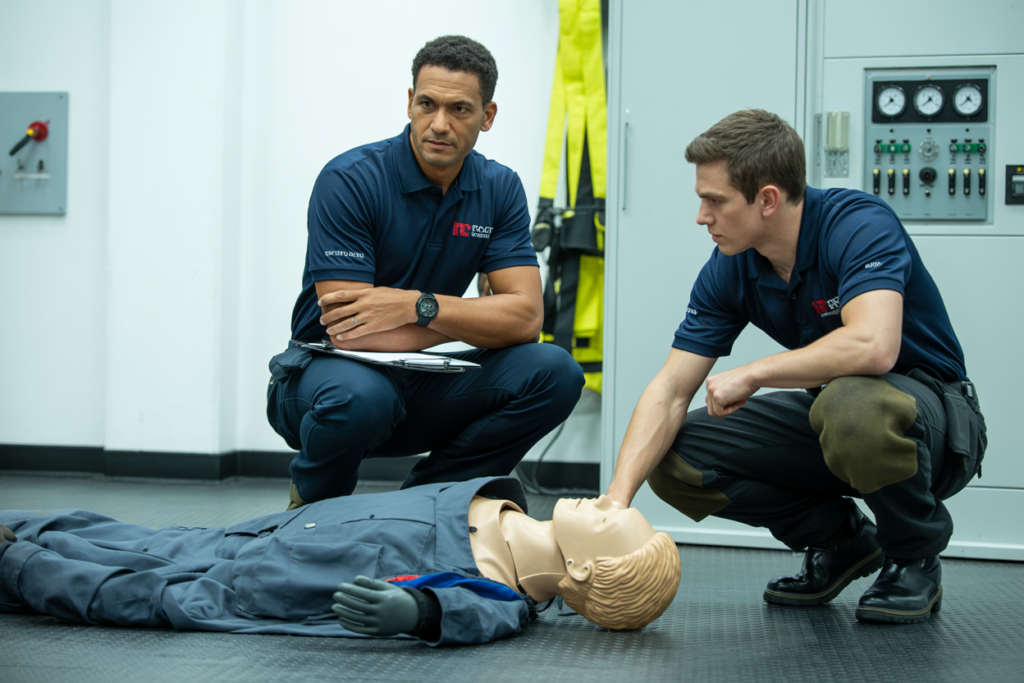
Here’s exactly what the process looks like from the moment you decide to book through to having the certificate in your inbox. Four steps. No surprises.
Step 1 – Enrol and Access the Online Theory Portal
You book the course, payment goes through, and your RTO sends you a login for the online theory portal. Access is typically immediate on enrolment. The portal works on whatever device you’ve got, phone, tablet, laptop. Most blokes complete the theory on their phone between jobs or in the evening.
Step 2 – Complete the Online Theory Component
The online theory is self-paced and can be completed across multiple sessions in the days before your practical. What you’re covering:
- Electrical hazard identification – recognising live versus isolated equipment, working safely in switchboard environments
- Queensland legislative framework – your obligations under the Electrical Safety Act 2002 and Electrical Safety Regulation 2013
- Rescue sequencing – the correct order of operations when a colleague contacts a live conductor
- CPR theory – the knowledge component that backs up what you’ll practise on the day
You need to have the online theory finished before you show up to the face-to-face session. It’s not optional. If you rock up on Saturday without completing it, you won’t be assessed and you won’t get a certificate.
Step 3 – Attend the Face-to-Face Practical Session
This is the part that actually gets you assessed. The practical runs with a qualified RTO trainer on a Saturday. Saturday sessions are standard with most providers, confirm availability when you book.
What to bring:
- Your booking confirmation email
- Comfortable clothes you can move around in
- Enclosed footwear, no thongs, no slip-ons
The practical covers rescue scenario simulations, CPR assessment on a manikin, and your final competency sign-off. The trainer walks you through what’s expected, you run through the scenarios, and if you hit the standard, you’re done.
Step 4 – Receive Your Digital Certificate
Once you’ve completed the practical assessment successfully, your digital UEECD0007 certificate gets emailed to you the same day. Not posted out later. Same day.
The certificate displays everything a principal contractor or site WHS officer needs to see, the UEECD0007 unit code, your RTO’s registration number, and your expiry date. Forward it straight from your phone to whoever needs it. Job done.
What the Online Theory Component Actually Covers
There’s a version of “online training” that’s basically just clicking through slides and ticking a box at the end. This isn’t that. The theory in a properly delivered blended LVR course is directly relevant to what you’ll be assessed on in the practical. If you rush through it without taking it in, you’ll feel it on the day when the trainer runs rescue scenarios and you’re trying to remember the isolation sequence under pressure.
Electrical Safety Legislation
The theory covers your obligations under the Electrical Safety Act 2002 and the Electrical Safety Regulation 2013, not an academic read-through but the practical application. What the legislation actually requires of a licensed electrician working on or near live low voltage equipment. The PCBU obligations that sit on your shoulders as a subcontractor or sole trader. And why a current LVR ticket isn’t just a site access requirement, it’s a legal one. If the Electrical Safety Office ever shows up on one of your sites, knowing your obligations isn’t optional.
Rescue Sequencing and Isolation Procedures
This is the core of the LVR unit, and where theory directly feeds into the practical assessment. The correct order of operations when a colleague contacts a live conductor. The most important point, the one that gets people tripped up in real scenarios, is isolation before contact. You do not touch the casualty until the circuit is isolated. Acting on the instinct to run in and grab someone in a live-conductor incident can put two people down instead of one. The theory also covers CPR sequencing post-rescue, feeding directly into the CPR assessment on the practical day.
Hazard Identification and Risk Assessment
The third component covers hazard identification in the kinds of environments electricians actually work in, switchboard environments, live panel work, construction sites, residential and commercial installs. You’re identifying live versus isolated equipment, reading the site for risks before you start work, and running through practical scenarios you’ll recognise from your own work history. By the time you’ve worked through all three areas, you’ve got the knowledge base to walk into the practical session and focus on execution.
🦺 On the practical day: Bring your confirmation email and enclosed footwear. The trainer runs you through rescue scenarios and CPR on a manikin. Hit the standard, get the certificate.
What Happens on the Face-to-Face Day
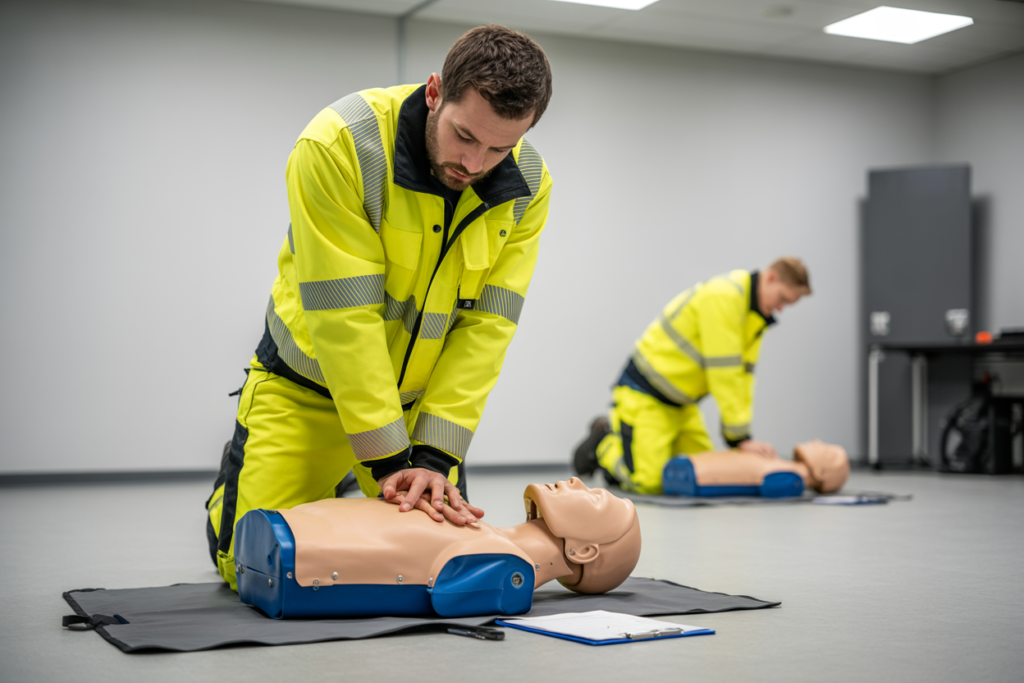
A lot of blokes show up to the practical session not quite knowing what to expect. Here’s exactly what happens and what the trainer is looking for.
Rescue Scenario Simulations
The trainer sets up a simulated rescue scenario. A colleague has contacted a live conductor. You’re the first person on scene. You’ll be assessed on the full rescue sequence, correct isolation first, safe approach to the casualty, rescue technique, and CPR initiation if required. The trainer is watching for the right order of operations.
The most common mistakes:
- Rushing to the casualty before isolating – the instinct is strong, the protocol is clear. Isolate first, every time.
- Incorrect hand positioning during CPR – covered in theory but easy to drift under assessment pressure
- Skipping the scene assessment – experienced tradies sometimes go straight to the casualty. The trainer will catch it.
The point of running the scenario isn’t to catch you out, it’s to make sure you can actually perform a rescue if you ever need to.
CPR Assessment
CPR is co-delivered with LVR in most blended courses, assessed to the HLTAID009 standard. You’ll work on a manikin, and the trainer will assess rate, depth, hand position, and airway management. Most people find it comes back quickly once they’re on the manikin.
What If You Don’t Pass First Time?
Most RTOs build in a reassessment opportunity on the same day or shortly after. It doesn’t mean starting from scratch. Before you book, ask the RTO directly what their reassessment policy is. Any decent provider should be able to answer it clearly.
How to Choose a Registered RTO for Blended LVR Training
Picking the right RTO isn’t complicated, but it does matter. The difference between a legitimate registered provider and one that’s cutting corners isn’t always obvious from a Google search result, and for a licensed electrician, the consequences of getting it wrong go well beyond wasted course fees. An invalid certificate means no site access. No site access means no income. It’s worth taking sixty seconds to check before you book.
The first thing to verify is whether the provider is actually registered. Every legitimate RTO in Australia holds a unique registration number listed on the national training register at training.gov.au. That’s a free government database, type in the provider’s name or their RTO number and you’ll see immediately whether they’re registered and what they’re approved to deliver. If a provider can’t or won’t display their RTO number on their website, that tells you everything you need to know. A legitimate RTO puts that number front and centre because it’s the foundation of their credibility.
The second check is the one most electricians miss, and it’s the most important one. Confirming UEECD0007 is specifically listed on the provider’s scope of registration. Being a registered RTO isn’t enough on its own. The provider needs to be registered to deliver this particular unit. A certificate issued by an RTO that doesn’t have UEECD0007 on scope is not worth the email it’s attached to. It will be rejected on site, no exceptions, and you’ll be back to square one. Check training.gov.au. It takes thirty seconds and it can save you a very bad Monday morning.
Beyond the registration checks, a trustworthy provider makes it easy to book with confidence. Their RTO number is on the booking page, not buried in a footer. UEECD0007 is listed on the course details. Same-day digital certificate delivery is stated explicitly. Saturday availability is visible without having to send an enquiry and wait for a callback. And CPR is clearly listed as co-delivered in the same session. Those five signals don’t just indicate compliance, they indicate a provider who understands what licensed electricians actually need to see before they’ll commit. A booking page that ticks all five is a booking page worth trusting.
Book Your First Aid Training Now
Fast, affordable, and nationally accredited training delivered by professionals who care
Blended LVR Training - Frequently Asked Questions
Q. How long is a blended LVR certificate valid in Queensland?
A blended LVR certificate (UEECD0007) is valid for three years in Queensland. CPR, which is typically co-delivered in the same session, must be renewed annually, so even if your LVR ticket still has time on it, your CPR renewal will come around each year.
Q. Is CPR included in blended LVR training?
Most registered RTOs co-deliver CPR (HLTAID009) with the LVR practical session on the same day. Confirm with your RTO before booking that CPR is bundled in, don't assume it's included without checking the course listing directly.
Q. Can I do the online theory on my phone?
Yes. The online theory component is accessible on any device including mobile. Most participants complete it on their phone between jobs or across a few evenings before the Saturday practical, which is exactly what it's designed for.
Q. Will my blended LVR certificate be accepted on site?
Yes, provided it's issued by a registered RTO with UEECD0007 on their scope of registration. Principal contractors cannot reject a blended-delivery certificate on the basis of delivery format alone. The unit code, RTO number, and expiry date are what gets checked, not how you completed the theory.
Q. What happens if I don't finish the online theory before the practical day?
You must complete the online theory before attending the face-to-face practical session. If you haven't finished it, contact your RTO to reschedule. Arriving unprepared will not result in a certificate, and the trainer won't be able to assess you on the day.
Q. How quickly will I receive my digital certificate after the course?
Digital certificates are typically emailed on the same day as course completion. Confirm same-day certificate delivery with your RTO before booking. Any provider worth booking with should be able to confirm it upfront without hesitation.
Q. What's the difference between UEECD0007 and UEECD0009?
UEECD0007 is the Low Voltage Rescue unit required for licensed electricians working on or near live low voltage equipment. UEECD0009 covers a broader rescue scope. If you're a licensed sparky working on standard electrical installations, UEECD0007 is the unit you need. If you're unsure which applies to your work, check with your principal contractor or the Queensland Electrical Safety Office before booking.
Making first aid training more affordable for
every classroom
We believe every student deserves access to life-saving first aid knowledge. That’s why we offer specially reduced pricing for schools and educational groups. Whether you’re booking for a single class, a year group, or your entire school, our flexible packages make training more accessible and cost-effective — without compromising quality.
