

It’s 9pm on a Sunday and Carla is sitting on the couch with her laptop, staring at a staff compliance spreadsheet she should have looked at three weeks ago. One of her educators starts tomorrow morning and the first aid certificate on file is either expired or was never the right one to begin with. She’s tired, she’s got a toddler asleep in the next room, and she’s typing “can I do HLTAID012 online” into Google with the kind of urgency only a compliance gap can create.
If you’re reading this while doing the same search, here’s the short answer. No, HLTAID012 can’t be done completely online. There’s a face to face, in person component that has to happen, and there’s no way around that part, no matter how good the theory portal is.
But before you close the laptop in frustration, it’s not as bad as it sounds. Most of the course is set up as a blended model. That means the theory side (the stuff about anaphylaxis, asthma, basic life support knowledge, the legal and regulatory bits) can be done online at your own pace. It’s the hands on skills, the CPR practice, the choking response, the scenarios, that need an assessor watching in the room.
This is actually a pretty common search, and it makes sense why. Most of us are used to doing everything online these days, renewing licences, lodging paperwork, even doing other bits of professional development, all from a laptop without ever leaving the house. So it’s a fair assumption to make that a first aid certificate might work the same way. It doesn’t, and once you understand why, the whole thing makes a lot more sense.
Quick Answer: Is HLTAID012 Available Online?
No. HLTAID012 can’t be completed 100% online. Here’s the breakdown:
Component | Delivery | What’s covered |
Theory | Online, self paced | Anaphylaxis, asthma, basic life support knowledge, legal/regulatory context |
Practical | In person, face to face | CPR, choking response, infant/child/adult scenarios, assessor observation |
Your certificate only gets issued once both parts are done. That’s what keeps it meeting ACECQA and NQF requirements, not just a box ticking exercise.

What’s Actually Online vs. What Requires In-Person Attendance
Let’s break this down properly, because a lot of centre directors get tripped up thinking “blended” means “mostly online with a quick add-on.” It’s not quite that.
The Online Theory Component
This is the part you or your staff can knock out from the staffroom, the couch, wherever. It covers:
- Anaphylaxis and asthma management theory
- Basic life support knowledge, including the reasoning behind the practical skills you'll perform later
- The legal and regulatory context around first aid in an education and care setting
The good thing about this bit being online is the flexibility. If you’ve got a few educators who all need HLTAID012 and you can’t pull them off the floor at the same time, they can each work through the theory on their own schedule. No rostering headache for that part at least.
It also means the learning actually sinks in a bit better for some people. Sitting through a long lecture style theory session in a group, especially after a full shift, isn’t exactly when most adults absorb information best. Being able to work through it in smaller chunks, pause when something needs re-reading, and come back to it later tends to land better than trying to cram it all into one sitting.
The In-Person Practical Component
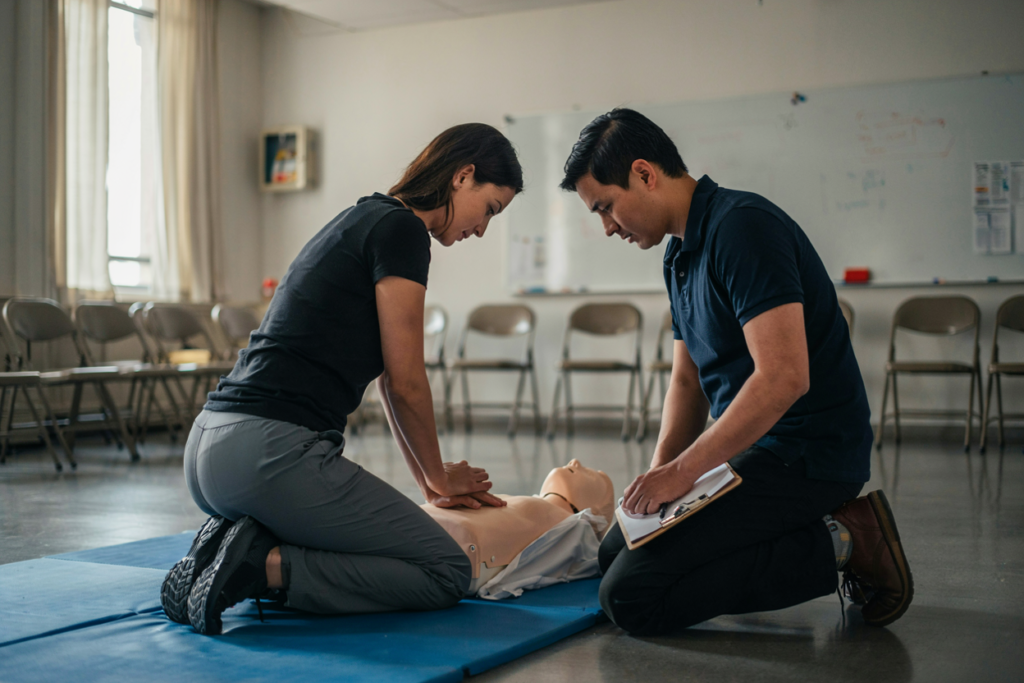
This is the non-negotiable bit. You physically need to be in a room with a trainer for:
- CPR practice on a mannequin
- Choking response practiced properly, not just watched on a video
- Scenario-based assessment that differentiates between infant, child, and adult situations
- An assessor watching you perform the skills and signing off that you can do them correctly
There’s no shortcut here. No amount of watching a video at home and nodding along gets you across the line for this part.
Think about it from the child’s perspective for a second. If an educator ever has to step in during a real emergency, choking, a severe allergic reaction, a fall on the playground, that moment isn’t going to feel calm and controlled. Hands shake, adrenaline kicks in, and the body does strange things under stress. Practicing the physical motions in a supervised setting, with someone correcting technique in real time, is what makes the difference between an educator who freezes and one who acts.
Why the In-Person Requirement Exists
It’s not red tape for the sake of red tape. Nationally recognized training standards (the ASQA framework that sits behind all of this) require hands on skills to be demonstrated in person because, frankly, a video can’t tell if you’re doing compressions at the right depth or panicking under pressure. It’s not there to slow you down, it’s there to make sure that when a child in your care actually needs someone to act, the person standing there has done it for real, not just read about it.
That protects your compliance position too, Carla. When an assessor at your service asks whether your staff’s HLTAID012 is legitimate, “yes, they sat a supervised practical assessment” is a much stronger answer than “they watched some videos.”
It’s worth remembering too that this isn’t unique to first aid. Plenty of nationally recognised qualifications across other industries work the same way, theory online, hands on skills demonstrated to a trainer in person. It’s not something specific to childcare or being difficult on purpose, it’s just how competency based training works when the skill being assessed is a physical one rather than a knowledge one.
If you’re still working out whether HLTAID012 is even the right course for your team versus general first aid, it’s worth reading our HLTAID012 vs HLTAID011 comparison page before you book anything. And if you want the official word on the unit itself, training.gov.au has the HLTAID012 unit details listed there too.
🗓️ For directors: The in-person part is the bit you actually need to plan your roster around.
The In-Person Session and Your Roster
So the theory’s online, but how does the in person part actually fit around your staffing?
This is usually the first question Carla asks after “is it online,” because a staff member being off the floor for training is something she’s got to cover somehow.
Here’s roughly how the whole thing flows:
- Online theory completed first, at your own pace
- In-person practical session booked in
- Certificate issued once both are ticked off
On-Site / In-Service Options for Centres
If pulling staff out to an external venue is a logistical nightmare (and for a lot of centres, it genuinely is), on-site or in-service training is worth looking at. A trainer comes to you and runs the practical component at your centre, so your staff aren’t losing time travelling somewhere and back. It’s one of the easier ways to get a group through the practical component without gutting your ratios.
The flow at a glance: Online theory (self paced), then the in person practical session, then the certificate is issued.
If you’ve got multiple staff needing this done, running them through an on-site session together is usually far less disruptive than sending them off individually.
There’s also something to be said for training happening in a space your staff actually recognise. Practicing scenarios in the same rooms they work in every day, rather than a generic training venue somewhere across town, tends to make the whole thing feel a bit more real and a bit less like a box ticking exercise. It’s easier to picture how you’d respond in your own centre than in a room you’ve never set foot in before.
Does Blended Delivery Satisfy ACECQA and Regulatory Requirements?
Understanding the structure is one thing. Knowing it’ll actually hold up at your next assessment visit is another.
What Assessors Actually Check
Here’s the part that should put your mind at ease. When an assessor or a regulatory authority officer looks at your staff compliance file, they’re not checking how the course was delivered, online theory plus in person practical, entirely in person, whatever mix. What they’re checking is whether the certificate itself is valid. Was it issued by a nationally recognized provider, does it cover the right unit (HLTAID012, not a generic first aid course), and is it current.
Blended delivery, done properly with a real supervised practical component, produces exactly the same valid certificate as a course run entirely face to face. There’s no asterisk next to it, no “lesser” version noted anywhere on your compliance register.
Blended isn’t a shortcut either. The practical, hands-on assessment is identical to what you’d do in a fully in person course. The only thing that moved online is the theory reading and knowledge checks, and a valid HLTAID012 certificate is a valid HLTAID012 certificate regardless of how that theory portion was delivered.
It’s a fair thing to worry about, honestly. A lot of directors have been burned before by staff turning up with a certificate from an old job that turns out not to satisfy the education and care setting requirement at all, so a bit of scepticism about delivery method is understandable. But the mode of delivery isn’t the thing an assessor cares about. What they care about is whether the training provider is registered to deliver nationally recognised training, whether the assessment was genuinely supervised, and whether the unit code on the certificate is the right one for your setting.
If you want to check the requirement straight from the source rather than take our word for it, ACECQA’s National Quality Framework page lays out exactly what’s required for first aid qualifications in an education and care setting.
This is also a good reminder to keep your own records tidy on your end. Even a fully valid certificate can cause a headache at an assessment visit if it can’t be located quickly, or if the version on file doesn’t clearly show the unit code and issue date. Filing certificates properly the moment they’re issued, rather than scrambling to track them down later, saves a lot of stress when an assessor is standing in your office asking to see them.
📝 Before you book: Whether it's just you or your whole team, the process works the same way: theory first, practical second.
Getting Your Team Sorted
So to bring it back to where we started. HLTAID012 isn’t a fully online course, and it shouldn’t be. The practical skills your staff need in an actual emergency have to be practiced properly, with someone watching and signing off on it, not just clicking through on a screen. That’s not the course being difficult for the sake of it, that’s the course doing exactly what it’s meant to do.
The online theory component still takes a genuine chunk of the admin burden off your plate though. Your staff can work through the anaphylaxis, asthma, and basic life support knowledge on their own time, in their own homes if that’s easier, and you’re not trying to pull everyone off the floor at once just to sit through a slideshow together. That flexibility matters more than it sounds like on paper, especially when you’re already stretched thin on rostering.
And when it comes to the in person part, you’ve got options that don’t have to gut your day. On-site group delivery means a trainer comes to your centre rather than you sending educators off somewhere else and losing time to travel. For a director juggling ratios and a roster that barely has any give in it, that’s the difference between training feeling like a disruption and training feeling like something you can actually plan around.
None of this changes what the certificate means once it’s in hand. A blended HLTAID012, done properly, holds exactly the same weight at an assessment visit as one done entirely face to face. What matters to an assessor is whether the certificate is current and whether it’s the right one for an education and care setting, not how the theory portion happened to be delivered.
It’s easy to get caught up thinking about first aid training purely as a compliance task, something to tick off a list and file away. But underneath the paperwork is a genuinely simple goal, having someone in the room who knows exactly what to do the moment it matters. The blended format doesn’t change that goal at all, it just gets your team there in a way that fits around the reality of running a centre full of children who need you present, not stuck in a training room all day.
If you’ve got a staff member starting soon, or you’ve just realised a certificate has quietly lapsed, the fastest thing you can do is get it booked in before it becomes tomorrow’s emergency instead of tonight’s admin task. Book your HLTAID012 course, or book for your team, or if you’re not quite ready to commit to a date yet, check your team’s compliance dates or enquire about on-site group training and work out what your roster actually needs first.
Book Your First Aid Training Now
Fast, affordable, and nationally accredited training delivered by professionals who care
Frequently Asked Questions
Q.Is HLTAID012 available fully online?
No. The theory component can be completed online at your own pace, but the practical skills, CPR, choking response, and scenario-based assessment need to be demonstrated in person to an assessor before a certificate can be issued.
Q.Does a blended HLTAID012 certificate count as less valid than one done fully in person?
No. A blended certificate carries exactly the same weight as one completed entirely face to face, as long as the practical component was genuinely supervised and assessed. Assessors check certificate validity, not how the theory was delivered.
Q.Can my whole team complete the online theory at the same time?
Yes, each staff member can work through the online theory independently and on their own schedule, which makes it easier to get a group through without pulling everyone off the floor at once.
Q.What happens if a staff member only completes the online theory?
The certificate isn't issued until both the theory and the practical component are complete. Theory alone doesn't satisfy the HLTAID012 requirement for an education and care setting.
Q.Will an assessor accept a blended HLTAID012 certificate during a compliance check?
Yes. What matters to an assessor is whether the certificate is current, issued by a nationally recognised provider, and covers the correct unit code for an education and care setting, not the delivery method used to get there.
Making first aid training more affordable for
every classroom
We believe every student deserves access to life-saving first aid knowledge. That’s why we offer specially reduced pricing for schools and educational groups. Whether you’re booking for a single class, a year group, or your entire school, our flexible packages make training more accessible and cost-effective — without compromising quality.
