

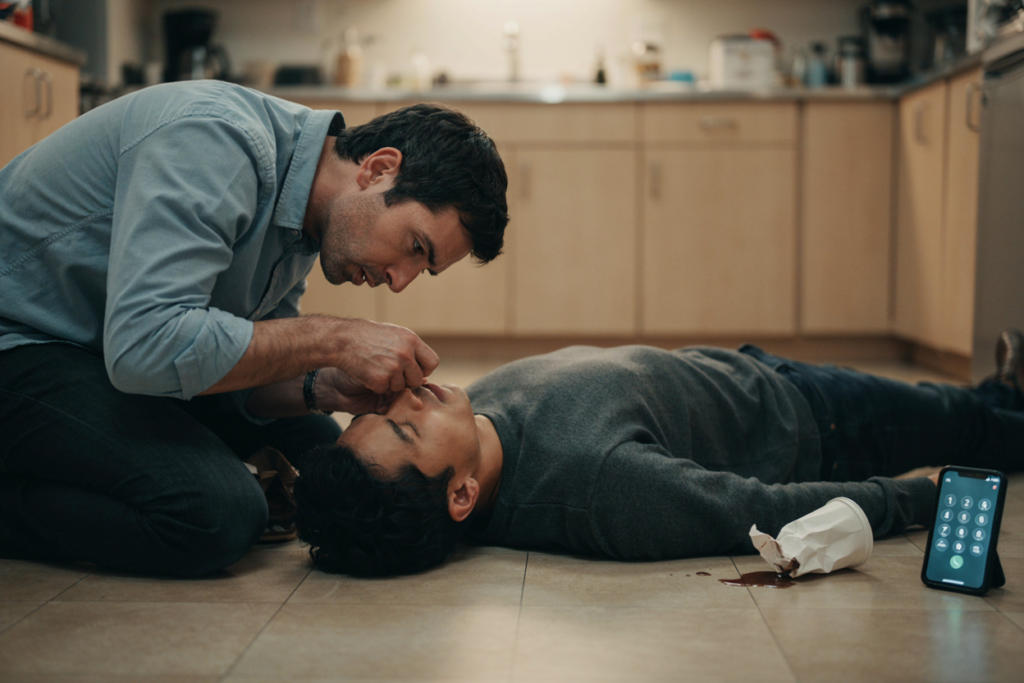
A bloke collapses in the staff kitchen. Nobody saw it coming, he was fine five minutes ago, and now he’s on the floor and not breathing right. What happens in the next few minutes decides whether he goes home to his family or doesn’t. Not the ambulance crew screaming down the highway. Not the hospital. The next few minutes, and whoever happens to be standing there.
That’s what the chain of survival first aid is built around, and it’s a lot simpler than most people think. ANZCOR recognises it as a four step sequence, and each step only works if the one before it happened. Skip a link and the whole chain falls apart, no matter how good the paramedics are once they arrive.
Here’s the bit that surprises people. The first two links in the chain aren’t down to paramedics at all. They’re down to whoever’s nearby when it happens, which could easily be you. Maybe you’ve thought about this before, standing in a crowded office or a busy shopping centre, wondering quietly what you’d actually do if someone went down in front of you. Most people have that thought at some point and then never follow it up. That’s the gap this article is trying to close.
Below we’ll walk through all four links, and where a first aid course like HLTAID011 fits into making sure you’d actually know what to do.
What Is the Chain of Survival?
Quick answer, since this is probably what brought you here. The chain of survival is a four step sequence, recognised by ANZCOR, that gives someone the best possible shot at surviving a cardiac arrest. Each link depends on the one before it works properly.
- 1. Early recognition: spotting the signs fast and calling Triple Zero (000)
- 2. Early CPR: chest compressions to keep blood moving to the brain and heart
- 3. Early defibrillation: using an AED as soon as one's available
- 4. Post-resuscitation care: the ongoing treatment once paramedics take over
The first two links don’t need a medical background. They need someone willing to act.
Why Every Second in the Chain of Survival Counts
This bit isn’t meant to scare you, it’s meant to explain why the chain works the way it does. Once you get it, the rest of this makes a lot more sense.
What Happens to the Body During Cardiac Arrest
In simple terms, the heart stops pumping properly. Blood stops moving the way it should, and that means oxygen stops getting to the brain and the rest of the body. It’s not the same as a heart attack, even though people mix the two up all the time. A heart attack is a blood flow problem in the heart itself. Cardiac arrest is an electrical problem, and it can happen to someone who looked completely healthy thirty seconds earlier. That’s part of what makes it so unsettling for the people standing nearby, there’s often no warning at all, no clutching the chest, no slow build up. One moment someone’s mid conversation, the next they’re on the ground, and the person next to them has to decide what to do without any lead up time to prepare for it.
Survival Rates Drop Fast Without Bystander Action
Survival chances fall quickly for every minute that passes without someone stepping in, and that’s true no matter how good the local ambulance service is. It’s not really about paramedics being slow, it’s about the gap between someone collapsing and someone else acting, and that gap exists regardless of how fast help is on its way.
Which is actually good news, if you think about it the right way. It means the person most likely to make the difference isn’t a paramedic at all. It’s whoever’s standing there. Could be a colleague. Could be you.
🚨 Quick take: unresponsive and not breathing normally means act now, don't wait to see if it resolves itself.
Link 1: Early Recognition and Calling Triple Zero (000)
How to Recognise Cardiac Arrest in Someone Near You
Two things to check. Are they responsive, and are they breathing normally? If someone’s not responding when you talk to them or give them a shake, and their breathing doesn’t look right, that’s your signal to act, not to wait and see.
One thing that trips people up constantly: agonal gasping. It’s this irregular, gasping sound some people make in the early stages of cardiac arrest, and it can look and sound like breathing to someone who doesn’t know what they’re looking at. It isn’t normal breathing. If you’re not sure, treat it as not breathing normally and act.
What to Say When You Call 000
Once you’ve called, the operator’s going to talk you through it, so you don’t need to have it all memorised. But it helps to have the basics ready:
- Where you are, as specific as you can manage
- What's happened and what state the person's in
- Then just follow what the operator tells you to do next
This is honestly the link most people underestimate. It’s not that people don’t know CPR exists, it’s that they freeze for those first ten or fifteen seconds wondering if they’re overreacting, if someone else will handle it, if they’re about to make a fool of themselves calling an ambulance for nothing. That hesitation is where the chain most often breaks, not because someone didn’t know what to do, but because they talked themselves out of doing it fast enough. It’s a very human reaction, nobody wants to be the person who overreacts in front of a room full of colleagues, and that little bit of social embarrassment can genuinely delay someone acting when seconds matter. Knowing that in advance, and knowing it’s a completely normal thing to feel, tends to make people quicker to push past it when it actually counts.
Link 2: Early CPR
Why Chest Compressions Matter More Than People Think
Once you’ve called 000 and confirmed someone’s not breathing normally, CPR is what keeps blood moving to their brain and heart until an AED or the paramedics arrive. Without it, the gap between collapse and help getting there is basically doing nothing for the person. With it, you’re buying time. That’s genuinely the whole job.
The Basics of CPR: Compression Rate and Depth
ANZCOR guidelines use a 30:2 ratio, that’s 30 chest compressions followed by 2 rescue breaths, repeated. The compressions go in the centre of the chest, firm and steady. People often worry about pressing too hard and causing an injury, but the honest answer is that a broken rib is a far better outcome than the alternative, and it’s a genuinely common side effect of effective compressions, not a sign you’re doing something wrong.
“Am I Allowed to Do This Without Training?”
Yes. ANZCOR is clear on this one, any attempt at CPR is better than none. You’re not going to make things worse by trying. The only wrong move here is not trying at all.
That said, there’s a difference between knowing the theory and having actually done it, hands on, on a manikin, with someone correcting your technique in real time. Reading about compression depth and feeling what the right depth actually is under your hands are two very different things.
⚡ Quick take: an AED only shocks a shockable rhythm, you genuinely can't make things worse by switching one on and following the prompts.
Link 3: Early Defibrillation (Using an AED)
What an AED Actually Does
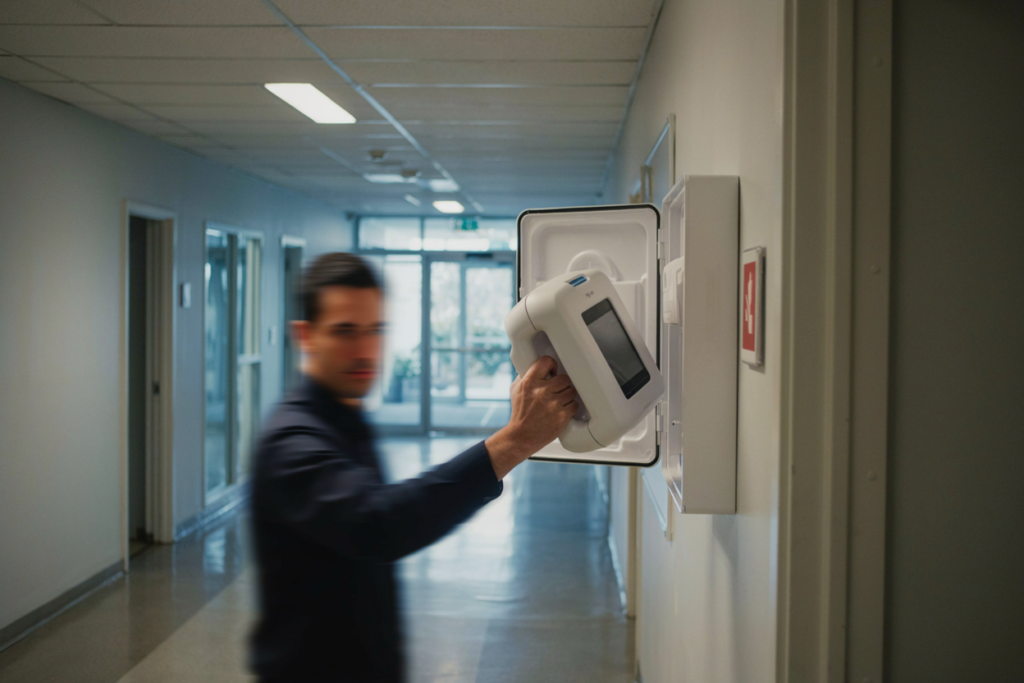
The idea of grabbing an AED and using it on someone scares a lot of people who’ve never done it, and it shouldn’t. An AED only delivers a shock if it detects a shockable heart rhythm. It won’t shock someone who doesn’t need it. It talks you through every step out loud, and it’s built to be used by anyone, not just people with medical training. Even the placement of the pads is shown clearly on the device itself, with pictures, so there’s genuinely very little you can get wrong beyond just switching it on and following along.
Where to Find an AED
They’re more common than most people realise once you start looking. Workplaces, shopping centres, gyms, community centres, plenty of them have one mounted on a wall, usually near reception or a first aid station. Worth knowing where the nearest one is at your own workplace, before you ever need it.
For guidance on where AEDs should be positioned in a workplace, the Heart Foundation’s AED workplace placement resources are a solid reference.
Knowing your workplace’s AED location isn’t just useful, it’s genuinely part of meeting your workplace health and safety obligations. If you’re the one who tends to notice these gaps before anyone else does, it might also be worth checking how long your own certificate has left, our certificate validity and renewal explainer covers exactly that.
Link 4: Post-Resuscitation Care
Once paramedics arrive and take over, they continue treatment, stabilize the person, and get them to hospital for further care. This is the part of the chain that’s out of your hands as a bystander, and that’s fine. Your job was the first three links. Once the professionals are there, you’ve done what you needed to do, and that’s worth remembering even if the outcome isn’t what everyone hoped for. Acting is always the right call, regardless of how things turn out afterwards.
🎓 Quick take: the first three links are yours to act on, and training is what turns knowing the theory into actually doing it.
Where Your First Aid Training Fits Into the Chain
The First Three Links Are Yours to Act On
Early recognition, early CPR, early defibrillation, all three sit with whoever’s on scene before paramedics get there. That’s not a coincidence, it’s the whole reason first aid training exists in the first place. HLTAID011 covers all three, recognising the signs, performing CPR properly, and using an AED with confidence instead of guessing.
Confident, Not Just Certified
It’s easy to think of a first aid certificate as a box to tick for work, something HR asked for and you sorted out because you had to. Fair enough, that’s usually how it starts. But there’s a difference between having a piece of paper that says you’re qualified and actually knowing, in your body, what to do in those first sixty seconds. One of those helps you at your next compliance audit. The other one might help someone you work with.
HLTAID011 is delivered under RTO 31106, nationally recognised, so the Statement of Attainment you walk away with is accepted at workplaces right across the country.
Conclusion
By now the four links should make a lot more sense than they did five minutes ago. Early recognition, early CPR, early defibrillation, and post-resuscitation care, each one leaning on the one before it, and each one shortening the gap between someone collapsing and someone actually getting help. It’s not complicated once you see it laid out, it’s just something most people never think about until they’re standing in the middle of it, and by then it’s a bit late to be figuring out the theory for the first time.
What matters most out of all four is that the first two links sit with whoever’s nearby, not with paramedics, not with anyone in a uniform. That’s you at work, at the shops, wherever you happen to be when it happens. It’s a strange thing to sit with, knowing you might genuinely be the difference for a stranger or a colleague on their worst day, but it’s the truth of how the chain actually works.
Most people who end up doing a first aid course didn’t start out thinking about any of this. They got a reminder from work, or HR flagged an expired certificate, or a new job asked for proof before day one. Fair enough, that’s how it goes for most of us, and there’s nothing wrong with sorting something out because you had to. But it’s worth noticing that the same course that ticks the compliance box is also the thing that teaches you compressions, AED use and recognising the signs properly, not just in theory but with your hands actually doing it.
There’s a real gap between reading about compression depth and feeling what the right depth is under your palms, with someone correcting you in the moment. That gap is exactly what a practical session closes, and it’s why knowing the chain of survival on paper and being able to act on it under pressure aren’t quite the same thing.
None of this needs to feel heavy or dramatic to matter. It’s a small time investment set against knowing you’d actually know what to do rather than freezing and hoping someone else steps in first. That’s really the whole point of the training, confidence over guesswork, when it counts.
If you’ve been meaning to get this sorted, whether your certificate’s lapsed or you’ve just never done the course, HLTAID011 covers all three of the links that are yours to act on, in one practical session. A quick call or a look at the next available session is usually all it takes to get it off the to-do list for good.
Book Your First Aid Training Now
Fast, affordable, and nationally accredited training delivered by professionals who care
Frequently Asked Questions
Q.What is the chain of survival in first aid?
The chain of survival is a four step sequence recognized by ANZCOR that gives someone the best possible chance of surviving a cardiac arrest. It covers early recognition, early CPR, early defibrillation, and post-resuscitation care, with each link depending on the one before it.
Q.What are the four links of the chain of survival?
The four links are early recognition and calling Triple Zero (000), early CPR, early defibrillation using an AED, and post-resuscitation care once paramedics take over. The first three sit with whoever's on scene, and the fourth is handled by paramedics and hospital staff.
Q.Do I need training to start CPR?
No. ANZCOR guidance is clear that any attempt at CPR is better than none, and you're not going to make things worse by trying. Training helps you do it with more confidence and correct technique, but it's never a reason to hold back from acting.
Q.Is it safe to use an AED on someone?
Yes. An AED only delivers a shock if it detects a shockable heart rhythm, so it won't shock someone who doesn't need it. The device talks you through each step out loud and is designed to be used by anyone, regardless of medical background.
Q.What happens after paramedics take over?
Paramedics continue treatment, stabilize the person, and get them to hospital for further care. This is the fourth link in the chain, and it's out of a bystander's hands, your role was the first three links leading up to this point.
Q.Does HLTAID011 cover the chain of survival?
Yes. HLTAID011 covers recognizing the signs of cardiac arrest, performing CPR, and using an AED, which are the three links a bystander is responsible for. The course is delivered under RTO 31106 and results in a nationally recognized Statement of Attainment.
Making first aid training more affordable for
every classroom
We believe every student deserves access to life-saving first aid knowledge. That’s why we offer specially reduced pricing for schools and educational groups. Whether you’re booking for a single class, a year group, or your entire school, our flexible packages make training more accessible and cost-effective — without compromising quality.
