

She’s booked the course. She’s confirmed the date. She’s figured out how to cover ratios for the day. And now the night before one of her educators sends a message asking what actually happens at the assessment.
It’s the question no one thinks to ask until it’s almost too late.
The childcare first aid face to face assessment is what separates a genuine HLTAID012 qualification from a box-ticking exercise and it’s what stands between your educators holding a current certificate and your service being exposed at a Quality Assessment visit. Getting it wrong means rebooking costs, disrupted rosters, and a compliance count that doesn’t add up when the Queensland Department of Education comes knocking.
This article walks through exactly what the face-to-face component involves what skills are assessed, what assessors are evaluating, how to prepare your educators, and how quickly they’ll walk out with an ACECQA-recognised certificate. Advanced Resuscitation Training delivers HLTAID012 specifically for education and care settings paediatric-specific, ASCIA-aligned, and built for the real emergencies childcare educators actually face.
Quick Answer: What Happens at a Childcare First Aid Face to Face Assessment?
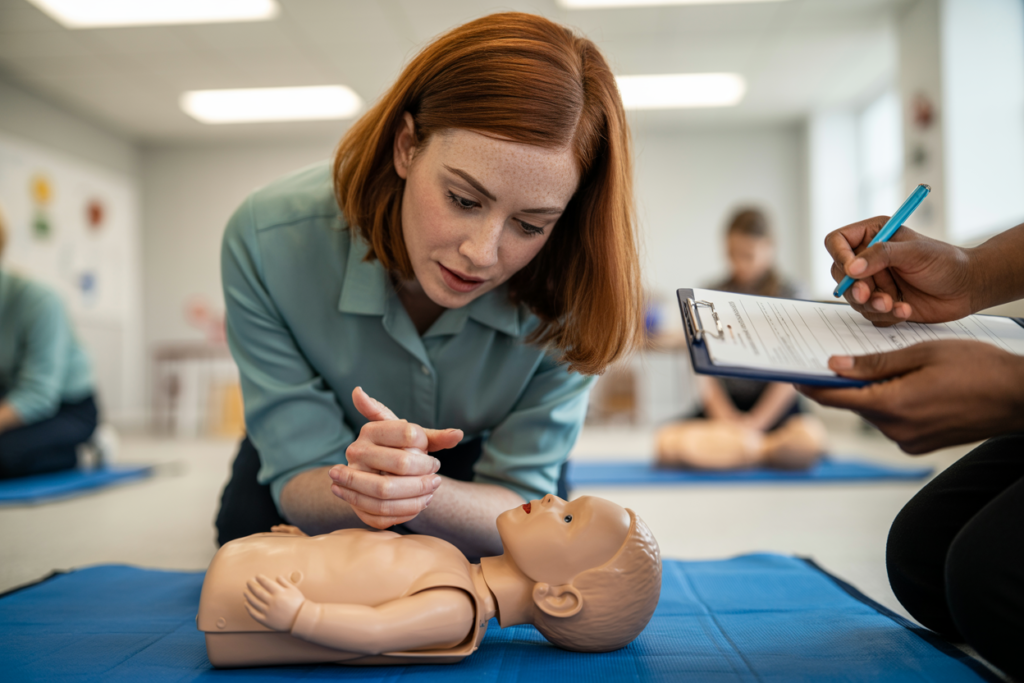
The HLTAID012 face-to-face assessment is a structured, practical skills demonstration not a written exam or theory recap. Here’s what your educators will work through:
- CPR on adult and infant manikins – to current ANZCOR standards
- Scenario-based paediatric emergency response – anaphylaxis, asthma, unconscious child
- Assessor observation – competency assessed against HLTAID012 unit requirements; no written component
- Equipment familiarisation – EpiPen trainer, spacer devices, AED
- Debrief and sign-off – assessor confirms competency, certificate issued same day
It’s a supported skills demonstration in a childcare-specific context. Not something to fear something to prepare for.
What Is the Face-to-Face Assessment in HLTAID012?
HLTAID012 – Provide First Aid in an Education and Care Setting is a nationally recognised unit of competency governed by ASQA. Unlike a lot of professional development in the early childhood sector, this one can’t be ticked off behind a screen.
Regulatory authorities and ACECQA don’t just need to know that your educators can describe what to do when a child stops breathing. They need evidence that your educators can actually do it hands on a manikin, under observation, performing the correct sequence when it matters. Without the face-to-face component, HLTAID012 is a theory exercise with a certificate attached. That’s not what Regulation 136 requires.
Why Can’t the Whole Course Be Done Online?
Theory pre-learning can be completed online through a blended delivery model. But the practical skills demonstration CPR, scenario response, equipment handling must be assessed in person by a qualified assessor. That’s an ASQA requirement for training package units with practical components, and it’s non-negotiable.
If you come across a provider offering a fully online HLTAID012 with no face-to-face component, that’s a significant red flag. Certificates issued without a practical assessment may not satisfy your regulatory authority’s requirements which means your compliance count could be sitting on a very unstable foundation.
Knowing the structure is one thing. Knowing exactly what your educators will be asked to demonstrate is another.
What Skills Are Assessed During the Face-to-Face Session?
Here’s how the assessed components break down:
| Skill Component | What's Assessed | Assessor Focus |
|---|---|---|
| CPR — adult manikin | Compression depth, rate, rescue breathing | ANZCOR guideline compliance |
| CPR — infant manikin | Hand positioning, compression technique, rescue breaths | Paediatric-specific adaptation |
| Paediatric emergency scenario | Decision-making, response sequence, communication | Correct action plan applied without prompting |
| EpiPen trainer administration | Technique, timing, follow-up steps | Regulation 137 readiness |
| Spacer and inhaler use | Correct assembly, child mask positioning | Asthma management protocol |
| DRSABCD action plan | Sequencing under simulated pressure | Applied correctly, not just recited |
| AED operation | Device activation, pad placement, safety clearance | Procedural accuracy |
⚠️ Important: If your provider doesn't include EpiPen trainer practice and paediatric scenarios in the face-to-face session, your educators may not meet Regulation 137 requirements even with a valid HLTAID012 certificate.
CPR – Adult and Infant
CPR is assessed on both adult and infant manikins, because the technique is different and both matter in a childcare setting. For the adult manikin, educators demonstrate correct compression depth, rate, and rescue breathing. For the infant manikin, the focus shifts to correct two-finger hand positioning and adjusted compression depth. Assessors are watching for correct technique and the ability to apply it not perfection on the first compression. ANZCOR guidelines are updated periodically, and a quality provider always delivers to the current version.
Paediatric Emergency Scenarios
This is what separates HLTAID012 from HLTAID011. Educators work through scenario-based responses to real paediatric emergencies anaphylactic reaction in a child, acute asthma episode, unconscious or unresponsive child, and choking in an infant or toddler. Each scenario requires the correct response sequence, not just the correct knowledge. Assessors are evaluating decision-making under pressure whether the educator knows what to do first, second, and third when the situation is real.
Equipment Handling
Educators are assessed on their ability to use actual first aid kit equipment EpiPen and EpiPen Jr trainers, spacer devices with child-appropriate masks, bag-valve masks where applicable, and AED operation. Under Regulation 137, a trained educator must be present whenever a child with a documented allergy is in attendance for most centres, that’s every operating hour. An educator who holds a certificate but can’t confidently administer an EpiPen trainer hasn’t met the intent of the regulation. Pediatric-specific equipment throughout not the generic workplace kits built for construction sites.
The DRSABCD Action Plan
DRSABCD: Danger, Response, Send for help, Airway, Breathing, CPR, Defibrillation runs through every emergency scenario in the assessment. Assessors observe whether educators apply this sequence correctly under simulated pressure. Not whether they can recite it. Whether they actually use it when a child is unresponsive and the clock is running.
Understanding the skills list is useful. Understanding how assessors evaluate those skills and what they’re not penalising is what separates a confident educator from an anxious one.
What Are Assessors Actually Looking For?
Here’s something worth saying plainly: assessors are not trying to catch your educators out.
The face-to-face assessment exists to verify genuine competency to confirm that the person holding the certificate can actually respond when a child needs help. A good assessor knows the difference between an educator who doesn’t know what they’re doing and one who knows exactly what they’re doing but is nervous about being watched.
Competency-Based Assessment Not a Pass/Fail Exam
There is no percentage score. No mark out of 100. HLTAID012 uses competency-based assessment the assessor determines whether each required skill is performed to the standard described in the unit of competency. If a component isn’t demonstrated satisfactorily the first time, the assessor will typically allow a reassessment attempt on the same day not issue an automatic fail.
The framing for your team isn’t “don’t mess up.” It’s “here’s what you’ll practise, here’s what you’ll demonstrate, and the assessor is there to support you through it.”
Common Reasons Educators Are Asked to Repeat a Component
The most common issues are incorrect compression depth or rate during CPR, hesitation in scenario response sequence, failure to verbalise key steps during the assessment, and incorrect EpiPen administration technique. None of these are knowledge failures they’re practice failures. An educator who has had genuine practice time before the assessment moment is almost never the one who needs to repeat a component. The quality of the training that precedes the assessment matters just as much as the assessment itself.
How to Prepare Your Educators for the Face-to-Face Assessment
Every minute spent briefing educators before the day saves ten minutes of follow-up calls and rebooking admin.
What to Bring on the Day
Send this to your educators the week before in writing, so there’s no confusion on the morning.
| Item | Notes |
|---|---|
| Comfortable clothing | Suitable for floor-based CPR practice |
| Photo ID | Required for identity verification |
| Completed pre-learning | Confirm completion before the session morning |
| Enrolment confirmation | Provided by First Aid Alive at time of booking |
| Water and snacks | Recommended — it's a physical day |
How to Brief Your Educators Before They Attend
The directors who see the fewest reassessment requests are the ones who have a five-minute conversation with their team beforehand. Cover what the face-to-face component involves, that it’s a skills demonstration not an exam, that they’ll practise before being assessed, and that the assessor is there to support competency not catch them out. That last point does more for educator confidence than anything else a director can say.
Pre-Learning Completion Is Non-Negotiable
Educators who arrive without completing their online pre-learning may not be permitted to participate in the face-to-face session at all. That means a full day wasted, a compliance count still sitting one short, and a rebooking cost on top.
ART sends pre-learning reminders to all enrolled participants ahead of their session. But the final check still sits with the director because it always does.
What Happens After the Assessment Certificates and Compliance Records
Advanced Resuscitation Training issues same-day digital certificates upon successful completion of the HLTAID012 face-to-face assessment. Educators receive their certificate before leaving the session or via email the same day because compliance records don’t wait.
Certificate validity for HLTAID012 is three years from the date of issue. Record the expiry date the day the certificate arrives not when the next audit notice lands.
What the Certificate Covers and What It Doesn’t
HLTAID012 satisfies Regulation 136 of the Education and Care Services National Regulations 2011 the requirement for a qualified first aid officer present at all times when children are being cared for. But Regulations 137 and 168(a) are a separate matter. Regulation 137 requires that an educator who can administer an EpiPen and manage anaphylaxis is present whenever a child with a documented allergy is in attendance. Regulation 168(a) covers asthma management. These are only satisfied when the provider has explicitly integrated both components into course delivery not just attached the HLTAID012 unit code to a generic workplace program.
Not every provider does this. Some issue valid HLTAID012 certificates that satisfy Regulation 136 and leave Regulations 137 and 168(a) unaddressed. Educators come back certified and the service is still exposed. ASCIA-aligned anaphylaxis and asthma management into every HLTAID012 delivery built in, not bolted on.
The certificate is only as valuable as the training behind it. Here’s how to make sure your provider is delivering to the standard your centre actually requires.

What to Look for in a Provider
Carla already knows how to evaluate a provider. She checks RTO numbers, reads course descriptions word by word, and calls to ask the questions a generic website won’t answer. She didn’t develop that habit out of caution — she developed it because she got burned, and she’s not doing it again.
🔒 First Aid Alive — RTO [RTO number] ASQA-registered. Delivering HLTAID012 for education and care settings. Verify at training.gov.au.
| Criterion | What to Look For |
|---|---|
| ASQA-registered RTO | RTO number visible on website — verify at training.gov.au |
| Explicit paediatric scenarios in course description | Named in the course page, not implied |
| ASCIA-aligned anaphylaxis and asthma content | Stated explicitly — not just HLTAID012 unit code |
| Adequate practice time before assessment | Confirm directly — not a rushed run-through |
| Weekend availability | Visible on the course schedule page without having to call |
| Same-day digital certificate | Stated in the first paragraph of the course page |
| Reviews from childcare directors and educators | Google reviews that use words like "childcare," "anaphylaxis," "HLTAID012" |
A provider who ticks every one of these boxes without you having to dig understands what childcare directors actually need. One who makes you work for basic details is telling you something about how they’ll treat your educators on the day too.
Book Your Centre’s HLTAID012 Face-to-Face Session
The face-to-face assessment isn’t the hard part. The hard part is everything that leads up to it — tracking expiry dates, covering ratios, finding a provider who actually delivers HLTAID012 the way an education and care setting requires it, and making sure every educator walks in prepared and walks out certified. Get those things right and the assessment itself is exactly what it should be: a structured, supported skills demonstration that confirms your team is genuinely ready.
That’s what ART builds every HLTAID012 session around. Paediatric-specific scenarios. ASCIA-aligned anaphylaxis and asthma content. Qualified assessors who understand the difference between an educator who doesn’t know what they’re doing and one who’s just nervous about being watched. Same-day digital certificates so your compliance records are updated before the week is out.
If you’ve got educators with certificates expiring in the next 90 days, or a new staff member who needs HLTAID012 before they can legally cover a room on their own, the next step is straightforward. Check the course dates, pick a session that works for your roster, and get in touch about a group booking. Your educators do the work. ART handles the rest.
Book Your First Aid Training Now
Fast, affordable, and nationally accredited training delivered by professionals who care
Frequently Asked Questions
Q.How long does the face-to-face assessment take?
The face-to-face component of HLTAID012 typically runs between four and six hours depending on group size and delivery format. That time includes trainer-led practice on CPR manikins, scenario walkthroughs, equipment handling, and the formal competency assessment itself. Educators who complete their online pre-learning beforehand move through the day more efficiently. Skipping the pre-learning is the most common reason a session runs long or an educator is turned away at the door.
Q.Is HLTAID012 the same as HLTAID011 First Aid?
No, and the distinction matters for compliance. HLTAID011 covers general workplace first aid and may satisfy Regulation 136 in many contexts, but it does not include the paediatric-specific scenarios, ASCIA-aligned anaphylaxis management, or childcare equipment handling that HLTAID012 requires. HLTAID012 is specifically designed for education and care settings and is the unit recognised by ACECQA for services operating under the National Quality Framework. A centre with staff who hold only HLTAID011 may still be exposed under Regulations 136, 137, and 168(a).
Q.Can HLTAID012 be completed entirely online?
No. ASQA requires that practical skills components of nationally recognised training are assessed in person by a qualified assessor. Theory pre-learning can and should be completed online through a blended delivery model, but CPR, scenario response, and equipment handling must be demonstrated face to face. Any provider offering a fully online HLTAID012 certificate with no in-person component is not delivering a compliant qualification, and certificates issued without a practical assessment may not satisfy your regulatory authority or ACECQA at a Quality Assessment visit.
Q.Does HLTAID012 cover EpiPen administration and anaphylaxis management?
It should, but not every provider builds it in. HLTAID012 as a unit of competency requires paediatric emergency scenarios, but the depth of anaphylaxis and asthma content varies significantly between providers. First Aid Alive integrates ASCIA-aligned anaphylaxis and asthma management into every HLTAID012 session, including EpiPen and EpiPen Jr trainer practice and spacer device handling, because Regulations 137 and 168(a) require more than a certificate with the right unit code attached. If your provider doesn't explicitly name these components in their course description, it's worth asking directly before you book.
Q.How often do educators need to renew their HLTAID012?
HLTAID012 certificates are valid for three years from the date of issue. ACECQA and state regulatory authorities require that a currently certified educator is present at all times children are in attendance, so any gap in currency creates an immediate compliance issue. Most directors track expiry dates in their compliance register and book renewal sessions at least 60 to 90 days before expiry, allowing time to accommodate roster adjustments and avoid any period where a centre is operating without a qualified first aid officer on the floor.
Making first aid training more affordable for
every classroom
We believe every student deserves access to life-saving first aid knowledge. That’s why we offer specially reduced pricing for schools and educational groups. Whether you’re booking for a single class, a year group, or your entire school, our flexible packages make training more accessible and cost-effective — without compromising quality.
